
显示器

Search documents
海信发布旗舰显示器GX:三大电视同源技术 新品首发价4399元
Zheng Quan Ri Bao· 2025-12-05 13:39
Core Viewpoint - Hisense has launched its flagship monitor GX, integrating advanced technologies from its high-end TVs to enhance user experience and performance in the display market [2] Group 1: Product Features - The Hisense GX monitor features a low-reflective black screen that minimizes environmental light interference, achieving a reflection rate as low as 1.8%, ensuring clear visuals even in bright conditions [4] - It utilizes a STW visual compensation film that allows for a 178° viewing angle without loss of brightness or color, providing an optimal viewing experience from various angles [6] - The monitor is powered by the MT9655 chip with 4GB RAM and 64GB storage, enabling rapid system response and advanced image processing capabilities [7] - The U+Mini LED backlight system offers precise local dimming with 2304 independent zones, enhancing contrast and detail in bright and dark scenes [10] - With a peak brightness of XDR2000 nits and 98% DCI-P3 color coverage, the monitor delivers rich color and shadow details, accurately reflecting the creators' intentions in 3A games [13] Group 2: Versatility and User Experience - The Hisense GX supports dual modes of UHD@160Hz and FHD@320Hz, catering to both high-quality gaming and competitive gaming needs [14] - It features a built-in smart TV system, allowing users to access streaming services and high-bitrate local video playback without needing an external console [16] - The monitor incorporates health-focused technologies, including DC dimming to reduce flicker, low blue light certification, and AI ambient light sensing for automatic brightness adjustment [17] - The design includes an ergonomic stand for adjustable angles and a unique GaN power adapter for compactness and efficiency [19] Group 3: Market Positioning - The launch of the Hisense GX monitor demonstrates the company's strategy to leverage its established TV technology in the display sector, providing a high-performance solution for both entertainment and professional use [19]



传LGD拟再出售2条LCD产线
WitsView睿智显示· 2025-12-02 04:31
Group 1 - LG Display plans to sell its P2 and P3 production lines and 200,000 square meters of land in the Gumi National Industrial Complex to Mico Ceramics, which will help improve LG Display's financial situation and provide space for Mico Group's hydrogen fuel cell business [1][4] - LG Display is gradually exiting the LCD market due to competition from Chinese LCD panel manufacturers and is accelerating its transition to the OLED sector [2] - In 2024, LG Display sold its Guangzhou LCD factory to TCL Huaxing Optoelectronics for 11.088 billion RMB and announced plans to invest in a small and medium-sized OLED production line at its Paju factory [2] Group 2 - Mico Power plans to build a hydrogen fuel cell factory on the acquired land, with a production scale expected to exceed 100 megawatts to meet global market demand [4] - Hydrogen fuel cells utilize an environmentally friendly power generation method, achieving zero carbon emissions by using only hydrogen [4] - LG Display continues to produce automotive LCD and OLED products at its Gumi facility, which has been primarily used for small display production lines [4]
82岁爱马仕继承人被曝无钱可用,150亿美元离奇蒸发;影视飓风否认冲锋衣致癌;罗永浩回应为何没发录音丨邦早报
创业邦· 2025-12-01 00:09
Group 1 - MediaStore, a subsidiary of Yingshi Typhoon, denied allegations that their jackets contain carcinogenic substances, presenting a testing report showing no PFOA detected and claiming the accuser's samples were compromised [4] - Xu Xin's Capital Today acquired a portion of ByteDance's shares for approximately $300 million, valuing the company at $480 billion, indicating strong investor interest in TikTok's parent company [6] - The heir of Hermes, Nicolas Piéchaud, claimed that $15 billion of his wealth has "vanished" due to alleged mismanagement by his wealth manager, who recently died under suspicious circumstances [6][7] Group 2 - Xiaomi Auto announced the opening of 17 new stores in November, bringing the total to 441 across 131 cities, with plans for 36 more in December [11] - AirAsia completed a software rollback for its A320 fleet in compliance with emergency directives from Airbus, achieving full compliance within 24 hours [11] - Samsung Display announced internal restructuring to enhance service capabilities for key clients like Apple and to expand into emerging markets [13] Group 3 - ByteDance launched a new AI model, Vidi2, designed for video understanding, capable of processing hours of raw footage and generating content based on simple prompts [14][15] - The manufacturing PMI for November was reported at 49.2%, indicating a slight improvement, while the non-manufacturing business activity index was at 49.5%, showing a decline [17][18]
“韩美中日竞争力”调查触动韩国
Huan Qiu Shi Bao· 2025-11-24 22:44
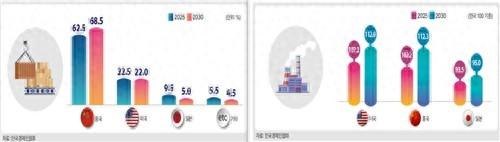
Core Insights - The South Korean government is set to unveil its "2026 Economic Growth Strategy" aimed at achieving a real growth rate of 2% amidst declining potential economic growth [1][2] - A recent survey indicates that South Korea's competitiveness in its top ten export industries is lagging behind China, with predictions that all these industries will fall behind in five years [2] Group 1: Economic Strategy - The "2026 Economic Growth Strategy" will focus on four key areas to reverse the ongoing low growth trend in South Korea [1] - The strategy aims to enhance the competitiveness of strategic industries such as semiconductors, defense, culture (including gaming, beauty, and food), and petrochemicals [3] Group 2: Competitiveness Analysis - A survey revealed that 62.5% of responding companies view China as their biggest competitor, followed by the US (22.5%) and Japan (9.5%) [2] - China has surpassed South Korea in competitiveness across several key industries, including steel (112.7), machinery (108.5), and electric batteries (108.4) [2] Group 3: Government Initiatives - The South Korean government plans to leverage recent outcomes from US-Korea tariff negotiations to strengthen its position in global value chains, particularly in shipbuilding [3] - The government will also promote projects related to "AI transformation" and "super innovative economy" to build future growth momentum [3]
韩称半数主力出口产业竞争力被中国赶超
Ke Ji Ri Bao· 2025-11-19 00:05
Core Insights - The report from the Korea Economic Association indicates that half of South Korea's top ten export industries have been surpassed by China in terms of competitiveness, with a prediction that all ten industries may fall behind China in five years [1][2] - A survey of 200 major companies in these industries revealed that 62.5% view China as their biggest competitor, with this figure expected to rise to 68.5% by 2030 [1] - The competitiveness index set by the surveyed companies ranks South Korea at 100, while China and the US are projected to surpass South Korea by 2030, with indices of 112.3 and 112.9 respectively [1] Industry Competitiveness - In specific sectors, Chinese companies lead in steel (112.7), general machinery (108.5), secondary batteries (108.4), displays (106.4), and automotive parts (102.4) [2] - South Korean companies still maintain an edge in semiconductors (99.3), electronics and electrical machinery (99), shipbuilding (96.7), petrochemicals and petroleum products (96.5), and biopharmaceuticals (89.2) [2] - The report highlights that China holds advantages in price competitiveness, production capacity, and government support, while South Korea only leads in brand competitiveness, which is expected to be overtaken in five years [2]
击败三星,华硕OLED显示器Q3全球出货第一
WitsView睿智显示· 2025-11-18 08:34
Core Insights - TrendForce projects that global OLED monitor shipments will reach approximately 644,000 units in Q3 2025, representing a 12% quarter-over-quarter increase and a remarkable 65% year-over-year growth [2] - The total annual shipment for OLED monitors in 2025 is expected to hit 2.62 million units, with an anticipated annual growth rate of 84% [2] - ASUS has overtaken Samsung to become the top shipper of OLED monitors, achieving a market share of 21.9% [4][3] Company Summaries ASUS - ASUS has achieved a market share of 21.9%, marking its first time as the leading shipper of OLED monitors in a single quarter [4] - The company offers a comprehensive product line, including the popular ROG gaming monitors and the ProArt professional OLED series, catering to various consumer needs [4] - ASUS is expected to maintain its position as the top OLED monitor shipper for the entire year of 2025 [4] Samsung - Samsung holds the second position in the global OLED monitor market with an 18% market share [5] - The company has maintained stable shipment performance from Q1 to Q3 2025, focusing on existing flagship products and ramping up new model production in the latter half of the year [5] MSI - MSI has climbed from fifth place in 2024 to third place in the first three quarters of 2025 in OLED monitor shipments, indicating effective market strategies [7] - The company offers over 20 mid-to-high-end models, focusing on UHD high-resolution designs to meet the demands of next-generation graphics cards and gaming [7] LG Electronics (LGE) - LG Electronics achieved a market share of 12.9% in Q3, ranking fourth in OLED monitor shipments [8] - The company faced challenges in Q2 due to production relocation but has since improved its ranking by launching new products [8] - LG is expected to benefit from new product releases and strong promotions for 45-inch models, potentially moving up to third place in Q4 [8]

最新报告:中国猛追,5年内韩国十大产业全线失守
Guan Cha Zhe Wang· 2025-11-18 00:34
Core Insights - The report from the Korea Economic Association indicates that half of South Korea's top ten export industries have been surpassed by China in terms of competitiveness, with a prediction that all ten industries may lose their competitive edge within five years [1][2]. Industry Competitiveness - A survey of 200 South Korean companies revealed that 62.5% identified China as their biggest competitor, significantly higher than the 22.5% who chose the United States and 9.5% who chose Japan. This perception is expected to increase, with 68.5% anticipating China as the main competitor by 2030 [1][2]. - The competitiveness levels, with South Korean companies using a standard of 100, are perceived as follows: the United States at 107.2, China at 102.2, and Japan at 93.5. By 2030, these levels are projected to be 112.9 for the U.S., 112.3 for China, and 95 for Japan, indicating a significant shift in competitiveness [2][4]. Sector Analysis - In specific sectors, South Korean companies believe that Chinese firms lead in steel (112.7), general machinery (108.5), batteries (108.4), displays (106.4), and automotive parts (102.4). However, South Korea still maintains an edge in semiconductors (99.3), electronics and electrical machinery (99), shipbuilding (96.7), petrochemicals (96.5), and biopharmaceuticals (89.2) [2][4]. - The report highlights that China has advantages in price competitiveness, production capacity, and government support, while the U.S. excels in branding, skilled talent, and core technologies. Currently, South Korea only leads in brand competitiveness, which is expected to be overtaken in five years [4][6].
存储器价格攀升,2026年全球智能手机及笔电生产出货预期下调
WitsView睿智显示· 2025-11-17 07:24
Core Viewpoint - The global market is expected to face uncertainties in 2026, with inflation impacting consumer market performance and a strong upward cycle in memory prices leading to increased overall costs and potential price hikes for end products, which may further affect consumer demand [2]. Group 1: Smartphone Market - TrendForce has revised down its production shipment forecasts for global smartphones in 2026 from a growth of 0.1% to a decline of 2% due to rising memory costs [2]. - The price increase in DRAM is expected to raise the BOM cost of smartphones by approximately 8-10% in 2025, with overall BOM costs projected to increase by 5-7% in the following year [3]. - Smaller smartphone brands may struggle to secure resources due to tight memory supply, potentially leading to a market reshuffle favoring larger players [4]. Group 2: Laptop Market - The laptop market is anticipated to face dual pressures of cost and demand in 2026, with memory components expected to account for over 20% of the BOM cost due to significant price increases [5]. - If brands pass on costs to consumers, laptop prices may rise by 5-15%, which could dampen demand, particularly in the low-end market where price sensitivity is high [5]. - The mid-range market may see a slowdown in replacement cycles as both corporate and household users extend the lifespan of their devices [5]. Group 3: Monitor Market - The monitor market, which typically uses smaller capacity memory, is less directly impacted by price increases; however, it may suffer indirectly if PC retail prices rise significantly, leading to a forecasted decline in annual shipments from a slight increase of 0.1% to a decrease of 0.4% [6]. Group 4: BOM Cost Analysis - For different market segments, the BOM cost increase from Q1 2025 to Q3 2026 is projected at 12% for high-end and mid-range products, and 10% for low-end products, with DRAM and SSD components making up 23%, 21%, and 20% of the BOM cost respectively [8].

TrendForce集邦咨询:存储器价格攀升冲击消费市场 下修2026年全球智能手机及笔电的生产出货预测
智通财经网· 2025-11-17 06:25
Core Insights - The global market is expected to face uncertainty in 2026, with inflation continuing to disrupt consumer market performance and a strong upward cycle in memory prices leading to increased overall costs and potential price hikes for end products [1] Smartphone Market - TrendForce has revised down its 2026 global smartphone production and shipment forecast from a growth of 0.1% to a decline of 2% due to rising memory costs [1] - DRAM prices are expected to rise significantly, with a projected increase of over 75% year-on-year in Q4 2025, leading to an estimated 8-10% increase in BOM costs for smartphones [2] - The low-end smartphone segment is particularly vulnerable, with brands likely to reduce the proportion of low-end models and increase prices across their product lines to maintain operations [2] Laptop Market - The laptop market is anticipated to face dual pressures of cost and demand in 2026, with memory components expected to account for over 20% of the BOM cost due to continuous price increases [3] - If brands pass on the increased costs, laptop prices may rise by 5-15%, which could negatively impact demand, especially in the low-price segment where consumers may delay upgrades or turn to the second-hand market [3] - The mid-range market may also see a slowdown in upgrade momentum as both businesses and households extend the lifecycle of their devices [3] Monitor Market - Monitors, which typically use smaller capacity memory, are less directly affected by price increases; however, they may still face indirect impacts if overall PC retail prices rise significantly, leading to a forecasted decline in annual shipments from a slight increase of 0.1% to a decrease of 0.4% [4] BOM Cost Increases - The BOM cost increases for different market segments are projected as follows: High-End (12%), Mid-Range (12%), and Low-End (10%) from Q1 2025 to Q3 2026 [5] - The percentage of DRAM and SSD in BOM costs for Q3 2026 is expected to be 23% for High-End, 21% for Mid-Range, and 20% for Low-End [5]

研报 | 存储器价格攀升冲击消费市场,下修2026年全球智能手机及笔电的生产出货预测
TrendForce集邦· 2025-11-17 06:19
Core Insights - The global market in 2026 is expected to face uncertainty due to persistent inflation affecting consumer behavior, alongside a strong upward cycle in memory prices, leading to increased costs for end products and potential price hikes that could impact the consumer market [2][3]. Smartphone Market - TrendForce has revised down its production shipment forecasts for global smartphones in 2026 from a growth of 0.1% to a decline of 2% due to rising costs driven by DRAM price increases, which surged over 75% year-on-year in Q4 2025, raising the BOM cost by 8-10% [3][4]. - The ongoing tight supply of memory components is expected to lead to a market reshuffle, favoring larger smartphone brands as smaller brands struggle to secure resources [3]. Laptop Market - The laptop market is projected to face dual pressures of rising costs and declining demand in 2026, with memory components (DRAM and NAND Flash) expected to account for over 20% of the BOM cost, up from 10-18% [4][5]. - If brands pass on the increased costs, laptop prices may rise by 5-15%, which could lead to delayed upgrades or a shift to the second-hand market, particularly in the low-end segment [5]. - The mid-range market may also see a slowdown in upgrade momentum as both corporate and household users extend the lifecycle of their devices [5]. BOM Cost Analysis - The BOM cost increase for high-end, mid-range, and low-end laptops is estimated at 12%, 12%, and 10% respectively from Q1 2025 to Q3 2026, with DRAM and SSD components making up 23%, 21%, and 20% of the BOM cost in Q3 2026 [6]. Display Market - The display market, while less directly impacted by memory price increases due to smaller memory capacities, may still face challenges if overall PC retail prices rise significantly, potentially leading to a decline in display shipments from a slight increase of 0.1% to a decrease of 0.4% [5].
