
企业竞争力

Search documents
探讨WMS仓储管理系统对企业的重要性
Sou Hu Cai Jing· 2026-01-29 16:16
Core Insights - The article emphasizes the importance of Warehouse Management Systems (WMS) in enhancing operational efficiency, reducing costs, and improving customer service for businesses. Group 1: Improving Warehouse Efficiency - WMS can automate and optimize warehouse processes, leading to more efficient operations. It reduces human errors and time wastage by providing real-time inventory monitoring, automatic slot allocation, and optimized picking routes [3] - The system offers accurate inventory information and alerts, enabling businesses to adjust replenishment plans timely and avoid overstocking or stockouts [3] Group 2: Cost Reduction - WMS helps lower storage costs by optimizing warehouse layout, maximizing storage utilization, and minimizing inventory losses. It accurately tracks inventory flow and turnover rates, allowing businesses to identify and address slow-moving or expired goods [4] - The system provides precise inventory reports and data analysis, aiding in supply chain management optimization and reducing procurement and transportation costs [4] Group 3: Enhancing Customer Service - WMS provides real-time inventory information and order processing status, allowing businesses to respond promptly to customer needs. It enables more accurate demand forecasting and pre-stocking, preventing delivery issues due to insufficient inventory [4] - The system also offers precise order tracking and delivery information, enhancing customer service experience and increasing customer satisfaction and loyalty [4] Group 4: Increasing Competitive Advantage - In a competitive market, WMS enhances business competitiveness by improving warehouse efficiency, reducing costs, and providing superior customer service. Efficient warehouse management shortens order processing times and increases delivery speed, attracting customers [4] - Cost reduction and high-quality customer service contribute to building a strong brand image, further enhancing market competitiveness [4]

四川美丰:公司聚焦成本管控等提质增效重点工作,以增强价值创造能力为核心,努力推动提升企业竞争力
Zheng Quan Ri Bao Zhi Sheng· 2025-12-24 13:11
Core Viewpoint - Sichuan Meifeng is actively responding to market volatility by focusing on cost control, market expansion, capacity release, management optimization, technological upgrades, and industrial transformation to enhance its value creation capability and improve competitiveness [1] Group 1 - The company emphasizes cost control as a key strategy to navigate market challenges [1] - Market expansion is identified as a critical area for growth and resilience [1] - The company is committed to releasing production capacity to meet market demands [1] Group 2 - Management optimization is a focus area to improve operational efficiency [1] - Technological upgrades are being pursued to enhance product offerings and competitiveness [1] - Industrial transformation is part of the company's strategy to adapt to changing market conditions [1]

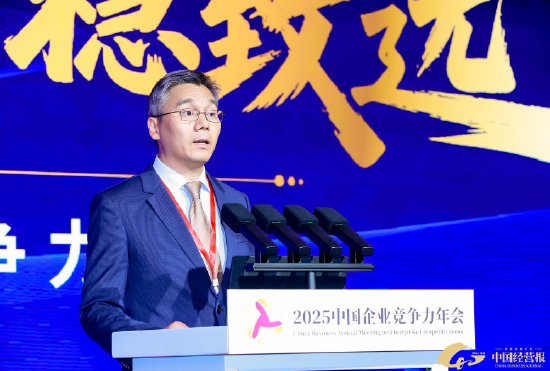
视频|开局谋新 行稳致远 2025中国企业竞争力年会精彩花絮
Zhong Guo Jing Ying Bao· 2025-12-09 07:09
Group 1 - The event highlighted the importance of innovation and stability for Chinese enterprises to enhance their competitiveness in the global market [2] - Key discussions focused on strategies for sustainable growth and adapting to changing market conditions [2] - Various industry leaders shared insights on leveraging technology and digital transformation to drive business success [2] Group 2 - The conference emphasized the role of collaboration among enterprises to foster a more competitive environment [2] - Participants addressed the challenges posed by international trade tensions and the need for resilience [2] - The event served as a platform for networking and sharing best practices among industry peers [2]
李鹏飞:企业竞争力既源于技术与产品硬实力, 更来自理念与格局软实力
Xin Lang Cai Jing· 2025-12-09 02:35
Core Insights - The "2025 China Enterprise Competitiveness Conference" was held on December 9-10 in Beijing, highlighting the resilience of the Chinese economy amidst complex domestic and international pressures [3][6] - Key themes included the robust growth of industrial production, the emergence of new industries, and the continuous recovery of the consumer market, showcasing the deep foundation of the Chinese economy [3][6] - The rise of new productive forces is identified as a core driving force for development, with a focus on the deep integration of digital technology and the real economy, breakthroughs in core technologies, and significant achievements in green transformation [3][6] Industry Challenges - Despite the positive outlook, companies face multiple challenges, including ongoing global geopolitical conflicts, uncertainties from supply chain restructuring, and the need to unlock the potential of the domestic market [3][6] - There are deep-seated issues in industrial upgrading that require urgent resolution [3][6] Long-term Trends - The long-term positive trends for the Chinese economy remain unchanged, with a strong synergy emerging from technological innovation, consumption upgrades, reform dividends, and talent dividends, contributing to high-quality development [3][6] Role of Enterprises - Enterprises are recognized as the main body of the market and the foundation of China's economic resilience, with many companies enhancing their competitiveness through innovation and practical efforts [4][7] - Examples include advancements in financial technology, insights into consumer trends, value extraction from data elements, and a commitment to healthcare [4][7] - The competitiveness of enterprises is derived not only from hard strengths in technology and products but also from soft strengths in concepts and frameworks, requiring both meticulous focus and the courage to break through [4][7]
美媒话糙理不糙:不在中国练级,西方企业迟早在全球被“卷”趴下
Sou Hu Cai Jing· 2025-12-07 14:14
Core Insights - The article emphasizes that Western companies' previous perception of the Chinese market as a "cash cow" is over, and they now face a challenging and competitive environment [1][3][5] Group 1: Market Dynamics - The Chinese market has transformed from a comfortable zone to a complex and competitive landscape, with foreign companies now facing significant challenges from local competitors [3][5] - Brands like Starbucks have lost their market leadership to local players such as Luckin Coffee, which employs aggressive pricing and speed strategies [3][5] - Foreign companies are now engaged in a fierce battle to protect their profits, having to lower prices and compete in ways they previously did not [3][5] Group 2: Competitive Pressure - The Chinese market is described as a "high-pressure chamber" for global business competition, where companies must innovate and control costs more effectively than in other regions [5][12] - Local companies' rapid product iterations and strict cost controls create a challenging environment for Western firms accustomed to slower development cycles [5][12] Group 3: Adaptation Strategies - Many Western brands are undergoing significant transformations to survive, such as Guerlain launching more affordable product lines to attract younger Chinese consumers [7] - Companies like 3M have reduced their product launch cycles to 10 months to keep pace with local competitors, while Volkswagen has increased its new model development speed by 30% [7][8] - Procter & Gamble has established R&D centers in China, treating the market as a testing ground for global innovation [8] Group 4: Corporate Decision-Making - There is a notable disconnect between the efforts of local teams in China and the conservative decision-making of their headquarters in the West, influenced by geopolitical tensions [10] - Some companies, like Ralph Lauren and 3M, have managed to achieve growth in China by quickly adapting to local market rhythms and committing to localization strategies [10] Group 5: Future Outlook - For most foreign companies, the Chinese market is no longer just a source of profits but a test of their competitive strength [12] - The choice for foreign firms is clear: either continue to struggle in the Chinese market to build competitiveness or retreat to their comfort zones and risk being surpassed by Chinese companies [12]




Ifo报告:德国工业企业竞争力跌至历史新低
Shang Wu Bu Wang Zhan· 2025-11-19 04:43
Group 1 - The core finding of the Ifo survey indicates that 36.6% of German companies reported a decline in competitiveness compared to non-EU countries, marking a historical low [1] - The proportion of companies experiencing a decline in competitiveness compared to EU member states rose from 12.0% to 21.5%, also reaching a historical high [1] - The survey suggests that the competitiveness of the German industrial sector has fallen to a new low, highlighting severe structural issues affecting the industry [1] Group 2 - All industries reported a decline in competitiveness, with energy-intensive sectors facing particularly severe challenges [1] - More than half of the chemical industry companies indicated a decrease in competitiveness, while the percentages for electronics and optical products, and machinery manufacturing were 47% and 40%, respectively [1]
韩称半数主力出口产业竞争力被中国赶超
Ke Ji Ri Bao· 2025-11-19 00:05
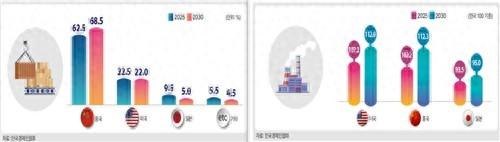
Core Insights - The report from the Korea Economic Association indicates that half of South Korea's top ten export industries have been surpassed by China in terms of competitiveness, with a prediction that all ten industries may fall behind China in five years [1][2] - A survey of 200 major companies in these industries revealed that 62.5% view China as their biggest competitor, with this figure expected to rise to 68.5% by 2030 [1] - The competitiveness index set by the surveyed companies ranks South Korea at 100, while China and the US are projected to surpass South Korea by 2030, with indices of 112.3 and 112.9 respectively [1] Industry Competitiveness - In specific sectors, Chinese companies lead in steel (112.7), general machinery (108.5), secondary batteries (108.4), displays (106.4), and automotive parts (102.4) [2] - South Korean companies still maintain an edge in semiconductors (99.3), electronics and electrical machinery (99), shipbuilding (96.7), petrochemicals and petroleum products (96.5), and biopharmaceuticals (89.2) [2] - The report highlights that China holds advantages in price competitiveness, production capacity, and government support, while South Korea only leads in brand competitiveness, which is expected to be overtaken in five years [2]
最新报告:中国猛追,5年内韩国十大产业全线失守
Guan Cha Zhe Wang· 2025-11-18 00:34
Core Insights - The report from the Korea Economic Association indicates that half of South Korea's top ten export industries have been surpassed by China in terms of competitiveness, with a prediction that all ten industries may lose their competitive edge within five years [1][2]. Industry Competitiveness - A survey of 200 South Korean companies revealed that 62.5% identified China as their biggest competitor, significantly higher than the 22.5% who chose the United States and 9.5% who chose Japan. This perception is expected to increase, with 68.5% anticipating China as the main competitor by 2030 [1][2]. - The competitiveness levels, with South Korean companies using a standard of 100, are perceived as follows: the United States at 107.2, China at 102.2, and Japan at 93.5. By 2030, these levels are projected to be 112.9 for the U.S., 112.3 for China, and 95 for Japan, indicating a significant shift in competitiveness [2][4]. Sector Analysis - In specific sectors, South Korean companies believe that Chinese firms lead in steel (112.7), general machinery (108.5), batteries (108.4), displays (106.4), and automotive parts (102.4). However, South Korea still maintains an edge in semiconductors (99.3), electronics and electrical machinery (99), shipbuilding (96.7), petrochemicals (96.5), and biopharmaceuticals (89.2) [2][4]. - The report highlights that China has advantages in price competitiveness, production capacity, and government support, while the U.S. excels in branding, skilled talent, and core technologies. Currently, South Korea only leads in brand competitiveness, which is expected to be overtaken in five years [4][6].
东方证券:复合肥龙头现金牛属性有望持续增强 企业有望提升分红潜力
智通财经网· 2025-10-16 03:40
Core Viewpoint - The compound fertilizer industry is undergoing structural changes, with leading companies enhancing their competitive advantages, making them typical cash cow assets with potential for increased dividends in the future [1][2]. Group 1: Dividend Potential - The long-term dividend potential of leading compound fertilizer companies is underestimated, as the market often focuses on the industry's low asset intensity and manufacturing barriers, overlooking the competitive advantages of leading firms [1][2]. - The expected increase in dividends is driven by steady profit growth, supported by the enhanced competitiveness of leading companies [2][3]. Group 2: Competitive Advantages - Leading companies are experiencing increased brand loyalty, which supports sales growth, as they reduce uncertainty for channels and farmers, ensuring mutual benefits amid price fluctuations [2]. - The continuous improvement of integrated layouts enhances product profitability, with leading firms investing in upstream integration and differentiating terminal products to increase pricing power [2]. Group 3: Capital Expenditure and Cash Flow - The phase of significant capital expenditure is coming to an end, with leading companies having healthy operating cash flows and ample cash on hand, which allows for potential increases in dividends as investment becomes more restrained [3].



中企500强门槛近480亿元,11家企业“踩线”上榜
Bei Ke Cai Jing· 2025-09-23 07:49
Group 1 - The revenue threshold for entering the China Top 500 Enterprises list has increased from less than 25 billion yuan in 2016 to 47.96 billion yuan in 2025, representing a cumulative increase of 97.0% [1] - The State Grid Corporation leads the list with a revenue of 3.95 trillion yuan, followed by China Petroleum and China Petrochemical, with 15 companies now part of the "trillion club" [1] - JD Group has made its debut in the top ten, indicating a shift in the traditional enterprise landscape due to the rise of private internet companies [1] Group 2 - The competition to enter the list is intensifying, with 11 companies having revenues below 50 billion yuan, and the maximum revenue difference among them being less than 2 billion yuan [2] - The "line-crossing" companies span various sectors, including traditional industries like construction and civil engineering, as well as emerging markets and upgraded traditional enterprises [2] - Several companies, including Guangdong Desay Group and Luoyang Industrial Holding Group, have entered the list for the first time in the past decade, while construction firms related to the real estate sector have shown a declining trend in rankings [2]