
生物

Search documents
未来五年,德州将持续做强工业经济“头号工程”
Qi Lu Wan Bao· 2026-01-22 05:30
Group 1: Modern Industrial System Development - The core focus is on establishing a modern industrial system to support high-quality development, emphasizing advanced manufacturing as the backbone [1] - The strategy includes upgrading traditional industries towards high-end, intelligent, and green transformations during the "14th Five-Year Plan" period [1] - Key projects include enhancing the high-end chemical industry, food processing, and sports equipment manufacturing to create competitive industrial clusters [1] Group 2: Emerging Industry Cultivation - The plan aims to promote the scale and cluster development of emerging industries during the "14th Five-Year Plan" period [2] - Significant projects include the comprehensive layout of semiconductor industries and the establishment of national-level innovation platforms in the information technology sector [2] - The biopharmaceutical industry is targeted for growth, with support for major companies to create national strategic emerging industry clusters [2] Group 3: Future Industry Layout - A mechanism for increasing investment in future industries will be established, focusing on incubators and acceleration parks [3] - The hydrogen energy industry is highlighted, with plans to create a comprehensive industrial chain for fuel cells and related systems [3] - The artificial intelligence sector will see integration with various industries, supported by the development of AI equipment industrial parks and data centers [3]
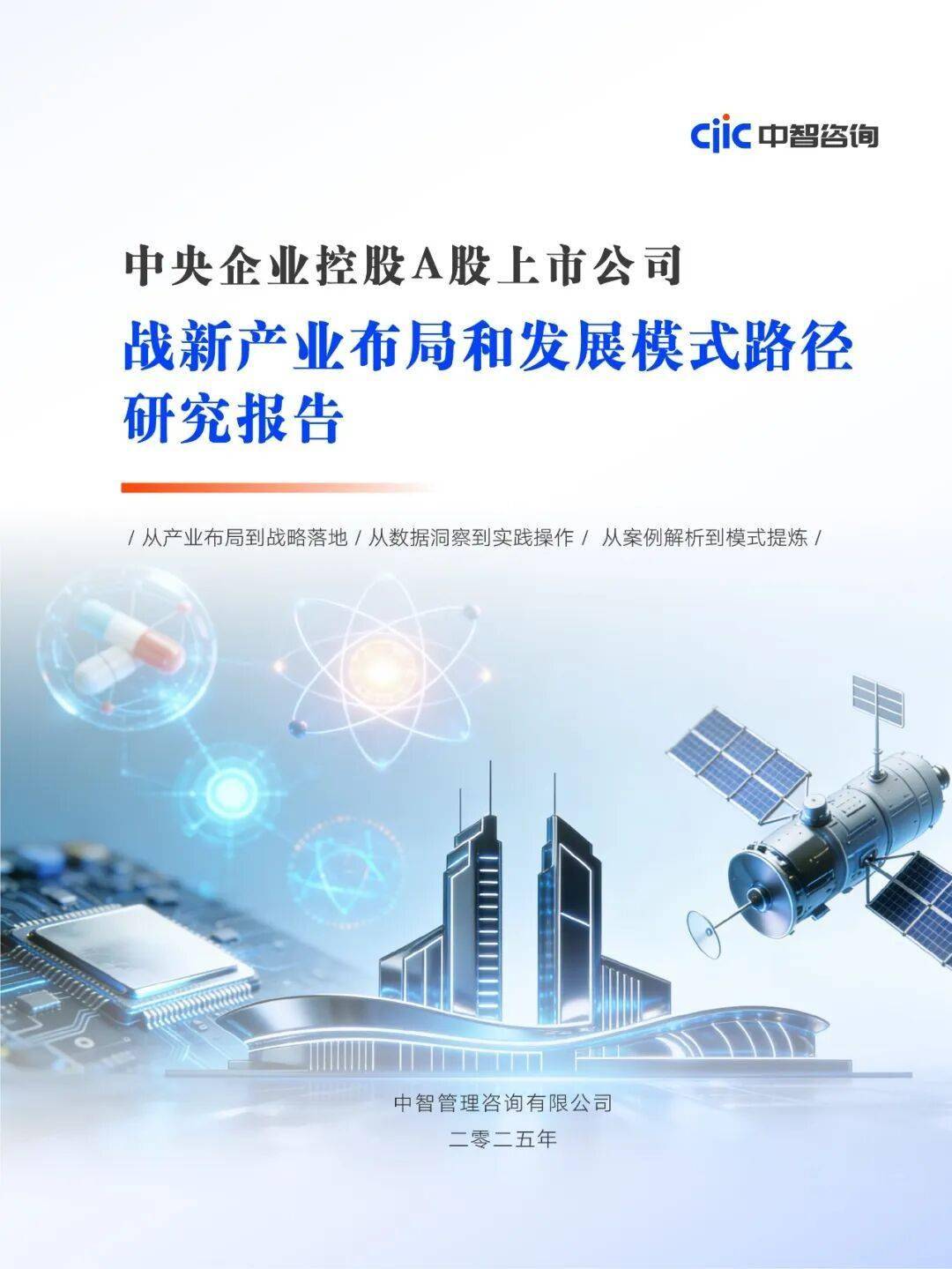
报告发布丨中智咨询《央企A股上市公司战新产业布局和模式路径比较研究报告》
Sou Hu Cai Jing· 2026-01-20 08:25
Core Insights - Strategic emerging industries have become the core battlefield for state-owned enterprises (SOEs) to explore a "second growth curve" under the national strategy of cultivating new productive forces [1] Group 1: Industry Overview - A report by Zhongzhi Consulting indicates that among 402 SOE-controlled A-share listed companies, 257 have over 30% of their revenue from strategic emerging industries, which are included in the study [6] - By the end of 2024, strategic emerging industry enterprises are expected to contribute 26% of operating income and 31.27% of total profit with approximately 25% of total assets, showing a net asset return rate superior to traditional industries [7] Group 2: Structural Layout - Nearly 80% of enterprises focus on advantageous fields such as new-generation information technology, new materials, and new energy, but there is a relative weakness in key areas like industrial mother machines and biomanufacturing, necessitating increased investment to enhance industry influence [8] - 43.85% of manufacturing enterprises in strategic emerging industries are actively upgrading to high-value-added segments like new materials and high-end equipment, while the share of strategic emerging business in transportation and financial service companies is less than 1% [9] Group 3: R&D Investment - Overall R&D investment intensity in strategic emerging industry enterprises is higher than that of traditional industries, but sectors like biotechnology, new materials, and energy conservation have lower R&D investment intensity compared to the average level of SOE A-shares (5.86%), indicating a gap with industry leaders [12] Group 4: Sector-Specific Insights - In the new energy sector, SOEs have established a full industrial chain layout covering power generation operations, equipment manufacturing, and technical services, transitioning from "scale competition" to "quality and efficiency competition" [14] - In the new materials sector, advanced steel materials face industry pressures, while advanced non-ferrous metal materials show high profitability and R&D investment, with companies adopting niche market and industry chain extension strategies [16] - In the biotechnology sector, many enterprises are positioned in relatively mature areas like raw materials and trade, but there is insufficient investment in innovative drugs and precision instruments, indicating a need to strengthen overall industry resilience [18] Group 5: Strategic Recommendations - Establish a full-cycle evaluation and adjustment mechanism for emerging industries, transitioning from experience-based to data-driven decision-making [21] - Implement a "one enterprise, one strategy; one industry, one model" incubation path to guide enterprises in selecting flexible combinations of business extensions, platform incubation, equity cooperation, and fund investment [21] - Optimize resource allocation mechanisms driven by innovation and capital, enhancing collaborative innovation resources and establishing special funds for emerging development [21] - Focus on creating an economic empowerment organization characterized by "small teams, large platforms" to enhance industry leadership and ecological construction capabilities [21]

1月19日生物经济(970038)指数跌0.15%,成份股智飞生物(300122)领跌
Sou Hu Cai Jing· 2026-01-19 10:24
Core Viewpoint - The Biotech Economy Index (970038) experienced a slight decline of 0.15%, closing at 2257.43 points on January 19, with a total trading volume of 28.494 billion yuan and a turnover rate of 2.21% [1] Group 1: Index Performance - On the same day, 23 constituent stocks of the Biotech Economy Index saw an increase, with Deep Technology leading the gainers at a rise of 5.2% [1] - Conversely, 25 stocks declined, with Zhifei Biological leading the losses at a drop of 7.19% [1] Group 2: Capital Flow - The net outflow of main funds from the Biotech Economy Index constituents totaled 0.792 billion yuan, while the net inflow from speculative funds was 0.216 billion yuan [2] - Retail investors contributed a net inflow of 0.576 billion yuan to the index constituents [2]


韩敲定2026年252万亿韩元金融支持计划,其中尖端产业获150万亿
Shang Wu Bu Wang Zhan· 2025-12-29 02:57
Core Viewpoint - The South Korean Financial Commission has finalized a financial support plan for 2026, with a total of 252 trillion KRW allocated by major policy financial institutions, marking an increase of approximately 1.8% from the previous year [1] Group 1: Financial Support Allocation - The financial support for advanced strategic industries will reach 150 trillion KRW, an increase of 12 trillion KRW or about 8.9% compared to this year [1] - Specific allocations include 42.5 trillion KRW for sectors such as semiconductors, secondary batteries, biotechnology, and artificial intelligence (AI) [1] - An additional 24.7 trillion KRW will be directed towards emerging industries like nanotechnology, hydrogen energy, aerospace, military, agricultural food, and wind power [1] Group 2: Additional Financial Support - Funds for enhancing industrial structure and restructuring existing industries will amount to 32.2 trillion KRW [1] - Support for nurturing unicorn companies and small to medium-sized enterprises (SMEs) will total 19 trillion KRW [1] - To mitigate the impact of exchange rate fluctuations on business operations, a support fund of 31.8 trillion KRW will be established [1]
12月18日生物经济(970038)指数涨0.41%,成份股迪安诊断(300244)领涨
Sou Hu Cai Jing· 2025-12-18 11:21
Group 1 - The core index of the biotechnology sector (970038) closed at 2106.64 points, with an increase of 0.41% and a trading volume of 13.689 billion yuan, resulting in a turnover rate of 1.1% [1] - Among the constituent stocks, 29 companies experienced an increase, with Dean Diagnostics leading the rise at 8.65%, while 18 companies saw a decline, with Yingke Medical leading the drop at 1.59% [1] Group 2 - The net inflow of main funds into the biotechnology index constituents totaled 105 million yuan, while speculative funds saw a net outflow of 259 million yuan, and retail investors had a net inflow of 155 million yuan [2] - In the past 10 days, the biotechnology index constituents underwent adjustments, adding 9 new stocks and removing 9 stocks [2]

浙江确定96家科技新小龙企业
Zhong Guo Xin Wen Wang· 2025-12-15 17:30
Core Insights - The "Zhejiang Province Technology New Dragon" initiative has identified 96 innovative enterprises in Zhejiang, focusing on various sectors including information technology, renewable energy, and biotechnology [1][2] - The initiative aims to provide comprehensive support for these enterprises through policy assistance, expert guidance, and resource connections, fostering a competitive innovation ecosystem in the region [1] Group 1: Identified Enterprises - 43 enterprises in the new generation information technology sector [1] - 12 enterprises in the renewable energy and environmental protection industry [1] - 18 enterprises in the biotechnology sector [1] - 12 enterprises in the new materials sector [1] - 3 enterprises in aerospace information [1] - 4 enterprises in bionic robotics [1] - 1 enterprise in brain science and brain-like intelligence [1] - 1 enterprise in the metaverse [1] - 2 enterprises in modern services [1] Group 2: Support Mechanisms - The initiative will conduct special matching activities for major provincial technology projects to assist enterprises in participating in significant technological challenges [2] - Enterprises are encouraged to focus on core technology breakthroughs and play a leading role in industrial upgrades and high-quality development [2] - The government emphasizes the need for enhanced services for these innovative enterprises to accelerate the growth of new productive forces in Zhejiang [2]
韩第62届贸易日:有望达成史上最大出口额
Shang Wu Bu Wang Zhan· 2025-12-11 17:20
Core Insights - South Korea's export is expected to exceed $700 billion for the first time, with a cumulative export amount of $640.2 billion from January to November, marking the highest level since 2022 [1] - Exports have shown positive growth for six consecutive months, indicating a recovery trend after a period of decline [1] - Key sectors driving this growth include semiconductors, automobiles, ships, and biotechnology, supported by the global spread of K-culture products such as K-food and K-beauty [1] Export Performance - The export market structure is diversifying, contributing to the overall growth [1] - In the third quarter, the number of small and medium-sized enterprises (SMEs) involved in exports reached a record high of 89,000, with export value from SMEs hitting $87.1 billion, also a historical peak [1] Recognition and Awards - During the 62nd Trade Day ceremony, 598 individuals and 1,689 companies were recognized for their contributions to South Korea's export achievements [1]
韩今年十大制造业投资为122万亿韩元,呈逐年增长趋势
Shang Wu Bu Wang Zhan· 2025-12-10 18:23
Core Insights - South Korea's top ten manufacturing industries are projected to invest 122 trillion won in domestic equipment this year, reflecting a year-on-year growth trend [1] Group 1: Investment Overview - The investment plan for the top ten manufacturing industries has been increased by 3 trillion won from the beginning of the year, reaching 122 trillion won [1] - The investment amounts for 2023 and 2024 are set at 100 trillion won and 110 trillion won, respectively, indicating a consistent upward trajectory [1] - The investment execution rate for the first three quarters of this year stands at 68%, maintaining a stable development momentum compared to the same period last year [1] Group 2: Sector-Specific Insights - The semiconductor and automotive sectors dominate the investment landscape, accounting for approximately 80% of the total investment plan [1] - Investment in the semiconductor sector is focused on high-end memory chips to meet the rising global demand driven by artificial intelligence [1] - The automotive industry is expanding investments to facilitate the transition to electric vehicles [1] Group 3: Government and Industry Collaboration - Participating companies have urged the government to expedite the implementation of electric vehicle subsidies, expand policy financial support, introduce investment tax credits, and reduce electricity costs [1]
韩国2026财年预算增8.1% AI与半导体获重点支持
Xin Hua Cai Jing· 2025-12-09 08:44
Core Points - The South Korean government approved the national budget for the fiscal year 2026, totaling 727.9 trillion won (approximately 35 trillion yuan), representing an 8.1% increase from the 2025 budget [1][2] - The final budget reflects a slight reduction of about 1 trillion won compared to the initial draft, indicating a cautious adjustment under fiscal discipline [1] - The budget focuses on two main areas: enhancing support for livelihoods and accelerating the cultivation of future growth drivers [1] Budget Allocation - The "Regional Love Voucher" program, aimed at providing consumer subsidies to local residents, received a budget allocation of 1.15 trillion won [1] - The government established a "National Growth Fund" with a dedicated investment of 1 trillion won, focusing on supporting strategic high-tech industries such as artificial intelligence, semiconductors, and biotechnology [1] - Despite an overall inclination to increase support for high-tech sectors, specific budget allocations for artificial intelligence-related support, policy funds, and contingency expenses were reduced by approximately 200 billion won compared to the draft [1] Economic Strategy - The 2026 budget aims to boost domestic demand and solidify the foundation for future industries as a dual strategy to address current economic growth pressures and build a support system for long-term competitiveness [2] - The budget will be submitted to the National Assembly for review, with the final execution dependent on legislative approval [2]
工业和信息化部将开展国家新兴产业发展示范基地创建活动
Zheng Quan Ri Bao Wang· 2025-11-26 01:28
Core Viewpoint - The Ministry of Industry and Information Technology of China has announced the creation of national emerging industry development demonstration bases, aiming to establish around 100 demonstration parks and 1,000 demonstration enterprises by 2035 to promote the healthy and orderly development of emerging industries [1][2]. Group 1: Demonstration Bases - The demonstration bases will include both parks and enterprises, focusing on key emerging industries such as new generation information technology, new energy, new materials, biotechnology, high-end equipment, intelligent connected vehicles, green environmental protection, low-altitude equipment, and aerospace [1]. - The initiative aims to create benchmarks in emerging industries, providing a robust support system for the development of new productive forces [1]. Group 2: Industry Insights - Various parks have already established strong clusters in specific sectors, such as advanced manufacturing, industrial internet, and new energy vehicles, indicating a growing specialization in these areas [2]. - To ensure the demonstration bases serve their intended purpose, it is crucial to select the right leading industries, provide solid public services, and implement strict assessment and evaluation measures [2]. Group 3: Long-term Impact - The demonstration bases are expected to gather innovative resources and industrial elements, promoting collaboration in tackling key core technologies and enhancing the security of industrial supply chains [3]. - Over time, as these bases develop and mature, they will foster a tiered industrial cluster pattern across the country, nurturing globally competitive leading enterprises and specialized small and medium-sized enterprises, thus transforming China from an industrial power to an industrial stronghold [3].