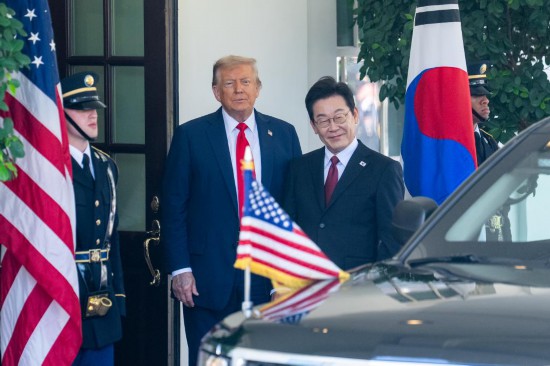
美韩贸易协议

Search documents
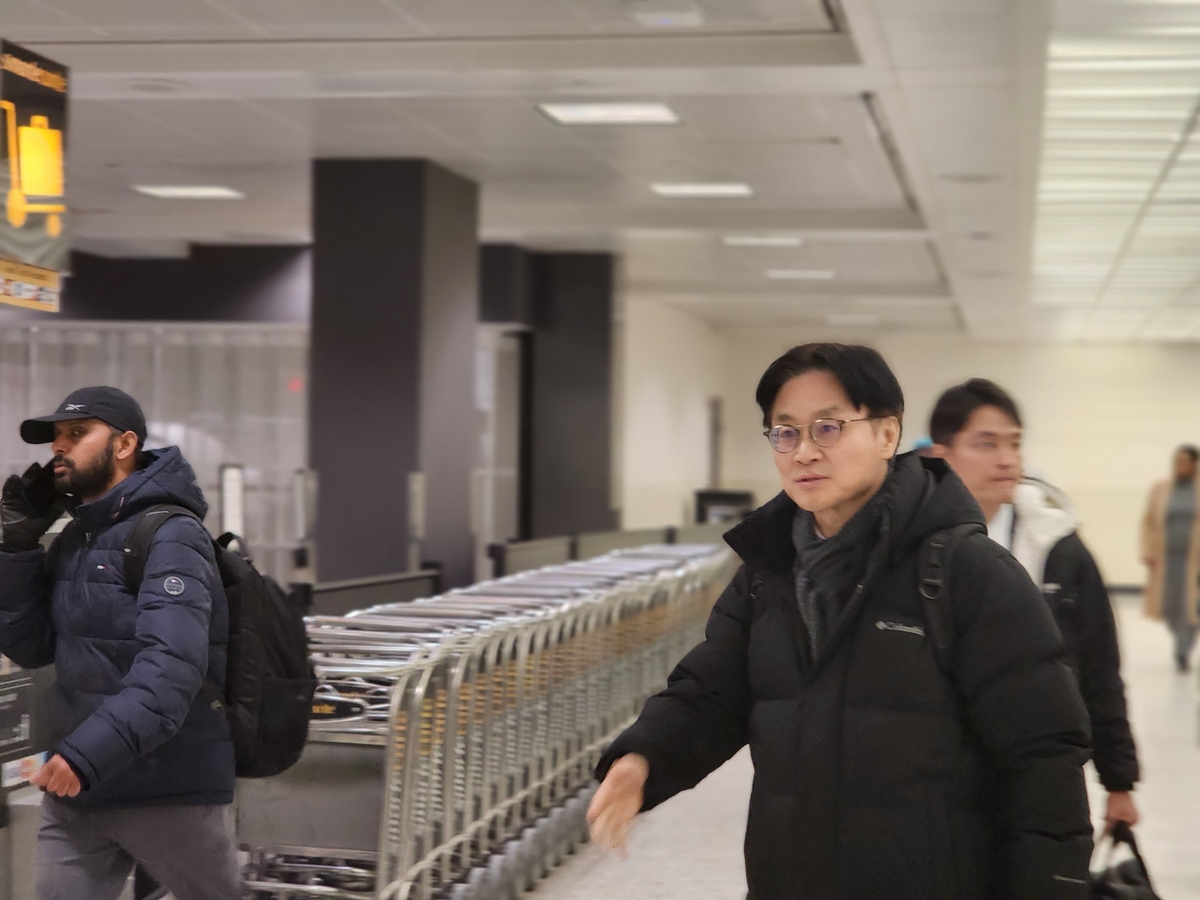
特朗普对韩国“关税突袭”,韩高官紧急赴美
Huan Qiu Wang· 2026-01-29 05:44
Core Viewpoint - The article discusses the urgent visit of South Korea's Minister of Trade, Industry and Energy, Kim Jong-hwan, to the United States following President Trump's announcement to raise tariffs on various South Korean goods, including automobiles and pharmaceuticals, from 15% to 25% due to dissatisfaction with the South Korean National Assembly's approval of the US-Korea trade agreement [1][3]. Group 1 - Kim Jong-hwan plans to meet with US Secretary of Commerce Wilbur Ross on the afternoon of the 29th to address the US's concerns regarding the trade agreement [3]. - President Trump expressed dissatisfaction with the South Korean National Assembly's delay in approving the trade agreement, which has led to the tariff increase announcement [3]. - Kim Jong-hwan emphasized that the South Korean government's stance on cooperation and investment with the US remains unchanged [3]. Group 2 - Kim Jong-hwan attempted to downplay the significance of issues raised by the US, such as those related to e-commerce giant Coupang, stating they do not directly impact the fundamental tariff issues [3]. - During his visit, Kim Jong-hwan is also scheduled to meet with other US officials, including the Secretary of Energy and the Secretary of the Interior [3].

国际金融市场早知道:1月28日
Zhong Guo Jin Rong Xin Xi Wang· 2026-01-28 01:09
Group 1 - President Trump stated that the US dollar is performing well and should return to its "appropriate level" [1][5] - Trump announced an increase in tariffs on key products from South Korea from 15% to 25% due to delays in the approval of a significant US-Korea trade agreement [1][5] - The US government faces a risk of partial shutdown if Congress does not reach an agreement on six remaining funding bills by Friday midnight, affecting approximately 78% of federal government functions [1][5] Group 2 - Japan's Finance Minister reiterated the importance of coordinating with the US but maintained a cautious stance on commenting about specific exchange rate levels [1][6] - The US consumer confidence index dropped significantly by 9.7 points to 84.5 in January, marking the lowest level since 2014, indicating increased public concern about the economic outlook [1][6] Group 3 - The Dow Jones Industrial Average fell by 0.83% to 49,003.41 points, while the S&P 500 rose by 0.41% to 6,978.6 points, and the Nasdaq Composite increased by 0.91% to 23,817.1 points [2][7] - COMEX gold futures rose by 1.91% to $5,179.60 per ounce, while COMEX silver futures decreased by 2.73% to $112.34 per ounce [3][8] - US oil futures increased by 3.2% to $62.57 per barrel, and Brent oil futures rose by 2.98% to $66.71 per barrel [4][9]
市场不买账!特朗普对韩翻脸炸锅,韩股笑纳"黑天鹅"
Ge Long Hui· 2026-01-28 00:07
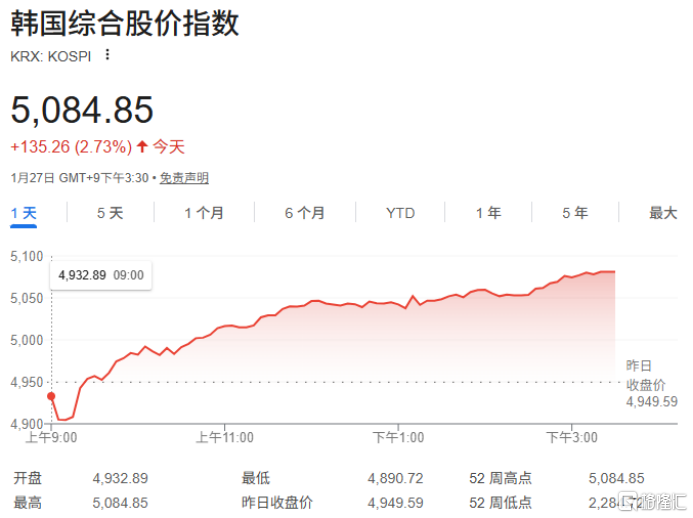
Group 1 - The U.S. President Trump announced an increase in tariffs on South Korean products, including automobiles, wood, and pharmaceuticals, from 15% to 25% due to the South Korean National Assembly's failure to approve the U.S.-Korea trade agreement [1][6] - Following the announcement, the South Korean Composite Stock Price Index opened lower but rebounded to close up 2.73%, reaching a new historical high [1] - The trade agreement, initially signed in 2025, included commitments from South Korea to invest $350 billion in strategic areas, pay $200 billion in cash, and procure $100 billion in U.S. liquefied natural gas [8][9] Group 2 - The U.S. had previously reduced tariffs on South Korean automobiles and parts from 25% to 15% as part of the agreement, but the implementation has been stalled in the South Korean National Assembly [9] - South Korea's Finance Minister's statement regarding the delay in the $350 billion investment due to the weakening won further fueled U.S. frustrations, leading to the tariff increase [9][11] - The South Korean government is actively seeking to address the tariff threat, with plans for high-level discussions in the U.S. and legislative efforts to expedite the approval of the trade agreement [10][11] Group 3 - The increase in tariffs is expected to significantly impact South Korea's automotive exports, which amounted to $30.2 billion in 2025, accounting for 25% of total exports to the U.S., and has already seen a year-on-year decline of 13.2% [11] - The South Korean won has reached its lowest level since the 2007-2009 financial crisis, raising concerns about capital outflows [11] - The outcome of negotiations and the South Korean National Assembly's review of the trade agreement will be critical in determining the future of the tariff situation [13]
特朗普认为他被李在明耍了,勃然大怒,把对韩国的关税提高到25%
Sou Hu Cai Jing· 2026-01-27 20:36
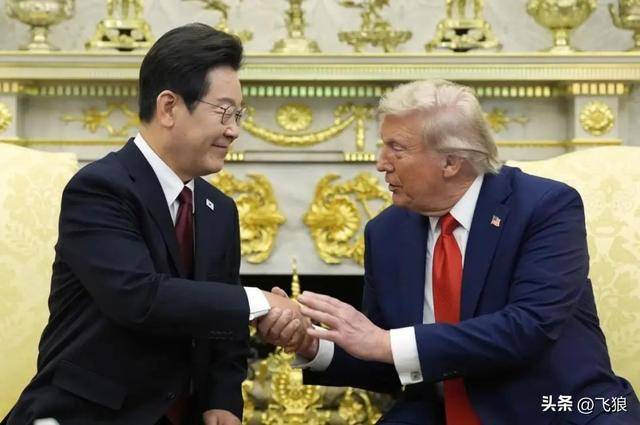
Core Viewpoint - The U.S. President Trump expressed strong dissatisfaction with South Korea for not approving a trade agreement, leading to an increase in tariffs on South Korean goods from 15% to 25% [2][4]. Group 1: Tariff Changes - Trump announced the increase of tariffs on South Korean products due to the South Korean parliament's failure to approve the trade agreement, which includes items like automobiles, timber, and pharmaceuticals [2]. - The tariffs were previously reduced from 25% to 15% as part of a framework agreement signed on July 30, 2022, between Trump and South Korean President Moon Jae-in [2][4]. Group 2: South Korea's Response - The South Korean government held an emergency meeting to discuss how to respond to the tariff increase, indicating the seriousness of the situation [4]. - South Korea's Ministry of Trade expressed its willingness to fulfill the trade agreement with the U.S. and plans to send officials to negotiate with U.S. counterparts [5][6]. Group 3: Legislative Context - The South Korean National Assembly has not approved the "Special Law on Investment in the U.S." which is seen as a necessary step for the implementation of the trade agreement [8]. - The ruling Democratic Party of Korea holds a majority in the National Assembly, suggesting that approval of the law should not face significant obstacles, yet it remains unapproved [6][8]. Group 4: Future Implications - There is speculation that President Moon Jae-in may push for the approval of the investment law to negotiate a reduction in tariffs back to 15% [8]. - However, given Trump's negotiating style, it is suggested that South Korea may need to offer more concessions to alleviate the tariff situation [8].
韩总统府:将尽快与美方磋商
Xin Lang Cai Jing· 2026-01-27 18:56
Core Viewpoint - The South Korean government is responding to U.S. President Trump's announcement of increased tariffs on South Korean products, emphasizing that no formal notification has been received from the U.S. government regarding this matter [1] Group 1: Tariff Changes - President Trump announced an increase in tariffs on South Korean exports to the U.S., raising rates from 15% to 25% on products such as automobiles, timber, and pharmaceuticals [1] - The U.S. and South Korea had previously agreed on a trade framework in July 2025, which has faced criticism and opposition within South Korea [1] Group 2: Government Response - The South Korean presidential office, Cheong Wa Dae, held an emergency meeting to discuss countermeasures and expressed a willingness to fulfill the Korea-U.S. trade agreement [1] - South Korea's Minister of Trade, Industry and Energy, Kim Jeong-gwan, is set to visit the U.S. for discussions with U.S. Commerce Secretary Gina Raimondo [1] Group 3: Investment Commitments - Under the trade agreement, South Korea is committed to investing $350 billion and purchasing $100 billion worth of liquefied natural gas and other energy products from the U.S. [1] - The agreement also includes provisions for the complete opening of trade between the two nations [1]
特朗普宣布对韩加征关税,韩政府:将冷静对待
Guo Ji Jin Rong Bao· 2026-01-27 12:19
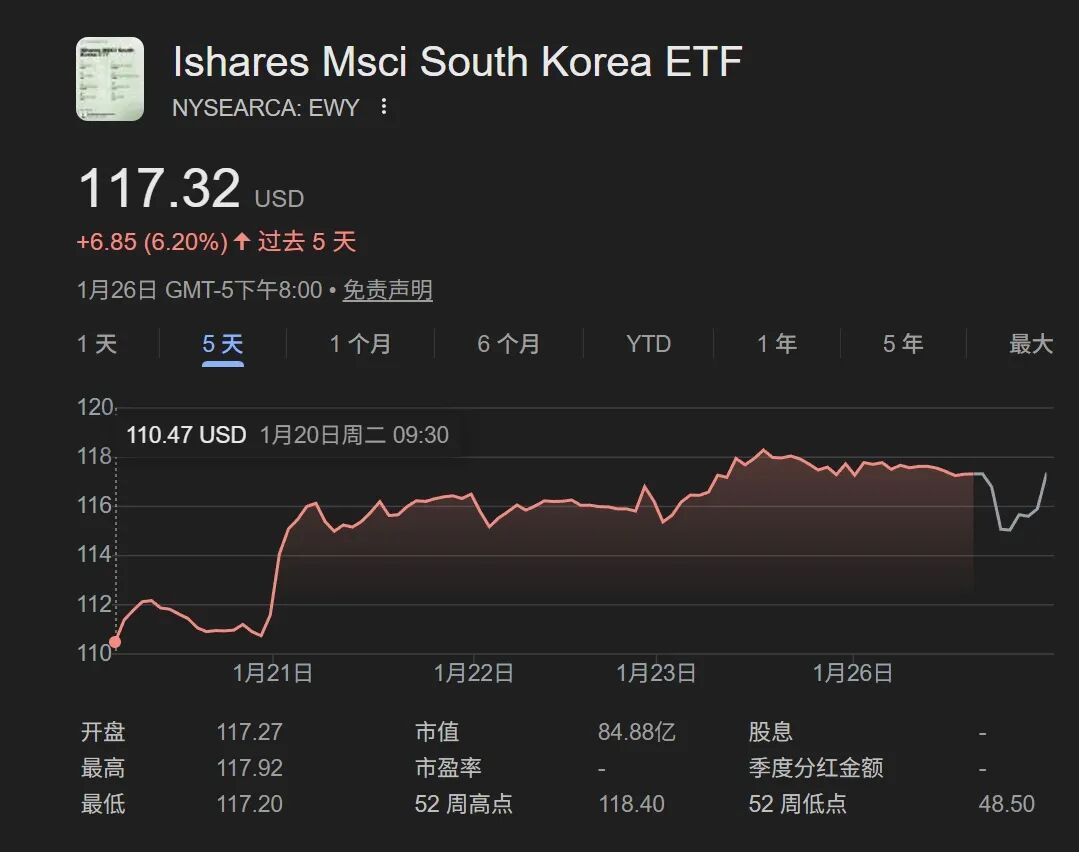
Group 1 - The U.S. President Trump announced a sudden increase in tariffs on South Korean goods from 15% to 25%, citing the lack of approval from the South Korean National Assembly for a trade agreement [1][2] - The trade agreement framework, reached in July 2025, includes South Korea investing $350 billion in the U.S. and purchasing $100 billion worth of liquefied natural gas and other energy products from the U.S. [2] - Following the announcement, the iShares MSCI South Korea ETF, which tracks the MSCI Korea 25/50 Index, experienced a decline, reversing previous gains [2] Group 2 - There is significant opposition within South Korea regarding the trade agreement, with the ruling Democratic Party arguing that the agreement does not require National Assembly approval, while the opposition party insists it does due to the substantial financial commitments involved [5] - The opposition party criticized the government's negotiation as "humiliating diplomacy," claiming that other competitors like Japan and the EU received better tariff conditions [5] - Some opinions in South Korea suggest that accepting a 25% tariff may be more beneficial for corporate profits than making large investments in the U.S. [5] Group 3 - As of now, it is unclear whether the U.S. will immediately implement the tariff increase, and the South Korean government is preparing to engage in discussions with U.S. officials [6] - South Korean officials are set to meet with U.S. Commerce Secretary to discuss the situation and express their commitment to fulfilling the trade agreement [6] - Earlier in January, the U.S. had threatened to impose tariffs on South Korean semiconductor investments, causing concern within the South Korean semiconductor industry [7]
【环球财经】韩总统府:将尽快就特朗普宣布提高对韩关税与美方磋商
Xin Hua She· 2026-01-27 05:17
Core Viewpoint - The South Korean government is responding to U.S. President Trump's announcement to increase tariffs on South Korean exports to the U.S., indicating that no formal notification has been received from the U.S. government regarding this matter [1]. Group 1: Tariff Changes - President Trump announced an increase in tariffs on South Korean products, including automobiles, timber, and pharmaceuticals, from 15% to 25% due to the South Korean National Assembly's failure to ratify the U.S.-South Korea trade agreement [1]. - The trade agreement framework established in July 2025 has faced criticism and opposition within South Korea, with both countries previously experiencing disagreements on the execution of the agreement [1]. Group 2: Government Response - The South Korean presidential office, Cheong Wa Dae, held an emergency meeting to discuss countermeasures and expressed a willingness to fulfill the U.S.-South Korea trade agreement [1]. - South Korea's Minister of Trade, Industry and Energy, Kim Jeong-gwan, is set to visit the U.S. for discussions with U.S. Secretary of Commerce Gina Raimondo [1]. Group 3: Investment Commitments - According to the agreement framework, South Korea is expected to invest $350 billion in the U.S. and purchase $100 billion worth of liquefied natural gas or other energy products from the U.S., while also fully opening trade with the U.S. [1].
韩高官自曝与美商务部长“充满火药味”电话会议:“有过像是大声争执的紧张时刻”
Huan Qiu Wang· 2025-09-02 01:36
Core Viewpoint - There are significant disagreements between South Korea and the United States regarding the details of a $350 billion fund related to the U.S.-Korea trade agreement, leading to tense discussions prior to a leaders' meeting [1][3]. Group 1: Disagreements and Tensions - The U.S. attempted to pressure South Korea for investment detail documents ahead of the leaders' meeting, which was met with resistance from South Korean officials, raising concerns about the meeting's outcome [3]. - A two-hour phone call between South Korean officials and U.S. Secretary of Commerce Wilbur Ross was described as "full of gunpowder," indicating high tension and the potential for a negative impact on the upcoming meeting [3]. - South Korea indicated that direct investment would only constitute a small part of the fund, with the majority being composed of loans and guarantees, highlighting the existing differences in fund structure [3]. Group 2: Meeting Outcomes - Despite the disagreements, the leaders of South Korea and the U.S. held a successful meeting that fostered personal rapport and trust between them [3]. - The meeting addressed various topics, including the U.S.-Korea alliance, the situation on the Korean Peninsula, and cooperation in manufacturing [3].
大涨60%!特朗普,意外引爆!
Zheng Quan Shi Bao Wang· 2025-08-27 09:18
Group 1 - Monami, a South Korean pen manufacturer, experienced a stock price surge of 60% over two days, reaching a high of 3,190 KRW per share, marking its highest level in nearly 19 months [1][3] - The stock price increase was triggered by an incident involving U.S. President Trump expressing interest in a pen used by South Korean President Lee Jae-myung during a signing ceremony [2][3] - Trump praised the pen's design and inquired about its origin, leading to a temporary gift exchange where the pen was given to him by Lee [3][4] Group 2 - Although the pen was not manufactured by Monami, it featured a nib produced by the company, while the body was made by a local firm named Zenyle [4] - Zenyle confirmed that they produced the pen at the request of the South Korean presidential office and have since halted sales due to increased demand [4] - The incident has positioned Monami as a notable player in the market, benefiting from the publicity generated by the event [3][4]
打破惯例的访问:李在明用心准备,特朗普另有盘算
Xin Hua Wang· 2025-08-26 06:30
Group 1: US-Korea Relations - The meeting between US President Trump and South Korean President Lee Jae-myung focused on US-Korea alliance, the situation on the Korean Peninsula, and manufacturing cooperation [1][3] - Trump expressed intentions to request ownership of land for US military bases in South Korea, which currently are provided for free by the Korean government [2] - Lee Jae-myung emphasized the importance of US-Korea-Japan cooperation and mentioned his recent visit to Japan to address historical issues between Korea and Japan [9][11] Group 2: Economic Cooperation - Trump mentioned that South Korea is interested in renegotiating the trade agreement reached in July, indicating a willingness to discuss economic relations [5] - South Korea's Korean Air announced plans to purchase over 100 Boeing aircraft, marking the largest deal in Korean aviation history, with a total value of approximately $50 billion [8] - Trump indicated plans for the US to procure ships from South Korea and expressed interest in local labor production in the US shipbuilding sector [6] Group 3: Future Engagements - Trump expressed a desire to meet with North Korean leader Kim Jong-un again, indicating optimism about North Korea's potential [3] - Trump plans to visit South Korea soon for a trade meeting, likely related to the upcoming APEC summit [6]