绿色环保

Search documents
光大环境20260323
2026-03-24 01:27
Summary of the Earnings Call for Guangda Environment Company Overview - **Company**: Guangda Environment - **Date of Earnings Call**: March 23, 2023 Key Points Financial Performance - In 2025, the company's net profit attributable to shareholders increased by 16% to HKD 3.925 billion, driven by improved operational efficiency, reduced asset impairment, and lower financial costs [2][3] - Operating revenue grew by 2% to HKD 19.8 billion, with its share of total revenue rising from 64% to 72% [2][3] - Construction revenue fell by 53% to HKD 2.7 billion, accounting for 10% of total revenue [3] - Financial income decreased by 2% to HKD 5 billion, representing 18% of total revenue [3] - Financial costs for 2025 were HKD 2.4 billion, down by HKD 600 million, benefiting from a 56 basis point reduction in overall financing costs [3] Business Segment Highlights - The Environmental Energy segment reported a net profit of HKD 4.5 billion, up 17%, primarily due to savings in financial costs and operational efficiency [4] - The waste treatment capacity of operational waste incineration projects reached 40,300 tons per day, with a 3% increase in household waste processed to 53.7 million tons [4] - The electricity generated from waste increased by 5% to 17.9 billion kWh, with the efficiency of electricity generation per ton of waste rising by 1% to 467 kWh [4] - The Green Environmental segment significantly reduced losses, achieving a net profit of HKD 113 million compared to a loss of HKD 415 million in 2024 [5] - The Environmental Water segment's net profit decreased from HKD 1.02 billion in 2024 to HKD 842 million in 2025, impacted by a decline in construction revenue and a one-time reduction in water prices [5] Cash Flow and Capital Expenditure - Free cash flow surged to RMB 10.13 billion from RMB 4.04 billion in 2024, driven by improved collections and reduced capital expenditures [5] - The collection rate for accounts receivable exceeded 98%, with the national renewable energy subsidy collection rate reaching 134% [5] - Capital expenditures decreased significantly from RMB 4.87 billion to RMB 2.6 billion [5] Dividend Policy and Future Potential - The company increased its dividend per share to HKD 0.27, a 17% increase from HKD 0.23 in 2024, with a payout ratio of 42.3% [6] - Future dividend potential could reach HKD 6.1 billion to HKD 6.6 billion, with a theoretical payout ratio potential of 155%-168% [6] Valuation and Asset Quality - The current price-to-book (PB) ratio is 0.6, with potential for recovery to 1.0 PB driven by the collection of national subsidies [7] - The recovery of RMB 13.38 billion in national subsidies, which accounts for 21% of net assets, is expected to enhance the PB ratio by approximately 0.2 [7] - Continuous improvement in operational assets and the potential A-share listing are seen as catalysts for valuation enhancement [7] Additional Insights - The company is focusing on enhancing operational efficiency through increased waste-to-energy conversion and expanding into overseas markets [7] - The overall improvement in asset quality is a key driver for the company's valuation recovery [7]

江苏盐城绿色低碳产业专项母基金招GP
FOFWEEKLY· 2026-03-20 10:11
Core Viewpoint - The article discusses the establishment of the Jiangsu Yancheng Green Low-Carbon Industry Special Fund, which aims to promote the development of strategic emerging industries in Jiangsu Province with a total scale of 2 billion yuan [2]. Group 1: Fund Structure and Purpose - The special fund has a total scale of 2 billion yuan and operates under a limited partnership system, with a duration of 15 years, including an investment period of 8 years and an exit period of 7 years [2]. - The fund aims to support the integration and development of strategic emerging industry clusters in Yancheng, optimizing the layout of the local modern industrial system [2]. Group 2: Investment Strategy - The investment direction focuses on green low-carbon industries, including new energy, smart energy, new energy vehicles, and environmental protection [3]. - The sub-funds must be registered within Jiangsu Province, with a minimum scale of 300 million yuan, and it is encouraged to establish sub-funds of over 500 million yuan [3]. - At least 70% of direct investments must be made in enterprises within Jiangsu Province, with strict reviews required for any overseas investments [3].

打造济南副城高质量发展增长极
Qi Lu Wan Bao· 2026-01-21 13:44
Core Viewpoint - The Steel District aims to enhance its economic development by focusing on industrial upgrades, agricultural advancements, investment promotion, urban-rural integration, and improving public welfare, all under the theme of "Project Empowerment Year" [1][2][3][4][5][6] Group 1: Industrial Development - The Steel District is implementing an industrial stronghold strategy to upgrade its leading industries, focusing on high-end, intelligent, and green development [1] - The district plans to strengthen its three main industries: steel, advanced materials, and new energy equipment, while also promoting precision casting and green construction [1] - New industries such as new energy, new materials, and laser equipment will be cultivated to enhance production capabilities [1] Group 2: Agricultural Development - The Steel District is committed to modern efficient agriculture, aiming to establish a core cluster for the "Northern Seed Industry Capital" through the development of a comprehensive poultry breeding industry [2] - The district will accelerate the construction of six poultry breeding sub-projects and an innovation center for animal breeding [2] Group 3: Investment and Consumption - The district is focusing on project development, with plans to accelerate the construction of 10 provincial, 30 municipal, and 238 district-level key projects [3] - The Steel District aims to attract over 80 quality projects in key industries through targeted investment strategies [3] - Consumer promotion activities will be organized, including over 25 events in key sectors like automotive and home appliances [3] Group 4: Urban-Rural Integration - The Steel District is advancing urban construction and renewal, with 14 projects underway to improve infrastructure such as roads and utilities [4][5] - Efforts will be made to enhance the living environment and integrate urban and rural development [5] Group 5: Public Welfare Improvement - The district prioritizes public welfare, planning to provide vocational training for over 3,000 individuals and improve employment opportunities for key groups [6] - The district aims for a 5.2% increase in per capita income and will enhance educational and healthcare services [6] - Plans include the construction of new childcare centers and the optimization of elderly care services [6]
央行推出八项举措加大结构性货币政策工具支持力度
Xin Hua Wang· 2026-01-16 03:12
Core Viewpoint - The People's Bank of China (PBOC) is implementing eight policy measures to enhance credit support in key areas, aiming to facilitate economic structural transformation and optimization. Group 1: Monetary Policy Adjustments - The PBOC will lower the interest rates of various structural monetary policy tools by 0.25 percentage points, reducing the one-year re-lending rate from 1.5% to 1.25% [1] - The PBOC will merge the quotas for agricultural and small enterprise re-lending and rediscounting, increasing the agricultural and small enterprise re-lending quota by 500 billion yuan, with a dedicated quota of 1 trillion yuan for private enterprises [1] - The quota for re-lending for technological innovation and technological transformation will be increased from 800 billion yuan to 1.2 trillion yuan, expanding the support to include private small and medium-sized enterprises with high R&D investment levels [1] Group 2: Risk Management and Support Tools - The PBOC will merge the existing private enterprise bond financing support tool and the technological innovation bond risk-sharing tool, providing a total re-lending quota of 200 billion yuan [1] - The carbon reduction support tool will be expanded to include more projects with carbon reduction effects, guiding banks to support comprehensive green transformation [1] - The minimum down payment ratio for commercial property loans will be lowered to 30% in collaboration with the financial regulatory authority [3] Group 3: Consumer and Currency Support - The support areas for service consumption and elderly care re-lending will be expanded to include the health industry, based on health industry recognition standards [2] - Financial institutions are encouraged to enhance their foreign exchange risk management services and diversify foreign exchange risk management products for enterprises [3]
新型储能纳入政府投资基金投向!国家首次作出系统规范
中关村储能产业技术联盟· 2026-01-13 12:15
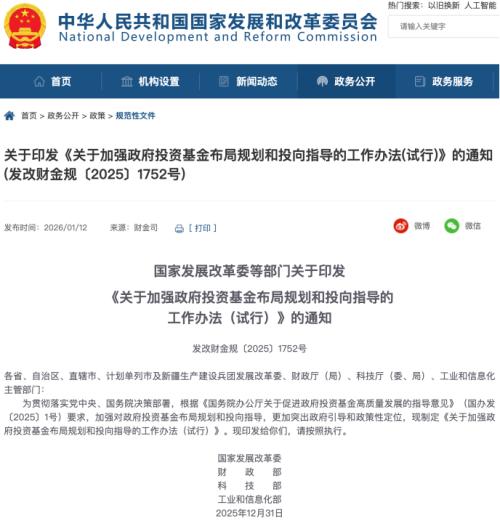
Core Viewpoint - The article discusses the implementation of a new regulatory framework for government investment funds in China, aimed at optimizing their layout and guiding investment directions to support national strategies and industrial upgrades [2][3][4]. Group 1: Government Investment Fund Overview - Government investment funds are established by various levels of government to guide social capital in supporting industry development and innovation through market-oriented methods such as equity investment [2][12]. - The new framework includes a systematic approach to fund layout and investment direction, marking the first national-level regulation of government investment funds [2][4]. Group 2: Supported Investment Areas - The framework identifies key investment areas, including: - Emerging and future industries such as information technology, new energy, advanced manufacturing, and artificial intelligence [2][3]. - Upgrading traditional industries and supporting high-quality development in manufacturing [3][4]. - Promoting the digital economy through initiatives like "AI+" and the application of 5G technology [3][4]. Group 3: Policy Measures - The framework outlines 14 policy measures focusing on three main aspects: where to invest, how to invest, and who manages the funds [3][4]. - It emphasizes early, small, long-term investments in hard technology and aims to prevent homogeneous competition and crowding out of social capital [11][12]. Group 4: Evaluation Management - An evaluation management method has been established to assess the investment direction of government funds, focusing on compliance with national planning and industry directories [4][5]. - The evaluation system includes three main indicators: policy compliance (60% weight), optimization of productivity layout (30% weight), and policy execution capability (10% weight) [6][7]. Group 5: Specific Evaluation Indicators - The evaluation indicators cover aspects such as support for new productivity, technology innovation, green development, and the promotion of private investment [29][33]. - Specific metrics include the proportion of investments in encouraged industries, the effectiveness of fund management, and the impact on social welfare [29][33][40].
重磅利好!万亿级“国家队”投向明确了
Zhong Guo Jing Ji Wang· 2026-01-13 02:32
Core Viewpoint - The Chinese government has established a systematic framework for the development and direction of government investment funds, marking the first time such guidelines have been issued at the national level [1]. Group 1: Policy Framework - The "Work Method" outlines three main aspects: where to invest, how to invest, and who manages the funds, proposing 14 policy measures [3]. - The framework emphasizes supporting major strategies and key areas, particularly in sectors where market resources are insufficient, promoting deep integration of technological and industrial innovation, and focusing on nurturing emerging pillar industries [3]. Group 2: Investment Guidance - Funds must align with national major plans and encourage industries listed in the national industrial directory, while avoiding investments in restricted, eliminated, or prohibited sectors [3]. - Provincial development and reform departments are tasked with creating lists of key investment areas to optimize fund allocation [3]. Group 3: Evaluation Metrics - The "Management Method" establishes three primary indicators: 1. Policy compliance (60% weight), assessing the fund's role in supporting new productive forces, technological innovation, and green development [4]. 2. Optimization of productive layout (30% weight), evaluating alignment with national regional strategies and effective capacity utilization [5]. 3. Policy execution capability (10% weight), focusing on fund efficiency and the professional level of fund managers [5]. Group 4: Focus Areas - The investment focus includes emerging industries such as next-generation information technology, new energy, high-end equipment, and green technology, as well as future industries like the metaverse, brain-computer interfaces, and generative artificial intelligence [5].
重磅利好,万亿级“国家队”投向明确了
2 1 Shi Ji Jing Ji Bao Dao· 2026-01-12 16:52
Group 1 - The National Development and Reform Commission, Ministry of Finance, Ministry of Science and Technology, and Ministry of Industry and Information Technology jointly released guidelines for the planning and investment direction of government investment funds, marking the first systematic regulation at the national level [1] - The evaluation of fund investment direction will focus on whether it supports the development of new productive forces, with targeted sectors including emerging industries and future industries [1] - Emerging industries include next-generation information technology, new energy, new materials, high-end equipment, new energy vehicles, green environmental protection, and civil aviation, while future industries encompass the metaverse, brain-computer interfaces, quantum information, and humanoid robots [1] Group 2 - On January 12, the A-share trading volume reached a historical high of 3.6 trillion, with over 4,100 stocks in the market showing positive performance [2]
利好来了!“国家队”投向明确!四部门联合发布
凤凰网财经· 2026-01-12 13:37
Core Viewpoint - The article discusses the recent issuance of guidelines by four government departments in China aimed at strengthening the planning and investment direction of government investment funds, marking a significant step in defining the future of these funds, which are crucial for supporting emerging and future industries [2][3]. Group 1: Government Investment Fund Guidelines - The guidelines, titled "Work Method for Strengthening the Layout Planning and Investment Direction of Government Investment Funds (Trial)," were jointly released by the National Development and Reform Commission, Ministry of Finance, Ministry of Science and Technology, and Ministry of Industry and Information Technology [3]. - The guidelines focus on three main aspects: where to invest, how to invest, and who manages the funds, proposing 14 policy measures to optimize fund allocation [3]. - Funds are required to support major strategies and key areas, particularly in sectors where market resources are inadequately allocated, emphasizing early, small, long-term investments in hard technology [3][5]. Group 2: Investment Direction and Evaluation - The investment direction must align with national major plans and encourage industries listed in the national industrial catalog, avoiding investments in restricted or eliminated sectors [4]. - Local development and reform departments are tasked with creating lists of key investment areas to optimize fund allocation based on regional characteristics [5]. - The guidelines also clarify the roles of national and local funds, with national funds focusing on supporting the modernization of the industrial system and overcoming key technological challenges [6]. Group 3: Evaluation Management Method - The "Management Method for Evaluating Investment Direction of Government Investment Funds (Trial)" was also released, establishing a comprehensive evaluation system that combines quantitative and qualitative assessments [6]. - The evaluation includes three primary indicators: policy compliance (60% weight), optimization of productivity layout (30% weight), and policy execution capability (10% weight) [6][7]. - The evaluation aims to ensure that funds effectively support new productive forces, technological innovation, and the development of the digital economy, among other areas [8].

湖南衡阳 激活数据“增信”价值
Jin Rong Shi Bao· 2025-12-16 03:32
Core Insights - The financial innovation practice in Hengyang is transforming the financing model for small and micro enterprises by leveraging credit data and breaking down information barriers between banks and businesses [1] Group 1: Financing Innovations - As of the end of Q3 this year, the balance of credit loans for enterprises in Hengyang reached 35.097 billion, a year-on-year increase of 11.48%, with a net increase of 4.882 billion since the beginning of the year, accounting for 16.85% of all new enterprise loans [1] - The national platform for sharing credit information on small and micro enterprises has enabled banks to assess businesses based on cash flow data, leading to the issuance of credit loans even without traditional collateral [1][2] - The platform has facilitated 1,915 queries and 753 loans amounting to 1.497 billion, with a loan balance of 1.363 billion as of Q3 this year [2] Group 2: Case Studies - A recycling company in Hengyang received a credit loan of 10 million due to stable cash flow and good transaction records, despite lacking traditional collateral [1] - An agricultural enterprise in Qidong was able to secure 2.88 million in credit within three working days, allowing it to stabilize its supply chain and support local farmers [2] - A construction company in Changning obtained 114 million in loans by utilizing future revenue rights as collateral, demonstrating the effectiveness of tailored financing solutions [3] Group 3: Regulatory and Operational Support - The People's Bank of China in Hengyang has prioritized the promotion of the credit information platform, conducting monthly statistics and feedback sessions to enhance its application [3] - By the end of Q3, 10 banks had provided financing services to 3,725 enterprises through the platform, with a total loan amount of 5.114 billion, reflecting a growth of 145.75% compared to the end of last year [3] - The unified registration system for movable property financing has seen a significant increase in registrations and queries, with 1,171 new registrations and a 155.68% year-on-year growth [4]
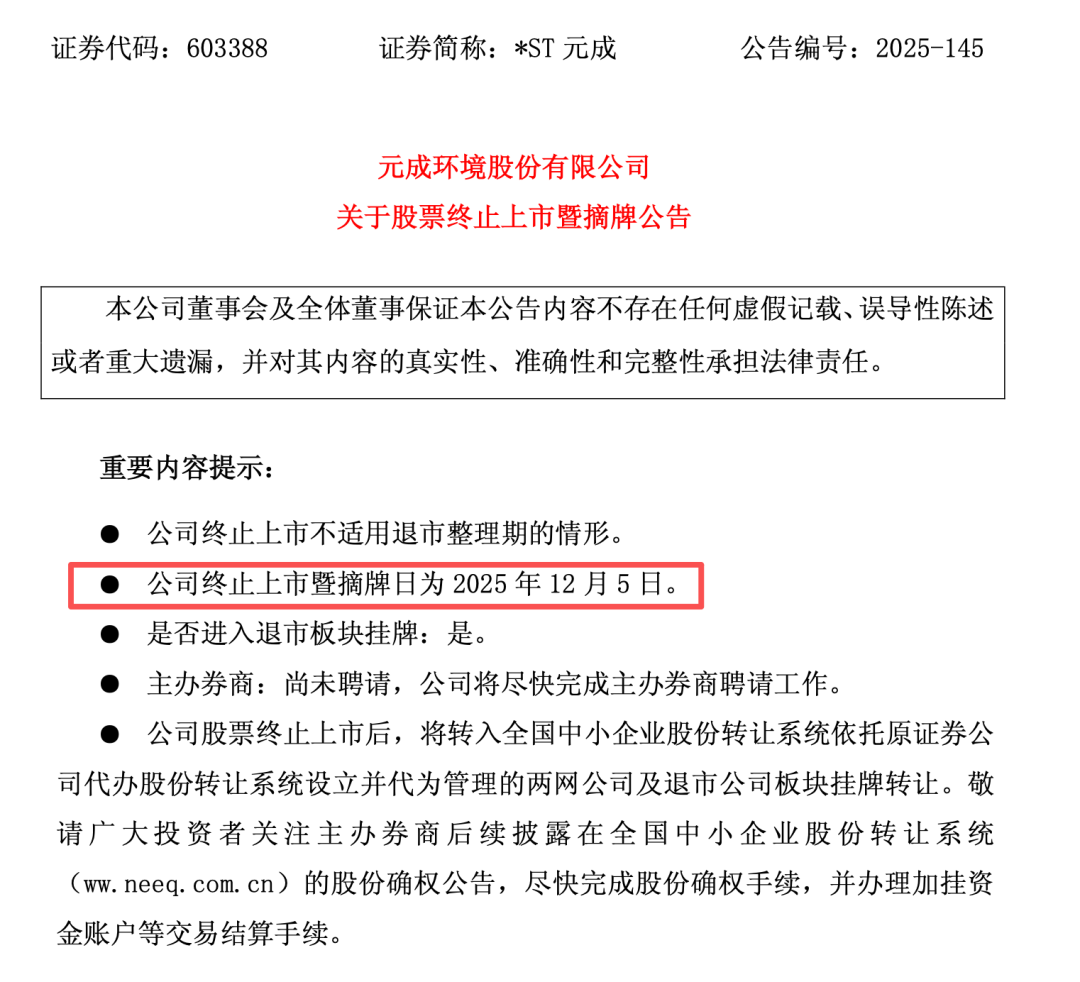
603388,12月5日终止上市,停牌前21连跌停
Zheng Quan Shi Bao· 2025-11-28 15:08
Core Points - *ST Yuancheng (603388) has received a decision from the Shanghai Stock Exchange to terminate its stock listing, effective December 5, 2025 [1] - The company has been facing financial difficulties, with a continuous decline in market value and a significant drop in stock price [4][7] Financial Performance - From October 14 to November 10, 2025, *ST Yuancheng's market capitalization fell below 500 million yuan for 20 consecutive trading days [4] - The company's stock price was recorded at 0.58 yuan per share as of November 10, with a total market value of approximately 189 million yuan [4] - For the first three quarters of the current year, *ST Yuancheng reported revenue of 102 million yuan and a net loss of 143 million yuan [7] Regulatory Actions - The company has been under financial risk warnings since May 6, and was subjected to additional warnings for major legal violations starting October 13 [7] - In October 2025, the Zhejiang Securities Regulatory Bureau issued a notice indicating that the company's annual reports from 2020 to 2022 contained false records, leading to proposed penalties totaling 37.45 million yuan [7] - The company’s actual controller and former chairman, Zhu Changren, faces a personal fine of 28 million yuan and a 10-year ban from the securities market [7]