
罐头食品

Search documents
兽药超标一倍! “梅林牌”罐头港澳紧急下架,光明火速撇清,中粮持续沉默
Xin Lang Cai Jing· 2025-12-11 09:53
Core Viewpoint - The import of "Meilin" brand pickled vegetable and shredded meat canned food has been suspended due to excessive levels of sulfamethazine, a veterinary drug, detected in the product, which has not yet entered the Macau market [2][4][21]. Group 1: Product and Regulatory Actions - The product in question is "Meilin" brand pickled vegetable and shredded meat canned food, with a best before date of April 7, 2028, and a net weight of 240 grams. The detected sulfamethazine level was 204 μg/kg, exceeding the Macau maximum residue limit by more than double [4][23]. - The Macau Municipal Bureau has called for immediate cessation of sales and consumption of the affected product, and Hong Kong has initiated a comprehensive recall [4][23]. - The product is manufactured by COFCO Industrial Products Import and Export Co., Ltd., and the brand is distinct from the "Meilin" brand owned by Bright Food Group [2][12][22]. Group 2: Company Responses and Market Impact - Bright Food Group clarified that the implicated product is not under its brand but is instead associated with COFCO Group, emphasizing that the two brands operate independently [12][22]. - COFCO Group has not responded to inquiries regarding whether the affected product has entered mainland China or the measures taken for disposal [15][32]. - The "Meilin" brand has historical ties, with the brand being authorized to COFCO for export purposes in the mid-20th century, leading to confusion in the market regarding the two brands [31]. Group 3: Financial Performance and Consumer Trust - Bright Food Group reported a revenue of 16.854 billion yuan for the first three quarters of the year, a year-on-year increase of 2.87%, but its net profit dropped significantly by 55.94% to 168 million yuan [11][29]. - Consumer complaints regarding food safety issues have been frequent, with reports of contaminated products and poor customer service, which may erode consumer trust in the brand [18][34][35].


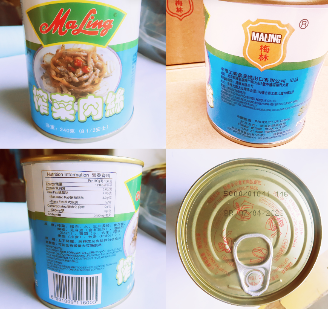
澳门检出“梅林”罐头兽药超标,光明肉业澄清非自家产品
Guo Ji Jin Rong Bao· 2025-12-11 03:44
Core Viewpoint - A batch of "Meilin" brand canned pickled vegetables with shredded meat imported to Macau was found to have sulfamethazine residue exceeding local standards by more than 100%, prompting emergency measures in both Hong Kong and Macau [1][4]. Group 1: Product and Regulatory Response - The batch of "Meilin" canned product weighed 240 grams and had a shelf life until April 7, 2028, with a processing plant code of 5000/01011 [4]. - The detected sulfamethazine content was 204 μg/kg, surpassing the maximum residue limit of 100 μg/kg set by Macau, indicating a 104% exceedance [4]. - The Macau authorities have halted the import application for the affected product and alerted Hong Kong for a comprehensive recall [5]. Group 2: Health Implications and Brand Clarification - Sulfamethazine is a widely used antibacterial drug in animal husbandry, and excessive intake may lead to allergic reactions and urinary system damage; however, the Macau authorities stated that the detected levels are unlikely to cause adverse health effects under normal consumption [6]. - The incident initially caused confusion with "Guangming Meat Industry" (600073), as "Meilin" is a historical brand associated with it; however, it was clarified that the affected product belongs to COFCO Group's COFCO Meilin [6]. - The historical context of the "Meilin" brand dates back to the 1950s when Shanghai Meilin authorized COFCO to use the brand for export, leading to the current dual-brand situation [6]. Group 3: Company Performance and Market Impact - Guangming Meat Industry reported a revenue of 16.854 billion yuan for the first three quarters of the year, a year-on-year increase of 2.87%, primarily driven by beef and lamb products, which contributed 9.833 billion yuan, up 10.95% [8]. - Despite the overall revenue growth, several business segments faced declines, with the pig farming sector dropping over 22%, negatively impacting overall revenue [8]. - The company's net profit attributable to shareholders fell significantly by 55.94% to 168 million yuan, with a reported loss of 8.02 million yuan in the third quarter, indicating substantial pressure on profitability [8].

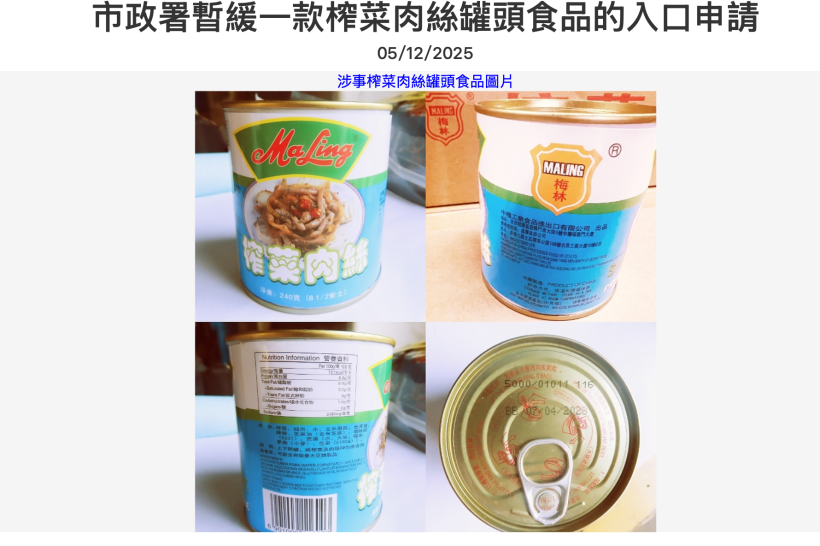
澳门检出“梅林”罐头兽药超标,上海光明迅速回应:不是我们家的
第一财经· 2025-12-10 10:25
Core Viewpoint - A batch of "Maling" brand canned pickled vegetable meat has been found to contain excessive residues of the veterinary drug sulfadimidine, which has raised concerns about food safety in Macau [3][5][7]. Group 1: Product Details - The affected product is "Maling" brand canned pickled vegetable meat, with a shelf life until April 7, 2028, and a net weight of 240 grams. The detected sulfadimidine content was 204 μg/kg, exceeding the maximum residue limit of 100 μg/kg set by Macau regulations [5][7]. - Sulfadimidine is a sulfonamide antibiotic widely used in animal husbandry, and long-term excessive intake may lead to allergic reactions and urinary system damage [7]. Group 2: Company Background - The "Maling" brand is a time-honored brand in China, and the related company is Shanghai Bright Food Group Co., Ltd., which is publicly listed [7][10]. - Bright Food is one of the largest food production and sales companies in China, leading in market share for products like luncheon meat and honey, and owns well-known sub-brands such as "White Rabbit" and "Guanshengyuan" [10]. Group 3: Brand Confusion - Bright Food clarified that the affected product is not from its Shanghai Maling but from COFCO Group's COFCO Maling, indicating that there are two distinct "Maling" brands operated by different companies [13]. - The historical context of the two brands dates back to the 1950s when Shanghai Maling authorized COFCO Group to use the brand for canned exports, leading to the current situation where both brands coexist with different product lines [13][15].
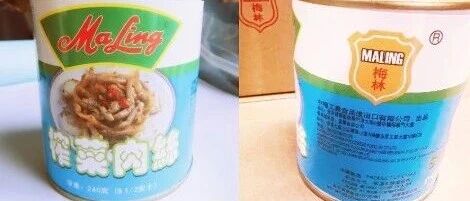
“梅林”罐头在澳门被检出过量残留兽药“磺胺二甲嘧啶”,光明肉业回应:不是我们家的
Xin Lang Cai Jing· 2025-12-09 13:47
Group 1 - A batch of "Meilin" brand canned shredded pork with pickled vegetables was found to have excessive residues of veterinary drug sulfanilamide, according to an announcement from the Macau Municipal Bureau on December 5 [1] - The affected products did not enter the market, and the company Guangming Meat Industry clarified that the implicated product is not under its brand but rather belongs to COFCO Group's COFCO Meilin [1] - There are two distinct "Meilin" brands in the domestic market, operated by different companies, which originated from a historical licensing agreement in the 1950s for export purposes [1]
涉中华老字号!一批梅林榨菜肉丝罐头残留兽药超标被港澳通报
Nan Fang Du Shi Bao· 2025-12-08 10:02
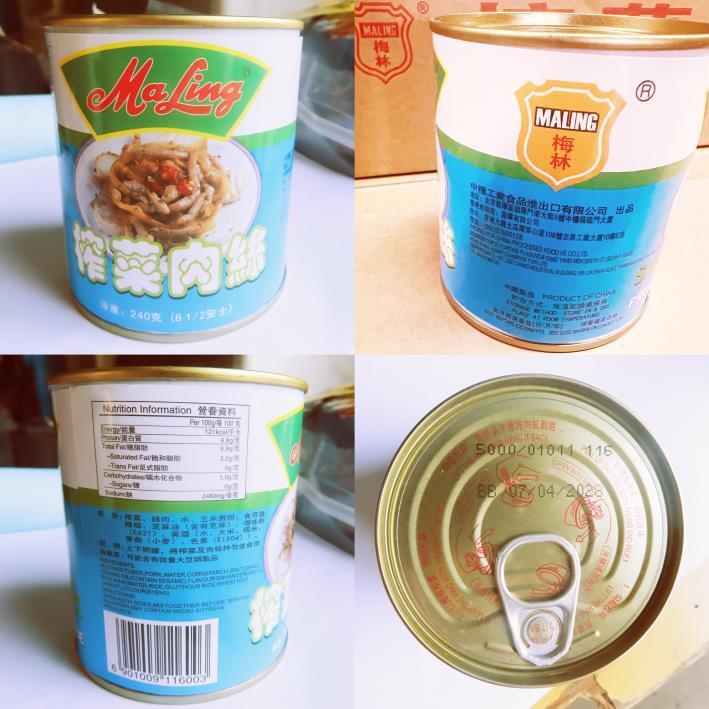
Core Viewpoint - A batch of "Meilin" brand canned pickled vegetables with shredded meat has been reported in Hong Kong and Macau for exceeding veterinary drug residue limits, specifically sulfanilamide [1][2][3] Group 1: Incident Details - On December 5, Macau's Municipal Authority announced that a batch of canned pickled vegetables with shredded meat, imported from Hong Kong, was found to contain excessive levels of sulfanilamide at 204μg/kg, exceeding the maximum residue limit of 100μg/kg set by Chinese regulations [2][3] - The affected product is labeled as "Meilin brand" with a shelf life until April 7, 2028, and a net weight of 240 grams [2] - The Hong Kong Food and Environmental Hygiene Department confirmed on December 7 that the affected batch had been imported by a distributor named Changhui Limited, which has since ceased sales and initiated a recall [3][5] Group 2: Company Responses - Guangming Meat Group clarified on December 8 that the affected product is not under its Shanghai Meilin brand but is produced by COFCO Meilin, indicating that there are two distinct Meilin brands operated by different companies [6][7] - COFCO Meilin's customer service stated that they would report the incident to their colleagues responsible for the Hong Kong and Macau markets, but no further response was available at the time of reporting [6][7] Group 3: Regulatory Actions - The Macau Municipal Authority has paused the import applications for the affected product and has urged the public and industry to stop selling and consuming it [3][5] - The authority emphasized that while occasional consumption of the product may not pose health risks, long-term exposure to excessive sulfanilamide could lead to allergic reactions and urinary system damage [3][5]
近3年出口规模年均增长7.3% 遂宁肉罐头“出海记”
Si Chuan Ri Bao· 2025-11-09 01:31
Core Insights - The canned meat industry in Suining, Sichuan, is experiencing significant growth, with companies focusing on expanding their overseas markets due to limited domestic growth potential [3][4]. Industry Overview - Suining is home to the largest canned meat production base in Southwest China, with an average daily production capacity of 100 tons and an annual output of 120,000 tons [1]. - The canned meat industry in Suining has seen the establishment of nine regulated enterprises, with a focus on both domestic and international markets [2]. Export Performance - Sichuan Haizi Food Co., Ltd. exports approximately 4,000 tons of canned meat annually, accounting for half of its total production, with products reaching Southeast Asia and Africa [2]. - Sichuan Meining Food Co., Ltd. expects its export orders to exceed 4,000 tons this year, marking a 20% increase year-on-year, and holds a 6.12% share of the international market for its brand [2]. - The overall revenue for the Suining canned meat industry is projected to reach 17.23 billion yuan in 2024, with foreign trade exports amounting to 71.52 million yuan, reflecting an average annual growth rate of 7.3% over the past three years [2]. Market Dynamics - The domestic market for canned goods is characterized by low per capita consumption, with an average of less than 6 kg per person compared to 50-90 kg in Europe and the U.S., indicating a significant growth opportunity in international markets [3]. - The foreign market is increasingly demanding higher quality canned meat products, leading to a 20% increase in product prices and profit margins [4]. Technological Advancements - Companies are investing in automation to enhance production efficiency, with Haizi Company implementing over 70 new automated devices, resulting in a 20% increase in overall production efficiency and a 30% reduction in energy consumption [4]. - Meining Company's automated production line has achieved a 60%-80% reduction in labor costs and a 30%-40% decrease in energy costs [4]. Industry Collaboration - The Suining canned meat industry is focusing on a chain collaboration model, with leading companies extending their operations into breeding and packaging to strengthen the entire supply chain [4].
“滞销”的中国罐头大王,被挤下了餐桌
3 6 Ke· 2025-10-22 08:33
Core Viewpoint - The article discusses the decline of the Chinese canned food giant, Huanlejia, highlighting its significant revenue and profit drops, as well as the changing consumer preferences that have led to its current struggles in the market [5][8][36]. Group 1: Company Performance - Huanlejia's revenue for 2024 is projected to be 1.855 billion yuan, a year-on-year decrease of 3.53%, with net profit plummeting by 47.06% to 147 million yuan [5]. - In Q1 2025, the company reported revenue of 449 million yuan, down 18.52%, and a net profit of only 34.25 million yuan, a staggering decline of 58.27% [5]. - The company's market value has halved from its peak, dropping to 7 billion yuan, indicating a severe loss of investor confidence [8]. Group 2: Market Position and Competition - Huanlejia was once a leading player in the canned fruit market, competing with brands like Linjiapuzi and Zhenxin, but now faces intense competition as the market has become saturated with numerous brands [7][24]. - The canned food industry in China has seen a decline in production since its peak in 2016, with the market size for canned fruit dropping from 11.57 billion yuan to 8.1 billion yuan between 2017 and 2021 [36]. Group 3: Consumer Trends - There is a noticeable shift in consumer preferences, with younger generations moving away from canned products due to health concerns and a desire for less sugary options [35][37]. - The rise of the "no sugar" trend has led to a decline in demand for traditional canned fruits, which are often perceived as unhealthy due to their high sugar content and artificial additives [37]. Group 4: Strategic Responses - Huanlejia is attempting to adapt by exploring overseas markets and investing in production capabilities, such as a recent investment in Indonesia to enhance its supply chain [39][42]. - The company is also focusing on integrating its supply chain and diversifying its product offerings to meet changing consumer demands, including healthier options [42][45].
欢乐家3870.9万投资印尼椰子加工项目 经销商减少椰子汁销量大幅下滑下能否收到预期回报?
Xin Lang Cai Jing· 2025-10-16 03:52
Core Viewpoint - The company,欢乐家, has officially launched its coconut processing project in Indonesia by acquiring assets from PT PRIMA COCO INDONUSA for approximately 38.709 million RMB, aiming to enhance its raw material supply and supply chain competitiveness despite facing declining sales and profitability pressures [1][2]. Investment Details - The investment involves purchasing land, factory, and equipment from PRIMA COCO for 900 billion Indonesian Rupiah (approximately 38.709 million RMB) [2]. - The total investment for the coconut processing project is capped at 21 million USD, which includes various asset acquisition methods and operational costs [2][4]. - The acquisition includes land use rights and factory assets located in Medan, Indonesia [2]. Operational Implications - The acquisition is expected to strengthen the company's upstream supply chain and diversify its product offerings, particularly in fresh coconut juice and related products [3]. - Employees from PRIMA COCO will transition to the newly established subsidiary, 印尼欢乐家 [3]. Financial Context - The funding for this acquisition will come from the subsidiary's own or raised funds, with the parent company increasing its registered capital from 17 million USD to 38 million USD [4]. - As of mid-2023, the company reported cash reserves of 493 million RMB, with short-term and long-term borrowings totaling 191 million RMB and 112 million RMB, respectively [4]. Current Challenges - The company is experiencing significant declines in sales, particularly in its core coconut juice and canned fruit segments, with projected revenue drops of 3.66% and 11.51% for 2024, and even steeper declines of 19.86% and 23.87% in the first half of the year [6]. - The company faces low production capacity utilization rates, with only 37% for beverages and 38% for canned goods, indicating underperformance in its operational efficiency [6]. - The decline in sales is attributed to channel reforms and changes in product structure, leading to a significant reduction in the number of distributors [7]. Cost Pressures - Rising raw material costs have further strained profitability, with procurement prices for coconut products increasing by over 30% year-on-year, resulting in a 6.33 percentage point drop in gross margin [7][8]. - The overall expense ratio has increased from 23% to 24%, contributing to a net profit decline to 18.5525 million RMB, with a net profit margin of only 2.48% [8].
宗泽后推出“娃小智”品牌:已经签约153家经销商
Sou Hu Cai Jing· 2025-10-12 06:11
Core Insights - The new brand "Wawa Xiaozhi" was launched by Zong Zehou, the uncle of Zong Fuli, featuring a diverse product line including AD calcium milk, mineral water, coconut water, and eight-treasure porridge, with pricing lower than that of Wahaha [1][3] - A national招商会 (investment promotion meeting) was held on October 10 in Hangzhou, where exclusive distribution rights were offered to those purchasing over 100,000 yuan worth of products [1] - As of now, "Wawa Xiaozhi" has signed contracts with 153 clients, primarily in Zhejiang, with some in Hunan and Guizhou, focusing on chain supermarkets and large distribution clients [1] Company Overview - "Wawa Xiaozhi Food (Hangzhou) Co., Ltd." was established in 2025 and is primarily engaged in wholesale activities, with Zong Zehou identified as the actual controller of the company [3] - The brand "Wawa Xiaozhi" was introduced this year to coincide with the launch of "Wawa Xiaozong" by Zong Fuli, indicating a strategic alignment in brand development [3][6] Market Positioning - The brand "Zong Shifu," launched last year, will gradually be phased out as "Wawa Xiaozhi" becomes the main focus for future projects [6] - There is speculation that "Wawa Xiaozhi" is intended to compete with "Wawa Xiaozong," although the招商人员 (investment promotion personnel) clarified that the brands are independently developed [6]

欢乐家(300997) - 2025年9月19日投资者关系活动记录表(2025-016)
2025-09-19 10:16
Group 1: Product Development and Market Strategy - The company continues to focus on fruit canned goods and coconut juice as dual drivers of its development strategy, with new product development based on consumer dietary habits [2] - In the first half of 2025, the company revamped its coconut water series based on market feedback and launched two new beverages, expanding the price range of coconut water products [2] - The company plans to develop new products and marketing strategies tailored to different sales channels and consumer needs in the second half of 2025 [3] Group 2: International Operations - The company has established wholly-owned subsidiaries in Vietnam and Indonesia to implement coconut processing projects, with initial processing sales already underway [3][4] - The Indonesian subsidiary was completed in August 2025 and is currently in the preparatory phase for business operations [3] Group 3: Marketing and Sales Channels - The company is actively selling products through official flagship stores on platforms like JD.com, Tmall, Pinduoduo, and Douyin, and is collaborating with influencers for live-stream sales [3][4] - The company has expanded its sales channels to include snack specialty chains, achieving revenue of 87.82 million yuan in the first half of 2025 from this channel [5] Group 4: Financial Performance and Cost Management - The company's sales expenses increased significantly in the first half of 2025, but the revenue growth was limited; the company is confident in creating value in the second half [4] - The company will continue to optimize its sales strategies and expense structure based on market conditions [4]