质量认证

Search documents
市场监管总局发布六年行动方案,推动质量认证行业“提质升级”
Xin Jing Bao· 2025-12-10 08:43
Core Viewpoint - The "Quality Certification Professional Capacity Improvement Action Plan (2025-2030)" aims to address core issues in the certification industry, including insufficient credibility, support, and influence, promoting a profound shift towards quality and efficiency [1][2] Group 1: Goals and Timeline - The plan outlines a three-step phased goal for the next six years: by the end of 2026, establish a traceability system for the entire certification lifecycle [1] - By the end of 2028, resolve issues of homogenized competition and insufficient effective supply in the certification sector, making the certification system more aligned with demand [1] - By 2030, effectively address the lack of credibility, insufficient support for high-quality development, and inadequate international market influence in the certification industry [1] Group 2: Key Tasks - The action plan focuses on "strengthening the baseline" and "raising the high line," deploying eight key tasks to enhance compliance and effectiveness [2] - It emphasizes reinforcing the responsibilities of certification institutions and personnel, establishing accountability mechanisms, and promoting self-discipline within industry organizations [2] - The plan aims to enhance the professional capacity of the certification industry by leveraging certification as a tool for market credibility, quality management, and trade facilitation [2] Group 3: Organizational Support - The State Administration for Market Regulation will coordinate efforts to ensure a collaborative framework involving departmental regulation, institutional constraints, and industry self-discipline [2] - The initiative is positioned as a foundational system for transmitting trust and supporting development in the market economy [2] - The next steps involve solidly advancing the action plan to enhance certification professional capabilities and credibility, thereby supporting high-quality development and high-level openness [2]
广东共同推进质量认证行业公信力建设,促进质量认证行业健康发展
Zhong Guo Fa Zhan Wang· 2025-12-03 06:29
Core Viewpoint - The Guangdong Provincial Market Supervision Administration is enhancing the credibility of the quality certification industry through training and regulatory compliance initiatives [1][2] Group 1: Training and Regulatory Compliance - A training session was held in Guangzhou focusing on the theme "Lawful Certification, Standardized Practice, Promoting the Credibility of Quality Certification" [1] - Key regulations such as the "Certification and Accreditation Regulations," "Management Measures for Certification Institutions," and the updated "Quality Management System Certification Rules" were explained [1] - The training included a report on the "double random, one public" supervision checks for voluntary certification institutions in Guangzhou for 2025, emphasizing compliance management and legal awareness among certification personnel [1] Group 2: Policy and Action Plans - The meeting also disseminated policies and action plans related to the credibility of the quality certification industry and digital transformation initiatives organized by the State Administration for Market Regulation [1] - Certification institutions are encouraged to enhance training and application of relevant standards and technical regulations, aiming for comprehensive management and quality control in certification activities [1] - Future actions include organizing various forms of training on certification regulations and promoting quality certification, with a focus on legal compliance and the healthy development of the certification industry [2]
“2025质量认证在身边”公益宣传活动在京举行
Zhong Guo Jing Ji Wang· 2025-12-03 00:04
Core Points - The event "2025 Quality Certification Around Us" aims to educate consumers on how to purchase safe and healthy products, addressing common concerns among residents [2] - Experts from various organizations provided insights on safety certifications and the importance of quality assurance in consumer products [3][4] Group 1: Event Overview - The event was organized by the Market Supervision Administration and aimed to enhance community awareness of quality certification [2] - The initiative focuses on promoting quality certification knowledge and its impact on consumer safety [4] Group 2: Expert Insights - Experts discussed the importance of recognizing safety certifications like CCC when purchasing electric bicycles, helmets, and batteries [3] - Information was shared on the risks associated with substandard household appliances, such as gas stoves and water heaters, emphasizing safety measures [3] - The dangers of battery-related products, including mobile phones and power banks, were highlighted, with advice on safe usage and storage [3] Group 3: Future Initiatives - The Market Supervision Administration plans to continue the "Quality Certification Around Us" series, aiming to innovate public education methods and enhance quality awareness [4] - The China Consumer Product Quality Safety Promotion Association will persist in delivering practical quality certification knowledge to communities [5]


国家发展改革委有关负责人回答证券时报记者提问时表示 支持民企建设重大中试平台 构建开放共享生态体系
Zheng Quan Shi Bao· 2025-11-11 18:03
Core Points - The State Council issued measures to promote private investment, focusing on expanding access, removing barriers, and strengthening support [1] - The National Development and Reform Commission (NDRC) emphasized the importance of private investment as a key indicator of economic activity and stability [2] Group 1: Expanding Access - The measures prioritize expanding private investment access, particularly in sectors like railways, nuclear power, low-altitude economy, and commercial aerospace, allowing private capital to hold over 10% in eligible projects [2] - In the energy sector, private capital participation has been increasing, with 20 private companies involved in new nuclear projects, aiming for a 10% share in 2024 and 10%-20% by 2025 [2] Group 2: Removing Barriers - The measures propose multiple initiatives to protect the legal rights of private enterprises in areas such as electricity grid access and oil and gas pipeline usage [4] - There is a strong emphasis on encouraging private enterprises to build significant pilot platforms that integrate innovation and industry, enhancing the connection between the innovation chain and the industrial chain [4][5] Group 3: Strengthening Support - The measures focus on addressing the core concerns of private investment regarding both investment and financing [6] - On the investment side, the government plans to increase support for eligible private investment projects through central budget investments and new policy financial tools [7] - On the financing side, the measures include implementing inclusive credit policies and supporting technology companies in accessing public markets and financing [7] Group 4: Multi-Dimensional Support System - A multi-dimensional support system is being established to ensure the effectiveness of the measures, including ongoing communication between government and enterprises [8] - The NDRC will enhance coordination and promote the implementation of the Private Economy Promotion Law to facilitate high-quality development of private investment [8]
促进民间投资!国家发改委,最新发声
Zhong Guo Zheng Quan Bao· 2025-11-11 12:10
Core Viewpoint - The National Development and Reform Commission (NDRC) is introducing measures to further promote private investment development, aiming to enhance investment vitality and overall effectiveness [1][2]. Group 1: Policy Measures - The NDRC will encourage industry authorities and local governments to refine specific requirements for private capital participation in project construction [2]. - Measures will focus on encouraging private enterprises to enter high-value-added technology service industries, such as industrial design and common technology services [3]. - The NDRC supports the construction of significant pilot platforms by private enterprises, particularly in advanced manufacturing clusters [5]. Group 2: Investment Opportunities - The NDRC has recommended 105 projects to the China Securities Regulatory Commission (CSRC), with 83 projects already listed, raising a total of 207 billion yuan, expected to drive over 1 trillion yuan in new project investments [7]. - Among private investment projects, 18 have been recommended, with 14 successfully listed, raising nearly 30 billion yuan [7]. - The NDRC aims to broaden financing channels for private enterprises by supporting more eligible private investment projects to issue infrastructure REITs [7][8]. Group 3: Digital Transformation - The NDRC emphasizes the importance of digital transformation in manufacturing and service industries, proposing the establishment of comprehensive digital empowerment platforms to facilitate this transition [6]. - The initiative includes leveraging industry leaders to drive small and medium enterprises into the transformation ecosystem, enhancing their operational capabilities [6].
【省市场监管局】陕西发布质量认证行业发展白皮书
Shan Xi Ri Bao· 2025-10-27 22:53
Core Insights - The "Quality Certification Industry Development White Paper" for Shaanxi Province has been recently released, indicating significant growth in the certification industry and enhanced service capabilities of certification institutions [1] Group 1: Certification Industry Overview - As of the end of 2024, Shaanxi Province has a total of 81,300 valid certification certificates and 26,400 certified organizations [1] - In the product certification sector, there are 8 product certification institutions, 129 certified personnel, and a total of 16,652 certificates issued, including 3,956 mandatory product certification certificates covering various sectors such as electrical cables and agricultural machinery [1] Group 2: Organic Product Certification - Shaanxi has developed 8 pilot areas for organic product certification, showcasing rapid growth and distinct regional characteristics in the organic certification sector [1] - The organic industry in Shaanxi has achieved significant scale effects, indicating a robust development trajectory [1] Group 3: Service Certification - There are 11 service certification institutions in Shaanxi, with 64 certified personnel and 1,337 certificates issued, covering areas such as wholesale and retail services, transportation, and cultural services [1] - A multi-level certification system has been established in the homestay service certification sector, leading to the creation of several homestay brands [1] Group 4: Regulatory Framework - The provincial market supervision department plans to explore and improve a normalized regulatory system to ensure a healthy development of the certification market [2] - There is an emphasis on promoting high-end and diversified certification services, accelerating the establishment of certification standards in emerging fields, and fostering collaborative development among enterprises of various sizes to support high-quality regional economic growth [2]
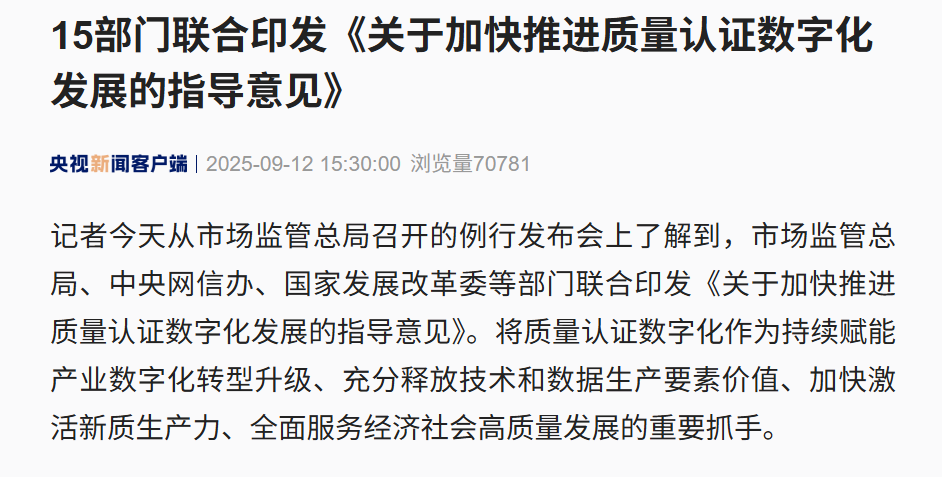
国家市场监督管理总局:利用数字技术赋能质量认证关键环节
Zheng Quan Ri Bao Wang· 2025-09-12 13:16
Group 1 - The core viewpoint of the news is the release of the "Guiding Opinions on Accelerating the Digital Development of Quality Certification" by the State Administration for Market Regulation and the National Development and Reform Commission, aiming to enhance the digital transformation of quality certification by 2030 [1][2] - The guiding opinions outline a goal to gradually improve the top-level institutional design for digital quality certification, establish digital evaluation rules, and explore machine-readable standards in certification [1] - The document emphasizes the importance of digital technology in empowering key aspects of quality certification and encourages certification bodies to integrate digital technology innovations into their processes [2] Group 2 - The guiding opinions identify five key areas for action, including promoting the digital development of certification institutions, supporting digital transformation in key industries, enhancing quality certification for the digital industry, strengthening smart regulation, and building a favorable ecosystem for digital quality certification [1][2] - The document highlights the challenges faced by certification institutions, such as outdated data acquisition methods and insufficient intelligent evaluation capabilities, particularly in emerging sectors like smart manufacturing and digital healthcare [2][3] - The market regulation authority aims to transform traditional quality certification methods through the use of new technologies like blockchain and artificial intelligence, shifting from manual judgment to data-driven approaches and from static certification to dynamic quality services [3]
市场监管总局:加快推进质量认证数字化发展
Zhong Guo Xin Wen Wang· 2025-09-12 12:27
Core Viewpoint - The Chinese government is accelerating the digital transformation of quality certification to support the construction of a digital China and a quality-oriented nation [1][2]. Group 1: Digital Transformation of Quality Certification - The State Administration for Market Regulation (SAMR) has issued guidelines to promote the digital development of the quality certification industry [1]. - The essence of quality certification is to provide quality services and credit proof through objective, fair, and professional technical evaluations [1][2]. - Traditional quality certification systems are facing challenges such as insufficient adaptability, slow response, and difficulties in data sharing, especially in emerging sectors like smart manufacturing and digital healthcare [1][2]. Group 2: Goals and Objectives - The guidelines aim to enhance the digital transformation of quality certification through reforms in institutional design, technical standards, application scenarios, regulatory models, standard systems, and international mutual recognition [2]. - Key objectives for empowering industrial digital upgrades include promoting the transition from traditional manufacturing to smart, green, and precise manufacturing, and supporting sectors like education, healthcare, and financial technology [2]. - For supporting digital industrial development, the focus will be on strengthening certification technology research in key areas, improving the quality certification system for digital infrastructure, and enhancing network and data security [2].
重磅!国家发改委等15部门联合印发!这个行业迎利好
Mei Ri Jing Ji Xin Wen· 2025-09-12 09:27
Core Viewpoint - The joint issuance of the "Guiding Opinions on Accelerating the Digital Development of Quality Certification" by multiple government departments aims to enhance the digital transformation of industries and improve the quality of economic and social development through digital quality certification [1][3]. Group 1: Goals - By 2030, the goal is to gradually improve the top-level institutional design for digital quality certification, establish digital evaluation rules and technical standards, and explore successful cases of certification empowering digital transformation in key industries [3]. - By 2035, the aim is to fully establish a clear and innovative digital quality certification system and implementation framework, accelerating the construction of high-level new quality infrastructure to meet the development needs of various industries [3]. Group 2: Key Tasks - Promote the innovative application of digital technology in quality certification, enabling real-time online collection and analysis of key evidence for certification business, and exploring AI-assisted review models to enhance certification effectiveness and credibility [4]. - Explore digital certification for smart farms, smart pastures, and smart fishing grounds, while increasing the supply of high-standard service certification systems in education, healthcare, elderly care, smart cities, digital communities, and fintech [4]. - Strengthen key technological innovations in certification for digital infrastructure such as operating systems, cloud computing, and data centers, while continuously improving the certification system for cybersecurity, data security, and personal information protection [4]. - Enhance the unified collection, deep mining, and effective utilization of data to enable quality prediction and full-process traceability of certified products, creating a new model for intelligent regulation [4].

重磅!市场监管总局、中央网信办、国家发改委等15部门联合印发!这个行业迎利好
Mei Ri Jing Ji Xin Wen· 2025-09-12 09:17
Core Viewpoint - The article discusses the joint issuance of guidelines by various government departments in China to accelerate the digital development of quality certification, emphasizing its role in empowering industrial digital transformation and enhancing high-quality economic development [1]. Group 1: Goals - By 2030, the aim is to gradually improve the top-level institutional design for quality certification digitalization, establish digital evaluation rules and technical standards, and explore successful cases of certification empowering digital transformation in key industries [3]. - By 2035, the goal is to fully establish a clear and innovative quality certification digital technology system and implementation framework, creating high-level new quality infrastructure that meets the development needs of various industries [3]. Group 2: Key Tasks - Promote the innovative application of digital technology in quality certification, enabling real-time online collection and analysis of key evidence for certification business, and exploring AI-assisted review models to enhance certification effectiveness and credibility [4]. - Explore digital certification for smart farms, smart pastures, and smart fishing grounds, while increasing high-standard service certification in education, healthcare, elderly care, smart cities, digital communities, and fintech [4]. - Strengthen key technological innovations in digital infrastructure certification, including operating systems, cloud computing, and data centers, while continuously improving certification systems in cybersecurity, data security, and personal information protection [4]. - Enhance data collection, deep mining, and effective utilization to enable quality prediction and full-process traceability of certified products, creating a new model for intelligent regulation [4].