Alcoholic Beverages

Search documents
今年优质酱酒联动促消费活动启动
Xin Lang Cai Jing· 2026-02-24 22:23
转自:贵州日报 本报讯(记者 朱登芳)记者从省商务厅获悉,2026年优质酱酒联动促消费活动将延续"酒车""酒菜""酒 商"三大联动核心模式,在参与门槛、权益标准、服务流程等方面进一步优化,切实降低企业成本。 在酒车联动方面,将覆盖个人及民营企业法人消费者,购买7座及以下新车(含新能源及多功能用途货 车)即可参与,购车金额10万元起对应不同购酒权益,最高可平价购买12件(72瓶)优质酱酒。消费者 通过"黔云易购"小程序实名认证预约,购车后3日内上传支付凭证(不低于5000元),30日内补充车辆 登记证书,审核通过后7日内通过"航旅黔购"小程序完成购酒。汽车零售企业可通过云闪付APP申报, 经公示、签约培训后即可参与。 在酒菜联动方面,消费者在活动餐饮企业消费满300元即可平价购买1瓶优质酱酒现场饮用,每增加300 元可多购1瓶,单次上限6瓶,省外指定餐饮企业同步适用该规则。消费者现场确认参与后,通过云闪付 APP支付费用,餐饮企业需在次日12点前上传发票及用酒数量完成核验。 在酒商联动方面,创新采用积分兑换机制,消费者在商场、超市等活动企业消费后,通过银联标准支付 渠道付款可累计积分,30日内满2000分即可兑 ...
Yellowstone Revives Its Back Bar Bottle with Recollection Bourbon
Prnewswire· 2026-02-24 15:00
Yellowstone Revives Its Back Bar Bottle with Recollection Bourbon [Accessibility Statement] Skip NavigationThe legacy American whiskey brand blends a historic design with a contemporary expressionST. LOUIS, Feb. 24, 2026 /PRNewswire/ -- Today, [Yellowstone Bourbon] announced the release of Yellowstone Recollection Bourbon, inspired by the brand's historic back bar decanters seen across saloons and restaurants in the late 1800s. Originally introduced as a Limestone Branch Distillery exclusive, Yellowstone Re ...



开工抢彩头,不如深耕这层商业逻辑
Sou Hu Cai Jing· 2026-02-24 07:33
大家都说正月初八开工要抢彩头,图的是个八方来财的好寓意。但你有没有想过,真正能让生意通四海的,从来不是仪式上的热闹,而是藏在细节里的商业 逻辑重构。那些能在新一年跑通增长的人,早把"策马奔腾"的劲儿用在了找对赛道、盘活资源上。 01 传统的获客逻辑是"我找客户",而AI时代的获客逻辑是"客户找我"。通过AI工具的数据分析,你能精准知道你的客户在什么平台、喜欢看什么内容、什么时 候愿意下单。比如用AI生成符合客户喜好的文案和视频,用AI给客户打标签做分层,用AI自动回复客户的常见问题。 有个酒水行业的老板,去年用AI工具做私域运营,把之前加的3000多个"僵尸粉"重新激活。他用AI给每个客户做了画像,根据客户的购买记录、聊天内容, 把客户分成了"品鉴型""送礼型""收藏型",然后用AI生成不同的内容推送给不同的客户。比如给"送礼型"客户推节日定制礼盒,给"品鉴型"客户推新酒试饮 活动。结果只用了三个月,复购率就从10%涨到了35%。 别让开工仪式,代替了战略思考 刚开工的办公室里,不少人还沉浸在抢红包、放开门炮的热闹里。朋友圈里全是开工大吉的九宫格,配文清一色的"八方来财,万事顺遂"。但热闹过后,该 面对的问题 ...

Scotch export data highlights headaches for distillers
Yahoo Finance· 2026-02-23 09:58
This time six years ago, Scotch whisky was in a pretty good spot. Export shipments in 2019 had ticked up close to the £5bn ($6.75bn) barrier, with the equivalent of 1.3bn bottles sold outside the UK. Shipments to the US – already comfortably Scotch’s most important export destination – hit £1.07bn, despite a 25% slump in the fourth quarter, prompted by the introduction of a 25% import tariff. Only that, plus worrying news about a new respiratory virus emerging in China, took the gloss off the numbers. Ba ...
Market Disruption: Alcohol Giants Lose $830B as Gen Z Pulls Back, While AI “Scare Trade” Rattles Software and Wealth Sectors
Stock Market News· 2026-02-22 02:08
Alcohol Industry - The global alcohol industry has experienced a "structural change," resulting in a loss of $830 billion in market value since 2021, which is a 46% decline from its peak in June 2021 [2][7] - The downturn is particularly significant among Gen Z consumers, with 21.5% of legal-age adults in this group not consuming alcohol at all, and 39% drinking only occasionally [3] - The rise of the "sober curious" movement and the popularity of GLP-1 weight-loss drugs are contributing to this shift, leading major companies like Diageo and Pernod Ricard to see their shares drop to decade lows [3][7] - Non-alcoholic beverage sales have surged by 30% last year, prompting traditional alcohol brands to adapt their long-term business strategies [7] Software and Services Sector - The U.S. software and services sectors have lost approximately $2 trillion in value since October, driven by an "AI Scare Trade" where investors are selling firms perceived as vulnerable to automation [4][7] - Companies like Salesforce, Adobe, and Intuit have seen significant declines in their stock prices, with Salesforce dropping 30% in 2026 and Adobe and Intuit falling 25% and 40% respectively [4][5] - The launch of advanced AI tools has intensified market panic, leading to indiscriminate selloffs in sectors like legal services and insurance brokerage [5] Wealth Management Sector - The wealth management sector has been impacted by the introduction of AI-enabled tools, such as Altruist's "Hazel," causing significant stock declines for firms like Raymond James Financial and Charles Schwab [6][7] - Analysts suggest that the selloff reflects fears of massive fee compression and a permanent shift in market share away from traditional advisors due to AI applications [6] Broader Market Trends - The market sentiment has shifted from "buying AI winners" to "fleeing AI losers," affecting various sectors including private credit and real estate brokerage [7] - Real estate and private credit markets are also facing challenges, with companies like CBRE Group experiencing a 16% drop in valuation as investors question the future of human-led services [8] - Alternative asset managers like Blackstone and KKR have seen declines between 13% and 24% this year due to concerns over their exposure to the struggling software sector [8]


Stocks Set to Open Lower as AI Jitters Linger, Fed Minutes and U.S. Economic Data Awaited
Yahoo Finance· 2026-02-17 11:30
Economic Data - The U.S. consumer prices rose by +0.2% month-over-month in January, which is weaker than the expected +0.3% and marks the smallest gain since July [1] - Year-over-year headline inflation decreased to +2.4% in January from +2.7% in December, also below the expected +2.5% [1] - The core CPI, excluding food and fuel prices, increased by +0.3% month-over-month and +2.5% year-over-year in January, aligning with expectations [1] Market Performance - Wall Street's major equity averages closed mixed, with software stocks like CrowdStrike Holdings rising over +4% and ServiceNow gaining more than +3% [2] - Cryptocurrency-exposed stocks surged after Bitcoin's price rose over +4%, with Coinbase Global jumping over +16% [2] - Applied Materials advanced over +8% after reporting better-than-expected FQ1 results and issuing strong FQ2 guidance [2] - Constellation Brands slumped more than -8% after announcing a CEO succession [2] Federal Reserve Insights - The CPI report is not expected to change the Fed's near-term outlook, with potential for further easing later this year contingent on a convincing decline in inflation [6] - Chicago Fed President indicated that interest rates could be lowered if inflation trends towards the 2% target, but currently, it remains around 3% [6] - U.S. rate futures indicate a 92.2% chance of no rate change and a 7.8% chance of a 25 basis point rate cut at the March Fed meeting [7] Corporate Earnings and Reports - Notable companies reporting earnings this week include Walmart, Palo Alto Networks, and Booking Holdings, among others [11] - Quarterly 13F filings from major investors like Berkshire Hathaway are expected to provide insights into fourth-quarter portfolio changes [11] Global Market Trends - The Euro Stoxx 50 Index is attempting to stabilize after volatility due to AI concerns, with utilities and healthcare stocks advancing [13] - The U.K. unemployment rate rose to 5.2%, and Germany's annual inflation rate increased to 2.1% in January [14] - Japan's Nikkei 225 Index closed lower amid profit-taking and concerns over AI disruption, while Japan's bond market saw increased demand [16][17]
【“春雷”行动】兰州市市场监督管理局曝光酒类商品违法经营典型案例(第六批)
Zhong Guo Zhi Liang Xin Wen Wang· 2026-02-14 04:35
Core Viewpoint - The article emphasizes the importance of regulating the liquor market to ensure product quality and consumer safety, highlighting the enforcement actions taken against businesses violating trademark and food safety laws [2]. Group 1: Regulatory Actions - The Lanzhou market supervision department is intensifying efforts to crack down on illegal liquor sales and ensure compliance with relevant laws [2]. - A total of ten typical cases of trademark infringement and food safety violations have been publicly exposed, showcasing the department's commitment to a "zero tolerance" policy [2]. Group 2: Case Summaries - Case 1: Yuzhong *he Trading Company was fined 50,000 yuan for selling trademark-infringing liquor, including "Flying Moutai" and "Wuliangye" [3]. - Case 2: Qilihe District *Hui Jin Convenience Store was fined 23,919 yuan for selling trademark-infringing "Fenjiu" and other brands [4]. - Case 3: Qilihe District *Ma Convenience Store was fined 7,500 yuan for selling trademark-infringing "Wuliangye" [5]. - Case 4: Chengguan District *Li Comprehensive Store was fined 7,380 yuan for selling trademark-infringing "Wuliangye" [6]. - Case 5: Qilihe District *Pin Tobacco and Alcohol Retail Store was fined 5,148 yuan for selling trademark-infringing "Rouhe Jinhui" [6]. - Case 6: Qilihe District *Duhao Convenience Store was fined 3,408 yuan for selling trademark-infringing "Jianan Chun" [6]. - Case 7: Gaolan *Ge Convenience Store was fined 2,088 yuan for selling trademark-infringing "Fenjiu" [6]. - Case 8: Gansu *Xiong Trading Company was fined 6,080 yuan for selling "Tianchi Huangjiu" with incorrect alcohol content labeling [7]. - Case 9: Chengguan District *Jiang Liquor Business was fined 5,080 yuan for selling "Shuanggou Daqu" with incorrect alcohol content labeling [7]. - Case 10: Chengguan District *Tan Liquor Store was fined 2,285 yuan for selling bulk liquor that did not meet food safety standards [7].
白酒稳基盘、低度酒寻增量:中国酒类市场的结构分化与投资机会
QYResearch· 2026-02-14 00:48
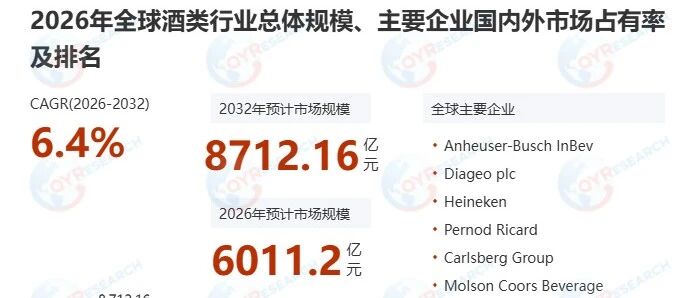
Core Insights - The Chinese alcoholic beverage market is projected to reach USD 254.1 billion by 2032, with a CAGR of 6.63% during the forecast period [2] - The market is highly concentrated, with baijiu (Chinese liquor) expected to account for 78.57% of revenue by 2025, significantly higher than beer (11.22%) and other categories [2] Market Structure - Baijiu dominates the market, while beer is experiencing a shift towards premiumization and craft options, and low-alcohol/no-alcohol products are gaining traction among new consumer demographics [2] - The structure indicates that the base of the market is determined by baijiu, but growth and structural changes are driven by the premiumization of beer and the penetration of low-alcohol products [2] Technical Features and Product Classification - The alcoholic beverage industry is characterized by a combination of raw material systems, fermentation/distillation processes, aging systems, blending capabilities, and packaging/channel adaptation, which ultimately contribute to brand premium and price segmentation [5] - Baijiu is defined by solid-state fermentation and aging techniques, leading to high margins and strong brand characteristics, but also slower capacity ramp-up and sensitivity to inventory and pricing [5] - Beer is the most industrialized, focusing on scale and channel efficiency, with recent competition shifting towards high-end and craft products [5] Competitive Landscape - The Chinese market shows a concentration in baijiu, with leading companies like Kweichow Moutai and Wuliangye dominating the high-end segment, while regional players seek growth through local market penetration [7] - The beer market is characterized by competition among major players like Tsingtao Brewery and China Resources Snow Breweries, focusing on product upgrades and channel penetration [8] - The wine and yellow wine markets are smaller, where brand and channel efficiency are more critical than scale [9] Future Trends and Challenges - Over the next 3-5 years, the market is expected to stabilize with baijiu, while beer will focus on premiumization and low-alcohol/no-alcohol products will drive growth [17] - Challenges include consumer segmentation, price pressure, raw material cost fluctuations, and stricter regulatory requirements [20]
场景消费崛起,酒企真“读懂”消费者了?
Sou Hu Cai Jing· 2026-02-12 08:40
Core Insights - The Chinese liquor industry is undergoing a structural transformation, with traditional consumption scenarios declining while new, fragmented, and emotional consumption scenes are emerging [1][7] - The shift from "selling liquor" to "selling scenarios" is becoming the core competitive strategy for liquor companies, focusing on integrating liquor into consumers' daily lives [2][7] Group 1: Traditional vs. New Consumption Scenarios - Traditional consumption settings such as wedding banquets and business dinners are diminishing, leading to a rise in personal drinking, small gatherings, and cultural experiences [1] - Companies are encouraged to proactively build new consumption ecosystems rather than lamenting the loss of traditional banquet scenes [1] Group 2: Innovative Marketing Strategies - Li Du has pioneered a three-tiered scene marketing system that enhances consumer engagement through sensory experiences and cultural recognition [2] - Zhen Jiu has effectively integrated liquor into daily dining experiences through customized food and drink pairings, transitioning from concept to practical application [2] Group 3: Broader Industry Trends - Other alcoholic beverages, such as beer and fruit wine, are also innovating in consumption scenarios, with Qingdao Beer focusing on quality moments rather than quantity [5] - The rise of experiential and lightweight drinking options is appealing to younger consumers, with social media playing a significant role in promoting mixed drinks and unique recipes [5] Group 4: Challenges in Scene Consumption - Many so-called "scenes" lack genuine user insights, leading to ineffective marketing strategies that do not address real consumer needs [8] - There is a significant issue of scene homogenization, with many brands offering similar experiences, which can lead to consumer fatigue [10] - The traditional liquor industry faces challenges in adapting to younger, more casual drinking scenarios due to its cultural baggage and higher consumption thresholds [10] Group 5: Sustainability and Long-term Value - The sustainability of scene marketing is questioned, as many brands frequently change themes without building lasting brand assets [10][11] - The current focus on sales rather than long-term consumer relationships may hinder the depth of consumer experiences [13] - Data capabilities are lacking in many companies, limiting their ability to optimize scene operations based on consumer behavior [13] Group 6: Future Outlook - The rise of scene consumption signifies a paradigm shift from a product-centered approach to a user-centered approach in the liquor industry [14] - The future winners will be brands that understand consumer emotions and provide value at the right time and place [14]