Workflow
乘用车
icon
Search documents
崔东树:2025年9月乘用车市场价格段跟踪
智通财经网· 2025-10-18 08:16
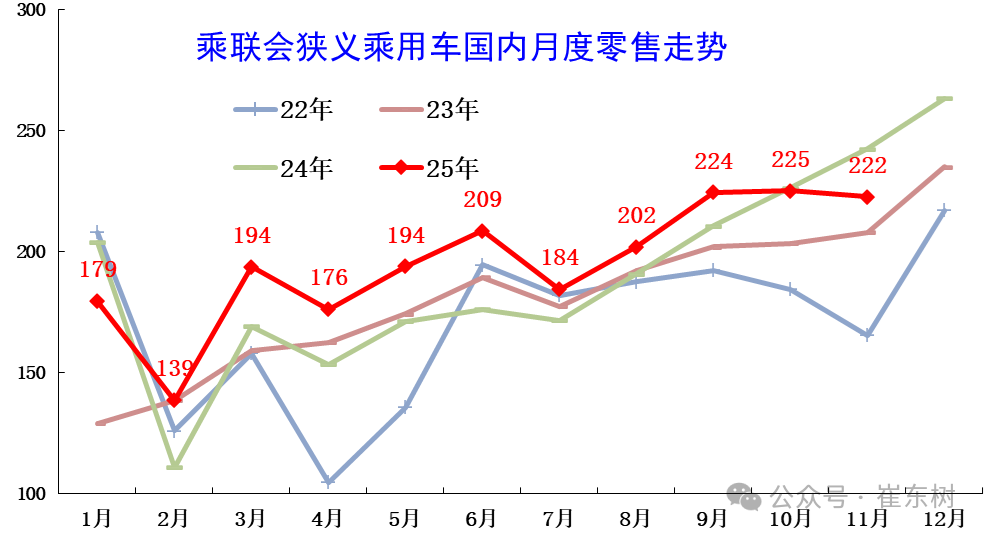
Core Insights - The passenger car market in September 2025 showed strong growth of 6% despite a high base, with the market for cars priced below 150,000 yuan being particularly active, while high-end range-extended and plug-in hybrid models performed weakly [1][4] - The average price of passenger cars in the first nine months of 2025 was 170,000 yuan, a decrease of 7,000 yuan compared to 2024, with a notable drop in the average price of new energy vehicles [1][4] - The upcoming expiration of the vehicle purchase tax exemption policy is expected to further stimulate the new energy vehicle market, leading to potential promotional activities by manufacturers to meet annual sales targets [1][4] Price Trends - The average retail price of passenger cars has been on a continuous upward trend from 151,000 yuan in 2019 to 183,000 yuan in 2023, but has seen a decline to 177,000 yuan in 2024 and 170,000 yuan in the first nine months of 2025 [4][5] - The average price of new energy vehicles has decreased significantly from 184,000 yuan in 2023 to 160,000 yuan in 2025, indicating a vibrant consumer market for these vehicles [1][4] Market Structure - The market structure has shifted, with a notable increase in the sales of entry-level electric vehicles, while the share of high-end traditional vehicles has declined [1][9] - The market share of vehicles priced above 150,000 yuan has decreased, particularly in the 200,000-300,000 yuan segment, which fell from 17% in 2024 to 16% in 2025 [9][10] Sales Volume by Price Segment - The sales volume in the low-end market (below 150,000 yuan) has increased, reflecting a broader consumer base entering the market, which is beneficial for overall market growth [6][9] - The penetration rate of new energy vehicles in the microcar segment reached 100%, with A0-class small cars at 80% and A-class vehicles at 44% [11][12] New Energy Vehicle Structure - The penetration rate of new energy vehicles reached 57.8% in September 2025, with a strong contribution expected in the coming months [14] - The growth of pure electric vehicles continues to outpace that of plug-in hybrids, with traditional passenger vehicles facing ongoing sales pressure [13][14]
乘用车板块10月17日跌3.26%,长安汽车领跌,主力资金净流出44.29亿元
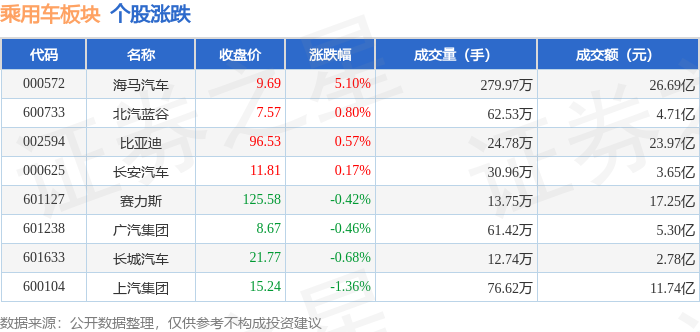
Market Overview - The passenger car sector experienced a decline of 3.26% on October 17, with Changan Automobile leading the drop [1] - The Shanghai Composite Index closed at 3839.76, down 1.95%, while the Shenzhen Component Index closed at 12688.94, down 3.04% [1] Individual Stock Performance - BYD closed at 104.43, down 2.37% with a trading volume of 625,700 shares and a transaction value of 6.577 billion [1] - SAIC Motor closed at 16.35, down 2.62% with a trading volume of 482,300 shares and a transaction value of 797.4 million [1] - Great Wall Motors closed at 22.85, down 3.26% with a trading volume of 221,800 shares and a transaction value of 512 million [1] - GAC Group closed at 7.71, down 3.38% with a trading volume of 582,900 shares and a transaction value of 455 million [1] - Seres closed at 155.08, down 3.41% with a trading volume of 279,700 shares and a transaction value of 439.3 million [1] - Haima Automobile closed at 6.83, down 4.34% with a trading volume of 3,669,200 shares and a transaction value of 2.608 billion [1] - BAIC Blue Valley closed at 7.65, down 4.85% with a trading volume of 1,522,500 shares and a transaction value of 1.182 billion [1] - Changan Automobile closed at 12.48, down 6.38% with a trading volume of 3,702,000 shares and a transaction value of 4.711 billion [1] Capital Flow Analysis - The passenger car sector saw a net outflow of 4.429 billion from main funds, while retail investors contributed a net inflow of 3.054 billion [1] - The following stocks had significant capital flow changes: - Great Wall Motors: Main funds net outflow of 4.2565 million, retail net inflow of 16.4935 million [2] - GAC Group: Main funds net outflow of 22.7288 million, retail net inflow of 28.0403 million [2] - SAIC Motor: Main funds net outflow of 79.6867 million, retail net inflow of 70.8389 million [2] - BAIC Blue Valley: Main funds net outflow of 13.47 million, retail net inflow of 80.4870 million [2] - Haima Automobile: Main funds net outflow of 2.35 billion, retail net inflow of 179 million [2] - Seres: Main funds net outflow of 7.701 billion, retail net inflow of 5.01 billion [2] - Changan Automobile: Main funds net outflow of 12.13 billion, retail net inflow of 869 million [2] - BYD: Main funds net outflow of 19.70 billion, retail net inflow of 134.1 million [2]
上汽集团跌2.03%,成交额5.25亿元,主力资金净流出7424.87万元
Xin Lang Cai Jing· 2025-10-17 06:15
Core Viewpoint - SAIC Motor Corporation Limited has experienced a decline in stock price and significant net outflow of funds, indicating potential challenges in the market [1][2]. Financial Performance - For the first half of 2025, SAIC Motor reported revenue of 299.59 billion yuan, a year-on-year increase of 5.23% [2]. - The net profit attributable to shareholders was 6.018 billion yuan, reflecting a year-on-year decrease of 9.21% [2]. Stock Market Activity - As of October 17, SAIC Motor's stock price was 16.45 yuan per share, down 2.03% during the trading session, with a total market capitalization of approximately 189.1 billion yuan [1]. - The stock has declined by 20.43% year-to-date, with a 3.97% drop over the last five trading days and a 13.28% drop over the last 20 days [1]. Shareholder Information - As of June 30, 2025, the number of shareholders was 163,800, a decrease of 23.10% from the previous period [2]. - The average number of circulating shares per shareholder increased by 30.04% to 70,672 shares [2]. Dividend Distribution - Since its A-share listing, SAIC Motor has distributed a total of 150.94 billion yuan in dividends, with 9.11 billion yuan distributed over the last three years [3]. Institutional Holdings - As of June 30, 2025, Hong Kong Central Clearing Limited was the fifth-largest circulating shareholder, holding 344 million shares, an increase of 10.3 million shares from the previous period [3]. - Huatai-PB CSI 300 ETF was the tenth-largest circulating shareholder, holding 82.24 million shares, an increase of 6.43 million shares [3].
国泰海通:9月乘用车零售价格回升 行业价格竞争相对温和
智通财经网· 2025-10-17 03:41
Core Viewpoint - The passenger car industry is experiencing a price rebound, indicating an improvement in supply and demand dynamics, with a stable pricing policy during the traditional consumption peak season of "Golden September and Silver October" [1] Group 1: Price Trends - In September 2025, the average retail price of domestic passenger cars was 176,000 yuan, reflecting a year-on-year increase of 6.8% and a month-on-month increase of 3.6% [2] - The average price reduction for domestic passenger cars compared to early 2023 was 20.1%, with the number of discounted car models increasing by 2 in September [1] Group 2: Vehicle Type Analysis - The average retail price for fuel vehicles in September was 178,000 yuan, with a year-on-year increase of 4.2% and a month-on-month increase of 4.4% [3] - The average retail price for pure electric vehicles was 161,000 yuan, showing a year-on-year increase of 10.0% and a month-on-month increase of 1.1% [3] - The average retail price for plug-in hybrid and extended-range vehicles was 199,000 yuan, with a year-on-year increase of 16.9% and a month-on-month increase of 6.2% [3] Group 3: Industry Outlook - The improvement in retail prices is attributed to the introduction of high-end new energy models and the positive impact of reduced competition due to the "anti-involution" trend [3] - The company expects that the gross profit margin for new car business among dealers will likely improve, especially for leading dealers, as the market dynamics continue to stabilize [1]
广汽集团跌2.01%,成交额1.07亿元,主力资金净流出1574.42万元
Xin Lang Cai Jing· 2025-10-17 02:04
Core Viewpoint - GAC Group's stock has experienced a decline of 16.09% year-to-date, with a recent drop of 2.01% on October 17, 2023, indicating potential challenges in the automotive sector [1][2]. Financial Performance - For the first half of 2025, GAC Group reported a revenue of 42.611 billion yuan, a year-on-year decrease of 7.88%, and a net profit attributable to shareholders of -2.538 billion yuan, reflecting a significant decline of 267.39% [2]. - Cumulative cash dividends since the A-share listing amount to 25.639 billion yuan, with 3.974 billion yuan distributed over the last three years [3]. Stock Market Activity - As of October 17, 2023, GAC Group's stock price was 7.82 yuan per share, with a market capitalization of 79.741 billion yuan [1]. - The stock has seen a trading volume of 1.07 billion yuan and a turnover rate of 0.18% on the same day [1]. - The stock's recent performance includes a 2.36% increase over the last five trading days and a 0.64% increase over the last 20 days [1]. Shareholder Information - As of June 30, 2025, GAC Group had 135,800 shareholders, an increase of 1.03% from the previous period [2]. - The top ten circulating shareholders include significant institutional investors, with Hong Kong Central Clearing Limited holding 120 million shares, an increase of 19.8711 million shares [3].
降价减少、促销平缓 9月乘用车市场格局微变
Mei Ri Jing Ji Xin Wen· 2025-10-16 14:01
Core Insights - The Chinese automotive market experienced both month-on-month and year-on-year growth in September 2025, with retail sales reaching 2.241 million units, a 6.3% increase year-on-year and an 11.0% increase month-on-month [1] - The trend of "decreasing price competition and stable promotions" is emerging in the market, leading to a more stable automotive environment [1] - Domestic brands continue to outperform, while joint venture brands face challenges, with only a few exceptions showing positive performance [1] Domestic Brands Performance - In September, domestic brands achieved retail sales of 1.5 million units, marking a 13% year-on-year increase and a 12.9% month-on-month increase, capturing 66.9% of the domestic retail market share, up 3.6 percentage points year-on-year [2] - The penetration rate of new energy vehicles (NEVs) among domestic brands reached 78.1%, solidifying their position as a sales driver [2] - BYD remains a leader among domestic brands, although it experienced its first year-on-year decline in sales since March 2024, with September sales at 396,200 units, down 5.52% [2] Key Competitors in Domestic Market - Geely and Chery are actively increasing their market share in the NEV sector, with Geely reporting sales of 273,100 units in September, a 35.24% year-on-year increase [3] - Chery, which recently listed on the Hong Kong Stock Exchange, achieved sales of 255,600 units in September, up 8.90% year-on-year [3] - Other domestic brands like Changan and Great Wall also reported significant growth, with Changan's sales at 266,300 units (up 24.92% year-on-year) and Great Wall's at over 133,600 units (up 23.29% year-on-year) [3] Joint Venture Brands Performance - Joint venture brands saw a month-on-month sales increase but faced year-on-year declines, with mainstream joint venture brands retailing 490,000 units in September, down 6% year-on-year [4] - Luxury brands also experienced a year-on-year decline, with sales of 240,000 units in September, down 1% year-on-year [4] - Volkswagen's joint ventures showed mixed results, with SAIC Volkswagen achieving a record high of 94,100 units sold, while FAW-Volkswagen faced a similar decline as other mainstream joint ventures [4] Performance of Foreign Brands - Japanese brands held an 11.6% market share in September, down 1.1 percentage points year-on-year, with mixed performances among different brands [5] - American brands saw a slight increase in market share to 5.8%, with SAIC General reporting a remarkable year-on-year sales increase of over 124% [5]
中汽协:9月乘用车产销分别完成290万辆和285.9万辆 环比分别增长16%和12.5%
智通财经网· 2025-10-16 09:20
Core Insights - The Chinese automotive industry is experiencing significant growth in both production and sales of passenger vehicles, with a notable increase in exports and domestic sales in September 2025 compared to previous months and the same period last year [1][5][6]. Production and Sales Performance - In September 2025, the production and sales of passenger vehicles reached 2.9 million and 2.859 million units respectively, marking a month-on-month increase of 16% and 12.5%, and a year-on-year increase of 15.9% and 13.2% [1]. - From January to September 2025, the production and sales totaled 21.241 million and 21.246 million units, reflecting a year-on-year growth of 13.9% and 13.7% [1]. Vehicle Types and Trends - In September 2025, among the main types of passenger vehicles, the production of crossover vehicles slightly decreased while their sales saw a minor increase; other three major categories experienced double-digit growth [4]. - For the period of January to September 2025, all four major categories of passenger vehicles showed varying degrees of growth compared to the same period last year, with crossover vehicles exhibiting the most significant growth [4]. Export Performance - In September 2025, passenger vehicle exports reached 560,000 units, representing a month-on-month increase of 5% and a year-on-year increase of 22.4% [5]. - From January to September 2025, total passenger vehicle exports amounted to 4.201 million units, showing a year-on-year growth of 15.6% [5]. Domestic Sales - In September 2025, domestic sales of passenger vehicles were 2.299 million units, with a month-on-month increase of 14.5% and a year-on-year increase of 11.2% [6]. - For the first nine months of 2025, domestic sales totaled 17.044 million units, reflecting a year-on-year growth of 13.3% [6].
乘用车板块10月16日涨0.36%,海马汽车领涨,主力资金净流入15.16亿元
Market Overview - The passenger car sector increased by 0.36% compared to the previous trading day, with Haima Automobile leading the gains [1] - The Shanghai Composite Index closed at 3916.23, up 0.1%, while the Shenzhen Component Index closed at 13086.41, down 0.25% [1] Stock Performance - Notable stock performances include: - China Chengtong (000572) rose by 10.02% to a closing price of 7.14 [1] - Changan Automobile (000625) increased by 3.82% to 13.33 [1] - BAIC BluePark (600733) gained 2.16% to 8.04 [1] - BYD (002594) decreased by 0.13% to 106.96 [1] - GAC Group (601238) fell by 1.36% to 7.98 [1] Capital Flow - The passenger car sector saw a net inflow of 1.516 billion yuan from main funds, while retail funds experienced a net outflow of 794 million yuan and 722 million yuan respectively [1] - Key capital flows for individual stocks include: - Changan Automobile had a net inflow of 1.109 billion yuan from main funds, with a net outflow of 588 million yuan from retail funds [2] - BAIC BluePark experienced a net inflow of 199 million yuan from main funds, with a net outflow of 101 million yuan from retail funds [2] - BYD had a net inflow of 87.44 million yuan from main funds, while retail funds saw a net outflow of 90.51 million yuan [2]
长城汽车涨2.03%,成交额2.18亿元,主力资金净流入661.18万元
Xin Lang Cai Jing· 2025-10-16 02:43
Core Viewpoint - Great Wall Motors' stock price has experienced fluctuations, with a year-to-date decline of 6.84% and a recent increase in trading activity, indicating potential investor interest amidst mixed performance metrics [1][2]. Financial Performance - For the first half of 2025, Great Wall Motors reported a revenue of 923.35 billion yuan, reflecting a year-on-year growth of 0.99%. However, the net profit attributable to shareholders decreased by 10.48% to 63.37 billion yuan [2]. - Cumulatively, since its A-share listing, the company has distributed a total of 346.96 billion yuan in dividends, with 89.50 billion yuan distributed over the past three years [3]. Stock Market Activity - As of October 16, Great Wall Motors' stock price was 24.11 yuan per share, with a trading volume of 2.18 billion yuan and a market capitalization of 206.33 billion yuan [1]. - The stock has seen a net inflow of 661.18 million yuan from major funds, with significant buying activity from large orders [1]. Shareholder Structure - As of June 30, 2025, Great Wall Motors had 178,500 shareholders, an increase of 18.73% from the previous period. The average circulating shares per person remained at zero [2]. - Among the top ten circulating shareholders, China Securities Finance Corporation holds 197 million shares, while Hong Kong Central Clearing Limited has reduced its holdings by 1.94 million shares [3].
乘用车板块10月15日涨1.61%,海马汽车领涨,主力资金净流入12.6亿元
Core Viewpoint - The passenger car sector experienced a rise of 1.61% on October 15, with Haima Automobile leading the gains, while the Shanghai Composite Index closed at 3912.21, up 1.22% [1] Group 1: Market Performance - The passenger car sector's individual stock performance showed significant increases, with notable gainers including: - Haima Automobile (10.00% increase, closing at 6.49) - GAC Group (7.44% increase, closing at 60.8) - Changan Automobile (2.39% increase, closing at 12.84) [1] - The overall trading volume for the passenger car sector was substantial, with Changan Automobile recording a transaction volume of 2.51 million shares and a transaction value of 3.208 billion [1] Group 2: Capital Flow - The passenger car sector saw a net inflow of 1.26 billion from main funds, while retail investors experienced a net outflow of 810 million [1] - Individual stock capital flows indicated: - Changan Automobile had a main fund net inflow of 651 million, while retail investors had a net outflow of 386 million [2] - BYD experienced a main fund net inflow of 245 million, with a retail net outflow of 158 million [2] - Haima Automobile had a main fund net inflow of 238 million, with retail investors seeing a net outflow of 116 million [2]