
养殖业

Search documents
湘佳股份:12月12日召开董事会会议
Mei Ri Jing Ji Xin Wen· 2025-12-12 09:35
Company Overview - Xiangjia Co., Ltd. (SZ 002982) announced on December 12, 2025, that its 19th meeting of the fifth board of directors was held, where it reviewed the proposal for applying for comprehensive credit from banks [1] - As of the report date, Xiangjia's market capitalization is 2.8 billion yuan [1] Financial Performance - For the first half of 2025, Xiangjia's revenue composition is entirely from the aquaculture industry, accounting for 100% [1]

农林牧渔行业双周报(2025、11、28-2025、12、11):生猪价格有所回升-20251212
Dongguan Securities· 2025-12-12 08:40
Investment Rating - The report maintains an "Overweight" rating for the agriculture, forestry, animal husbandry, and fishery industry [1][51]. Core Insights - Recent recovery in pig prices is noted, with expectations for continued price increases as the seasonal consumption peak approaches. The inventory of breeding sows remains relatively high, indicating significant potential for capacity reduction [51]. - The report highlights investment opportunities in leading pig farming companies due to expected capacity reduction and improving profitability margins in chicken farming [51]. - The report emphasizes the importance of strong R&D capabilities in animal health companies and the long-term growth potential of domestic pet food leaders [51]. Industry Performance Overview - The SW agriculture, forestry, animal husbandry, and fishery industry underperformed the CSI 300 index, declining by 0.92% from November 28 to December 11, 2025, lagging behind the index by approximately 1.73 percentage points [12]. - Among the sub-sectors, only animal health and planting recorded positive returns, increasing by 1.96% and 1.18%, respectively, while other sectors such as agricultural product processing, feed, breeding, and fishery experienced declines of 1.01%, 1.5%, 3.03%, and 3.76% [15][18]. - Approximately 68% of stocks in the industry recorded negative returns during the same period, with over 60% of stocks showing losses [16][18]. Valuation Metrics - As of December 11, 2025, the overall price-to-book (PB) ratio for the SW agriculture, forestry, animal husbandry, and fishery industry is approximately 2.75 times, reflecting a recent decline in valuation. This level is around 61.8% of the historical median since 2006, indicating a relatively low historical valuation [19]. Key Industry Data - **Pig Farming**: The average price of external three yuan pigs rose from 11.28 CNY/kg to 11.45 CNY/kg during the reporting period. However, self-breeding pig farming continues to incur losses, with profits at -163.34 CNY per head, while purchased pig farming shows a loss of -240.69 CNY per head [23][28]. - **Poultry Farming**: The average price of broiler chicks increased slightly to 3.54 CNY per chick, while the average price of white feather broilers rose to 7.33 CNY/kg, with losses of -0.71 CNY per bird [30][33]. Company Highlights - The report suggests focusing on key companies such as Muyuan Foods (002714), Wens Foodstuff Group (300498), and Shengnong Development (002299) due to their market leadership and potential for recovery [51][52].


20股获推荐,温氏股份、泰和新材目标价涨幅超30%丨券商评级观察
2 1 Shi Ji Jing Ji Bao Dao· 2025-12-12 01:05
Core Insights - The article highlights the target price increases for several listed companies as recommended by brokerages, with notable gains in specific sectors [1] Group 1: Target Price Increases - The companies with the highest target price increases include Wen's Foodstuffs Group with a rise of 35.97%, Taihe New Materials with 30.43%, and Yuheng Pharmaceutical with 17.04% [1] - These companies belong to the aquaculture, chemical fiber, and pharmaceutical industries respectively [1] Group 2: Brokerage Recommendations - On December 11, a total of 20 listed companies received recommendations from brokerages, including Yuheng Pharmaceutical, Huayang Co., and Taihe New Materials, each receiving one recommendation [1]


养殖业板块12月11日跌0.57%,民和股份领跌,主力资金净流出1.86亿元
Zheng Xing Xing Ye Ri Bao· 2025-12-11 09:01
从资金流向上来看,当日养殖业板块主力资金净流出1.86亿元,游资资金净流入5782.23万元,散户资金 净流入1.28亿元。养殖业板块个股资金流向见下表: 以上内容为证券之星据公开信息整理,由AI算法生成(网信算备310104345710301240019号),不构成投资建议。 证券之星消息,12月11日养殖业板块较上一交易日下跌0.57%,民和股份领跌。当日上证指数报收于 3873.32,下跌0.7%。深证成指报收于13147.39,下跌1.27%。养殖业板块个股涨跌见下表: ...


养殖业板块12月10日涨0.62%,罗牛山领涨,主力资金净流入1.77亿元
Zheng Xing Xing Ye Ri Bao· 2025-12-10 09:04
证券之星消息,12月10日养殖业板块较上一交易日上涨0.62%,罗 牛 山领涨。当日上证指数报收于 3900.5,下跌0.23%。深证成指报收于13316.42,上涨0.29%。养殖业板块个股涨跌见下表: 从资金流向上来看,当日养殖业板块主力资金净流入1.77亿元,游资资金净流出1.22亿元,散户资金净 流出5499.75万元。养殖业板块个股资金流向见下表: 以上内容为证券之星据公开信息整理,由AI算法生成(网信算备310104345710301240019号),不构成投资建议。 ...

养殖业板块12月9日跌1.2%,罗牛山领跌,主力资金净流出1.85亿元
Zheng Xing Xing Ye Ri Bao· 2025-12-09 09:05
证券之星消息,12月9日养殖业板块较上一交易日下跌1.2%,罗 牛 山领跌。当日上证指数报收于 3909.52,下跌0.37%。深证成指报收于13277.36,下跌0.39%。养殖业板块个股涨跌见下表: 以上内容为证券之星据公开信息整理,由AI算法生成(网信算备310104345710301240019号),不构成投资建议。 从资金流向上来看,当日养殖业板块主力资金净流出1.85亿元,游资资金净流入1.37亿元,散户资金净 流入4798.47万元。养殖业板块个股资金流向见下表: ...
三方能繁延续去化,供应压力猪价调整
CAITONG SECURITIES· 2025-12-08 11:12
Core Insights - The report maintains a positive outlook on the agricultural sector, particularly in the livestock and pet industries, while highlighting ongoing challenges in pig farming due to supply pressures and price adjustments [2][5][9]. Livestock Industry Overview - Pig farming is experiencing downward price adjustments due to increased supply from smallholders and insufficient demand for cured products, leading to a supply-demand struggle [9][18]. - The number of breeding sows decreased by 0.38% in November, indicating a potential acceleration in capacity reduction [21][9]. - As of December 4, the average price for market pigs was 11.30 CNY/kg, reflecting a week-on-week decline of 1.57% [32][33]. - The profitability of pig farming remains negative, with losses of 167.69 CNY per head for self-bred pigs and 259.39 CNY per head for purchased piglets reported [39][42]. Poultry Industry Insights - The poultry sector is seeing a rise in white chicken prices, with an average price of 7.27 CNY/kg as of December 5, up 1.11% week-on-week [40][44]. - The ongoing outbreaks of avian influenza in overseas markets are expected to benefit the white feather chicken industry in the medium to long term [40][41]. Animal Health Sector - The animal health industry is under pressure due to a decline in demand linked to the overall losses in pig farming, with significant year-on-year decreases in vaccine approvals [50]. - However, the development of new vaccines, including progress in African swine fever vaccine trials, may provide a boost to the sector [50]. Seed Industry Trends - The prices of key agricultural commodities such as wheat, corn, and soybean have shown slight increases, with wheat prices at 2515 CNY/ton, corn at 2357 CNY/ton, and soybean meal at 3111 CNY/ton as of December 5 [53][55]. - The USDA's November report indicates a decrease in global corn and soybean stocks, which may impact future pricing and availability [54][57]. Pet Industry Developments - The pet food export market faced a decline, with October exports amounting to 772 million CNY, down 15.9% year-on-year [58][60]. - Domestic sales of pet food are growing rapidly, with e-commerce sales in October increasing by 19% year-on-year, driven by strong performances from local brands [61][62]. - The Double Eleven shopping festival saw significant sales growth for domestic pet brands, indicating a shift towards local products in the market [62].


养殖业板块12月8日跌0.26%,华英农业领跌,主力资金净流出1.06亿元
Zheng Xing Xing Ye Ri Bao· 2025-12-08 09:01
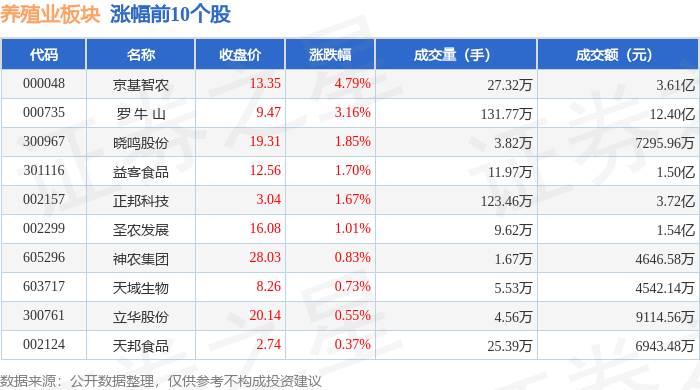
Group 1 - The aquaculture sector experienced a decline of 0.26% on December 8, with Huaying Agriculture leading the drop [1] - The Shanghai Composite Index closed at 3924.08, up 0.54%, while the Shenzhen Component Index closed at 13329.99, up 1.39% [1] - Key stocks in the aquaculture sector showed varied performance, with Jingji Zhino rising by 4.79% to 13.35 and Huaying Agriculture falling by 4.38% to 2.62 [2] Group 2 - The net outflow of main funds in the aquaculture sector was 106 million yuan, while speculative funds saw a net inflow of 151 million yuan [2] - Retail investors experienced a net outflow of 44.86 million yuan [2] - The detailed fund flow for key stocks indicates that Zhengbang Technology had a net inflow of 66.93 million yuan from main funds, while Huaying Agriculture saw a net outflow of 12.83 million yuan from speculative funds [3]



生猪均重持续提升,看好旺季牛价上涨
SINOLINK SECURITIES· 2025-12-07 12:27
Investment Rating - The report does not explicitly state an investment rating for the agricultural sector, but it implies a cautious outlook due to ongoing challenges in various sub-sectors [61]. Core Insights - The agricultural sector is currently facing a downturn, with the agricultural index declining by 1.49% week-on-week, underperforming compared to major indices like the Shanghai Composite [13][14]. - The pig farming industry is experiencing significant losses, with prices expected to continue declining in the short term, although there is potential for recovery in the medium to long term due to capacity reduction and policy support [3][20]. - Poultry farming shows signs of stabilization, particularly in yellow feathered chicken prices, driven by improved demand and supply contraction, while white feathered chicken prices remain under pressure [4][28]. - The beef and dairy sectors are also under pressure, with beef prices expected to rise as the market enters a consumption peak, while dairy prices are stabilizing after a period of decline [5][36]. - The planting sector is witnessing fluctuations in grain prices, with corn prices showing slight increases amid tight supply conditions, and potential improvements expected if crop yields decline significantly [6][41]. Summary by Sections 1. Swine Farming - The average price of live pigs is currently at 11.20 CNY/kg, with a slight week-on-week increase of 0.09% [19]. - The average weight of pigs at slaughter is 129.82 kg, indicating a slight increase, but the industry remains in a state of loss with negative profit margins for both purchased and self-bred pigs [20][19]. - The report suggests focusing on low-cost, high-quality enterprises like Muyuan Foods and Wens Foodstuff Group for potential investment opportunities [3][20]. 2. Poultry Farming - The average price for white feathered chickens is 7.27 CNY/kg, reflecting a week-on-week increase of 1.11% [28]. - The profitability of parent stock and broiler chickens has shown improvement, although overall profits remain under pressure due to high supply levels [28]. - The report recommends monitoring companies like Lihua Agricultural and Shennong Group for potential investment as the market stabilizes [4][28]. 3. Livestock - Live cattle prices in Shandong are at 26.71 CNY/kg, with a year-on-year increase of 13.18% [5][36]. - The dairy sector is seeing a recovery in raw milk prices, with average procurement prices at 3.02 CNY/kg, indicating a potential stabilization in the market [5][36]. - The report highlights the potential for a new beef cycle and suggests focusing on companies like Yurun Group and Modern Dairy for investment [5][36]. 4. Planting Sector - Corn prices are currently at 2228.57 CNY/ton, with a slight increase of 0.45% week-on-week, while soybean prices remain stable [41]. - The report notes that external uncertainties and weather disruptions could lead to reduced crop yields, which may improve the planting sector's outlook [6][41]. - Companies involved in seed production, such as Longping High-Tech, are recommended for monitoring as the sector seeks to enhance productivity [6][41]. 5. Feed and Aquaculture - Feed prices have stabilized, with pig feed at 3.32 CNY/kg and poultry feed remaining unchanged [50]. - Aquaculture prices are showing positive trends, particularly for shrimp and fish products, indicating a potential recovery in this segment [50].
鲁担惠农贷赋能东平养殖产业 富华养殖场实现生态养殖良性循环
Qi Lu Wan Bao· 2025-12-05 15:39
Core Insights - The article highlights the transformative impact of the "鲁担惠农贷" (Lüdan Huinong Loan) on the development of the Dongping Fuhua Breeding Farm, enabling it to grow from a small-scale operation to a significant player in the poultry industry [1][4] Group 1: Financial Support and Growth - The farm faced a "funding bottleneck" during its initial stages, requiring substantial investment for expansion and modernization [1] - The "鲁担惠农贷" provided a solution with a low-threshold guarantee model, allowing the farm to secure a total of 6 million yuan in loans over two years, which alleviated financial pressures [2] - With the financial backing, the farm established a mature batch production system, capable of raising 500,000 chickens per batch and completing four to five batches annually, leading to a sustainable development cycle [2] Group 2: Operational Excellence and Innovation - The farm operates under a registered capital of 5 million yuan and total assets nearing 50 million yuan, adhering to principles of integrity, cooperation, innovation, and standardization [3] - It collaborates with Lihua Company using a "company + cooperative + farmer" model, enhancing income for surrounding farmers and introducing various high-quality poultry breeds [3] - The farm has achieved automation and smart farming, with all operations from feeding to ventilation managed through a single control system, and has invested 5 million yuan in environmental upgrades, achieving a 100% resource utilization rate for waste [3] Group 3: Future Aspirations - The farm aims to adopt modern, high-tech agricultural standards while ensuring food safety, with plans to expand into integrated ecological farming and organic fertilizer production [4] - The evolution of the Dongping Fuhua Breeding Farm exemplifies how targeted financial support can empower agricultural entrepreneurs and drive high-quality development in local specialty farming [4]