保险资管

Search documents
保险资管机构加速布局“保险版ABS”
Zheng Quan Ri Bao· 2025-08-08 07:26
Core Viewpoint - The progress of asset-backed plan business by insurance asset management institutions is accelerating, with a significant increase in the number and scale of registered plans in 2023 compared to the previous year [1][2]. Group 1: Asset-Backed Plans Overview - As of April 17, 2023, 10 insurance asset management institutions have registered 19 asset-backed plans with a total scale of 769.41 billion yuan, representing a 57% year-on-year increase [1][2]. - Asset-backed plans are financial products where insurance asset management institutions act as custodians, raising funds from investors to invest in low liquidity but predictable cash flow underlying assets, often referred to as "insurance version ABS" [2]. Group 2: Advantages for Insurance Asset Management Institutions - Insurance asset management institutions have a dual role: they allocate assets on behalf of insurance funds and also act as investment banks to package assets, allowing them to access new investable assets beyond traditional debt and equity products [3]. - The fixed income characteristics and diversified cash flow sources of asset-backed plans align with the risk preferences of insurance funds, providing new investment avenues amid an "asset shortage" environment [3]. Group 3: Diversification of Underlying Assets - The underlying asset categories for asset-backed plans have expanded to include green assets, small consumer loans, and financing leases, driven by the need for liquidity and the demand to revitalize existing assets [4]. - Insurance companies can achieve better asset-liability matching and risk diversification through the multi-allocation of asset-backed plans, optimizing investment returns and cash flow [4]. Group 4: Support for Real Economy - Asset-backed plans offer channels for insurance funds to strengthen the construction of technology financial product systems and support the development of the real economy [5]. - The emergence of asset securitization products signifies a mature financial system, providing enterprises with financing channels beyond equity and debt, particularly beneficial for managing risks associated with extended accounts receivable cycles [5]. Group 5: Future Outlook - The asset-backed plan business is expected to continue growing, with a trend towards diversification in the types of underlying assets and an increase in the number and scale of plans [6].
34家保险资管机构去年实现净利润超180亿元
Zheng Quan Ri Bao· 2025-08-08 07:25
Core Insights - The overall performance of insurance asset management institutions in 2023 was strong, with a total revenue of 41.6 billion yuan, representing a 14% year-on-year increase, and a net profit of 18.35 billion yuan, up 18% year-on-year [1][2] Group 1: Financial Performance - 34 insurance asset management institutions reported a total revenue of 41.6 billion yuan and a net profit of 18.35 billion yuan for the year [1] - China Life Asset Management Company led in revenue with 6.703 billion yuan, followed by Taikang Asset Management at 6.282 billion yuan, and Ping An Asset Management at 4.045 billion yuan [2] - 21 institutions reported a year-on-year increase in net profit, with 33 out of 34 institutions being profitable [2] Group 2: Market Trends and Factors - The performance of insurance asset management institutions is closely linked to the performance of their parent insurance businesses, benefiting from a favorable insurance premium growth trend and strong investment returns [3] - Regulatory measures have been implemented to expand the investment space for insurance funds, including increasing the equity asset ratio and optimizing investment risk factors [4] Group 3: Strategic Focus - Insurance asset management institutions are encouraged to enhance their equity investment capabilities, with a focus on market-driven incentive mechanisms and long-term assessment frameworks [4] - There is a need to adapt asset allocation strategies to align with China's economic transformation, emphasizing equity investment opportunities and managing asset volatility [5]
保险资管ABS业务加速发展
Jin Rong Shi Bao· 2025-08-08 07:25
Core Viewpoint - The successful issuance of the "Taikang Asset - Caitong - Yuanjing New Energy Holding Real Estate Asset Support Special Plan (Carbon Neutral)" marks a significant step in the securitization of wind power assets and provides a useful reference for insurance asset management companies to expand their ABS business on the exchange [1] Group 1: Asset Securitization Development - The issuance of the asset-backed securities (ABS) plan is the first of its kind using onshore wind farms as underlying assets, indicating a key advancement in the wind power asset securitization market [1] - As of June 20, 2023, insurance asset management companies have registered 37 asset support plans this year, with a total scale of 1700.96 billion, representing a year-on-year increase of 16.61% [1] - Since the launch of the insurance exchange ABS project in 2023, insurance asset management companies have issued a total of 11 projects, amounting to 165.85 billion [1] Group 2: Trends in Asset Support Plans - Asset support plans have become more common, providing insurance funds with new investment assets beyond traditional debt and equity products, aligning with their risk preferences [2] - The transition from a registration system to a filing system for asset support plans in September 2021 has led to rapid growth, with the scale surpassing 1000 billion in 2021, over 3000 billion in 2022, and reaching 4600 billion in 2023 [2] - The trading exchange ABS business began pilot testing in October 2023, with five insurance asset management companies approved to conduct ABS and REITs business [2] Group 3: Future Outlook and Policy Support - Insurance asset management companies are expected to actively participate in the ABS and REITs business, enhancing their ability to create more financial products and better serve the real economy [3] - The implementation of the "High-Quality Development Plan for Financial Technology in Banking and Insurance" supports increased investment in technology-related bonds and asset support plans by insurance institutions [3] - The positive outlook for the ABS business is reinforced by policy support, which is anticipated to invigorate the capital market and enhance the service channels for insurance funds in the real economy [4]
中国保险资产管理业协会或将更名为“中国银行保险资产管理业协会”
Xin Lang Cai Jing· 2025-08-07 03:24
8月7日,某保险资管公司内部人士向记者透露,中国保险资产管理业协会已召集会员开过审议表决会, 协会将更名为中国银行保险资产管理业协会。中国保险资产管理业协会的更名与银行理财公司加入该协 会有关。更名后,该协会将成为涵盖银行保险资管业的行业自律组织。(中证金牛座) ...

两家保险资管总经理,人事调整落定!
券商中国· 2025-08-06 23:48
Core Viewpoint - Recent personnel changes in two insurance asset management companies highlight the evolving leadership landscape in the industry, with significant implications for their operational strategies and market positioning [1][4]. Group 1: Personnel Changes - Zhang Jian has been officially appointed as the General Manager of China Post Insurance Asset Management Co., Ltd. (China Post Asset Management), with his qualifications approved by the Beijing Financial Regulatory Bureau [2]. - Zhang Jian holds a Ph.D. in Economics and has previously served as the temporary head and Deputy General Manager of China Post Asset Management [2]. - Zhu Jian is proposed to take over as the General Manager of Everbright Sun Hung Kai Asset Management Co., Ltd. (Everbright Asset), with interim responsibilities until regulatory approval is obtained [4]. Group 2: Company Background and Performance - China Post Asset Management was established with a registered capital of 500 million yuan and has seen its managed assets grow from over 540 billion yuan to over 600 billion yuan as of now [2]. - The company has been approved to participate in the third batch of long-term investment pilot programs for insurance funds, with an approved amount of 10 billion yuan [3]. - Everbright Asset, founded in April 2012, has a registered capital of 500 million yuan and is primarily owned by Everbright Sun Hung Kai Life Insurance [4][5]. - As of the end of 2024, Everbright Asset is expected to manage over 400 billion yuan in total assets, focusing on transparency and high performance in asset management [5].


独家|会员大会通过更名议案 保险资管业协会将变身“中国银行保险资产管理业协会”
Xin Lang Cai Jing· 2025-08-06 13:14
转自:智通财经 【独家|会员大会通过更名议案 保险资管业协会将变身"中国银行保险资产管理业协会"】智通财经8月6 日电,记者从多家银行理财公司确认,中国保险资产管理业协会近期已召开会员大会,并通过更名议 案。更名后,该协会将变身"中国银行保险资产管理业协会",成为涵盖整个银行保险资管业的行业自律 组织。今年5月底智通财经曾独家报道,多家银行理财公司彼时正按计划申请成为保险资管业协会会 员,在所有银行理财公司纳入后,保险资管业协会有望更名。(智通财经记者 郭子硕) ...
中国养老金专题:长钱长投:企业年金的过去、现在与未来
Hua Yuan Zheng Quan· 2025-08-04 07:01
1. Report Industry Investment Rating - The report does not provide a specific industry investment rating. 2. Core Viewpoints of the Report - China's pension system is undergoing profound changes due to the acceleration of population aging. The enterprise annuity, as an important part of the second - pillar pension, has significant development potential. In the future, through measures such as expanding coverage, optimizing equity allocation, and integrating the three - pillar pension system, it is expected to enhance the retirement income replacement rate of employees in small and medium - sized enterprises and become a key support in addressing the challenges of aging [1]. - The enterprise annuity is transitioning from "short - term investment of long - term funds" to "long - term investment of long - term funds". With the implementation of the "automatic enrollment + voluntary withdrawal" mechanism, the establishment of a long - term assessment mechanism, and the integration of the three - pillar pension system, the enterprise annuity's role in the pension system will be further strengthened [1]. 3. Summary by Relevant Catalogs 3.1 Historical Evolution - **Non - marketization to Marketization**: From 1991 - 2004, it was the non - marketization operation stage, including the exploration period (1991 - 2000) and the pilot transformation period (2000 - 2004). After 2004, it entered the market operation stage, with the rapid development period from 2007 - 2016 and the mature deepening period from 2017 to the present. During this process, policy dividends continuously promoted scale expansion, but there were also deep - seated contradictions such as system design and investment performance fluctuations [8][9][10]. - **Enterprise Annuity Management Institutions**: The market shows characteristics of high concentration and professional division of labor. There are four types of management institutions, with different numbers and types of institutions in each category. The insurance - based institutions dominate the trustee market, and the public - offering fund companies play an important role in the investment management field [16]. - **Enterprise Annuity Plans and Pension Products**: There are single plans and collective plans. Single plans are suitable for large enterprises, while collective plans have advantages such as high efficiency and low cost. Pension products have gradually expanded their investment scope over the years [39][41][44]. 3.2 Current Situation of Enterprise Annuity - **Coverage and Regional Characteristics**: The number of participating employees in enterprise annuities is increasing, but the coverage rate has not improved significantly. The participation rate is far lower than that of OECD countries. In terms of regional distribution, central enterprises and economically developed regions dominate [45][50]. - **Investment Performance**: The overall performance of enterprise annuities has been growing steadily in the long - term. In the past three years (2022Q1 - 2025Q1), the cumulative return reached 7.46%. Asset allocation is significantly differentiated, with fixed - income products performing better in the past three years. The performance also varies between different plans and investment managers [55][65][71]. - **Different Investment Managers**: The market shows a trend of strengthening the leading position of top - tier institutions. The assessment mechanism is shifting towards long - term orientation. Different types of institutions have different investment capabilities in equity and fixed - income products [71][72]. - **Annuity Pension Products**: As of 2025Q1, there are 649 registered pension products and 573 actually operating products. The top three in terms of the number of actually operating products are common stock - type, hybrid, and common fixed - income products [75]. 3.3 Future Development of Enterprise Annuity - **Coverage Expansion**: The "automatic enrollment + voluntary withdrawal" mechanism may be promoted to reduce the participation threshold for small and medium - sized enterprises and expand the coverage [1][82]. - **Head - Concentration of Institutions**: The "Matthew effect" in the trustee and investment management markets may intensify, with insurance - based institutions continuing to dominate, and the proportion of large state - owned banks may increase [82]. - **Structural Adjustment of Investment Management**: There may be a two - way evolution in the investment management of single and collective plans. The long - term assessment mechanism may be implemented soon, and the equity allocation ratio may increase [83].
掘金公募REITs大时代 三大维度严选高质量资产
Zheng Quan Shi Bao· 2025-08-03 18:43
Group 1 - The event "Digging for Gold in the Public REITs Era: Ecological Co-construction and Value Co-existence" was successfully held in Beijing, organized by the Securities Times [1] - Professionals from fund companies, insurance asset management, and securities firms discussed the value of ecological development in public REITs, focusing on asset selection, asset management, and investment valuation [1]
中邮保险资管迎首任总经理!一年副转正两级跳,资深老将提前下车
Sou Hu Cai Jing· 2025-08-02 12:17
Core Viewpoint - The appointment of Zhang Jian as the first general manager of China Post Insurance Asset Management Company marks a significant leadership change within the company, reflecting a rapid career progression and a restructuring of the management team [1][3][5]. Management Changes - Zhang Jian was promoted from deputy general manager to general manager within a year, following the unexpected departure of his predecessor, Yin Xiusheng, who left after less than a year in the role [3][5]. - The management structure has evolved from an initial "one general manager and three deputy managers" to "one general manager and two deputy managers," indicating a consolidation of leadership [6]. Company Performance - China Post Insurance Asset Management, which officially commenced operations on October 27, 2023, reported a revenue of 178 million yuan and a net profit of 17 million yuan for its first full operational year in 2024 [7][8]. - As of September 2024, the company managed entrusted assets totaling 540 billion yuan, generating returns of 18.53 billion yuan for clients [7]. Investment Strategy - The company has adopted an aggressive investment strategy, with significant allocations in various sectors, including nearly 200 billion yuan in total investments, of which 44.93 billion yuan was directed towards green and low-carbon projects [7][9]. - The investment performance has shown volatility, with financial investment returns of 4.84%, 2.70%, and 3.89% from 2022 to 2024, while comprehensive investment returns fluctuated significantly [9]. Strategic Focus - The company aims to enhance its core investment capabilities, expand third-party business, leverage technology for business support, and strengthen risk management as part of its strategic objectives under the leadership of Chairman Han Guangyue [10]. - The successful implementation of these strategies will be crucial for the company to establish a competitive position in the third-party asset management market [11].
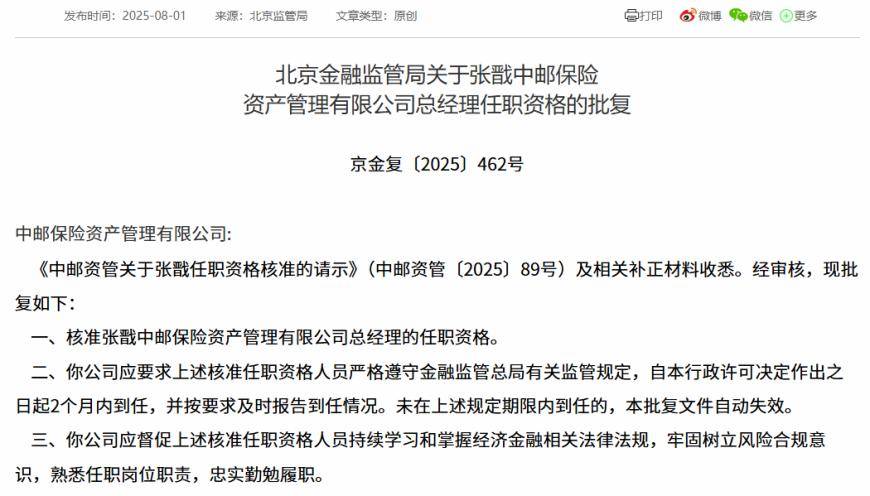
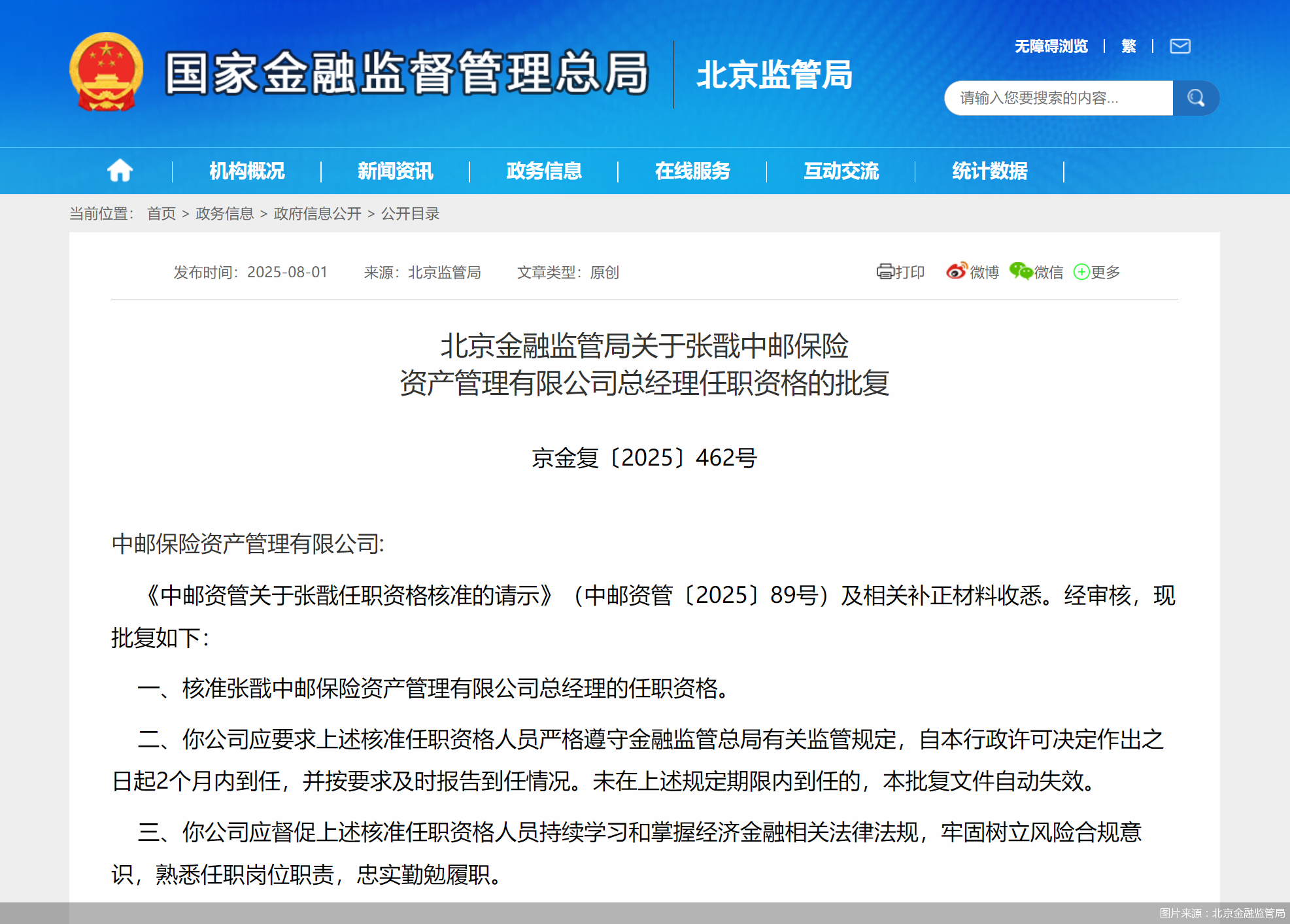
张戬获批出任中邮保险资管总经理
Bei Jing Shang Bao· 2025-08-01 12:00
Core Viewpoint - The Beijing Financial Regulatory Bureau has approved Zhang Jian's qualification as the general manager of China Postal Insurance Asset Management Co., Ltd. [1] Group 1 - The approval emphasizes the importance of continuous learning and mastery of economic and financial laws and regulations for the qualified personnel [1] - The company is required to instill a strong awareness of risk compliance among its management [1] - The management is expected to be familiar with their job responsibilities and to perform their duties faithfully and diligently [1]