普钢

Search documents
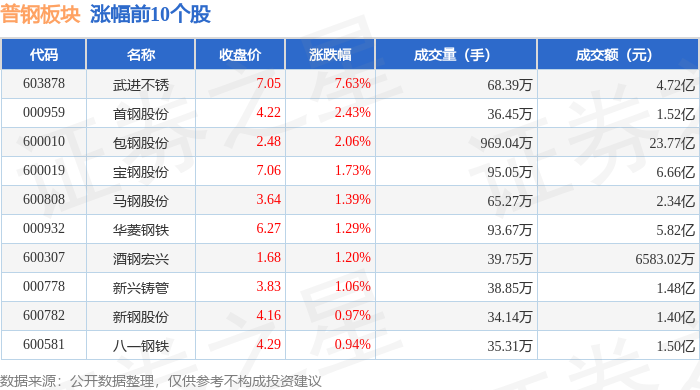
普钢板块9月11日涨1.15%,武进不锈领涨,主力资金净流入1.06亿元
Zheng Xing Xing Ye Ri Bao· 2025-09-11 08:40
Market Performance - On September 11, the general steel sector rose by 1.15%, with Wujin Stainless Steel leading the gains [1] - The Shanghai Composite Index closed at 3875.31, up 1.65%, while the Shenzhen Component Index closed at 12979.89, up 3.36% [1] Individual Stock Performance - Wujin Stainless Steel (603878) closed at 7.05, with a gain of 7.63% and a trading volume of 683,900 shares, amounting to a transaction value of 472 million yuan [1] - Shougang Co. (000959) closed at 4.22, up 2.43%, with a trading volume of 364,500 shares and a transaction value of 152 million yuan [1] - Baotou Steel (600010) closed at 2.48, up 2.06%, with a trading volume of 9,690,400 shares and a transaction value of 2.377 billion yuan [1] - Other notable performances include Baosteel (600019) at 7.06 (+1.73%), and Maanshan Steel (600808) at 3.64 (+1.39%) [1] Capital Flow Analysis - The steel sector saw a net inflow of 106 million yuan from institutional investors, while retail investors experienced a net inflow of approximately 89.64 million yuan [2] - Notably, Wujin Stainless Steel had a net inflow of 4.02 million yuan from institutional investors, while retail investors saw a net outflow of 10.98 million yuan [3] - Baotou Steel had a significant net inflow of 103 million yuan from institutional investors, indicating strong institutional interest [3]


9月11日早间重要公告一览
Xi Niu Cai Jing· 2025-09-11 03:58
Group 1 - Company Wuchan Jinyun plans to reduce its shareholding by up to 3%, amounting to a maximum of 6.24 million shares [1] - Company Hualing Steel's shareholder intends to increase its stake by 1% to 2%, acquiring between 6.91 million and 13.8 million shares [1] - Company Zhujiang Co. plans to sell multiple stock assets, potentially generating over 50% of its audited net profit from the previous year [1] Group 2 - Company Dash Smart's actual controller plans to reduce holdings by up to 1.52%, equating to 30.41 million shares [2] - Company Zhendian Medical's controlling shareholder intends to transfer 5% of its shares, totaling 13.32 million shares, at a price of 26.74 yuan per share [2] - Company Dajin Heavy Industry's subsidiary signed a contract worth approximately 1.25 billion yuan for offshore wind power foundations, representing about 33% of its projected revenue for 2024 [4] Group 3 - Company Andy Su received approval for a stock issuance to specific investors [5] - Company Shield Environment plans to invest approximately 5 billion yuan in a new smart manufacturing headquarters project [7] - Company Dongfang Guoxin intends to establish a joint venture with Shunyi Jin Kong with a registered capital of 300 million yuan [8] Group 4 - Company ST Lian Shi signed a pre-restructuring investment agreement with selected investors, with share prices set at 5.65 yuan and 6.73 yuan for different lock-up periods [9][10] - Company Langzi Co. plans to acquire 67.5% of Chongqing Time for 92.475 million yuan [11] - Company Yingli Co. intends to purchase 77.94% of Youte Li for 468 million yuan and raise up to 196 million yuan through a private placement [13] Group 5 - Company Betta Pharmaceuticals plans to issue H-shares and apply for listing on the Hong Kong Stock Exchange [14] - Company Hehua Co. intends to transfer control by selling 23.76% of its shares for 632 million yuan [16] - Company Jieshun Technology's shareholder plans to reduce holdings by up to 3%, totaling 1.92 million shares [18] Group 6 - Company Wuyang Zikong's controlling shareholder plans to transfer 15% of its shares, changing the controlling party [19] - Company Zhongliang Kegong plans to reduce its shareholding by up to 3%, amounting to 1.54 million shares [20] - Company Changhua Chemical intends to reduce its shareholding by up to 3%, totaling 417,420 shares [22]




本钢板材跌2.17%,成交额1727.04万元,主力资金净流出705.52万元
Xin Lang Cai Jing· 2025-09-11 02:22
Core Viewpoint - The stock price of Benxi Steel Plate fell by 2.17% on September 11, 2023, with a current price of 3.60 CNY per share and a market capitalization of 14.79 billion CNY [1] Group 1: Stock Performance - Year-to-date, Benxi Steel Plate's stock price has increased by 12.50%, with a slight increase of 0.28% over the last five trading days, a decrease of 3.23% over the last 20 days, and a 0.28% increase over the last 60 days [2] - As of June 30, 2023, the number of shareholders is 46,200, a decrease of 3.47% from the previous period [2] Group 2: Financial Performance - For the first half of 2025, Benxi Steel Plate reported operating revenue of 24.698 billion CNY, a year-on-year decrease of 12.93%, and a net profit attributable to shareholders of -1.399 billion CNY, an increase of 9.78% year-on-year [2] Group 3: Shareholder Information - Since its A-share listing, Benxi Steel Plate has distributed a total of 9.174 billion CNY in dividends, with no dividends paid in the last three years [3] - As of June 30, 2023, the fifth largest shareholder is China Merchants Securities (Hong Kong) Co., Ltd., holding 16.0119 million shares, an increase of 172,200 shares from the previous period [3]

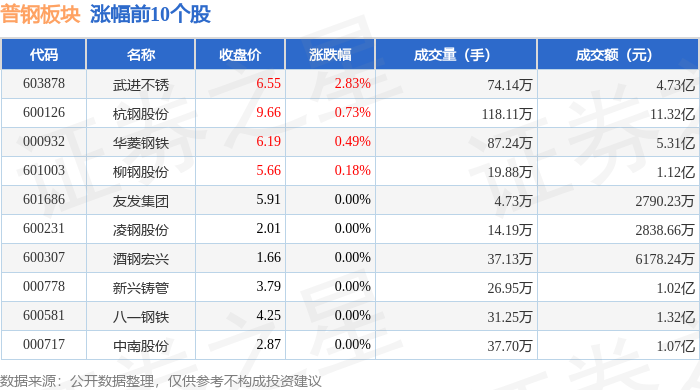
普钢板块9月10日跌0.78%,宝钢股份领跌,主力资金净流出1987.77万元
Zheng Xing Xing Ye Ri Bao· 2025-09-10 08:30
Market Overview - On September 10, the steel sector experienced a decline of 0.78%, with Baosteel leading the drop [1] - The Shanghai Composite Index closed at 3812.22, up 0.13%, while the Shenzhen Component Index closed at 12557.68, up 0.38% [1] Individual Stock Performance - Notable gainers included: - Wujin Stainless Steel (603878) with a closing price of 6.55, up 2.83% and a trading volume of 741,400 shares [1] - Hangang Co. (600126) closed at 9.66, up 0.73% with a trading volume of 1,181,100 shares [1] - Major decliners included: - Baosteel (600019) closed at 6.94, down 1.84% with a trading volume of 929,400 shares [2] - Sijiang Steel (600808) closed at 3.59, down 1.64% with a trading volume of 704,200 shares [2] Capital Flow Analysis - The steel sector saw a net outflow of 19.88 million yuan from institutional investors and 72.73 million yuan from speculative funds, while retail investors had a net inflow of 92.61 million yuan [2] - Baosteel experienced a significant net outflow of 32.51 million yuan from institutional investors [3] - Hangang Co. had a net inflow of 28.99 million yuan from institutional investors, despite a net outflow from speculative funds [3]
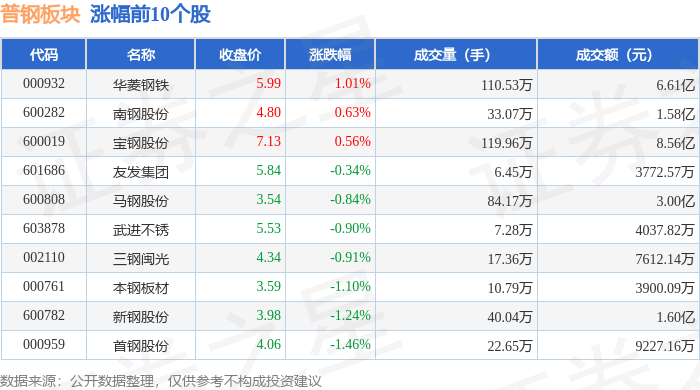
普钢板块9月3日跌1.24%,杭钢股份领跌,主力资金净流出4.64亿元
Zheng Xing Xing Ye Ri Bao· 2025-09-03 08:39
Market Overview - On September 3, the steel sector declined by 1.24%, with Hangzhou Steel leading the drop [1] - The Shanghai Composite Index closed at 3813.56, down 1.16%, while the Shenzhen Component Index closed at 12472.0, down 0.65% [1] Individual Stock Performance - Major stocks in the steel sector showed mixed performance, with Hualing Steel up by 1.01% and Hangzhou Steel down by 4.86% [1][2] - The trading volume for Hualing Steel was 1,105,300 shares, with a transaction value of 661 million yuan [1] - Hangzhou Steel had a trading volume of 1,052,100 shares, with a transaction value of 1.014 billion yuan [2] Capital Flow Analysis - The steel sector experienced a net outflow of 464 million yuan from institutional investors, while retail investors saw a net inflow of 476 million yuan [2][3] - Hualing Steel had a net inflow of 41.79 million yuan from institutional investors, while retail investors had a net outflow of 40.52 million yuan [3] - The overall trend indicates a shift in capital flow, with retail investors increasing their positions despite institutional selling [2][3]


反内卷:157个细分行业供给侧全景
2025-09-02 14:41
Summary of Conference Call Notes Industry Overview - The conference call discusses the supply-side reform across various industries, highlighting a slower capacity reduction compared to previous reforms. The overall capacity and inventory cycles for non-financial enterprises in the second quarter remain at the bottom, indicating a need for time and policy accumulation for recovery [3][4]. Key Points and Arguments - **Supply Capacity Assessment**: Analysts evaluate supply capacity using three dimensions: current supply capacity (capacity utilization rate and inventory), future supply changes (expansionary capital expenditure), and industry profitability (gross margin and proportion of loss-making enterprises) [4][5]. - **Manufacturing Sector**: - Industries such as construction, chemicals, and coke are categorized as "three lows" (low capacity utilization, low inventory, low expansionary capital expenditure), indicating low production willingness and limited future production capacity, accelerating capacity clearance [6]. - In contrast, cyclical products like textile chemicals, glass fiber, and fluorochemicals show profit growth, particularly fluorochemicals [6]. - Manufacturing areas like inverters, silicon materials, and silicon wafers are performing well, while lithium batteries and photovoltaic cell components are at the left-side bottom [6]. - **Consumer Goods Sector**: Chemical pharmaceuticals and clothing/home textiles are performing well, while traditional Chinese medicine is positioned in the middle to later stages of the left side [6]. - **TMT Sector**: Electronic chemicals, integrated circuit manufacturing, and security equipment are in relatively good positions, with no observed left-side bottom industries [2][6]. Additional Important Insights - The current supply-side framework is based on listed company data, reflecting the latest industry conditions as of the second quarter. The introduction of anti-involution policies has led to some positive factors across industries, but the overall situation remains at the bottom, requiring further time and policy efforts for noticeable changes [3]. - The assessment of supply capacity includes measuring capacity utilization through fixed asset turnover ratios and inventory through cumulative year-on-year comparisons over the past decade [4][5]. - Continuous tracking of data across different sectors is essential for making accurate judgments regarding potential investment opportunities and risks [6].
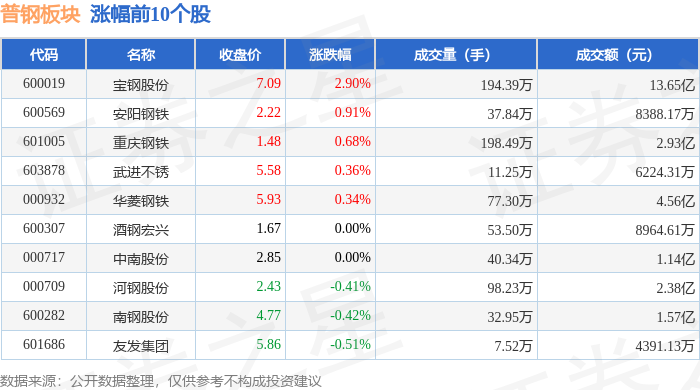
普钢板块9月2日跌0.47%,杭钢股份领跌,主力资金净流出9.11亿元
Zheng Xing Xing Ye Ri Bao· 2025-09-02 08:55
Market Performance - On September 2, the steel sector declined by 0.47% compared to the previous trading day, with Hangzhou Steel leading the decline [1] - The Shanghai Composite Index closed at 3858.13, down 0.45%, while the Shenzhen Component Index closed at 12553.84, down 2.14% [1] Individual Stock Performance - Baosteel Co., Ltd. (600019) saw a closing price of 7.09, with an increase of 2.90% and a trading volume of 1.9439 million shares, totaling a transaction value of 1.365 billion [1] - Anyang Iron & Steel (600569) closed at 2.22, up 0.91%, with a trading volume of 378,400 shares and a transaction value of 83.8817 million [1] - Chongqing Steel (601005) closed at 1.48, up 0.68%, with a trading volume of 1.9849 million shares and a transaction value of 293 million [1] - Other notable performances include Wujin Stainless Steel (603878) at 5.58 (+0.36%), Hualing Steel (000932) at 5.93 (+0.34%), and Jiuquan Steel (600307) at 1.67 (unchanged) [1] Capital Flow Analysis - The steel sector experienced a net outflow of 9.11 billion from institutional investors, while retail investors saw a net inflow of 7.92 billion [2] - Notable capital flows include Baosteel Co., Ltd. with a net inflow of 1.43 billion from institutional investors, but a net outflow of 796.78 million from retail investors [2] - Anyang Iron & Steel had a net inflow of 981.58 million from institutional investors, but also saw outflows from both retail and speculative investors [2]
招商证券A股中报解读:收入端边际改善 关注中游制造业、医药生物业绩的回暖
Zhi Tong Cai Jing· 2025-09-01 22:44
Core Viewpoint - The overall profitability growth of A-share listed companies is slowing down due to continuous price declines and weak effective demand, despite some improvements in revenue [1][2] Profitability Analysis - The net profit growth of listed companies has narrowed, with quarterly net profit growth rates for 2024Q4, 2025Q1, and 2025Q2 being -15.7%, 3.2%, and 1.2% respectively [2] - Non-financial oil and petrochemical sectors show even more significant declines, with quarterly net profit growth rates of -50.2%, 4.5%, and -0.1% for the same periods [2] Revenue Trends - A-share companies have seen an improvement in quarterly revenue growth compared to 2025Q1, with growth rates of 1.4%, -0.3%, and 0.4% for 2024Q4, 2025Q1, and 2025Q2 respectively [2] - Non-financial oil and petrochemical sectors also show improved revenue growth rates of 1.2%, 0.5%, and 0.9% for the same quarters [2] Sector Performance - Key sectors showing improved profitability include healthcare, midstream manufacturing, and financial real estate, with information technology leading in profit growth [4] - The quarterly profit growth rates for 2025Q2 are ranked as follows: Information Technology > Midstream Manufacturing > Financial Real Estate > Healthcare > Utilities > Consumer Services > Resource Products [4] Cash Flow and Capital Expansion - Free cash flow as a percentage of market value and revenue is steadily increasing, with operating cash flow showing high growth, particularly from midstream manufacturing [5] - Capital expenditure growth has declined since reaching a peak in Q2 2023, with limited recovery in demand and low corporate capital expansion willingness [5] Focus Areas for Growth - Industries with high or improving profit growth in 2025Q2 include TMT (software development, gaming, components, communication devices, other electronics, semiconductors, consumer electronics), mid-to-high-end manufacturing, and certain resource products [6]

金融工程行业景气月报:行业表现大幅分化,浮法玻璃盈利持续改善-20250901
EBSCN· 2025-09-01 11:43
Quantitative Models and Construction Methods 1. Model Name: Coal Industry Profit Forecast Model - **Model Construction Idea**: The model estimates monthly revenue and profit growth rates for the coal industry based on changes in price and capacity factors[10][15] - **Model Construction Process**: 1. The pricing mechanism is determined by the last price index of the previous month, which sets the sales price for the next month[10] 2. The model uses year-on-year changes in price factors and capacity factors to estimate revenue and profit growth rates on a monthly basis[10] - **Model Evaluation**: The model provides a systematic approach to track and predict industry profitability trends, but it is sensitive to price fluctuations and external shocks[15] 2. Model Name: Hog Supply-Demand Gap Estimation Model - **Model Construction Idea**: This model predicts the supply-demand gap for hogs six months in advance based on the relationship between sow inventory and hog slaughter rates[16][17] - **Model Construction Process**: 1. The model assumes a stable proportional relationship between quarterly hog slaughter and sow inventory lagged by six months[16] 2. The formula for the slaughter coefficient is: $ \text{Slaughter Coefficient} = \frac{\text{Quarterly Hog Slaughter}}{\text{Sow Inventory (Lagged 6 Months)}} $[16] 3. The potential supply six months later is calculated as: $ \text{Potential Supply (t+6)} = \text{Sow Inventory (t)} \times \text{Slaughter Coefficient (t+6)} $[17] 4. The potential demand six months later is estimated using historical quarterly slaughter data[17] - **Model Evaluation**: The model effectively identifies hog price cycles but relies heavily on the accuracy of historical slaughter coefficients[17] 3. Model Name: Steel Industry Profit Forecast Model - **Model Construction Idea**: The model predicts monthly profit growth and per-ton profitability for the steel industry by integrating steel prices and raw material costs[19] - **Model Construction Process**: 1. The model incorporates comprehensive steel prices and costs of raw materials such as iron ore, coke, pulverized coal, and scrap steel[19] 2. Monthly profit growth rates and per-ton profitability are calculated based on these inputs[19] - **Model Evaluation**: The model provides a detailed view of profitability trends but may not fully capture external demand-side factors[23] 4. Model Name: Glass and Cement Industry Profitability Tracking Model - **Model Construction Idea**: This model tracks profitability changes in the glass and cement industries using price and cost indicators, and generates allocation signals based on these changes[25] - **Model Construction Process**: 1. The model monitors price and cost indicators to assess profitability trends[25] 2. It incorporates manufacturing PMI and real estate sales data to evaluate macroeconomic impacts on industry expectations[25] - **Model Evaluation**: The model is useful for identifying short-term profitability trends but may be limited by the lag in macroeconomic data updates[26] 5. Model Name: Refining and Oilfield Services Profitability Model - **Model Construction Idea**: This model estimates profit growth and cracking spreads for the refining industry based on changes in fuel prices, crude oil prices, and new drilling activity[27] - **Model Construction Process**: 1. The model calculates profit growth rates using changes in fuel and crude oil prices[27] 2. Cracking spreads are derived from the difference between product prices and raw material costs[27] 3. Allocation signals are generated based on oil price trends and drilling activity[27] - **Model Evaluation**: The model captures key profitability drivers but may not fully account for geopolitical risks affecting oil prices[34][35] --- Backtesting Results of Models 1. Coal Industry Profit Forecast Model - **Excess Return**: The coal industry underperformed the Wind All-A Index by -9.8% in August 2025[10] 2. Hog Supply-Demand Gap Estimation Model - **Supply-Demand Balance**: The potential supply for Q1 2026 is estimated at 19,380 million heads, while the demand is forecasted at 19,476 million heads, indicating a slightly tight balance[18] 3. Steel Industry Profit Forecast Model - **Profit Growth**: The steel industry is predicted to achieve positive year-on-year profit growth in August 2025[23] 4. Glass and Cement Industry Profitability Tracking Model - **Glass Industry**: Profit margins continued to decline year-on-year in August 2025, but the rate of decline narrowed[26] - **Cement Industry**: Profitability slightly declined year-on-year in August 2025[26] 5. Refining and Oilfield Services Profitability Model - **Refining Industry**: Profit growth for August 2025 is predicted to be positive[28] - **Oilfield Services**: Oil prices in August 2025 were lower than the previous year, and drilling activity remained stable, leading to a neutral allocation signal[35]
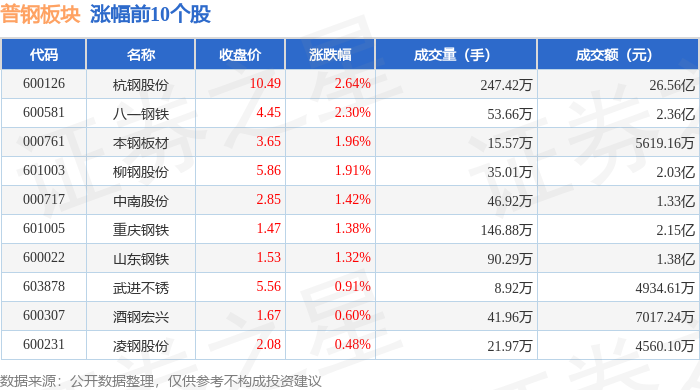
普钢板块9月1日跌0.1%,包钢股份领跌,主力资金净流出11.9亿元
Zheng Xing Xing Ye Ri Bao· 2025-09-01 08:39
Market Overview - On September 1, the general steel sector experienced a slight decline of 0.1%, with Baogang Co. leading the drop [1] - The Shanghai Composite Index closed at 3875.53, up 0.46%, while the Shenzhen Component Index closed at 12828.95, up 1.05% [1] Individual Stock Performance - Notable gainers in the steel sector included: - Hangang Co. (600126) with a closing price of 10.49, up 2.64% and a trading volume of 2.4742 million shares, totaling 2.656 billion yuan [1] - Bayi Steel (600581) closed at 4.45, up 2.30% with a trading volume of 536,600 shares, totaling 236 million yuan [1] - Benxi Steel (000761) closed at 3.65, up 1.96% with a trading volume of 155,700 shares, totaling 56.1916 million yuan [1] - Conversely, Baogang Co. (600010) saw a decline of 1.43%, closing at 2.75 with a trading volume of 16.8029 million shares, totaling 4.601 billion yuan [2] - Other notable decliners included: - Hebei Steel (000709) down 1.21% to 2.44 with a trading volume of 139,090 shares [2] - Baosteel (600019) down 0.58% to 6.89 with a trading volume of 186,800 shares, totaling 1.291 billion yuan [2] Capital Flow Analysis - The steel sector experienced a net outflow of 1.19 billion yuan from major funds, while retail investors contributed a net inflow of 708 million yuan [2] - Specific stock capital flows included: - Chongqing Steel (601005) with a net inflow of 27.8511 million yuan from major funds, but a net outflow of 17.6784 million yuan from speculative funds [3] - Anshan Steel (000898) saw a net inflow of 7.5332 million yuan from major funds, with minimal activity from speculative and retail investors [3]