
石油加工

Search documents
国家发展改革委:12月22日24时起国内汽、柴油价格每吨分别降低170元和165元
Xin Hua Cai Jing· 2025-12-22 09:12
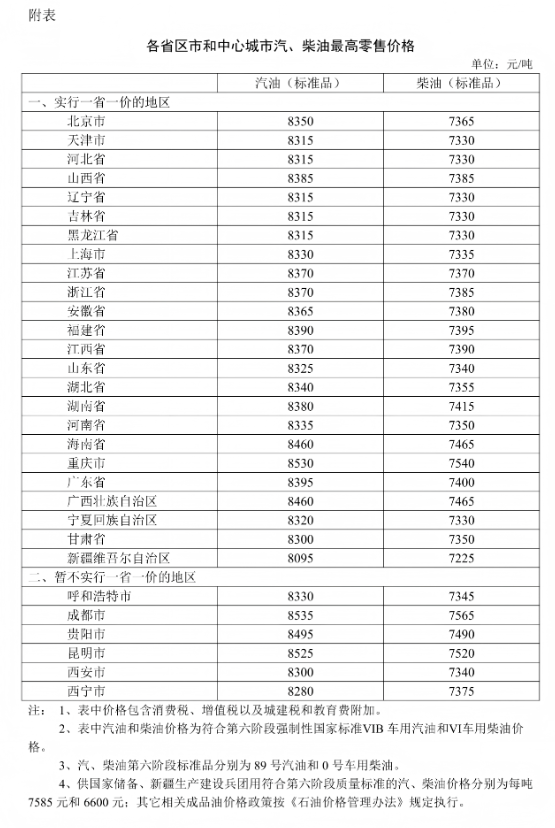
Core Viewpoint - The National Development and Reform Commission (NDRC) announced a reduction in domestic gasoline and diesel prices due to fluctuations in international oil prices, effective from December 22 at 24:00 [1] Price Adjustment Summary - Gasoline price per ton is reduced by 170 yuan, and diesel price per ton is reduced by 165 yuan [1] - The NDRC has mandated major oil companies, including PetroChina, Sinopec, and CNOOC, to ensure stable supply and compliance with national pricing policies [1] Regional Price Details - The maximum retail prices for gasoline and diesel in various provinces and cities are listed, with prices varying by region. For example, in Beijing, gasoline is priced at 8350 yuan per ton and diesel at 7365 yuan per ton [2] - Other regions have similar pricing structures, with slight variations, indicating a "one province, one price" policy in effect for most areas [2]

恒力石化:控股股东一致行动人质押5600万股股份补充流动资金
Xin Lang Cai Jing· 2025-12-22 07:53
Core Viewpoint - Hengli Petrochemical announced that its controlling shareholder, Hengli Group, through its action-in-concert party Hengneng Investment, has pledged 56 million shares to Tibet Trust, which accounts for 3.74% of its holdings and 0.80% of the total share capital, to supplement working capital. The principal debt secured by this pledge is due on January 22, 2027 [1] Summary by Category - **Shareholding Structure** - As of the announcement date, the controlling shareholder and its action-in-concert parties hold a total of 5.311 billion shares, representing 75.45% of the total share capital [1] - **Pledge Details** - A total of 1.686 billion shares have been pledged, which constitutes 31.75% of the shares held by the controlling shareholder and 23.95% of the total share capital [1] - **Risk Assessment** - Hengneng Investment has good creditworthiness, and the risk associated with this pledge is controllable, with no impact on the actual control of the company [1]

地缘溢价持续回吐,油价震荡下跌 | 投研报告
Sou Hu Cai Jing· 2025-12-22 02:14
来源:中国能源网 【美国原油供给】截至2025年12月12日当周,美国原油产量为1384.3万桶/天,较上周减少1.0万桶/天。 截至2025年12月19日当周,美国活跃钻机数量为406台,较上周减少8台。截至2025年12月19日当周,美 国压裂车队数量为160部,较上周减少8部。 【美国原油需求】截至2025年12月12日当周,美国炼厂原油加工量为1698.8万桶/天,较上周增加12.8万 桶/天,美国炼厂开工率为94.80%,较上周上升0.3pct。 【美国原油库存】截至2025年12月12日当周,美国原油总库存为8.37亿桶,较上周减少102.5万桶 (-0.12%);战略原油库存为4.12亿桶,较上周增加24.9万桶(+0.06%);商业原油库存为4.24亿桶, 较上周减少127.4万桶(-0.30%);库欣地区原油库存为2086.2万桶,较上周减少74.2万桶(-3.43%)。 【美国成品油库存】截至2025年12月12日当周,美国汽油总体、车用汽油、柴油、航空煤油库存分别为 22562.7、1426.3、11850.0、4357.6万桶,较上周分别+480.8(+2.18%)、-192.1(-1 ...






国泰君安期货能源化工石油沥青周度报告-20251221
Guo Tai Jun An Qi Huo· 2025-12-21 08:41
Report Overview - Report Title: Petroleum Asphalt Weekly Report - Report Date: December 21, 2025 - Analyst: Wang Hanxi - Investment Advisory Qualification Number: Z0019174 - Futures Practitioner Qualification Number: F3082452 Report Industry Investment Rating - Not provided in the report Core Viewpoints - This week, crude oil rebounded significantly, but due to the escalating situation in Venezuela, traders were worried about geopolitical risks and reduced their提货, leading to a significant increase in local inventories and a sharp drop in discounts. Asphalt deviated from the strong oil price and remained at a low level [4]. - The domestic asphalt processing theoretical profit averaged -355 yuan/ton this week, a week-on-week increase of 98 yuan/ton. The spot price of the asphalt market fluctuated in the range of 3081 - 3086 yuan/ton, and the decline of the average spot price of asphalt slowed down this week, with a narrower price fluctuation range [4]. - The strategy includes a low - level operation of the BU - SC crack spread [4]. Summary by Directory 1. Overview - **Supply**: From December 11 - 17, 2025, the capacity utilization rate of 92 asphalt refineries in China was 29.2%, a week - on - week decrease of 0.7%. The capacity utilization rate of 77 domestic heavy - traffic asphalt enterprises was 27.6%, a week - on - week decrease of 0.2%. Although some major refineries in East and South China resumed production and increased asphalt production, some refineries in Shandong intermittently switched to producing residual oil, resulting in a decline in capacity utilization [4]. - **Demand**: From December 10 - 16, 2025, the total shipment volume of 54 domestic asphalt enterprises was 350,000 tons, a week - on - week decrease of 8.9%. The shipment volume decreased significantly in East China and Shandong. In Shandong, local refineries stopped producing asphalt, and the overall supply declined. Coupled with the impact of rain and snow, the demand was weak, and the refinery shipment was average. In East China, the main refineries intermittently reduced production, and the high price suppressed the enthusiasm of traders to purchase, leading to a decrease in shipment volume [4]. 2. Price & Spread - **Cost Structure**: The cost of asphalt is affected by factors such as Brent, WTI, imported diluted asphalt, and Ma Rui crude oil. There are also factors such as raw material supply, substitution, import and export policies, exchange rates, and freight rates. Different crude oil varieties have different asphalt yields, for example, Ma Rui crude oil has a yield of 55% - 60% [7]. - **Price and Spread Charts**: The report provides multiple price and spread charts, including the relationship between futures - disk price, trading volume, and open interest, the relationship between spot heavy - traffic asphalt and Ma Rui crude oil, and the relationship between basis and monthly spread [9][11][12]. 3. Fundamental Data - **Demand** - **Consumption Distribution**: Asphalt demand is mainly in the road market (including highway construction and maintenance), waterproof market, ship - fuel market, coking market, and export market. Seasonal factors also have an impact, but the volume of some markets is small and the impact is limited [21]. - **Downstream Shipment**: From December 10 - 16, 2025, the total shipment volume of 54 domestic asphalt enterprises was 350,000 tons, a week - on - week decrease of 8.9%. The capacity utilization rate of 69 domestic modified asphalt enterprises was 7.7%, a week - on - week decrease of 1.3% and a year - on - year increase of 0.6% [26]. - **Supply** - **Supply Pattern**: Asphalt supply comes from domestic refineries (including major refineries and local refineries) and imports. Different regions and types of refineries have different characteristics, and factors such as inventory, production profit, maintenance plans, and monthly production schedules affect supply [27]. - **Output, Maintenance and Raw Materials**: In January 2026, the planned production volume of domestic asphalt refineries was 1.058 million tons, a month - on - month decrease of 150,000 tons (a decrease of 12.4%) and a year - on - year decrease of 289,000 tons (a decrease of 21.5%). As of December 18, 2025, the total inventory of 54 asphalt sample refineries was 635,000 tons, a 1.6% increase from December 15. The total inventory of 104 social asphalt warehouses was 1.023 million tons, a 0.6% decrease from December 15 [30]. - **Start - up**: The report provides the weekly start - up rate charts of 77 major asphalt refineries in different regions, including the total start - up rate and the start - up rate in Shandong, the Yangtze River Delta, North China, Central China, South China, Southwest China, and Northeast China [32][34][36]. - **Inventory**: The report provides the weekly inventory rate charts of asphalt refineries and the asphalt market in different regions, including the total inventory rate and the inventory rate in North China, Shandong, the Yangtze River Delta, Northeast China, and South China [42].
原油周报:地缘溢价持续回吐,油价震荡下跌-20251221
Xinda Securities· 2025-12-21 08:34
Investment Rating - The report maintains a "Positive" investment rating for the oil processing industry, consistent with the previous rating [1]. Core Insights - International oil prices experienced fluctuations, with Brent and WTI prices recorded at $60.05 and $56.52 per barrel respectively as of December 19, 2025, reflecting a decrease of 1.75% and 1.60% from the previous week [2][9]. - The geopolitical situation, particularly discussions around the Russia-Ukraine peace agreement and U.S. sanctions on Venezuela, has influenced market dynamics, leading to a mixed impact on oil prices [2][9]. - The oil and petrochemical sector showed resilience, with a 1.60% increase in the sector's performance compared to a 0.28% decline in the broader market (CSI 300) [10]. Summary by Sections Oil Price Review - As of December 19, 2025, Brent crude futures settled at $60.05 per barrel, down $1.07 (-1.75%), while WTI crude futures settled at $56.52 per barrel, down $0.92 (-1.60%) [2][17]. - The Urals crude price remained stable at $65.49 per barrel, while ESPO crude fell to $47.86 per barrel, down $1.77 (-3.57%) [2][17]. Offshore Drilling Services - The number of global offshore self-elevating drilling rigs increased to 375, with a net addition of 7 rigs, while floating drilling rigs rose to 131, with a net addition of 2 rigs [27]. U.S. Oil Supply - U.S. crude oil production was reported at 13.843 million barrels per day, a decrease of 10,000 barrels from the previous week [44]. - The active rig count in the U.S. decreased to 406, down by 8 rigs [44]. U.S. Oil Demand - U.S. refinery crude processing increased to 16.988 million barrels per day, with a utilization rate of 94.80%, up 0.3 percentage points from the previous week [55]. U.S. Oil Inventory - Total U.S. crude oil inventory stood at 837 million barrels, a decrease of 1.025 million barrels (-0.12%) from the previous week [62]. - Strategic oil reserves increased slightly to 412 million barrels, while commercial inventories decreased to 424 million barrels [62]. Related Companies - Key companies in the sector include China National Offshore Oil Corporation (CNOOC), China Petroleum & Chemical Corporation (Sinopec), and PetroChina, among others [3].
原油月报:2026年原油平均累库或超200万桶、日-20251221
Xinda Securities· 2025-12-20 23:30
Investment Rating - The report does not explicitly state an investment rating for the oil processing industry Core Insights - The average global crude oil inventory change for 2026 is projected to be +204.90 thousand barrels per day according to IEA, EIA, and OPEC [2] - For Q4 2025, the average inventory change is expected to be +162.53 thousand barrels per day, showing a revision from previous forecasts [2] - Global crude oil supply for 2025 is forecasted at 10617.36, 10607.84, and 10470.71 thousand barrels per day by IEA, EIA, and OPEC respectively, indicating a year-on-year increase [2] - The global crude oil demand for 2025 is estimated at 10392.25, 10393.68, and 10513.66 thousand barrels per day by IEA, EIA, and OPEC respectively, reflecting a modest increase from 2024 [2] Summary by Sections Oil Supply - IEA, EIA, and OPEC predict global crude oil supply for 2026 to be 10865.02, 10742.59, and 10654.18 thousand barrels per day respectively, with increases from 2025 [2][35] - The Q4 2025 supply increase is projected at +414.30, +385.36, and +254.12 thousand barrels per day by IEA, EIA, and OPEC respectively [35] Oil Demand - The demand for 2026 is forecasted at 10478.51, 10516.87, and 10651.70 thousand barrels per day by IEA, EIA, and OPEC respectively, indicating a growth from 2025 [2][35] - The demand increase for Q4 2025 is expected to be +108.72, +130.72, and +152.22 thousand barrels per day by IEA, EIA, and OPEC respectively [4] Oil Prices - As of December 18, 2025, Brent crude, WTI, Russian ESPO, and Russian Urals prices are reported at 59.82, 56.00, 47.94, and 65.49 USD per barrel respectively, with significant declines observed over the year [9][10] - Year-to-date price changes show Brent down by -21.22%, WTI by -23.42%, and Russian ESPO by -33.37% [9][10] Oil Inventory - The global crude oil inventory change for 2025 is projected at +225.11, +214.16, and -42.95 thousand barrels per day by IEA, EIA, and OPEC respectively, with an average increase of +132.11 thousand barrels per day [26] - The U.S. total crude oil inventory as of December 12, 2025, stands at 83658.8 thousand barrels, reflecting a slight increase [19][20]
南华期货沥青产业周报:冬储政策陆续出台,地缘扰动带来短期波动-20251220
Nan Hua Qi Huo· 2025-12-20 13:58
1. Report Industry Investment Rating No relevant information provided. 2. Core Viewpoints of the Report - This week, winter storage policies were gradually introduced. A refinery in Shandong released a winter storage contract at 2,900 yuan/ton for the end of March. Downstream purchasing enthusiasm was stronger than expected, and the futures market offered premiums and opportunities for positive arbitrage. However, major refineries in South China increased production and lowered prices, impacting the local market and even having a price advantage when transported to Northeast China considering logistics costs. Additionally, the continuous pressure from the US on Venezuela and the potential for military conflict led to supply disruptions in the asphalt raw material end, increasing asphalt price volatility [2]. - Refinery开工率 increased this week due to the resumption of production in Shandong refineries and increased production by major South China refineries, driving up overall asphalt supply. On the demand side, spot market trading improved as prices declined, but the end - of - peak - season performance in the South was not as expected. Factory inventories slightly increased, while social inventories remained stable. Crude oil prices, the cost factor, were weakly volatile. Spot basis remained stable, consistent with the weakening demand trend. In the long - term, demand in the North will end with the drop in temperature, while the end - of - peak - season demand in the South may boost overall consumption. Overall, the peak season for asphalt did not exceed expectations. In the short - term, the focus should be on the subsequent winter storage situation of refineries and whether they will further adjust prices to stimulate purchasing. Due to geopolitical and negotiation uncertainties in the crude oil cost factor, asphalt is expected to be volatile and slightly bullish in the short - term [3]. 3. Summary by Relevant Catalogs 3.1 Core Contradictions and Strategy Recommendations 3.1.1 Core Contradictions - The release of winter storage policies in Shandong provided a valuation anchor for the spot market. The potential for the US to promote an early end to the Russia - Ukraine conflict suppressed crude oil prices, while the increased military threat to Venezuela pushed up futures prices due to raw material shortage expectations. The US's strengthened sanctions on Russian oil companies may cause short - term disruptions to domestic refinery raw material imports [2][7]. - The increase in low - price point - of - sale resources and the release of short - term low - price contracts by some local refineries. Currently, asphalt is in the end - of - peak - season stage. A significant downward movement in asphalt prices still depends on the cost factor, crude oil. Given the current crude oil trend and refinery profits, this year's winter storage may not provide a favorable basis spread for the mid - and downstream, and there may still be a problem of insufficient volume [7]. - The expected demand impulse in the "15th Five - Year Plan" was a lackluster performance, mainly due to the persistent shortage of funds [7]. 3.1.2 Trading Strategy Recommendations - **Trend Judgment**: The market is expected to be bullish and volatile. Technical analysis should focus on the support level performance of BU2603. Strategy recommendations in this part are temporarily suspended [11]. - **Basis, Calendar Spread, and Hedging Arbitrage Strategy Recommendations**: The basis is expected to be bearish as spot prices are weak and the demand peak is passing. The calendar spread may show a weakening seasonal trend as the basis is weak. The crack spread between asphalt and crude oil has a short - term bullish driver. Detailed strategies in this part are temporarily suspended [11]. 3.1.3 Industrial Customer Operation Suggestions - **Price Range Forecast**: The monthly price range of the asphalt main contract is predicted to be between 2,800 - 3,150 yuan/ton. The current 20 - day rolling volatility is 21.15%, and its historical percentile over three years is 38.97% [12]. - **Risk Management Strategy Recommendations**: For inventory management, if product inventories are high and there are concerns about price drops, companies can short asphalt futures to lock in profits and cover production costs, with a short - selling ratio of 25% in the range of 3,100 - 3,300 yuan/ton. They can also sell call options to reduce capital costs, with a selling ratio of 20% in the range of 30 - 40 yuan/ton. For procurement management, if the regular procurement inventory is low and companies want to purchase according to orders, they can buy asphalt futures at the current stage to lock in procurement costs in advance, with a buying ratio of 50% in the range of 2,700 - 2,850 yuan/ton. They can also sell put options to collect premiums and reduce procurement costs, with a selling ratio of 20% in the range of 25 - 35 yuan/ton [12][13]. 3.2 This Week's Important Information and Next Week's Key Events 3.2.1 This Week's Important Information - **Likely Positive Information**: A Shandong refinery released a winter storage contract at 2,900 yuan/ton, boosting market expectations. Tensions between the US and Venezuela increased, with the possibility of military conflict [18]. - **Likely Negative Information**: Asphalt consumption entered the off - season, and demand was under pressure. The US urged Ukraine to resolve the battlefield issue, and the geopolitical premium of crude oil may decline. Major South China refineries increased production and lowered prices, impacting the spot market [18]. - **Domestic Asphalt Market Overview**: This week, asphalt prices in Northeast and North China increased by 15 - 20 yuan/ton, while prices in Northwest, Shandong, the Yangtze River Delta, South China, and Southwest China decreased by 25 - 350 yuan/ton. In North China, limited spot resource circulation was beneficial for traders to raise prices. In the Northwest, the price of Zhenhai's rail - transported asphalt decreased, lowering the regional price center. In Shandong, the resumption of production by the main refinery increased supply and decreased demand, leading to price drops for some local brands. In East China, supply was abundant, and some prices were lowered. In South China, a major refinery significantly increased production and reduced prices for road, sea, and rail transportation to ensure smooth sales [17]. - **Spot Market Outlook**: Demand in the North will stop, but limited supply growth and low factory inventories will limit price drops. In the South, the end - of - peak - season demand is decreasing, and sufficient supply in South and East China is negative for asphalt prices [19]. 3.2.2 Next Week's Key Events - Geopolitical situation changes, including Venezuela's latest crude oil shipping and arrival logistics. - Russia's crude oil export and shipping situation, the possibility of an end to the Russia - Ukraine conflict, and changes in floating storage inventories at sea. - Asphalt winter storage policies [20]. 3.3 Market Analysis 3.3.1 Price, Volume, and Capital Analysis - **Unilateral Trend and Capital Flow**: This week, asphalt futures prices showed a volatile trend, and market sentiment was cautious. The net short positions of key profitable seats in the asphalt market decreased, indicating that some institutions were more optimistic about the future. Overall, the decrease in net short positions increased the downward resistance of asphalt, and the market may continue to be volatile in the short - term [22]. - **Basis Structure**: This week, the asphalt basis structure showed signs of stabilization, with the futures market close to parity. The release of winter storage policies supported market activity, despite weak demand [26]. - **Calendar Spread Structure**: The asphalt calendar spread structure continued to weaken, in line with the approaching off - season [37]. 3.4 Valuation and Profit Analysis 3.4.1 Upstream and Downstream Profit Tracking in the Industrial Chain - As of December 18, compared with December 11, the price of coking materials in Shandong remained stable at 3,525 yuan/ton. Weak international oil prices earlier led to price drops in diesel and petroleum coke, reducing market enthusiasm for coking materials. However, later price increases in crude oil improved market trading. The mainstream transaction price of heavy - traffic asphalt in Shandong decreased by 50 yuan/ton to 2,960 - 3,350 yuan/ton. The demand for asphalt was shrinking, and the high prices of Sinopec refineries hindered sales. On Monday, the settlement price was lowered by 100 yuan/ton, and preferential policies were introduced, increasing the enthusiasm of mid - and downstream users. Some local refineries' short - term contract prices dropped below 2,800 yuan/ton. The main local refineries introduced winter storage policies at 2,920 yuan/ton, which were well - received by end - users. This week, the price gap between asphalt and coking materials in Shandong widened to over 600 yuan/ton, slightly reducing the profitability of asphalt production. Uncertain future supply of diluted asphalt led some refineries to produce asphalt at low levels or intermittently, providing some bottom support for asphalt prices [41]. 3.4.2 Import and Export Profit Tracking - **South Korea Market**: South Korean asphalt cargoes arriving in East China cost 400 - 410 US dollars/ton, with a RMB duty - paid price of 3,280 - 3,360 yuan/ton. Mainstream brands had a premium over domestic products due to quality and specific project demand. Mid - and downstream users in East China mainly consumed inventory. Some individual brands with lower prices, such as the January cargoes with a duty - paid price of 2,950 yuan/ton in East China, were attractive to some mid - and downstream users [49]. - **Singapore, Malaysia, and Thailand Markets**: Singaporean asphalt cargoes arriving in South China cost 490 - 500 US dollars/ton, with a RMB duty - paid price of 3,930 - 4,010 yuan/ton. Thai asphalt cargoes arriving in South China cost 515 - 525 US dollars/ton, with a RMB duty - paid price of 4,130 - 4,210 yuan/ton. The end - of - peak - season demand in South China supported the consumption of imported resources, most of which were from previous long - term contracts. In Southeast Asia, reduced typhoon activity increased demand, gradually consuming inventory, which will support the local spot market in the future [49]. - **Imported Asphalt Market Overview and Outlook**: Affected by the decline in crude oil and fuel oil prices, the price of some South Korean January cargoes continued to fall [49]. 3.5 Supply, Demand, and Inventory Analysis 3.5.1 Supply and Forecast - According to Baichuan Yingfu statistics, from January to November 2025, China's asphalt production was 26.04 million tons, a year - on - year increase of 2.78 million tons or 12%. Among them, PetroChina's refineries produced 5.02 million tons, a year - on - year increase of 1.22 million tons or 32%; Sinopec's refineries produced 5.87 million tons, a year - on - year decrease of 0.75 million tons or 11%; CNOOC's asphalt production was 1.91 million tons, a year - on - year increase of 10%; and local refineries produced 13.23 million tons, a year - on - year increase of 2.13 million tons or 19%. Based on the current production plan, China's asphalt production from January to December 2025 is expected to be about 28.27 million tons, a year - on - year increase of 2.79 million tons or 11%. It is expected that PetroChina's refineries will produce about 5.38 million tons, a year - on - year increase of 1.28 million tons or 31%; Sinopec's refineries will produce about 6.29 million tons, a year - on - year decrease of 0.98 million tons or 13%; CNOOC's asphalt production will be about 2.10 million tons, a year - on - year increase of 11%; and local refineries will produce about 14.49 million tons, a year - on - year increase of 2.28 million tons or 19% [52]. 3.5.2 Demand and Forecast - Demand in Central and South China was steadily released, increasing the operating rate of modified asphalt production. However, the end - of - peak - season demand in East China decreased, reducing the operating rate of modified asphalt production [71]. 3.5.3 Inventory and Forecast - In North, Northwest, and Northeast China, some social warehouses received winter storage resources, increasing the local social inventory rate. In Central China, reduced project demand in some areas and the receipt of shipping resources in some social warehouses also increased the social inventory rate [86]. 3.5.4 Supply - Demand Balance Sheet The report provides the monthly supply - demand balance sheet for asphalt from January to November 2025, including data on production, imports, exports, apparent consumption, actual demand, and inventory changes [111]. 3.5.5 Weather Outlook In the next 10 days (December 20 - 29), cumulative precipitation in northern and southwestern Xinjiang, western Gansu, southern Shaanxi, northeastern Inner Mongolia, Northeast China, Shandong, Jianghan, northern and western Jiangnan, South China, and eastern Southwest China will be 5 - 20 mm. In some areas of southwestern Xinjiang, southern Sichuan, Chongqing, eastern Guizhou, and Taiwan, it will be 25 - 40 mm, with local areas exceeding 50 mm. Cumulative precipitation in Northeast China and eastern Southwest China will be 40 - 80% higher than the same period of the year, with some areas more than doubling. Precipitation in most other areas of China will be significantly lower [112].
2025年1-10月中国原油加工量产量为61424.3万吨 累计增长4%
Chan Ye Xin Xi Wang· 2025-12-20 02:51
Core Viewpoint - The report highlights the growth in China's crude oil processing capacity, with a projected increase in processing volume and production in the coming years, indicating a positive trend for the industry [1]. Industry Summary - As of October 2025, China's crude oil processing volume is expected to reach 63.43 million tons, reflecting a year-on-year growth of 6.4% [1]. - From January to October 2025, the cumulative crude oil processing volume in China is projected to be 614.24 million tons, marking a cumulative growth of 4% [1]. Company Summary - The report mentions several listed companies in the oil sector, including Hengyi Petrochemical, Rongsheng Petrochemical, Sinopec, PetroChina, and Shanghai Petrochemical, among others, indicating their relevance in the context of the industry's growth [1].

【图】2025年9月新疆维吾尔自治区石油焦产量数据
Chan Ye Diao Yan Wang· 2025-12-19 02:11
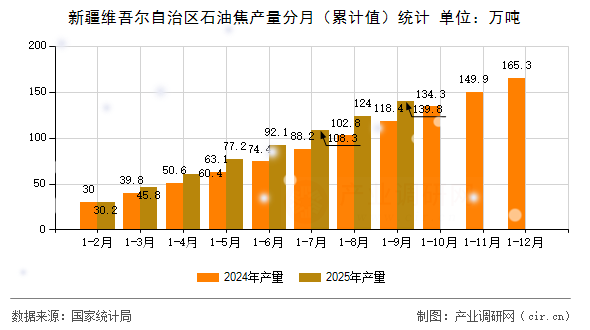
Group 1 - The core viewpoint of the articles indicates that the petroleum coke production in Xinjiang Uygur Autonomous Region has shown significant growth in the first nine months of 2025 compared to the same period in 2024, with a total production of 139.8 million tons, marking an 18.1% increase [1] - The growth rate of petroleum coke production in Xinjiang is 26.2 percentage points higher than that of the same period in 2024 and 22.8 percentage points higher than the national average [1] - In September 2025, the petroleum coke production in Xinjiang reached 15.8 million tons, reflecting a 1.1% increase year-on-year, although this growth rate is 4.5 percentage points lower than that of September 2024 [2] Group 2 - The share of Xinjiang's petroleum coke production in the national total for the first nine months of 2025 is approximately 6.0%, contributing to a national total of 2,342.9 million tons [1] - In September 2025, Xinjiang's production accounted for 6.1% of the national total of 259.7 million tons for that month [2] - The articles provide insights into the monthly production statistics of petroleum coke in Xinjiang, indicating trends and fluctuations in production levels [3]
浙江:11月规模以上工业增加值同比增长6.5%
Di Yi Cai Jing· 2025-12-19 01:34
Core Insights - In November, the industrial added value of large-scale industries in Zhejiang Province increased by 6.5% year-on-year, with 24 out of 37 major industrial sectors showing positive growth [1] Industrial Performance - The industries with significant growth in added value include: - Petroleum processing: 31.4% - Automotive: 23.2% - Railway and shipbuilding: 17.5% - Computer, communication, and electronic products: 15.7% - Chemical fiber: 9.9% - These sectors collectively contributed 4.5 percentage points to the growth of large-scale industrial added value [1] Innovation and New Products - The value rate of new products in large-scale industries reached 44.4%, an increase of 2.1 percentage points year-on-year [1] - The added value of high-tech manufacturing, strategic emerging industries, core digital economy industries, and equipment manufacturing grew by: - High-tech manufacturing: 11.8% - Strategic emerging industries: 11.5% - Core digital economy industries: 11.0% - Equipment manufacturing: 10.2% [1] Year-to-Date Performance - From January to November, the industrial added value of large-scale industries increased by 7.0% [1]