酒店业

Search documents
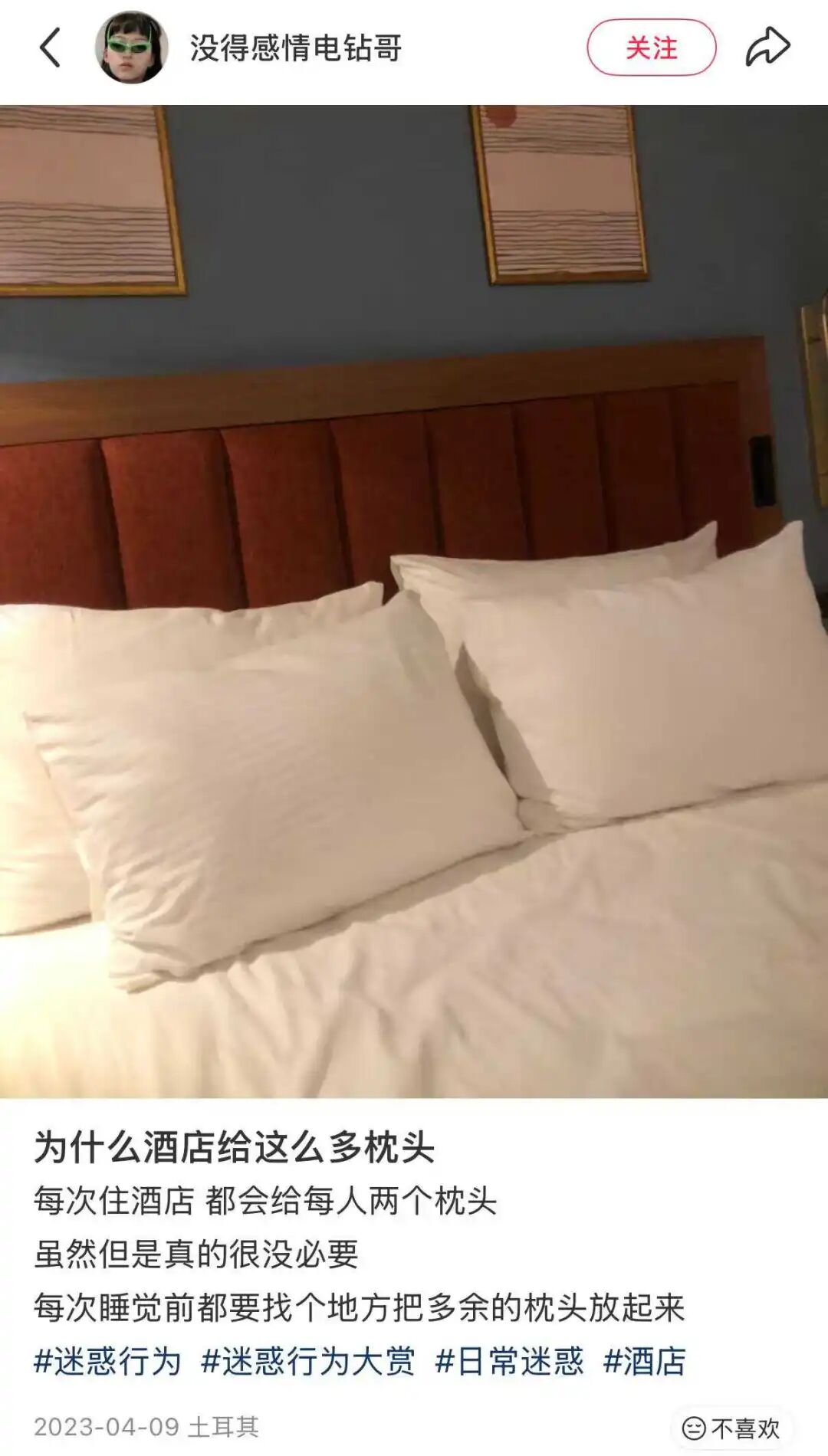
为什么酒店床上总放四个枕头?
Xin Lang Cai Jing· 2026-01-17 05:22
Core Viewpoint - Hotels typically provide four pillows on beds to cater to diverse guest preferences and enhance overall sleep quality, reflecting a service consensus developed over time in the hospitality industry [11][16]. Group 1: Pillow Configuration - Most hotels, regardless of brand or price range, maintain a standard configuration of four pillows for double beds, which is seen as a default setup [10][12]. - Different hotels may offer variations in pillow types, such as differing softness and filling, but the quantity remains consistent across various hotel tiers [10][13]. - The practice of providing four pillows is not limited to luxury hotels; even budget chains like Hanting and Home Inn follow this trend [6][8]. Group 2: Guest Comfort and Preferences - The provision of multiple pillows allows guests to customize their sleeping arrangements, accommodating various sleeping positions and preferences [11][12]. - Research indicates that sleep satisfaction significantly influences overall hotel satisfaction, with guests who find bedding uncomfortable being more likely to report poor sleep quality [11][12]. - The redundancy of having four pillows helps cover a wider range of sleeping preferences and reduces the likelihood of discomfort during sleep [13][16]. Group 3: Visual and Psychological Impact - The arrangement of four pillows contributes to a visually appealing and well-cared-for appearance of the bed, enhancing the perceived value of the room [13][14]. - This design choice aligns with the visual economy of the hospitality industry, making beds more attractive for promotional materials and social media [13][14]. - Hotels aim to convey a message of flexibility and consideration for individual guest needs through this pillow configuration, rather than enforcing a one-size-fits-all approach [16].

海南全岛封关后三亚的酒店业如何发展?
Sou Hu Cai Jing· 2026-01-16 13:54
Core Insights - The hotel industry in Sanya is entering a new phase following the implementation of the "full closure" policy in Hainan, presenting both opportunities and challenges in a reshaped competitive landscape [2] Group 1: Market Strategy and Customer Segmentation - Hotels need to abandon the "one-size-fits-all" approach and focus on precise market positioning, targeting three key customer segments: international vacationers, high-net-worth individuals from mainland China, and cross-border business travelers [4] - Differentiated products are essential to avoid price wars, leveraging the "duty-free+" concept through collaborations with duty-free shops and introducing high-quality international products [4] Group 2: Service and Experience Enhancement - Internationalization and refinement of services are crucial for customer retention, including multilingual communication, cultural adaptation, and convenient payment systems [6] - Embracing a "homestay mentality" and personalized services can enhance guest experiences, encouraging staff to act as "travel planners" [6] - Expanding into "hotel+" and "tourism+" new business models, such as medical tourism packages and yacht experiences, can create additional revenue streams [6] Group 3: Operational Optimization and Cost Control - Utilizing the benefits of the closure policy to lower operational costs by importing high-end ingredients and equipment under the "zero tariff" policy can enhance profit margins [8] - Adapting to new seasonal patterns and optimizing backend operations in lower-cost regions can improve overall cost efficiency [10] Group 4: Cultural Integration and Sustainable Development - Incorporating local cultural elements and sustainable practices into the hotel experience can enhance brand appeal and align with global sustainability trends [12] - Engaging in eco-friendly initiatives and creating unique cultural experiences can attract high-end international clientele [12] Group 5: Regional Collaboration and Talent Development - Collaboration with surrounding attractions and businesses is essential for creating a cohesive tourism experience and sharing customer bases [13] - Investing in talent development, particularly in language skills and professional training, is critical for maintaining service quality in a competitive environment [13] Group 6: Customer Relationship Management - Transitioning from merely selling rooms to managing customer relationships is vital for increasing customer loyalty and retention [15] - Implementing personalized service strategies and effectively handling complaints can transform guest experiences and foster long-term relationships [15] Group 7: Innovation and Technology - Exploring innovative models such as tokenization of hotel assets through blockchain technology can deepen customer engagement and create new revenue opportunities [16]
东呈集团程新华荣膺ECI年度创新企业家
Sou Hu Cai Jing· 2026-01-16 05:55
Group 1 - The 11th ECI International Digital Innovation Festival and the ECI Awards 2025 Annual Innovation Person Awards Ceremony were held in Guangzhou, China, where Cheng Xinhua, founder and CEO of Dongcheng Group, was awarded "ECI Annual Innovative Entrepreneur (2025)" [1][3] - The ECI Festival, initiated by the International Digital Economy Innovation Organization (IECIA), focuses on technology innovation, business innovation, and digital marketing, and has been awarding the ECI Awards since 2014, which is recognized as the "Nobel Prize of the global innovation community" [3][5] - Cheng Xinhua has nearly 20 years of experience in the Chinese hotel industry, leading Dongcheng Group to become one of the top 5 hotel groups in China and top 14 globally, with a brand value of 10.466 billion, ranking in the Top Brand 2025 China Brand 500 [4] Group 2 - The ECI Annual Innovative Entrepreneur award aims to promote entrepreneurs and innovators who create both commercial and social value, emphasizing the "three transcendences": transcending technology, transcending business, and transcending borders [5] - Cheng Xinhua's entrepreneurial philosophy emphasizes that entrepreneurship itself is a form of innovation, and he aims to continue driving innovation within the company and influence other entrepreneurs in the Greater Bay Area and globally [4][5] - The award ceremony highlighted various categories, including innovative business creators, marketing figures, influential individuals, female leaders, chief innovation officers, and entrepreneurs, showcasing stories of breakthrough ideas and successful global brand campaigns [3][5]

酒店前台,真的会被AI“干掉”吗?
3 6 Ke· 2026-01-16 04:15
Core Viewpoint - The article discusses the bold decision by Zheng Nanyan, Chairman and President of DeLong Group, to eliminate hotel front desks and fully integrate AI into hotel operations, positioning AI as a core competitive weapon for the future of the hotel industry [1][3]. Group 1: AI Integration in Hotel Operations - DeLong Group plans to replace all hotel front desks with AI, aiming to revolutionize hotel services and enhance operational efficiency [1][4]. - The AI system, named "Genie," will improve service efficiency and accuracy by allowing guests to make requests through voice or mobile, reducing response times and enhancing service quality [5][6]. - The integration of AI is expected to save 15%-25% in labor costs in areas such as finance and room service [5]. Group 2: Historical Context and Evolution - Zheng Nanyan has a history of leveraging technology in the hotel industry, having developed an integrated hotel management system in 1993 and founded 7 Days Inn in 2005, which pioneered a customer membership system [2][3]. - The establishment of Plateno Group in 2013 allowed for resource integration and the continuation of internet-driven operational models, enhancing brand expansion [3]. Group 3: Industry Trends and AI Adoption - Approximately 83% of international hotels plan to deploy or upgrade AI customer service systems, with significant improvements in operational efficiency reported [8][9]. - AI-driven solutions for revenue management and dynamic pricing are prioritized by 76% of hotels, indicating a shift towards data-driven decision-making [9][10]. - The cost of AI systems is decreasing significantly, making advanced AI capabilities more accessible to hotels, thus shifting competitive advantages towards data assets rather than traditional factors like location [10][11]. Group 4: Challenges and Considerations - The transition to AI-driven operations raises questions about the role of human staff, particularly in customer-facing positions like front desks, which are crucial for brand image and customer connection [11][12]. - The concept of "de-fronting" is becoming a trend, but operational challenges such as identity verification and customer service for diverse demographics remain significant hurdles [11][13].
一开年就“撒糖”,艺龙壹棠2.0把情绪做成增值硬通货
Jin Tou Wang· 2026-01-15 10:27
Core Insights - The hotel industry is undergoing a transformation with a focus on "emotional value" and "self-care" as key trends for 2026, reflecting a shift in the values of younger consumers [1][7] - Yilong Yitang Hotel has positioned itself as a "content value platform" that caters to the emotional needs of young business travelers while providing stable returns for investors through a "light asset + stable return" model [1][3] Group 1: Consumer Trends - Young business travelers prioritize emotional well-being and aesthetic experiences during their trips, seeking hotels that offer comfort and visual appeal [2][3] - The concept of "self-care" has become integral to travel decisions, with consumers willing to pay for experiences that enhance their emotional state [2][3] - Yilong Yitang's offerings, such as personalized welcome cards and local delicacies, create a sense of being valued, addressing the loneliness often felt during travel [2][3] Group 2: Investment Opportunities - Investors are attracted to Yilong Yitang's model due to its low initial investment and quick return on investment, with properties achieving stable operations shortly after opening [4][5] - The hotel’s operational efficiency is enhanced by standardized design and construction processes, significantly reducing costs and risks associated with delays [5][6] - The dual focus on "light assets" and "emotional assets" provides a robust investment strategy, appealing to investors looking for stable returns without high risks [4][5] Group 3: Industry Challenges and Future Directions - The rise of Yilong Yitang is seen as a response to the challenges faced by mid-range hotels, which have historically struggled with cost-cutting and quality degradation [7][8] - Maintaining differentiation in the increasingly competitive "emotional value" market will be crucial for Yilong Yitang as more brands enter this space [7][8] - The hotel industry must explore how to balance cost control with experience enhancement while ensuring consistent service quality during expansion [7][8]
国投证券(香港)晨会早报-20260115
国投证券(香港)· 2026-01-15 05:07
Group 1: Market Overview - The Hong Kong stock market continued its upward trend, with the Hang Seng Index rising by 0.56%, the Hang Seng China Enterprises Index increasing by 0.32%, and the Hang Seng Tech Index up by 0.66% [2] - Market sentiment remains active, with capital focusing on technology sectors, leading to a total trading volume of HKD 340.4 billion, while the short-selling amount decreased to 14.12% of total trading [2] - Southbound funds continued to show net inflows, with approximately HKD 2.9 billion entering the market, particularly favoring Tencent Holdings, Alibaba Health, and Alibaba Group [2] Group 2: AI Sector Performance - AI-related sectors emerged as the market's focal point, with internet healthcare and AI medical stocks leading the gains; Alibaba Health surged nearly 19% due to brand upgrades and innovative drug launches [3] - The enthusiasm for AI applications fueled strong performances in short video, cloud computing, SaaS, and mobile gaming sectors, with notable gains in stocks like Weimob and Alibaba [3] - The market's excitement around AI commercialization and the upcoming releases of new applications and models further solidified the technology sector's position as a key driver for the year [3] Group 3: U.S. Banking Sector Insights - The four major U.S. banks reported Q4 earnings, indicating a transition from a "rate fluctuation adaptation period" to a "operating leverage release period," benefiting from last year's strong stock market [4] - All four banks provided positive guidance for net interest income (NII) growth of 5-10% for 2026, reflecting a constructive outlook on the economy and consumer spending resilience [4][5] - Despite stock price declines post-earnings, the banks remain optimistic about capital markets and non-interest income as key growth drivers moving forward [5] Group 4: Atour's Business Model and Growth - Atour (ATAT.US) employs a "hotel + retail" dual-driven strategy, targeting the mid-to-high-end market with unique hotel designs and a growing membership base [7] - The membership system has expanded significantly, growing from 25 million in 2020 to over 100 million by September 2025, enhancing customer retention and reducing acquisition costs [7] - The retail segment has become a new growth engine, with revenue increasing from RMB 64 million in 2019 to RMB 2.2 billion in 2024, driven by successful product launches [8] Group 5: Industry Trends and Projections - The hotel industry is experiencing a strong rebound, with revenues increasing by 38% to RMB 531.4 billion in 2023, although growth is expected to slow to 5% in 2024 [8] - The competitive landscape is intensifying, with average room rates projected to decline in 2024 and 2025, but the rate of decline is expected to narrow [8] - The report anticipates continued growth for Atour, projecting net profits of RMB 1.62 billion, RMB 2.06 billion, and RMB 2.50 billion for 2025, 2026, and 2027, respectively [9]
万斯酒店集团一日连签三约 正式进军华南市场
Xin Lang Cai Jing· 2026-01-15 05:03
创始人卢跃称,此次布局基于对华南市场潜力的洞察;国冶矿业总经理刘智慧表示,双方将资源互补, 共建行业标杆。 观点网讯:近日,万斯酒店管理公司(广西分公司)成立签约仪式、万斯酒店集团与中饭协(广西)科 技有限公司全国战略合作签约仪式、万斯酒店(广西首店)与国冶(广西)矿业投资发展有限公司项目 签约仪式在万斯酒店(阿里巴巴西溪园区店)举行。 免责声明:本文内容与数据由观点根据公开信息整理,不构成投资建议,使用前请核实。 ...
房东集体破防,酒店租赁违约潮来了
3 6 Ke· 2026-01-15 01:26
"酒店挂了半年了,还没有人问价,房租再交不上我就卖设备撤了。" 类似的剧情正在全国范围内上演,大量租赁期限未满的酒店正在寻求转让,甚至直接违约退租。 据酒店转让平台指点网统计,2025年酒店转让数量已达2024年同期3倍,但成交量却持续低迷。 另据其预估,目前市场上至少30%的酒店因租金过高永远转不出去,最终只能走回收设备、弃店这条路。 曾经稳赚不赔的酒店租赁模式,为何会走向失控? 01 爆雷频发, 酒店断租潮来袭 签了 10 年租约,以为是稳赚不赔的长期收益,没想到第三年就遭遇租金拖欠; 看着酒店入住率下滑,却拿不到真实运营数据,等发现问题时,承租方早已濒临资不抵债…… 近两年,酒店租赁违约运营方爆雷跑路现象愈发频繁。 2025年4月,昌松之家在上海的第一个旅居基地——上海浦津国际酒店关停,入住的老人一夜之间被迫撤离。 而浦津酒店的管理方早已因拖欠数千万租金,屡次被列为被执行人。 2025年9月,温州嘉运大酒店因拖欠租金78万元被贴上了解除租赁合同通知书。 2025年11月,西安一家经营了11年的西安天骊君廷酒店突然停业断水断电,背后竟是长达五年的租金拖欠。 该酒店从2020年5月就开始出现租金拖欠,直至2 ...

广州岭南集团控股股份有限公司 董事会十一届二十二次会议决议公告
Zhong Guo Zheng Quan Bao - Zhong Zheng Wang· 2026-01-14 22:55
Group 1 - The company held its 22nd meeting of the 11th Board of Directors on January 14, 2026, via telecommunication, with all 7 directors present [2][4] - The Board unanimously approved a financial assistance proposal to its wholly-owned subsidiaries, providing up to RMB 100 million to Guangzhou Garden Hotel, RMB 320 million to China Grand Hotel, and RMB 60 million to Guangzhou Lingnan International Hotel Management [3][21] - The financial assistance is intended to support the subsidiaries' operations and development, reducing their financing costs, and is set to be effective from January 17, 2026, to January 16, 2027 [3][23] Group 2 - The company approved a proposal for its subsidiary, Guangzhou Guangzhilv International Travel Agency, to apply for a credit facility of RMB 130 million from Bank of China, with a credit period from March 12, 2026, to March 11, 2029 [6][10] - The credit facility is a credit-based arrangement and does not involve any guarantees or collateral [7][12] - The Board believes that this credit facility is necessary for the subsidiary's operational needs and will contribute to its stable and healthy development [15] Group 3 - The financial assistance agreements stipulate that the funds will be charged at a fixed interest rate, set at 30% below the one-year Loan Prime Rate (LPR) published by the National Interbank Funding Center [23][38] - The total amount of financial assistance provided by the company will reach RMB 480 million, accounting for 21.17% of the company's latest audited net assets [47] - The company has established a good risk control system for the subsidiaries, ensuring effective business and financial management [45][46]

上海新天地的五星级酒店,0元卖了
投中网· 2026-01-14 06:35
Core Viewpoint - The acquisition of Shanghai Lishi Hotel by Beijing State-owned Assets Supervision and Administration Commission's Jingtou Development for 0 yuan reflects a dramatic decline in the asset's value, driven by deteriorating financial conditions and a broader trend of discounted hotel asset sales in China [4][11][14]. Group 1: Acquisition Details - Jingtou Development announced plans to acquire a 45% stake in Shanghai Lishi Hotel for 0 yuan, increasing its ownership to 100% [4][5]. - The core asset of Shanghai Lishi is the Andaz Hotel located in Shanghai's Xintiandi, a prime area known for its luxury offerings [5][10]. - The hotel was previously listed for sale at 2.3 billion yuan but saw its value plummet to zero within six months [5][11]. Group 2: Financial Performance - As of December 31, 2024, Shanghai Lishi had total assets of 860 million yuan and total liabilities of 2.512 billion yuan, resulting in a net asset value of -1.651 billion yuan [13]. - By September 30, 2025, the company's total assets decreased to 810 million yuan, while liabilities increased to 2.528 billion yuan, leading to a net asset loss of -1.718 billion yuan [14]. Group 3: Market Context - The sale of Shanghai Lishi is part of a broader trend where hotel assets across China are being sold at significant discounts due to supply-demand imbalances and rising operational costs [22][24]. - The hotel industry is experiencing a shift towards a competitive landscape, with many high-end hotels facing declining revenues despite maintaining high room rates [22][23]. Group 4: Buyer Dynamics - State-owned enterprises are becoming key players in hotel asset acquisitions, with Jingtou Development's purchase exemplifying this trend [24]. - Other buyers include asset management firms and private equity funds looking to capitalize on undervalued hotel assets for restructuring and potential resale [24].