ETF基金

Search documents
AI硬件板块昨日再度走强,科创人工智能ETF(588730)等产品获资金关注
Sou Hu Cai Jing· 2025-08-29 03:44
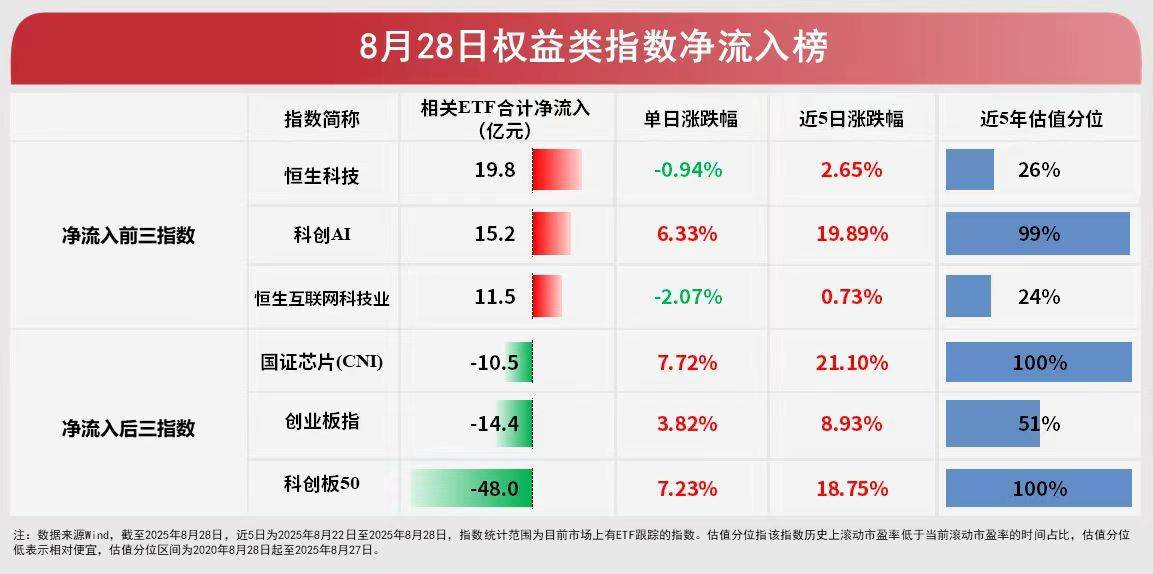
Core Viewpoint - The A-share market experienced a collective rise in the three major indices, with a total market turnover of approximately 3 trillion yuan, driven by technology sectors such as copper cables, CPO, photolithography machines, satellite communications, and semiconductors [1] Group 1: Market Performance - The Hang Seng Technology Index-related ETFs saw a net inflow of nearly 2 billion yuan, ranking first in the entire market, with the E Fund Hang Seng Technology ETF (513010) attracting over 350 million yuan in a single day [1] - The Sci-Tech Innovation Artificial Intelligence ETF (588730) and other ETFs tracking the Shanghai Stock Exchange Sci-Tech Innovation Board AI Index collectively attracted over 1.5 billion yuan [1] - The Double Innovation sector-related broad-based indices experienced outflows, with the Sci-Tech Innovation Board 50 Index and the ChiNext Index-related products seeing significant losses [1] Group 2: Investment Insights - Huatai Securities indicated that improvements in domestic fundamentals, domestic liquidity, and overseas liquidity are the three key pillars for the market to enter an upward trend, with all three factors currently showing positive changes [1] - The transition from quantitative to qualitative changes requires time, and a fully prepared momentum is necessary for the market to advance further [1] - Strategic allocation focuses on AI chains, innovative pharmaceuticals, military industry, and large financial sectors, with an internal strategy of moderately high cutting and low [1]

机构:科技是确定性主线,创业板ETF天弘(159977)、科创综指ETF天弘(589860)、双创龙头ETF(159603)集体上涨
2 1 Shi Ji Jing Ji Bao Dao· 2025-08-28 03:33
Group 1 - The A-share market indices collectively rose in early trading, with the ChiNext Index increasing by over 1.6% [1] - The Tianhong ChiNext ETF (159977) rose by 1.7% with a trading volume exceeding 82 million yuan, and its constituent stock, Tianfu Communication, surged over 18% [1] - The Tianhong ChiNext ETF has seen a net inflow of over 25 million yuan in the last five trading days, with a cumulative increase of nearly 20% in August [1] Group 2 - The Tianhong Sci-Tech Innovation ETF (589860) increased by 1.88% with a trading volume exceeding 37 million yuan, led by stocks like Zhenlei Technology and SMIC [1] - The Sci-Tech Innovation ETF closely tracks the Sci-Tech Innovation Index, covering approximately 97% of the market capitalization of the Sci-Tech Innovation Board, with a strong representation of small-cap hard technology companies [1] - The Double Innovation Leader ETF (159603) rose by 4.08% with a trading volume exceeding 19 million yuan, featuring leading stocks such as Tianfu Communication and SMIC [2] Group 3 - The Double Innovation Leader ETF tracks the CSI Sci-Tech Innovation and Entrepreneurship 50 Index, which selects 50 large-cap emerging industry companies from the Sci-Tech Innovation and ChiNext boards [2] - According to Dongfang Securities, market confidence is on an upward trend, with expectations for the index to continue rising, particularly in the technology sector [2]

创业板指站上2800点,创业板ETF天弘(159977)、科创综指ETF天弘(589860)半日涨超2%,双创龙头ETF(159603)涨近4%
2 1 Shi Ji Jing Ji Bao Dao· 2025-08-27 05:23
Group 1 - The A-share market saw a collective rise in the three major indices, with the ChiNext Index increasing by 2.41% and surpassing 2800 points as of the midday close on August 27 [1] - The Tianhong ChiNext ETF (159977) recorded a 2.39% increase and a trading volume exceeding 61 million yuan, with Longchuan Technology hitting the daily limit [1] - The Tianhong ChiNext ETF (159977) experienced a net inflow of over 45 million yuan on the previous day and has seen net inflows in 4 out of the last 5 trading days, totaling over 61 million yuan [1] Group 2 - The Tianhong ChiNext ETF (159977) has a year-to-date increase of 28.69% as of August 26 [1] - The Double Innovation Leading ETF (159603) rose by 3.93% with a trading volume exceeding 12 million yuan, featuring stocks like Yiwei Lithium Energy and Xinyi Sheng rising over 11% [1] - The Tianhong Sci-Tech Comprehensive Index ETF (589860) increased by 2.76% with a trading volume exceeding 30 million yuan, including multiple stocks like Nanjing New Pharmaceutical and Kaipu Cloud hitting the daily limit [1] Group 3 - The total margin balance for the ChiNext reached 453.31 billion yuan as of August 26, an increase of 4.878 billion yuan from the previous trading day, marking a continuous increase for 12 trading days [2] - Financing balance accounted for 451.85 billion yuan, also showing a daily increase of 4.884 billion yuan, with a cumulative increase of 51.618 billion yuan during this period [2] - Hu Long Securities indicated that policies to boost domestic demand are being introduced, and the fundamental situation is improving, supporting upward valuation space [2] Group 4 - Xiangcai Securities anticipates that the A-share market will exhibit wide fluctuations and gradual upward trends in September, suggesting a focus on sectors like artificial intelligence and infrastructure related to anti-involution events [3]




Is WisdomTree U.S. High Dividend ETF (DHS) a Strong ETF Right Now?
ZACKS· 2025-08-26 11:21
Core Insights - The WisdomTree U.S. High Dividend ETF (DHS) is a smart beta ETF launched on June 16, 2006, providing broad exposure to the Large Cap Value category [1] - DHS has accumulated over $1.29 billion in assets, positioning it as an average-sized ETF in its category [5] - The fund aims to match the performance of the WisdomTree U.S. High Dividend Index, which is fundamentally weighted and focuses on companies with high dividend yields [5] Investment Strategy - Smart beta ETFs, like DHS, differ from traditional market cap weighted indexes by selecting stocks based on fundamental characteristics rather than market capitalization [3][4] - The annual operating expenses for DHS are 0.38%, which is competitive within its peer group [6] - The fund has a 12-month trailing dividend yield of 3.38% [6] Holdings and Sector Exposure - DHS's top holdings include Philip Morris International Inc and Johnson & Johnson, with the US Dollar accounting for 100% of total assets [7] - The top 10 holdings represent approximately 139.08% of DHS's total assets under management, indicating a concentration in these positions [8] Performance Metrics - As of August 26, 2025, DHS has gained about 10% year-to-date and approximately 13.08% over the past year [9] - The fund has traded between $87.71 and $101.82 in the last 52 weeks [9] - DHS has a beta of 0.69 and a standard deviation of 14.45% over the trailing three-year period, categorizing it as a medium-risk investment [10] Alternatives - Other ETFs in the same space include Schwab U.S. Dividend Equity ETF (SCHD) and Vanguard Value ETF (VTV), which have significantly larger asset bases of $72.08 billion and $143.1 billion, respectively [12] - SCHD has a lower expense ratio of 0.06%, while VTV has an expense ratio of 0.04%, making them potentially more attractive options for cost-conscious investors [12]

这只创业板ETF,破千亿!
Sou Hu Cai Jing· 2025-08-26 09:46
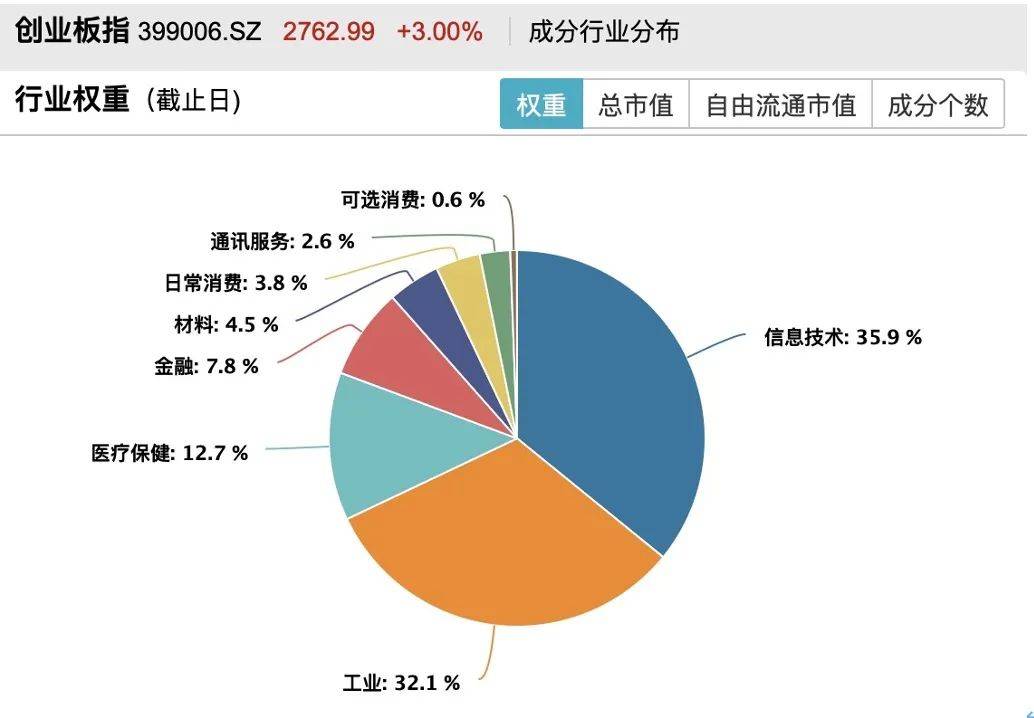
Core Viewpoint - The E Fund ChiNext ETF has surpassed 100 billion yuan in scale, becoming the largest ChiNext ETF in the market as of August 25 [1][4]. Group 1: ETF Performance and Growth - As of August 25, the E Fund ChiNext ETF reached a scale of 100.708 billion yuan, marking a significant increase since it last surpassed the 100 billion yuan mark on November 13 of the previous year [4][5]. - The ChiNext Index has shown impressive performance, with a year-to-date increase of over 29% and a maximum increase of over 58% since the low point in April [4][5]. - The E Fund ChiNext ETF was established on September 20, 2011, with an initial issuance of 562 million shares, and its current share count stands at 36.769 billion [4][5]. Group 2: Market Context and Comparisons - There are currently seven ETFs in the market with a scale exceeding 100 billion yuan, covering key indices such as CSI 300, SSE 50, and CSI 500 [2][5]. - The E Fund ChiNext ETF is the seventh large-scale stock ETF, with the top four positions held by CSI 300-related ETFs, the largest being the Huatai-PB CSI 300 ETF with over 400 billion yuan [5]. - The ChiNext Index is characterized by its growth style, primarily driven by the technology and new energy sectors, and has outperformed the CSI 300 and CSI 500 indices since 2011, with a cumulative increase of over 140% [7][11]. Group 3: Industry Composition and Valuation - The ChiNext Index covers strategic emerging industries, including high-end manufacturing, information technology, and biomedicine, with significant weight in information technology (35.9%) and industrial sectors (32.1%) [7][10]. - As of August 25, 2025, the ChiNext Index has a price-to-earnings ratio of 40.08, indicating a high valuation level [7][10]. - The recent optimization of the ChiNext Index's compilation rules has enhanced its market representation and investment value, focusing on new industries and high-tech enterprises [10][11].
ETF及指数产品网格策略周报(2025/8/26)
华宝财富魔方· 2025-08-26 09:33
Core Viewpoint - The article discusses the potential impact of U.S. Federal Reserve's interest rate cuts and the implications for various ETFs, particularly in the context of consumer demand and market liquidity [2][3]. Group 1: U.S. Economic Indicators - U.S. Treasury Secretary indicated a possible 50 basis points rate cut in September, with unemployment claims reaching 235,000, the highest since June [2]. - Continuing claims for unemployment benefits hit 1.972 million, the highest since November 2021, indicating a cooling labor market [2]. - Federal Reserve Chairman Powell signaled a dovish stance at the Jackson Hole meeting, suggesting a need to adjust policy due to rising inflation risks and declining employment risks [2]. Group 2: Impact on Consumer Demand - A potential rate cut could boost U.S. consumer demand, providing a favorable environment for economic recovery [3]. - The extension of tariff suspension on China by President Trump may mitigate the impact of new tariffs on domestic consumer prices and spending [3]. Group 3: ETF Performance and Strategy - The S&P Consumer ETF (159529.SZ) has shown promising backtest results over the past 120 trading days, indicating potential for future performance [4]. - The Hang Seng Technology Index ETF (513180.SH) has seen significant net inflows from southbound funds, totaling HKD 731.2 billion in the first half of 2025, which is 91% of last year's total [5]. - The Hang Seng Technology Index covers 30 leading tech companies listed in Hong Kong, with a current PE-TTM of 22.25, below the historical average [6]. - The New Economy ETF (159822.SZ) aims to track the performance of China's new economy sectors, focusing on high-growth areas such as internet technology and healthcare [9].

这只创业板ETF,破千亿!
中国基金报· 2025-08-26 07:42
Core Viewpoint - The E Fund ChiNext ETF has surpassed 100 billion yuan in scale, becoming the largest ChiNext ETF in the market as of August 25 [2][5]. Group 1: ETF Performance and Growth - As of August 25, the E Fund ChiNext ETF reached a scale of 100.71 billion yuan, marking a significant increase since it last surpassed the 100 billion yuan mark on November 13 of the previous year [5][6]. - The ChiNext Index has shown impressive performance, with a year-to-date increase of over 29% and a maximum increase of over 58% since the low point in April [5][6]. - The E Fund ChiNext ETF was established on September 20, 2011, with an initial issuance of 562 million shares, and its current share count stands at 3.68 billion [5][6]. Group 2: Market Context and Comparisons - There are currently seven ETFs in the market with a scale exceeding 100 billion yuan, covering key indices such as CSI 300, SSE 50, and CSI 500 [3][6]. - The E Fund ChiNext ETF is the seventh large-scale stock ETF, with the top four positions held by CSI 300-related ETFs, including the Huatai-PB CSI 300 ETF, which exceeds 400 billion yuan [6]. - The ChiNext Index is characterized by its growth style, focusing on emerging industries such as high-end manufacturing, information technology, and biomedicine, with significant representation from the information technology sector (35.9%) and industrial sector (32.1%) [8][12]. Group 3: Valuation and Future Outlook - As of August 25, 2025, the ChiNext Index has a price-to-earnings ratio of 40.08, placing it at the 38.36 percentile [9]. - The ChiNext Index has shown a cumulative increase of over 140% since January 1, 2011, significantly outperforming the CSI 300 and CSI 500 indices [8][12]. - Industry experts believe that the high proportion of emerging industries and high-tech enterprises in the ChiNext Index indicates strong growth potential and competitiveness, contributing to high-quality economic development in the long term [12].
沪指站稳3800点,资金布局上证综指,上证综指ETF(510760)连续4日净流入2亿元!
Sou Hu Cai Jing· 2025-08-26 07:05
Group 1 - The market sentiment has improved significantly, with trading volume increasing to 3.18 trillion yuan [1] - Multiple positive factors, including expectations of interest rate cuts by the Federal Reserve, new real estate policies in Shanghai, and Goldman Sachs raising its target price for Cambricon, have driven the market to accelerate upward [1] - Recent significant increases in the two innovation indices reflect a systematic reassessment of funds towards technology and growth sectors [1] Group 2 - Despite the recent index gains, the market is primarily driven by sentiment, with a lack of fundamental support [1] - After September 3, the market may cool down, and a comprehensive bull market could shift towards a structural one, focusing more on fundamentals and performance verification [1] - In the medium term, it is advisable to pay attention to undervalued high-quality growth stocks while avoiding previously overheated sectors [1]
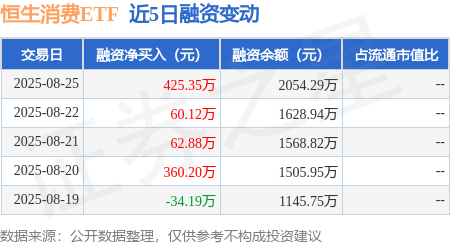
恒生消费ETF:8月25日融资净买入425.35万元,连续3日累计净买入548.35万元
Sou Hu Cai Jing· 2025-08-26 02:43
Group 1 - The core point of the news is that the Hang Seng Consumer ETF (513970) has seen a net financing inflow of 425.35 million yuan on August 25, 2025, with a total financing balance of 2,054.29 million yuan, indicating a positive market sentiment towards the ETF [1][2][3] - Over the past three trading days, the ETF has recorded a cumulative net inflow of 548.35 million yuan, with 12 out of the last 20 trading days showing net financing inflows [1] - The financing balance increased by 26.11% compared to the previous day, reflecting a strong bullish sentiment in the market [2][3] Group 2 - The financing inflow on August 25, 2025, was 425.35 million yuan, while the financing balance was 2,054.29 million yuan [2] - The financing balance has shown a consistent upward trend, with notable increases on previous trading days, such as 360.20 million yuan on August 20, 2025 [2][3] - The overall financing and margin trading balance reached 2,054.29 million yuan, marking a significant increase in market activity [3]
创业板指盘中创近3年新高!权重股“易中天”再创新高,创业板ETF广发(159952)一度涨超3%
Xin Lang Cai Jing· 2025-08-25 06:23
Group 1 - The ChiNext index surged over 3% as of noon on August 28, 2025, reaching a nearly three-year high, indicating a positive trend in the A-share market driven by recovering market confidence and improved liquidity [1] - The ChiNext ETF Guangfa (159952) rose by 1.35%, with a peak increase of over 3% during the session, reflecting strong performance among component stocks such as Jinli Permanent Magnet, which increased by 19.14%, and Lepu Medical, which rose by 12.67% [1] - The top ten weighted stocks accounted for 52.52% of the index, with notable gains from Zhongji Xuchuang (up 10.90%) and others like Xinyi Sheng and Yiwei Lithium Energy also showing positive trends [1] Group 2 - The Ministry of Industry and Information Technology emphasized the need to enhance computing power resource supply quality and promote the construction of green data centers, which could benefit the technology sector [1] - DeepSeek's optimization for domestic chip compatibility is expected to significantly benefit application sectors, particularly in finance and healthcare, potentially driving AI applications as a key market trend [2] - The latest scale of the ChiNext ETF Guangfa reached 12.09 billion yuan, marking a three-month high, with a recent increase of 81.6 million shares over the past week and a net inflow of 17 million yuan over four out of the last five trading days [2]