医美

Search documents
浙江杭州预付式消费综合治理成效明显
Zhong Guo Zhi Liang Xin Wen Wang· 2026-01-08 07:15
Core Insights - Hangzhou has achieved significant results in the comprehensive governance of prepaid consumption, launching a social co-governance action for integrity in business and a market-oriented reform plan for promotion across the province [1] Group 1: Government Initiatives - Hangzhou is the first city in China to define administrative departments involved in prepaid consumption management by industry supervision, comprehensive regulation, and law enforcement [1] - The city has strengthened inter-departmental collaboration and improved the risk warning and disposal mechanism, incorporating prepaid consumption into industry credit governance [1] - By the end of November 2025, the city received and handled 19,000 complaints related to closed prepaid consumption businesses, a year-on-year decrease of 19.23%, with the largest declines in education and training (59.37%) and sports fitness (29.36%) [1] Group 2: Market Developments - Hangzhou has actively developed a new model of platform economy, supporting the launch of market-oriented products such as Ant Group's "Anxin Pay" and Meituan's "Anxin Study" [1] - By the end of November 2025, the city had secured 562 million yuan in funds for consumer safety through these platforms [1] - The Gongshu District has implemented market-oriented reforms in prepaid consumption, covering 6,256 merchants across 21 sub-sectors, ensuring the safety of 110 million yuan in funds [2] Group 3: New Policies and Incentives - Three new policy measures were announced, allowing prepaid payments through compliant third-party platforms to be exempt from card issuance registration and to exceed the 5,000 yuan limit [2] - Businesses participating in the new prepaid consumption safety management model can receive up to 200,000 yuan in support for high-quality development from the city [2] - The first batch of 99 one-star stores in the beauty and hairdressing industry was announced, along with 13 stores in the "credit + sports consumption" application scenarios [2] Group 4: Collaborative Efforts - Ant Group announced the upgrade of "Anxin Pay 2.0," while Meituan launched the "Anxin Study Credit List" [3] - Representatives from government, consumers, and industry associations initiated a provincial promotion map for market-oriented reforms, marking the transition of the "Hangzhou experience" from pilot exploration to provincial deepening [3]
全面涨价?中韩医美免税政策同时终止
3 6 Ke· 2026-01-07 02:55
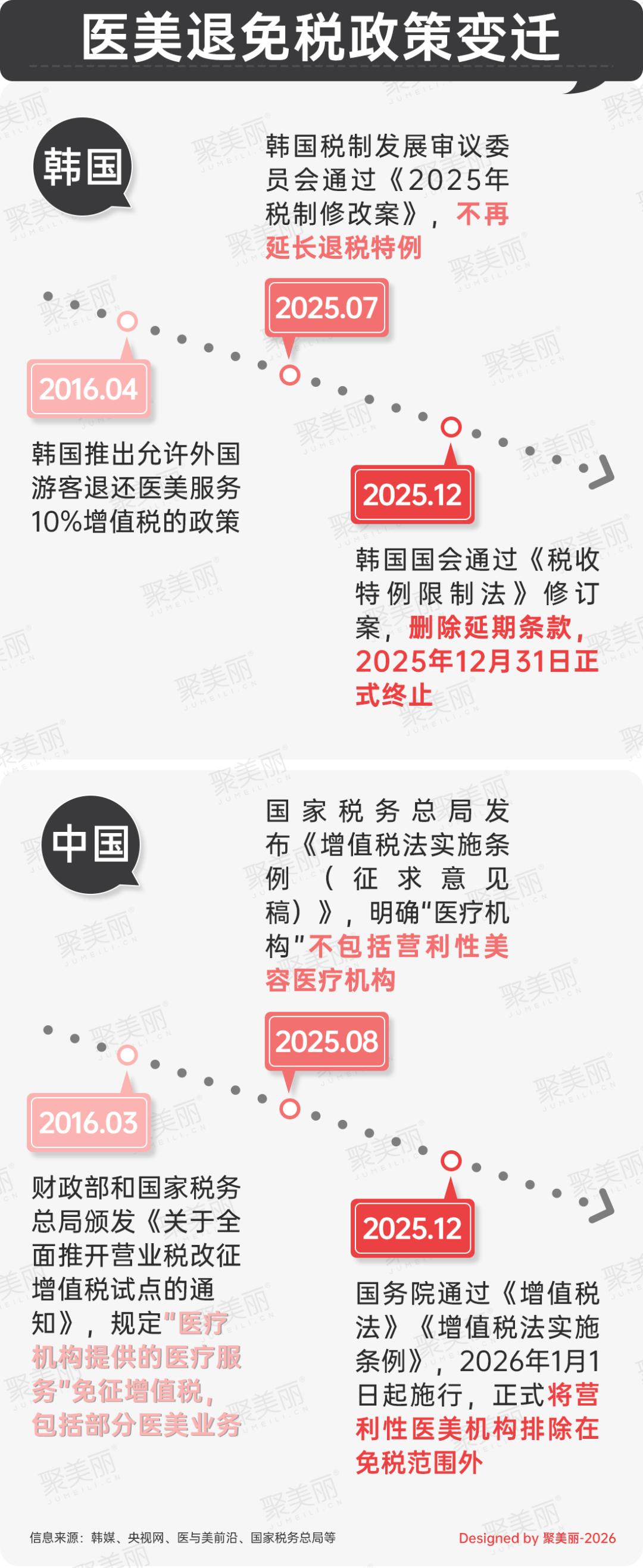
Core Insights - The medical beauty industry in China and South Korea is entering a new phase as both countries terminate their tax exemption policies for medical beauty services, marking the end of a tax incentive era [1][2][11] Group 1: Policy Changes - South Korea's medical beauty tax refund policy, which allowed foreign tourists to receive a 10% VAT refund, officially ended on December 31, 2025, after ten years of implementation [5][11] - China will implement a new VAT law starting January 1, 2026, which excludes profit-driven beauty medical institutions from tax exemptions, imposing a 6% VAT on these services [9][12] Group 2: Impact on Pricing - The immediate effect of these policy changes is an increase in operational costs for medical beauty institutions, likely leading to higher prices for consumers [12][13] - Experts suggest that while prices may rise due to the tax burden, the actual increase will vary based on regional factors and individual business strategies [12][13] Group 3: Industry Transformation - The end of tax incentives signals a shift from price competition to a focus on compliance and refined operations as core competitive advantages in the medical beauty sector [15][16] - Companies will need to enhance their technical capabilities, service quality, and overall customer experience to demonstrate value in a more regulated environment [15][16] Group 4: Future Directions - The regulatory changes may push the industry towards new collaboration models, such as partnerships with cosmetic brands to offer combined packages, helping to alleviate tax burdens [17][18] - The medical beauty sector is at a critical juncture, where the focus will shift from leveraging tax advantages to creating value and ensuring compliance, leading to a potential reshuffling of market leaders [18][19]

轻工、美护2026年年度策略:内需筑底深挖潜力,出海突围打开新局
HUAXI Securities· 2026-01-07 02:30
Group 1: Industry Overview - The light industry and beauty sector is expected to stabilize and improve due to the dual drivers of domestic demand policies and steady export growth [3] - The "14th Five-Year Plan" marks a year of enhanced domestic demand policies, coupled with consumers' increasing pursuit of high-quality living, creating significant growth opportunities for the industry [3] - The penetration rate of cross-border e-commerce has ample room for improvement, and the recovery of international relations and demand from emerging markets will further drive market expansion [3] Group 2: Beauty Sector - The cosmetics market is projected to grow steadily, with the skincare segment being the largest, reaching a market size of 4,619 billion yuan in 2024, and expected to grow at a CAGR of 8.6% from 2024 to 2029 [19] - The high-end cosmetics market is rapidly expanding, with the market size for high-end skincare products increasing from 749 billion yuan in 2019 to 1,144 billion yuan in 2024, reflecting a CAGR of 8.84% [19] - Key companies in the beauty sector include: - **Mao Geping**: Revenue reached 25.88 billion yuan in H1 2025, with a growth rate of 31.28% [23] - **Lin Qingxuan**: Revenue grew to 10.52 billion yuan in H1 2025, marking a 98.28% increase [27] - **Marubi**: Revenue is expected to reach 29.70 billion yuan in 2024, recovering from previous declines [32] Group 3: Medical Aesthetics - The medical aesthetics sector is facing short-term pressure due to cautious consumer spending, but the long-term growth potential remains strong, with a projected CAGR of 10%-15% from 2024 to 2027 [36] - The market penetration rate for medical aesthetics in China is currently at 4-5%, indicating a growth potential of 2-5 times compared to countries like the US and South Korea [36] - Key companies in the medical aesthetics sector include: - **Jinbo Biological**: Achieved revenue of 12.96 billion yuan in Q1-Q3 2025, with a year-on-year growth of 31.10% [45] Group 4: Daily Chemicals - The daily chemical industry is benefiting from domestic demand policies, with local brands poised to capture market share [49] - Companies such as **Dengkang Oral Care** and **Runben** are highlighted for their strong market positions and growth potential [51][55] - **Shanghai Jahwa** has shown significant growth, with revenue reaching 49.61 billion yuan in Q1-Q3 2025, reflecting a 10.83% increase [59] Group 5: Home Furnishing - The home furnishing sector is under pressure due to weak real estate sales, with a 15% decline in residential investment in 2025 [65] - National subsidies for home appliances and furnishings have provided some support, but the long-term effects are limited [65] - Leading companies such as **Oppein Home** and **Kuka Home** are noted for their strong channel capabilities and multi-category layouts [65]




美金融家警告,2026将爆最惨金融危机,日本首当其冲,原因在高市
Sou Hu Cai Jing· 2026-01-06 22:27
Group 1 - The article highlights the looming financial crisis predicted for 2026, with the U.S. debt nearing $40 trillion and Japan's debt expected to reach 235% of its GDP by year-end [1][3] - The global economic damage caused by uncontrollable factors since late 2019 has exacerbated debt accumulation issues in various countries, with Japan likely to be the first to face a crisis [3][5] - The Japanese government's current fiscal policies, particularly under Prime Minister Kishida, are criticized as detrimental to the economy, with reliance on deficit financing seen as a dangerous approach [5][15] Group 2 - The article discusses the adverse effects of Kishida's monetary policies, which contradict global central bank tightening, potentially leading to unsustainable debt levels for Japan [5][9] - Relations between Japan and China have deteriorated due to Kishida's provocative statements regarding Taiwan, which could have significant economic repercussions for Japan, given China's importance as a trading partner [9][10] - The economic impact of Kishida's policies is evident, with Japan's GDP contracting by 0.4% in the latest quarter, marking the first negative growth of the year, and further economic decline is anticipated [13][15]

今年起医美机构不再免增值税 行业商业模式或重构
Sou Hu Cai Jing· 2026-01-06 16:33
Core Viewpoint - The medical beauty industry will no longer enjoy tax exemption benefits as the new VAT law and its implementation regulations come into effect, requiring profit-oriented medical beauty institutions to pay a 6% VAT rate [1][5]. Group 1: Tax Policy Changes - The new VAT law, effective from January 1, 2026, specifies that "medical services provided by medical institutions" are exempt from VAT, but this does not include profit-oriented medical beauty institutions [1]. - Previously, profit-oriented medical beauty institutions could benefit from VAT exemptions if they met certain conditions, but this has changed with the new regulations [2][3]. - The removal of VAT exemptions for profit-oriented medical beauty institutions aims to ensure tax fairness and align the tax burden for similar services [3][4]. Group 2: Industry Impact - The medical beauty industry in China has seen rapid growth, with market size exceeding 300 billion yuan, driven by increasing demand and a growing number of young consumers [2]. - The cancellation of VAT exemptions may lead to price increases in medical beauty services, although the extent of these increases will vary based on factors such as regional differences and business strategies [6]. - The industry is expected to undergo a restructuring of its business model due to high marketing costs and the inability to claim VAT deductions on promotional expenses [6].
瑞丽医美(02135)附属拟255万港元认购莱丽医美51.0%股权
Zhi Tong Cai Jing· 2026-01-06 14:48
Core Viewpoint - 瑞丽医美 has entered into a subscription agreement to acquire shares in 莱丽医美有限公司, which will enhance its business operations in Hong Kong and provide potential investment returns [1][2] Group 1: Subscription Agreement Details - 瑞丽医美 will issue a total of 170,000 shares to the first investor 瑞丽美学有限公司 at a subscription price of 2.55 million HKD and 63,300 shares to the second investor 比夫有限公司 at a subscription price of 950,000 HKD [1] - After the completion of the agreement, the shareholding will be distributed as follows: 缪诗美学 will hold 30.0%, the first investor will hold 51.0%, and the second investor will hold 19.0% of the target company [1] - The target company 莱丽医美有限公司 will become an indirect non-wholly owned subsidiary of 瑞丽医美, and its financial performance will be consolidated into the group’s accounts post-completion [1] Group 2: Strategic Rationale - The board believes that the subscription aligns with the group’s business expansion strategy, particularly in enhancing its presence in the Hong Kong market [2] - The subscription is viewed as a unique opportunity to promote the brand and provide beauty services to potential customers, creating synergies with existing operations [2] - The operational and financial performance of the target company is expected to improve once it commences beauty services in Hong Kong, potentially leading to investment returns for the group [2]
瑞丽医美(02135.HK)附属认购莱丽医美51%股权 代价255万港元
Ge Long Hui· 2026-01-06 14:39
Group 1 - The core announcement involves a subscription agreement between Miao Shi Aesthetics, investors, shareholders, and the target company, Laili Medical Limited, dated January 6, 2026 [1] - The first investor agrees to subscribe for a total of 170,000 shares at a subscription price of HKD 2,550,000, while the second investor, Bif Limited, agrees to subscribe for 63,335 shares at a price of HKD 950,000 [1] - Upon completion, Miao Shi Aesthetics, the first investor, and the second investor will hold 30.0%, 51.0%, and 19.0% of the target company's shares, respectively [1]
一财主播说 | 今年起整容将告别免税 医美价格要涨价吗?
Di Yi Cai Jing· 2026-01-06 07:56
那么,不免税了,医美价格是否会涨价?上海国家会计学院副教授葛玉御表示,理论上,企业会把增值 税税负转嫁给消费者。但实际上,医美价格受多重因素影响,不仅仅是税收。此外,医美行业的特点是 医疗耗材成本占比低,渠道推广成本费用高,而渠道费很难拿到增值税发票来抵扣。在税务合规的背景 下,医美行业严重畸形的商业模式可能要重构。 医美行业部分业务享受免税优惠将成为历史。第一财经记者从税务总局北京市税务局12366纳税缴费服 务热线处了解到,今年开始,只要是营利性美容医疗机构,将不再享受免征增值税优惠政策。中南财经 政法大学田彬彬告诉第一财经,增值税免税是一种"福利"。国家希望通过免税降低老百姓看病救命的成 本。而美容医疗更多属于消费升级和悦己消费,不具备"基本医疗保障"的属性,应当取消免税优惠。 ...
餐饮星级评分“短期震荡”背后:“线上口碑”新标准正挤掉评分“水份”
第一财经· 2026-01-06 07:25
Core Viewpoint - The article discusses the recent upgrade of the star rating system by Dazhong Dianping, which aims to shift the focus of businesses from accumulating reviews to enhancing product quality and service, thereby addressing the issue of "review inflation" in the restaurant industry [1][6][12]. Group 1: Impact of the New Star Rating System - The new star rating system has led to a phenomenon termed "star rating shock," where businesses that previously engaged in excessive review solicitation face a decline in their ratings [2][3]. - Approximately 270,000 businesses have experienced a decrease in their star ratings, while around 290,000 have seen an increase, indicating a balanced "replacement" process in the industry [3]. - The new system evaluates the authenticity of reviews through multiple dimensions, including content and user behavior, making it difficult for businesses to gain star ratings through artificial means [2][9]. Group 2: Business Reactions and Adjustments - Some businesses that have consistently focused on quality and service have seen their ratings improve under the new system, while others have had to adjust their strategies to reduce solicitation efforts and enhance product quality [2][3]. - The article highlights the mixed feelings among businesses, with some expressing anxiety about potential rule circumvention by competitors, while others are optimistic about the focus on quality over quantity [7][9]. - The upgrade aims to alleviate the operational burden on businesses by discouraging excessive review solicitation and promoting a return to quality management [6][10]. Group 3: Future Directions and Industry Standards - The article emphasizes the need for transparency in the rating system to help businesses understand the changes and avoid unnecessary investments [10][12]. - Dazhong Dianping plans to extend the upgraded rating system beyond the restaurant sector to other industries, promoting a new standard for social evaluation [12]. - The ultimate goal of the upgrade is to foster a healthier business ecosystem, encouraging businesses to prioritize product and service quality over artificial rating manipulation [12].

暴利的宠物,大厂的坟墓
投中网· 2026-01-06 06:11
Core Viewpoint - The pet economy, while appearing lucrative with a market size of 300 billion and gross margins reaching 50%, is proving to be a challenging business for large companies, as evidenced by the failures of several high-profile entrants [6][7]. Group 1: Profitability and Business Challenges - Pet food is the hottest category in the pet economy, with domestic brands achieving gross margins of 40%-50%, but the actual profitability for companies is often much lower, with leading firms like Zhongchong Co. reporting a gross margin of only 28.16% and a net margin of 9.33% in 2024 [9][10]. - The high gross margins in the pet economy are often offset by significant marketing and operational costs, such as rising sales expenses for companies like Guibao Pet, which increased from less than 100 million in 2017 to over 1 billion in 2024, reflecting a 46.31% year-on-year increase [10][11]. - The emotional value associated with pet products does not translate into sustainable profits for companies, as the costs of marketing through KOLs and maintaining physical stores can erode margins significantly [17][18]. Group 2: Market Dynamics and Competition - The pet economy is characterized by a reliance on personal relationships and trust between pet owners and service providers, making it difficult for large companies to replicate the success of smaller, independent operators [27][30]. - Many businesses in the pet economy, such as grooming and veterinary services, thrive on the expertise and personal touch of individual operators, which large companies struggle to scale effectively [19][26]. - The challenges faced by large companies in the pet economy mirror those in other high-margin industries like beauty and medical services, where the core value often lies in the individual professionals rather than the corporate structure [20][22].