消费金融

Search documents
提振消费动真格了,金融市场会怎么走?
Sou Hu Cai Jing· 2025-12-15 02:32
Core Viewpoint - The core idea of the document is that finance should more directly and proactively support increased consumer spending, which has significant implications for the financial market, particularly the A-share market [1] Group 1: Financial Support for Consumption - The document outlines three main areas and eleven measures aimed at revitalizing consumer confidence, capacity, and scenarios [1] - The first main line emphasizes that financial support for commodity consumption is detailed and direct, focusing on making it easier for consumers to spend money [2] - Policies include more flexible consumer loan limits, extended terms, differentiated interest rates, and potential waivers on early repayment penalties for car loans [2] Group 2: Service Consumption - Service consumption is prioritized, addressing the need for consumers to spend on experiences rather than just goods [2] - Key sectors highlighted for support include dining, accommodation, cultural tourism, education, elderly care, childcare, sports and entertainment, and health services [3] Group 3: Financial Products and Services - The policy aims to make financial products more aligned with consumption scenarios, moving beyond just providing loans [4] - Specific initiatives include special loans for service consumption, refinancing for elderly care, and financing for intangible assets like intellectual property and technological achievements [4] Group 4: New Consumption Models - The document emphasizes the importance of new consumption models, including digital, green, and AI-driven consumption, as well as content and social e-commerce [5] - Financial institutions are encouraged to collaborate with platforms and merchants to reach more "long-tail users," indicating a shift towards sustainable growth supported by finance [5] Group 5: Economic and Market Implications - This initiative represents a shift where finance becomes a primary driver rather than a supporting role, with a focus on credit expansion rather than just subsidies [5] - The emphasis on stabilizing consumption is expected to improve corporate cash flows, restore profit expectations, stabilize bank asset quality, and lead to a more optimistic market outlook [5] Group 6: Market Sentiment - The measures aim to create conditions for a recovery in market risk appetite, with increased policy certainty for consumption-related sectors and growing opportunities in finance, technology, and services [6] - The document suggests that changes in consumer spending behavior can signal a turning point in the financial market [7]
影响市场重大事件:工信部深化拓展制造业数字化转型,加快卫星互联网建设发展;迪迩五号•中国科技城号发射成功,率先实现小型货运飞船商业化运营
Mei Ri Jing Ji Xin Wen· 2025-12-14 22:13
每经记者|杨建 每经编辑|肖芮冬 |2025年12月15日 星期一| NO.1 韩文秀:明年还将根据形势变化出台实施增量政策 2025-2026中国经济年会12月13日召开,主题为"贯彻落实中央经济工作会议精神,以高质量发展为'十 五五'开好局"。中央财办分管日常工作的副主任、中央农办主任韩文秀表示,做好明年经济工作,要坚 持稳中求进,提质增效,加大逆周期和跨周期调节,切实提升宏观经济治理效能。去年9月26日中央政 治局会议以来,先后出台实施了一系列政策措施,明年还将根据形势变化出台实施增量政策。要协同发 挥存量政策和增量政策的集成效应,推动经济稳中向好。 NO.4 商务部财务司负责人:将更大力度支持惠民生和提振消费 12月14日,商务部财务司负责人解读《关于加强商务和金融协同更大力度提振消费的通知》指出,《通 知》提出3方面11条政策措施。一是深化商务和金融系统协作。二是加大消费重点领域金融支持。三是 扩大政金企对接合作。下一步,商务部将会同中国人民银行、金融监管总局,指导各地相关部门和金融 机构加强协作,推动相关举措落地生效,更大力度支持惠民生和提振消费,为"十五五"良好开局作出积 极贡献。 NO.5 三 ...

消费利好!三部门,最新部署!
Zheng Quan Shi Bao· 2025-12-14 11:17
Core Viewpoint - The joint notice issued by the Ministry of Commerce, the People's Bank of China, and the Financial Regulatory Bureau aims to strengthen the collaboration between commerce and finance to boost consumption significantly [1][2]. Group 1: Policy Measures - The notice outlines 11 policy measures across three main areas: enhancing collaboration between commerce and finance, increasing financial support for key consumption areas, and expanding cooperation among government, finance, and enterprises [2][4]. - It emphasizes the need for local departments to improve communication and cooperation mechanisms, encouraging the integration of fiscal funds, credit, and social capital to implement specific measures effectively [2][5]. Group 2: Financial Support for Consumption - Financial institutions are encouraged to focus on five key areas: upgrading product consumption, expanding service consumption, fostering new consumption types, innovating diverse consumption scenarios, and supporting consumption assistance [2][7]. - Specific measures include enhancing financial services for durable goods and digital products, improving service consumption policies, and promoting new consumption models such as green and digital consumption [7][9]. Group 3: Government-Finance-Enterprise Cooperation - The notice encourages joint promotional activities for consumption, urging financial institutions to participate in local initiatives and develop tailored financial products to meet diverse consumer needs [2][11]. - It also highlights the importance of information sharing between local commerce departments and financial institutions to facilitate precise service delivery and enhance credit availability in the consumption sector [11][12].
2025普惠金融报告
Bei Jing Shang Bao· 2025-12-14 07:47
Core Insights - China's inclusive finance has evolved from a historical leap of "from nothing to something" to a focus on "precision" and "quality" in the next decade, addressing challenges such as customer homogeneity and rising risk control costs [1][3][10] Development and Achievements - The balance of inclusive loans for small and micro enterprises reached 36.5 trillion yuan, a year-on-year increase of 12.1%, more than double the end of the 13th Five-Year Plan [3][4] - Financial services have expanded to rural areas, achieving nearly 100% coverage of insurance services in towns and villages [5][10] - The concept of inclusive finance was officially proposed in 2013, aiming to provide financial services to underserved groups [4][10] Challenges and Market Dynamics - The transition from a "blue ocean" to a "red ocean" market has led to increased competition among financial institutions, with challenges such as customer homogeneity and rising acquisition costs [10][12] - Banks face difficulties in identifying new clients, particularly in rural areas where small businesses often lack collateral [10][12] - The insurance sector struggles with accurately pricing inclusive health insurance products for low-income groups [11][12] Future Directions - The next decade will focus on enhancing the quality of inclusive finance, with an emphasis on creating a high-level inclusive financial system that supports common prosperity [13][14] - A new coordination mechanism for supporting small and micro enterprises is being established to improve financial service accessibility [14][15] - Financial institutions are encouraged to innovate and develop tailored financial products for specific groups, enhancing service delivery through digital transformation [15][16]
三部门:加强商务和金融协同,更大力度提振消费
Hua Er Jie Jian Wen· 2025-12-14 07:40
商务部办公厅、中国人民银行办公厅、金融监管总局办公厅发布关于加强商务和金融协同,更大力度提 振消费的通知。其中提出,加大消费重点领域金融支持。加强大宗耐用消费品、数码产品等消费金融服 务,挖掘商品消费升级潜能。推动金融机构与平台、重点商户合作,走进商超卖场,完善分期付款、信 用卡、手机银行、数字人民币等产品服务模式,更好满足消费者换新需求。根据客户还款能力和信用情 况,合理确定贷款发放比例、期限和利率,落实好个人消费贷款额度、期限、利率差异化政策,加快推 动个人消费贷款业务发展。适当减免汽车以旧换新过程中提前结清贷款产生的违约金。加强金融机构与 内外贸一体化重点企业和平台对接,提供境内外交易撮合服务,完善跨境供应链融资模式,支持更多企 业内外贸一体化经营,扩大内贸险承保规模,支持更多优质外贸产品进入国内市场。 风险提示及免责条款 市场有风险,投资需谨慎。本文不构成个人投资建议,也未考虑到个别用户特殊的投资目标、财务状况或需要。用户应考虑本文中的任何 意见、观点或结论是否符合其特定状况。据此投资,责任自负。 ...
2025普惠金融报告|普惠十年记
Bei Jing Shang Bao· 2025-12-14 06:47
Core Insights - China's inclusive finance has evolved from a historical leap of "from nothing to something" to a focus on "precision" and "quality" in the next decade, with challenges such as customer homogeneity and rising risk control costs [1][12] - The development of inclusive finance has been marked by policy breakthroughs, technological empowerment, and service expansion, reaching rural areas and enhancing financial services beyond just credit [4][6] Group 1: Development Achievements - As of Q3 2025, the balance of inclusive loans for small and micro enterprises reached 36.5 trillion yuan, a year-on-year increase of 12.1%, more than double the end of the 13th Five-Year Plan [5] - The average interest rate for newly issued inclusive loans in 2024 was 4.13%, down 33 basis points from the previous year, indicating a trend towards more affordable financing [5] - The balance of agricultural loans reached 51.36 trillion yuan, growing by 9.8%, which is higher than the general loan growth rate [5] Group 2: Policy and Framework - The concept of inclusive finance was formally introduced in China in 2013, aiming to address the "Matthew effect" in financial services, where resources were concentrated among large enterprises [6] - The State Council issued a development plan for inclusive finance in 2015, establishing a framework to enhance financial services for underserved sectors [6][17] - The Central Financial Work Conference recognized inclusive finance as a key pillar for high-quality national development [8] Group 3: Challenges and Market Dynamics - The inclusive finance sector has transitioned from a "blue ocean" to a "red ocean," facing increased competition and challenges such as customer homogeneity and rising costs [12][13] - Financial institutions are struggling with the balance between expanding coverage and ensuring sustainable risk management, leading to issues like "picking the best" clients while neglecting smaller enterprises [13][14] - Specific challenges include the difficulty in assessing risks for small businesses and the need for insurance products to cover previously underserved populations [13][14] Group 4: Future Directions - The next decade will focus on enhancing the quality of inclusive finance, with an emphasis on creating a supportive monetary environment and improving service capabilities [16][19] - A new coordination mechanism for supporting small and micro enterprises is being established to facilitate better connections between banks and businesses [17] - The goal is to build a high-quality comprehensive inclusive finance system by 2025, with ongoing optimization of financial services for key sectors [17][18]


2025普惠金融报告|金融促消费,“大力出奇迹”
Bei Jing Shang Bao· 2025-12-14 06:20
Core Viewpoint - The article emphasizes the importance of financial services in stimulating consumer spending and addressing the current challenges in the consumption market, which faces both demand and supply-side issues [1][4]. Group 1: Demand and Supply Challenges - On the demand side, macroeconomic fluctuations and unstable income expectations have led to a widespread reluctance to consume among consumers [4]. - On the supply side, there are gaps in financial services within the consumption sector that fail to adequately meet market demand [4]. Group 2: Financial Services as a Solution - To expand consumption, it is essential to increase residents' financial capacity, which includes enhancing property income and providing sufficient financial support for consumption [4]. - Financial promotion of consumption is deemed a necessary measure for expanding domestic demand, requiring increased resource investment from financial institutions and targeted policies from regulatory bodies [4]. Group 3: Policy Coordination - A collaborative mechanism has been established at the policy level, where monetary policy provides liquidity and guidance, while fiscal policy directly reduces the costs of consumption and financial services through subsidies [2]. - Industry policies focus on key areas such as consumption upgrades and elderly care, effectively avoiding policy isolation and creating a multiplier effect to alleviate the reluctance to consume [2]. Group 4: Precision in Financial Policies - The article highlights the need for precision in financial policies to ensure that funds are effectively directed towards consumption rather than being diverted to savings or debt repayment [7]. - Specific subsidies or interest-free loans tied to particular consumption scenarios can significantly enhance the efficiency and impact of financial policies [7]. Group 5: Evolving Consumer Perspectives - Financial services should also play a role in guiding consumer attitudes, shifting the focus from merely satisfying desires to creating value [8]. - The development of financial products such as mortgages and consumer loans enables individuals to realize their consumption needs earlier, thereby enhancing their ability to achieve wealth aspirations [8]. Group 6: Quality Over Quantity - The strategy for promoting consumption is evolving from a focus on sheer volume to a greater emphasis on the quality, structure, equity, and sustainability of consumption [8]. - This shift reflects the necessity for financial services to support the real economy and contribute to the sustained recovery of consumption, ultimately aiding in high-quality economic development [9].

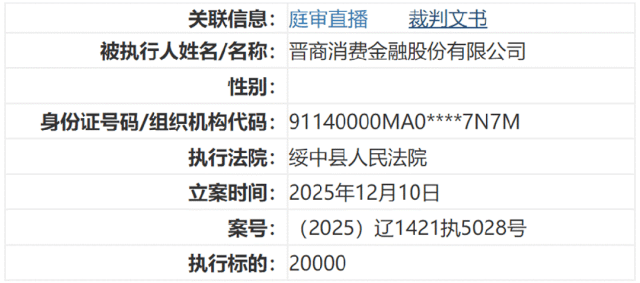
仅因2万元,晋商消金成被执行人
Sou Hu Cai Jing· 2025-12-13 08:37
近日,晋商消费金融成为被执行人,执行标的为2万元,立案时间为2025年12月10日,执行法院为绥中 县人民法院。 公开信息显示,晋商消费金融成立于2016年2月23日,目前注册资本5亿元,是经原银保监会批准成立的 全国性持牌消费金融公司,也是山西省内首家消费金融公司。 成立初期,晋商消费金融的第二大股东为360旗下北京奇飞翔艺商务咨询有限公司(本文称"奇飞翔 艺"),2023年1月,彼时的中国银保监局山西监管局批复了晋商消费金融股权变更的相关请示。 晋商消费金融股份有限公司 主营产品上,晋商消费金融旗下拥有"借蛙"、"晋情贷"等消费信贷产品。 批复显示,由上海荣大投资管理有限公司(本文称"上海荣大")受让奇飞翔艺持有晋商消费金融的1.25 亿股股份,受让后,奇飞翔艺不再持有相关股权。 截至目前,该公司前三大股东分别为:晋商银行(持股40%)、上海荣大投资管理有限公司(持股 25%)、天津宇信易诚科技有限公司(持股20%)。 在持牌消金公司中,晋商消费金融在资产规模和盈利方面上较为落后,且近几年的增长情况较为不稳 定。 截至2024年末,晋商消费金融总资产108.31亿元,较上年末增长20.99%;贷款余额10 ...
从货车司机到新市民,普惠金融如何精准滴灌“消费新蓝海”
Sou Hu Cai Jing· 2025-12-12 10:28
Core Insights - Inclusive finance is facing challenges such as product homogeneity and overlapping customer segments, while new opportunities arise from emerging consumer trends like the new citizen economy and green living [1] - Financial institutions are leveraging inclusive finance to unlock consumer potential by tailoring services to specific consumption scenarios [3] Group 1: Financial Institutions' Strategies - Banks are focusing on large consumer sectors like automotive and home appliances, offering specialized installment loans to ease consumer spending pressure [3] - Insurance companies are innovating products to enhance financial accessibility for low- and middle-income groups, while also emphasizing their social responsibility [3] - Consumer finance institutions are shifting from a "money finds people" approach to a "people find money" model, utilizing inclusive credit tools [1][3] Group 2: Emerging Consumer Trends - The consumer base is becoming younger and more educated, with millennials and Gen Z driving consumption, leading to a shift in spending habits towards online price comparison and offline purchases [6] - Specific consumer needs are becoming clearer, with business travelers focusing on travel-related benefits and families prioritizing education and health services [6] Group 3: Technological Integration - AI and large models are enhancing the capabilities of inclusive finance, allowing for more precise risk assessment and fraud detection [9][10] - Financial institutions are using technology to create a more personalized and efficient customer experience, transforming traditional risk management practices [11][12] Group 4: Challenges and Opportunities in REITs - The development of consumer-related REITs is still in its infancy, with only 12 out of 77 public REITs focused on consumer infrastructure, indicating significant growth potential [8] - There is a need for improved integration between fund managers and industry players to enhance operational management and decision-making processes [8] Group 5: Consumer Financial Health - Financial tools are being designed to help consumers manage their spending responsibly, with initiatives like government-subsidized personal loans and interest-free installment plans [5][6] - AI-driven features in financial products are aimed at promoting rational consumption and ensuring financial well-being for users [12]

蚂蚁消金首席合规官王彦敏:从“人找钱”到“钱找人”,AI重构普惠金融
Sou Hu Cai Jing· 2025-12-12 03:19
Core Insights - The article discusses the transformative impact of AI on consumer finance, emphasizing how it enhances financial services to meet the needs of users while ensuring safety and affordability [1][4][8]. Group 1: AI and Consumer Finance Transformation - Ant Group's consumer finance division aims to shift from a "money-seeking" model to a "money-finding" approach, making financial services more accessible and user-friendly [3][4]. - AI technology has improved risk assessment by analyzing diverse data points, allowing for quicker and more accurate lending decisions, particularly for underserved groups like new workers and delivery personnel [3][4][8]. Group 2: Financial Accessibility and Support - Ant Group has partnered with the government to offer consumer loan interest subsidies, enabling users to access interest-free installment plans for purchases, thus reducing financial pressure [4][5]. - The introduction of features like "Xiaohonghua" and "Bill Assistant" in the Huabei service helps users manage their finances better, leading to increased credit limits and lower delinquency rates [9]. Group 3: Security and Fraud Prevention - The rise of AI-generated fraud poses challenges, prompting Ant Group to develop advanced technologies to combat such threats, achieving a fraud detection accuracy rate of 98% [8][9]. - AI-driven customer service tools have significantly improved user satisfaction, with over 90% of users reporting positive experiences [8][9].