电力

Search documents
美国中期选举年,特朗普政府政策前瞻与投资策略:在政策旋涡中顺应时代潮流
Western Securities· 2026-03-19 12:25
Group 1 - The U.S. midterm elections will take place on November 3, 2026, with all 435 House seats and 35 Senate seats up for election. Young voter turnout will be a key variable affecting the election outcome, as their concerns focus on inflation, healthcare, and housing [1][8][15] - The report suggests that Trump's policies may shift towards economic and healthcare issues to gain support, while the Democratic Party needs to rebuild trust among young voters [1][8][15] Group 2 - Trump's tariff policy is expected to ease, with potential risks of increased tariffs on polysilicon, wind turbines, and drones. The uncertainty surrounding the U.S.-Mexico-Canada Agreement review process may lead to a painful renewal and annual review [2][20][25] - The healthcare policy will continue to follow the "America First, market-oriented, and reduce federal intervention" logic, with the "Great Healthcare Plan" unlikely to pass in an election year, but reforms in drug pricing and PBM are potential compromise areas [2][26][28] Group 3 - The housing policy aims to regulate demand but is unlikely to address the core supply-side issues, as young people's housing problems stem from low real income and tight housing supply [2][30][31] - The energy policy pressures tech giants to resolve their own power supply issues, as rising electricity prices due to data center demand could pose risks for the Republican Party in the midterm elections [2][36][37] Group 4 - The investment strategy for the midterm election year suggests focusing on precious metals and opportunities in Latin America, which has significant potential in key minerals, infrastructure, and new energy development [3][45][47] - The report highlights the importance of addressing electricity supply shortages as a constraint on U.S. tech development, recommending a focus on grid equipment and related engineering themes [3][49][50] - Geopolitical conflicts and increased strategic reserves may benefit basic and strategic metals, with a specific recommendation to focus on copper due to its demand driven by AI and energy storage [3][52]
中国电力市场化改革新纪元:实时定价、AI赋能与储能爆发,开启万亿智慧能源新蓝海
Sou Hu Cai Jing· 2026-03-19 12:24
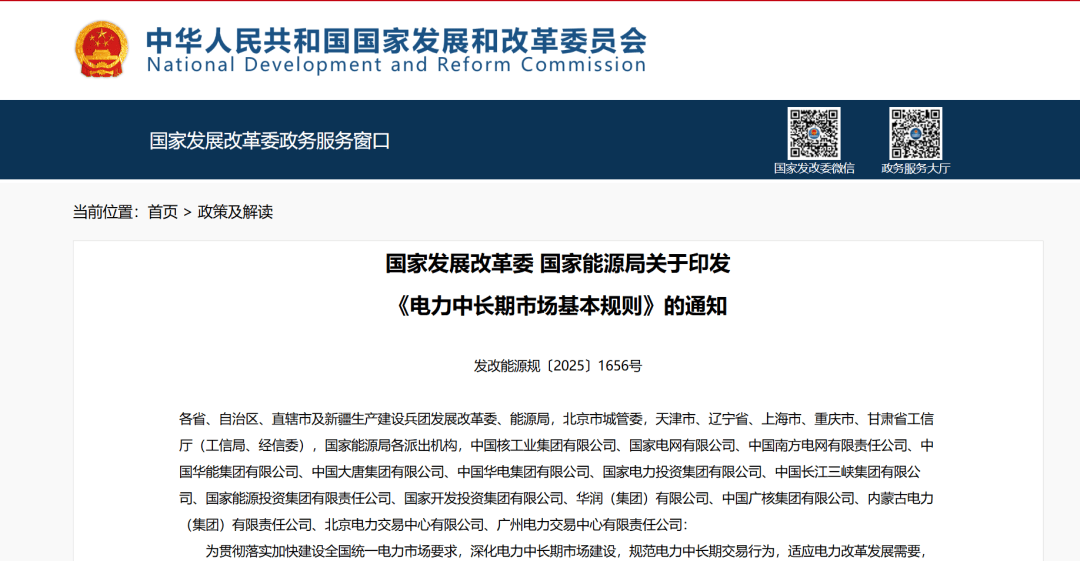
Core Insights - The implementation of the "Basic Rules for Long-term Electricity Market" marks a historic shift in China's electricity market, transitioning from a "planned pricing" era to a new phase characterized by "precise scheduling, flexible pricing, and dynamic competition" [1][3] Group 1: Reform Transition - The new rules signify a fundamental restructuring of China's electricity market across three dimensions: pricing mechanisms, trading models, and stakeholder responsibilities [3] - Fixed time-based electricity pricing has been completely eliminated, with over 27 provinces completing system upgrades and achieving a trading volume of 3.2 trillion kilowatt-hours, representing over 60% of total electricity consumption [3] Group 2: Market Transformation - The introduction of real-time pricing addresses key challenges in the new electricity system, enhancing efficiency across the entire supply chain, including the grid, users, and generation [4] - The essence of this transformation is to restore the commodity nature of electricity, optimizing resource allocation to support carbon neutrality goals and energy security [4] Group 3: AI Integration in Trading - The frequency of trading has increased to every 15 minutes, necessitating rapid data processing and decision-making, making AI an essential component of electricity trading [5] - Real-time pricing is now standard, with electricity prices determined by renewable output, grid load, and user demand, improving scheduling precision from daily to minute-level accuracy, enhancing market liquidity and price discovery [5][6] - The share of market-based trading for renewable energy is projected to exceed 85% post-regulation, moving away from guaranteed pricing and subsidies, thus driving technological upgrades and business model innovations [5] Group 4: International Players Entering the Market - UK-based Octopus Energy has entered the Chinese market by forming a joint venture with China’s Bicheng Energy, focusing on AI-driven electricity trading and virtual power plant operations [7] - Octopus's competitive edge lies in its proprietary Kraken AI platform, which manages 70 million energy accounts globally, setting a benchmark for real-time electricity trading [7] Group 5: Storage Market Expansion - The new pricing rules are expected to catalyze a trillion-yuan market for energy storage, which is essential for managing price volatility and securing stable returns [8] - By the end of 2025, China's new energy storage capacity reached 136 million kilowatts, accounting for over 40% of global installations, with real-time pricing elevating storage from a supporting role to a core market asset [8] Group 6: Future Outlook - The recent rule implementation is just the beginning of China's electricity market reform, with three clear trends emerging: the expansion of real-time pricing, deep integration of AI and storage, and the formation of a comprehensive industry ecosystem [9] - The market for real-time pricing is the largest incremental market globally, with AI trading penetration below 10%, indicating significant growth potential [9] - The projected increase in new energy storage installations to over 50 GW in 2026, doubling from 2025, is expected to drive over 250 billion yuan in industry investments [9]


市场分析:能源电力行业领涨,A股宽幅震荡
Zhongyuan Securities· 2026-03-19 09:41
分析师:张刚 登记编码:S0730511010001 zhanggang@ccnew.com 021-50586990 能源电力行业领涨 A 股宽幅震荡 ——市场分析 周四(03 月 19 日)A 股市场低开低走、宽幅震荡整理,早盘股指低 开后震荡回落,盘中沪指在 4015 点附近获得支撑,午后股指维持震 荡,盘中石油、煤炭、燃气以及电力等行业表现较好;贵金属、有 色金属、能源金属以及农化制品等行业表现较弱,沪指全天基本呈 现宽幅震荡整理的运行特征。创业板市场周四震荡回落,创业板成 分指数全天表现强于主板市场。 相关报告 《市场分析:通信半导体领涨 A 股小幅上行》 2026-03-18 《市场分析:金融光伏行业领涨 A 股小幅整 理》 2026-03-17 《市场分析:航运半导体领涨 A 股震荡整固》 2026-03-16 联系人: 李智 电话: 0371-65585629 地址: 郑州郑东新区商务外环路10号18楼 地址: 上海浦东新区世纪大道 1788 号 T1 座 22 楼 证券研究报告-市场分析 发布日期:2026 年 03 月 19 日 投资要点: ◼ A 股市场综述 ◼ 后市研判及投资建议 周四 ...
电能实业(00006):多个资产迎来回报率上调窗口期
HTSC· 2026-03-19 09:39
Investment Rating - The report maintains a "Buy" rating for the company with a target price of HKD 77.60 [6]. Core Views - The company reported a revenue of HKD 7.71 billion for 2025, a decrease of 16.1% year-on-year, primarily due to a reduction in interest income from loans to associated companies. However, the net profit attributable to shareholders was HKD 6.236 billion, reflecting a year-on-year increase of 1.9%, which is in line with expectations [1][4]. - The company is expected to benefit from an increase in return rates for several regulated assets entering new regulatory periods in 2026, which supports future earnings growth. The sale of UK Power Networks (UKPN) is anticipated to significantly enhance cash reserves and improve the company's capacity for global expansion and acquisitions [3][4]. - The Australian business contributed a profit of HKD 1.461 billion in 2025, up 4% year-on-year, driven by regulatory changes allowing for a return rate increase. The Hong Kong business remained stable, contributing HKD 1.051 billion, while the UK business's profit contribution was flat due to high base effects from the previous year [2][3]. Summary by Sections Financial Performance - The company achieved a revenue of HKD 7.71 billion in 2025, down 16.1% year-on-year. The net profit attributable to shareholders was HKD 6.236 billion, up 1.9% year-on-year. The dividend per share (DPS) for 2025 is HKD 2.82, maintaining a dividend payout ratio of 96% [1][4]. - The projected net profits for 2026-2028 are HKD 7.159 billion, HKD 7.264 billion, and HKD 7.561 billion, respectively, indicating a growth trajectory [4][9]. Regulatory Changes and Future Outlook - Several regulated assets are entering new regulatory periods in 2026, which is expected to lead to increased return rates. For instance, Northumbrian Water's return rate is set to increase by 0.83 percentage points to 4.03% [3]. - The company anticipates that the UKPN equity sale will be completed by the end of June 2026, potentially generating a profit contribution of approximately HKD 3 billion [2][4]. Valuation Metrics - The report estimates the company's price-to-book (PB) ratio at 1.80x for 2026, with a target price of HKD 77.60, reflecting a positive outlook based on historical averages and expected performance improvements [4][9].

别再只盯算力了!AI时代的“新卖铲人”赛道浮出水面
和讯· 2026-03-19 09:27
Core Insights - The article emphasizes the transformation of the power investment landscape driven by the integration of computing power and electricity, termed "computing-electricity synergy," which is becoming a focal point in the context of the new power system and the "14th Five-Year Plan" [1][5] - The planned investment scale of the State Grid during the "14th Five-Year Plan" period is set to reach 4 trillion yuan, marking a 40% increase compared to the previous plan, indicating a significant expansion in power infrastructure investment [1][9] Investment Cycle Analysis - The current power investment cycle is characterized as "deterministic," supported by four dimensions: historical investment intensity breakthrough, structural upgrades, dual demand drivers, and policy backing [9][10] - The article highlights that the power system is transitioning from a linear structure of "generation-transmission-consumption" to a new "smile curve" centered on system capabilities, with value shifting towards distribution, user sides, and power electronics [2][9] Key Infrastructure Components - The three core pillars of the new power system are identified as UHV (Ultra High Voltage), smart distribution networks, and energy storage systems [3][5] - UHV serves as the "skeleton" to address spatial mismatches in energy distribution, enabling large-scale long-distance transmission [3][19] - Smart distribution networks act as the "nervous system," facilitating precise distribution tasks and transitioning from a "passive" to an "active" role [3][51] - Energy storage systems function as "regulators," addressing the volatility of renewable energy sources and evolving from optional configurations to essential infrastructure [3][58] Demand Drivers - The demand for electricity is driven by the increasing share of renewable energy installations, which currently account for approximately 47.3%, and the rapid growth in electricity consumption from data centers, projected to double by 2030 [1][20][24] - The article notes that the global electricity consumption of data centers is expected to rise from 415 TWh in 2024 to 945 TWh by 2030, reflecting a significant increase in demand for power systems [24] Industry Chain Transformation - The traditional power industry chain is undergoing a transformation, with value migrating from centralized generation to distributed energy and user-side transactions, driven by the rise of distributed energy and market reforms [26][30] - The article outlines that the new power system's value chain is shifting towards digital grids, where IT and software integration becomes crucial, and energy storage and power electronics emerge as new core areas of value [30][31]



金融工程定期:3月转债配置:转债估值偏贵,看好平衡低估风格
KAIYUAN SECURITIES· 2026-03-19 08:15
Quantitative Models and Construction Methods 1. Model Name: "百元转股溢价率" (Premium per 100 Yuan Conversion Value) - **Model Construction Idea**: This model compares the valuation of convertible bonds and their underlying stocks by constructing a time-series comparable valuation metric, "百元转股溢价率" (Premium per 100 Yuan Conversion Value) [3][12] - **Model Construction Process**: 1. Fit a cross-sectional relationship curve between the conversion premium and conversion value for each time point 2. Substitute a conversion value of 100 into the fitted formula to calculate the "百元转股溢价率" 3. Formula: $$ y_{i} = \alpha_{0} + \alpha_{1} \cdot \frac{1}{x_{i}} + \epsilon_{i} $$ - \( y_{i} \): Conversion premium of the \( i \)-th bond - \( x_{i} \): Conversion value of the \( i \)-th bond [40] - **Model Evaluation**: Provides a relative valuation metric for comparing convertible bonds and stocks [3][12] 2. Model Name: "修正 YTM – 信用债 YTM" (Adjusted YTM – Credit Bond YTM) - **Model Construction Idea**: This model isolates the impact of conversion terms on the yield-to-maturity (YTM) of convertible bonds to assess the relative valuation between debt-heavy convertible bonds and credit bonds [4][12] - **Model Construction Process**: 1. Adjust the YTM of debt-heavy convertible bonds by accounting for the probability of conversion 2. Formula: $$ \text{Adjusted YTM} = \text{Convertible Bond YTM} \times (1 - \text{Conversion Probability}) + \text{Expected Annualized Return from Conversion} \times \text{Conversion Probability} $$ 3. Use the Black-Scholes (BS) model to calculate the conversion probability \( N(d2) \) 4. Calculate the median difference between adjusted YTM and credit bond YTM: $$ \text{"Adjusted YTM – Credit Bond YTM Median"} = \text{median}\{X_1, X_2, ..., X_n\} $$ - \( X_i \): Difference between adjusted YTM and credit bond YTM for the \( i \)-th bond [41] - **Model Evaluation**: Highlights the lower cost-effectiveness of debt-heavy convertible bonds compared to credit bonds [4][13] --- Model Backtesting Results 1. "百元转股溢价率" - Rolling 3-year percentile: 93.50% [3][13] - Rolling 5-year percentile: 96.10% [3][13] 2. "修正 YTM – 信用债 YTM" - Median value: -5.12% [4][13] --- Quantitative Factors and Construction Methods 1. Factor Name: 转股溢价率偏离度 (Conversion Premium Deviation) - **Factor Construction Idea**: Measures the deviation of the conversion premium from its fitted value to assess valuation differences across bonds with varying parities [18] - **Factor Construction Process**: 1. Formula: $$ \text{Conversion Premium Deviation} = \text{Conversion Premium} - \text{Fitted Conversion Premium} $$ 2. The fitted conversion premium is determined by the number of bonds, which affects the fitting quality [18] - **Factor Evaluation**: Effective in identifying valuation anomalies across bonds [18] 2. Factor Name: 理论价值偏离度 (Theoretical Value Deviation) - **Factor Construction Idea**: Measures the price expectation gap by comparing the closing price of a bond to its theoretical value, calculated using Monte Carlo simulation [18] - **Factor Construction Process**: 1. Formula: $$ \text{Theoretical Value Deviation} = \frac{\text{Convertible Bond Closing Price}}{\text{Theoretical Value}} - 1 $$ 2. Monte Carlo simulation considers conversion, redemption, downward revision, and resale clauses, simulating 10,000 paths at each time point using the same credit term limit rate as the discount rate [18] - **Factor Evaluation**: Particularly effective for equity-heavy convertible bonds [17][18] 3. Composite Factor Name: 转债综合估值因子 (Convertible Bond Comprehensive Valuation Factor) - **Factor Construction Idea**: Combines the rankings of the two factors above to create a comprehensive valuation metric [18] - **Factor Construction Process**: 1. Formula: $$ \text{Convertible Bond Comprehensive Valuation Factor} = \text{Rank}(\text{Conversion Premium Deviation}) + \text{Rank}(\text{Theoretical Value Deviation}) $$ 2. Bonds are ranked based on their factor scores, and the top 1/3 are selected to construct low-valuation indices for equity-heavy, balanced, and debt-heavy convertible bonds [19] - **Factor Evaluation**: Demonstrates strong performance across different bond categories [17][18] --- Factor Backtesting Results 1. Low-Valuation Factors (Equity-Heavy, Balanced, Debt-Heavy) - **1-Month Excess Returns**: - Equity-heavy: 4.73% - Balanced: 2.70% - Debt-heavy: -0.05% [5][20] - **Annualized Metrics (2018-02-14 to 2026-03-13)**: | Index Type | Annualized Return | Annualized Volatility | Max Drawdown | IR | Calmar Ratio | |--------------------|--------------------|------------------------|--------------|-------|--------------| | Equity-Heavy Index | 26.32% | 20.74% | 0.23 | 1.27 | 1.15 | | Balanced Index | 15.87% | 12.01% | 0.16 | 1.32 | 0.99 | | Debt-Heavy Index | 12.38% | 9.77% | 0.18 | 1.27 | 0.70 | [21] 2. Convertible Bond Style Rotation - **1-Month Return**: -0.65% - **YTD Return (2026)**: 9.34% - **Annualized Metrics (2018-02-14 to 2026-03-13)**: | Strategy Type | Annualized Return | Annualized Volatility | Max Drawdown | IR | Calmar Ratio | |----------------------------|--------------------|------------------------|--------------|-------|--------------| | Style Rotation Strategy | 25.60% | 16.95% | 15.89% | 1.51 | 1.61 | | Low-Valuation Equal Weight | 14.95% | 11.37% | 15.48% | 1.32 | 0.97 | | Equal Weight Index | 10.55% | 12.08% | 20.60% | 0.87 | 0.51 | [26]
日本第二轮对美投资聚焦核电和天然气发电
日经中文网· 2026-03-19 08:00
Group 1 - The core investment plan between Japan and the US is expected to reach a scale of 10 trillion yen, focusing on the construction of new generation small modular reactors (SMR) and two natural gas-fired power plants [2][4] - A joint document is anticipated to be released during the Japan-US summit on March 19 in Washington, which will outline the projects and agreements [4] - The agreement will also include joint development of rare earths, lithium, and copper, with specific projects involving Mitsubishi Materials and Mitsui & Co. being recognized for strengthening the supply chain [4]

中信证券裘翔:企业利润率回升是下阶段A股接续牛市的关键
Zhong Guo Jing Ying Bao· 2026-03-19 04:24
Group 1 - The second quarter is a critical window for rebuilding confidence in the A-share market, with long-term stabilization and recovery of corporate profit margins being a necessary prerequisite for the continuation of the bull market [1] - The A-share market is at a key juncture in terms of index, valuation, and macro liquidity, with the Shanghai Composite Index facing a significant pressure line that has persisted for 20 years since October 2007 [1] - Despite a prolonged bull market, many industries are experiencing profit margins at historical lows, indicating a structural characteristic of the current market where high valuations coexist with low profits [1] Group 2 - The rapid rise in oil prices presents an opportunity to test the pricing power of China's advantageous manufacturing sector, with the Middle East conflict acting as a catalyst for style switching in the market [2] - In the context of rising global costs and weakening financial conditions, low valuations and pricing power are crucial factors for investment [2] - The recommendation is to focus on re-evaluating the pricing power of China's advantageous manufacturing sectors, including chemicals, non-ferrous metals, power equipment, and new energy, while also increasing exposure to low-valuation factors such as insurance, brokerage, and electricity [2]

A股三大指数下挫,绿电、算力概念掀涨停潮,港股“龙虾”股集体回落,MiniMax大跌13%
21世纪经济报道· 2026-03-19 04:02
Market Overview - The A-share market experienced a downward adjustment, with the Shanghai Composite Index falling by 0.95% to 4024.23 points, the Shenzhen Component Index down 1.11% to 14030.34 points, and the ChiNext Index decreasing by 0.11% to 3342.64 points [1][2] - The total trading volume in the Shanghai and Shenzhen markets reached 1.3 trillion yuan, an increase of 649 billion yuan compared to the previous trading day, with over 4400 stocks declining [1][2] Sector Performance - The green energy and computing power sectors showed resilience, with stocks like Jinkai New Energy and Dongfang New Energy hitting the daily limit, while companies in the computing power hardware sector, such as Yuanjie Technology, also saw significant gains [5] - The energy and chemical sectors experienced a strong rally in commodity futures, with fuel oil contracts rising over 11%, methanol up over 10%, and crude oil increasing by over 8% [5] Stock Movements - The optical module index rose over 2%, with notable gains in stocks like Changguang Huaxin and Yuanjie Technology, which increased by over 13% and 8% respectively [6] - Conversely, the non-ferrous metals sector faced declines, with Longda Co. dropping over 9% and several other companies in the sector also experiencing significant losses [6] Corporate Announcements - Xiaomi Group announced the launch of its new electric vehicle, the Xiaomi SU7, with a pre-sale price ranging from 229,900 to 309,900 yuan, and introduced three self-developed large models [6] - Alibaba and Baidu both announced price increases, leading to a collective rise in computing power concept stocks [5] Institutional Activity - New institutional investments were reported, with social security funds entering 11 new heavy positions, indicating potential shifts in market sentiment [7]

电力板块逆势走强,多股涨停
财联社· 2026-03-19 03:45
Market Overview - The A-share market experienced a volatile adjustment, with the Shanghai Composite Index down nearly 1% and the Shenzhen Component Index down over 1% [1] - The total trading volume in the Shanghai and Shenzhen markets reached 1.3 trillion yuan, an increase of 649 billion yuan compared to the previous trading day [1] - By the close, the Shanghai Composite Index fell by 0.95%, the Shenzhen Component Index by 1.11%, and the ChiNext Index by 0.11% [1] Sector Performance - The green energy and computing power synergy concepts showed resilience, with stocks such as Jinkai New Energy, Dongfang New Energy, Guangdong Power A, Shaaneng Co., Guang'an Aizhong, and Huadian Liaoning Energy hitting the daily limit, while Jiawei New Energy reached a 20% limit up [3] - The computing hardware sector rebounded, with Yuanjie Technology rising over 8% to reach a historical high, and Changguang Huaxin increasing by over 10% [3] - The computing power leasing concept remained active, with Meiliyun achieving two consecutive limit-ups, and stocks like Guiguan Network, Tongniu Information, and Litong Electronics hitting the daily limit [3] Declining Sectors - The non-ferrous metals sector faced significant declines, with companies such as Weiling Co., Shanjin International, Zhongjin Gold, and Baowu Magnesium Industry experiencing notable drops [4]