
汇市

Search documents
创业板跌超1%,锂矿股上演涨停潮,人民币升破6.84关口,恒科指跌近1%,科网股普跌
Hua Er Jie Jian Wen· 2026-02-26 02:07
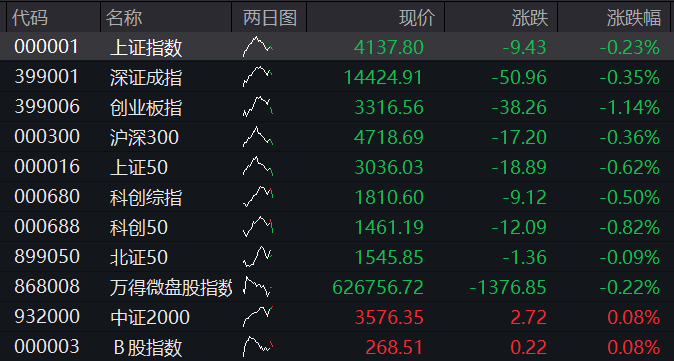
Group 1: Market Overview - The lithium mining sector experienced a surge, with stocks hitting the limit up, following Zimbabwe's Ministry of Mines and Mining Development's emergency statement to suspend all raw mineral and lithium concentrate exports [1] - On February 26, A-shares showed a downward trend, with major indices collectively declining; the ChiNext index fell nearly 1% [1] - The offshore RMB strengthened, surpassing the 6.84 mark, reaching a high of 6.8384 [1][7] Group 2: Stock Performance - Key A-share indices as of the report: Shanghai Composite Index at 4137.80 (-0.23%), Shenzhen Component Index at 14424.91 (-0.35%), and ChiNext Index at 3316.56 (-1.14%) [1] - In the Hong Kong market, the Hang Seng Index fell by 0.08% to 26745.06, while the Hang Seng Tech Index dropped by 0.96% to 5210.13 [2][3] Group 3: Commodity Market - Domestic commodity futures mostly rose, with lithium carbonate increasing by over 5% [4] - Other commodities such as tin, platinum, and fuel oil also saw gains, with tin rising by 4% and platinum, fuel oil, and manganese silicon increasing by over 2% [4] Group 4: Renewable Energy Sector - The renewable energy sector showed activity, with companies like Ganfeng Lithium and Tianqi Lithium experiencing significant stock price increases, reflecting a positive market sentiment towards lithium-related stocks [1][18] - The National Energy Administration's recent report indicated that by 2025, the newly installed capacity for renewable energy generation is expected to reach 452 million kilowatts, a year-on-year increase of 21%, accounting for 83% of the total new power generation capacity [10]


大类资产运行周报(20260112-20260116):美国通胀数据符合预期权益资产走势分化-20260119
Guo Tou Qi Huo· 2026-01-19 10:43
1. Report Investment Rating - There is no information about the industry investment rating in the report. 2. Core Viewpoints - From January 12th to January 16th, the US December CPI year - on - year growth rate met expectations and remained the same as the previous value. Global geopolitical risks continued to impact the market. The US dollar index rose weekly. Stocks and commodities performed strongly, while the bond market declined. In terms of the US dollar, commodities > stocks > bonds. In the domestic market, the stock market was divided, and the bond market and commodities rose weekly. Commodities > bonds > stocks. Geopolitical risk factors may still change in the short - term, significantly affecting the prices of major asset classes [5][8][19]. 3. Summary by Directory Global Major Asset Performance - **Global Stock Market**: From January 12th to January 16th, market sentiment was relatively cautious. Trump called for setting a 10% credit card interest rate cap starting from January 20, 2026, pressuring US stocks. Most global stock markets rose, with the Asia - Pacific region leading in gains. Emerging markets outperformed developed markets, and the VIX index rose weekly. For example, the MSCI Asia - Pacific region rose 2.75% weekly and 5.62% year - to - date, while the MSCI US fell 0.38% weekly but rose 1.39% year - to - date [10][13][14]. - **Global Bond Market**: Recently, most Fed officials' statements were hawkish, cooling market expectations of interest rate cuts. Medium - and long - term US Treasury yields generally rose, with the 10 - year US Treasury yield rising 6BP to 4.24% weekly. The bond market was weak, and globally, high - yield bonds > credit bonds > government bonds [16]. - **Global Foreign Exchange Market**: From January 12th to January 16th, data such as the US November retail sales month - on - month growth rate were good, and the US dollar index rose weekly. Most major non - US currencies depreciated against the US dollar, and the RMB exchange rate was volatile and strong. The US dollar index rose 0.23% weekly [16][17]. - **Global Commodity Market**: Geopolitical factors supported the weekly rise of international oil prices. Precious metal prices rose, while most non - ferrous metal and agricultural product prices fell. International silver prices rose significantly [17]. Domestic Major Asset Performance - **Domestic Stock Market**: Market risk appetite declined. Most major broad - based A - share indices rose, and the average daily trading volume of the two markets increased compared to the previous week. The performance of large - cap blue - chip stocks was weak. Computer and electronics sectors led in gains, while the military and agriculture, forestry, animal husbandry, and fishery sectors performed poorly. The Shanghai Composite Index fell 0.45% weekly [20][22]. - **Domestic Bond Market**: From January 12th to January 16th, the central bank's net open - market operations injected 111.28 billion yuan. The capital market fluctuated, and the bond market was strong weekly. Overall, government bonds > credit bonds > corporate bonds [23]. - **Domestic Commodity Market**: The domestic commodity market rose weekly. Among major commodity sectors, precious metals led in gains. For example, the Nanhua Precious Metals Index rose 9.41% weekly [24][25]. Major Asset Price Outlook - Geopolitical risk factors may still change in the short - term, significantly affecting the prices of major asset classes. It is necessary to pay attention to their subsequent changes [4][26].
21专访丨浙商宏观首席林成炜:黄金上涨仍有支撑 长期看好A股
2 1 Shi Ji Jing Ji Bao Dao· 2026-01-15 23:32
Group 1 - The core view is that the trend of residents moving savings from deposits to diversified assets like equities, gold, and insurance will continue into 2026, supported by improving fundamentals and declining deposit rates [1][18] - The A-share market is expected to experience a main upward trend driven by liquidity and risk appetite recovery, with a focus on indices like the CSI 2000, STAR 50, and ChiNext [4][21] - The bond market is anticipated to see a downward trend in interest rates, with the 10-year government bond yield expected to reach around 1.5% [5][22] Group 2 - The RMB/USD exchange rate is projected to peak at around 6.8 in the first half of 2026, with an average around 7 for the year [7][23] - The outlook for commodities includes a bullish stance on precious and non-ferrous metals, while maintaining a bearish view on crude oil, targeting $50 per barrel for WTI [8][24] - The GDP growth target for 2026 is set at approximately 4.8%, with quarterly expectations of 5.1%, 4.8%, 4.6%, and 4.7% [10][26] Group 3 - The fiscal policy for 2026 is expected to be more proactive, with a deficit rate projected between 4.0% and 4.2%, corresponding to a deficit scale of approximately 5.89 trillion to 6.19 trillion yuan [11][27] - The monetary policy is anticipated to be moderately loose, with potential for 50 basis points of reserve requirement ratio cuts and 10 basis points of interest rate cuts throughout the year [12][28] - The demand for financing in 2026 is expected to improve, with new credit estimated at 17.6 trillion yuan, reflecting a year-end growth rate of 6.5% [15][30] Group 4 - Key investment opportunities in 2026 are expected to focus on core technology breakthroughs, integration of technology and industry, and the transformation of manufacturing towards high-end, intelligent, and green practices [16][31] - The investment landscape will likely benefit from policies supporting infrastructure and high-end manufacturing, with a focus on projects that enhance economic stability [11][30]

经济分析与资产展望:整固蓄势,窄幅波动
HUAXI Securities· 2025-11-09 14:24
Global Market Performance - Major global stock indices mostly declined due to multiple factors including the cooling of Fed rate cut expectations and the U.S. government shutdown, with Japan and South Korea leading the drop at 4.07% and 3.74% respectively[1] - The Nasdaq fell 3.04%, marking its worst weekly performance since April, driven by concerns over AI tech stock bubbles and liquidity pressures from the government shutdown[1] - Global bond yields mostly rose, with U.S. Treasury yields experiencing fluctuations amid liquidity tightening and policy expectation dynamics[1] Domestic Market Insights - The A-share market saw a slight increase despite reduced trading volume, with daily transactions falling below 2 trillion yuan, while the Hang Seng Index led major indices with a gain[2] - China's CPI rose year-on-year in October, alleviating deflation concerns, while PPI's decline narrowed, indicating a potential stabilization in prices[2] - The People's Bank of China maintained liquidity easing, contributing to a stable bond market environment[2] Economic Developments - The U.S. government shutdown is entering its sixth week, with potential progress as Democrats soften their stance on funding resolutions[3] - China's exports showed a decline of 0.8% year-on-year in October, influenced by tariff disruptions and high base effects from the previous year[3] - China successfully issued $4 billion in sovereign bonds in Hong Kong, with a subscription rate of 30 times, indicating strong international investor interest[3] Inflation and Price Trends - October's CPI increased by 0.2% year-on-year, driven by holiday consumption and rising food prices, while core CPI rose to 1.2%[3] - The forecast for 2026 suggests a CPI central tendency of 0.6%, with expectations of price recovery driven by stable food prices and improved consumer demand[3] Risk Factors - Potential unexpected changes in macroeconomic conditions and industrial policies pose risks to market stability[5]
【UNforex本周总结】美元强势延续 黄金受压震荡 贸易与政策交织影响
Sou Hu Cai Jing· 2025-11-01 08:59
Group 1: Market Overview - Global financial markets continue to experience volatility driven by multiple macro factors, including a strengthening dollar, pressure on gold prices, and uncertainties surrounding trade and central bank policies [1] - The dollar index approached 99.70, reflecting increased market confidence in the U.S. economy, supported by hawkish comments from the Federal Reserve and high Treasury yields [1][3] - The euro declined over 0.4% due to weak European economic conditions and expectations of monetary easing, while the Japanese yen fell to a yearly low against the dollar, raising concerns about potential policy intervention [1] Group 2: Gold Market - Gold prices struggled to maintain support above $4000, facing pressure from a strong dollar and the Federal Reserve's hawkish stance, with limited upward movement observed [2] - Despite a brief rebound due to safe-haven buying, overall momentum for gold remains weak as the attractiveness of non-yielding assets diminishes with cooling rate cut expectations [2] Group 3: Federal Reserve Signals - The Federal Reserve's policy stance remains a focal point, with recent speeches from officials indicating a general hawkish tone despite some divergence in views on future interest rate paths [3] - The probability of a rate cut in December has decreased from 90% to below 70%, with expectations that the Fed will maintain a tightening policy to curb inflation [3] Group 4: U.S.-China Trade Relations - U.S.-China trade relations are a key market focus, with recent negotiations showing some positive signals, but significant differences remain in critical areas, leading to a decline in market optimism [4] - Investor concerns about the uncertainty in trade progress may pose risks to economic recovery, affecting risk appetite in the market [4] Group 5: European and Japanese Policy Stances - The European Central Bank maintained interest rates at its October meeting, emphasizing no premature policy commitments, which has led to increased uncertainty regarding future monetary policy direction [5] - Japan's new government reiterated the importance of stable exchange rates, with officials closely monitoring market dynamics amid concerns over yen depreciation [5] Group 6: Global Stock Market Performance - Global stock indices generally rose, with U.S. major indices continuing their upward trend, particularly driven by strong performance in the technology sector, exemplified by Nvidia reaching a new historical high [6] - Despite the strong dollar and hawkish Fed stance potentially limiting some gains, overall risk appetite appears to be improving, with investors focusing on upcoming U.S. economic data for insights into future growth trends [6]