
绿电绿证

Search documents
政策解读|以“五统一、一开放”打造现代电力市场体系标杆
Zhong Guo Dian Li Bao· 2026-02-26 01:35
Core Viewpoint - The State Council's recent "Implementation Opinions" outlines strategic goals for establishing a unified national electricity market system by 2030 and fully developing it by 2035, marking a new phase in China's electricity market reform [1] Group 1: Strategic Goals - By 2030, the goal is to have all types of power sources and electricity users (excluding guaranteed users) directly participate in the electricity market, with market transactions accounting for approximately 70% of total electricity consumption [1] - By 2035, the aim is to form a unified energy market system centered around electricity [1] Group 2: Specific Measures - The "Implementation Opinions" propose measures to optimize resource allocation, enhance market functions, promote equal participation, establish a unified market system, and strengthen policy coordination [1] - The Southern Power Grid Company aims to lead in the construction of the national unified market by adhering to the "five unifications and one openness" principle [2] Group 3: Market Integration and Development - The unified electricity market will transition to a joint trading model, allowing for nationwide supply-demand matching with a single demand proposal [3] - The Southern Power Grid will focus on integrating regional electricity markets and expanding market-based electricity transmission [3] Group 4: Multi-Category Market Construction - The "Implementation Opinions" emphasize the development of various market categories, including spot, medium-to-long-term, ancillary services, green certificates, capacity, and retail markets [4] - This multi-dimensional approach aims to enhance price discovery, supply-demand adjustment, and environmental value realization [4] Group 5: Encouraging Diverse Participation - The document outlines plans to increase participation from various power sources and new market entities, shifting the focus from generation-centric to a collaborative ecosystem involving all stakeholders [5] - The Southern Power Grid will innovate mechanisms for distributed energy sources and virtual power plants to enhance market participation [5] Group 6: Future Directions and Innovations - The "14th Five-Year Plan" period is critical for achieving the "carbon peak by 2030" goal, necessitating efficient resource allocation through the unified electricity market [6] - The Southern Power Grid will implement ten innovative market actions to establish a benchmark for the national unified electricity market [6] Group 7: Regional Market Development - The Southern regional electricity spot market is set to officially operate by 2026, optimizing resource allocation rules and enhancing market efficiency [7] - New mechanisms for cross-grid trading and market participation will be established to promote competition and efficient resource circulation [7] Group 8: New Business Models and International Cooperation - The document encourages the development of new business models, including distributed solar, virtual power plants, and adjustable loads, to support flexible market interactions [8] - It also promotes international cooperation in green energy and the establishment of a unified domestic and cross-border electricity market [8]
全国统一电力市场体系建设 为相关产业带来发展机遇
Xin Lang Cai Jing· 2026-02-12 22:59
Core Viewpoint - The State Council has issued the "Implementation Opinions on Improving the National Unified Electricity Market System," aiming to establish a basic national unified electricity market system by 2030 and fully complete it by 2035 [1][5]. Group 1: Key Progress and Goals - Significant progress has been made in building the national unified electricity market system, with a goal to achieve a preliminary establishment by 2025 [1][5]. - The construction of the national unified electricity market system has been ongoing for several years, focusing on addressing key bottlenecks such as barriers between regional power grids and inter-provincial obstacles [2][6]. Group 2: Barriers and Solutions - Major barriers to the establishment of the unified electricity market include institutional obstacles, technical bottlenecks, and differences in market rules [2][6]. - Reforms are needed to shift from local protectionism to a unified national approach, accelerate the development of key technologies like smart grids and ultra-high voltage transmission, and unify market rules to ensure fair competition [2][6]. Group 3: Market Dynamics and Renewable Energy - The reform emphasizes the participation of renewable energy in market transactions, with a focus on integrating wind and solar power into the electricity market by 2025 [3][7]. - The introduction of green electricity and green certificate mechanisms will provide pathways for renewable energy to compete fairly in the market, enhancing the efficiency of energy consumption and system operation [3][7]. Group 4: Industry Impact - The establishment of a national unified electricity market will benefit various sectors, including power generation companies, grid companies, and the energy storage industry [4][8]. - Power generation companies will gain broader market access and improved operational efficiency, while grid companies will find new opportunities in network construction and maintenance [4][8]. - The energy storage industry will become increasingly important in addressing the intermittency of renewable energy, entering a phase of rapid development [4][8].
电力体制改革再提速 谁将受益?
Zhong Guo Dian Li Bao· 2026-02-12 09:20
Core Viewpoint - The State Council issued the "Implementation Opinions on Improving the National Unified Electricity Market System," marking a significant step in China's electricity market reform, transitioning from "accelerating construction" to "improvement" of the market system [1][2]. Group 1: Goals and Objectives - The "Implementation Opinions" set two phased goals: to establish a basic national unified electricity market system by 2030, with market-based trading accounting for approximately 70% of total electricity consumption; and to fully establish the system by 2035, with a steadily increasing proportion of market-based trading [2]. Group 2: Market Structure and Achievements - The national unified electricity market structure has been largely established, transitioning from a planned to a market-oriented production organization over the past decade [4]. - By 2025, the market-based trading volume is expected to reach 6.6 trillion kilowatt-hours, a sevenfold increase from 2015, with the market share rising from less than 15% to 64% [5]. - Cross-provincial and cross-regional electricity trading is projected to grow from less than 0.1 trillion kilowatt-hours in 2015 to approximately 1.6 trillion kilowatt-hours by 2025, an increase of over 15 times [5]. Group 3: Market Mechanisms and Governance - A multi-level collaborative market structure has been formed, ensuring balance and supply security at the provincial level while enhancing inter-grid cooperation for broader resource circulation [5]. - A preliminary market price mechanism has been established, allowing for market-driven pricing of coal and industrial electricity within reasonable ranges [5]. - The governance framework for the electricity market has begun to take shape, with government departments responsible for overall design, regulatory bodies maintaining market order, and trading institutions providing platforms [6]. Group 4: Policy and Regulatory Framework - The "Implementation Opinions" address key systemic and mechanistic obstacles in the current electricity market, focusing on optimizing resource allocation, enhancing market functions, and promoting equal participation from various operators [10]. - The document proposes a shift from "individual pricing and trading" to "unified pricing and joint trading" across different market levels, aiming to improve transaction efficiency and flexibility [10]. Group 5: Participation and Inclusivity - The reform emphasizes increasing participation from private enterprises, particularly in new energy sectors such as storage and virtual power plants, while allowing small and medium-sized commercial users to directly engage in the electricity market [12]. - A diversified market governance system is proposed to ensure safe and regulated market operations, with independent oversight and collaborative management from various stakeholders [12].
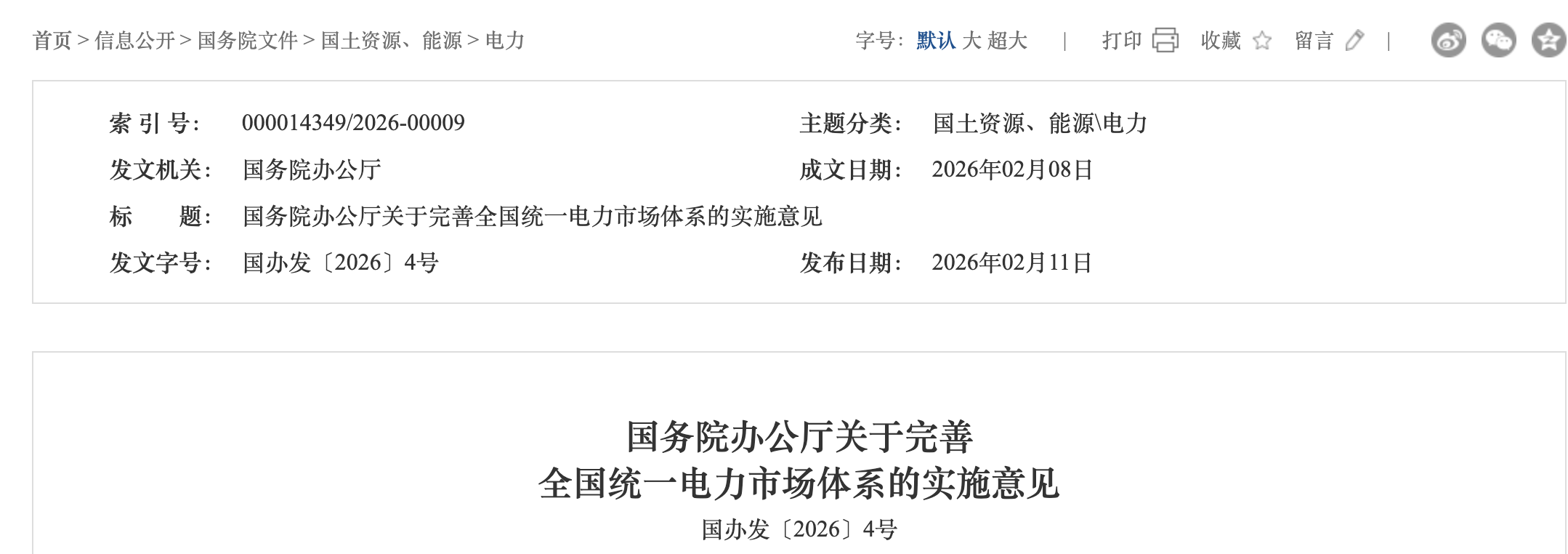
国办发文:到2030年基本建成全国统一电力市场体系
2 1 Shi Ji Jing Ji Bao Dao· 2026-02-11 14:06
Core Viewpoint - The State Council issued the "Implementation Opinions on Improving the National Unified Electricity Market System," marking a shift in electricity market reform from departmental promotion to national strategic deployment, with clear goals for 2030 and 2035 [1][3]. Group 1: Key Goals and Timeline - By 2030, the national unified electricity market system is expected to be basically established, with market transactions accounting for approximately 70% of total electricity consumption [1][3]. - By 2035, the market system will be fully established, with further maturation and an increasing proportion of market transactions [1][3]. Group 2: Systematic Reform Measures - The implementation opinions propose systematic reforms to address key issues such as breaking market barriers, promoting diverse participation, and enhancing capacity assurance mechanisms [3][4]. - The document emphasizes breaking down market barriers to optimize electricity resource allocation nationwide, enabling "electricity to flow nationwide" [3][4]. Group 3: Market Participation and Structure - The opinions outline pathways for various market participants, including gas, hydro, and nuclear power, to enter the market, promoting a diverse and competitive market structure [4][6]. - New entities like virtual power plants and smart microgrids are encouraged to participate flexibly in the market [4][6]. Group 4: Market Mechanism Development - Continuous improvement of market mechanisms is emphasized, including the establishment of a capacity price mechanism for coal, pumped storage, and new energy storage resources [4][6]. - The document highlights the need for effective transmission of auxiliary service costs in regions with continuous spot market operations [4][6]. Group 5: Market Function Clarification - The implementation opinions clarify the functions of six major markets: spot, medium- and long-term, auxiliary services, green electricity, capacity, and retail markets [6][7]. - The new pricing system represents a significant breakthrough in China's electricity market construction, shifting from a "single electricity pricing" model to a market-driven approach [6][7]. Group 6: Green Electricity and International Standards - The opinions stress the importance of strengthening the traceability of green electricity consumption and exploring the feasibility of incorporating green certificates into carbon emission accounting [7][8]. - There is a call for proactive engagement in international standard-setting processes to align China's green electricity standards with global systems [8].

突破4500亿!同比增长3.87倍
Zhong Guo Dian Li Bao· 2026-02-05 11:38
Core Insights - The annual green electricity and green certificate trading volume in the southern region is expected to exceed 450 billion kilowatt-hours by 2025, representing a year-on-year increase of 387% and surpassing the total of the previous four years combined [1] - The green certificate trading market is projected to reach 407 million certificates, accounting for approximately 60% of the national trading volume [1] - The number of registered entities in the green certificate market is anticipated to grow by 1034% to 84,000, covering 34 provincial-level administrative regions across the country [1] Group 1: Market Dynamics - High-energy-consuming, export-oriented, and high-tech enterprises are the main consumers of green certificates, with manufacturing accounting for 50% and the electricity, heat, gas, and water production and supply industry for 23% [2] - The awareness of residential green electricity consumption is increasing, with nearly 1.57 million green certificates purchased by residents in 2025, marking a 33% year-on-year growth [2] - The total installed capacity of renewable energy in the southern power grid is expected to exceed 260 million kilowatts, maintaining its position as the largest power source, with non-fossil energy accounting for 66% of installed capacity and 55% of electricity generation [2] Group 2: Market Reforms and Innovations - As market reforms deepen, renewable energy entities are fully integrated into the trading system, with 1,149 renewable energy trading units participating in the southern electricity spot market [3] - The first five virtual power plants officially participated in the southern electricity spot trading on December 29, 2025, enhancing the market pathways for distributed renewable energy [3] - Future plans include further deepening the green electricity and green certificate market reforms, improving mechanisms for renewable energy participation, and expanding cross-regional trading collaboration [3]

安徽“十四五”能源工作取得新成效:外送电量达3000亿千瓦时以上
Zhong Guo Dian Li Bao· 2026-01-21 01:30
Core Viewpoint - Anhui Province has made significant progress in energy supply, green transformation, technological innovation, and market reform during the "14th Five-Year Plan" period, setting a strong foundation for high-quality economic development [1][2][3] Group 1: Energy Supply Achievements - During the "14th Five-Year Plan," Anhui has established new coal mines and formed a high-voltage transmission network, achieving an electricity export volume exceeding 300 billion kilowatt-hours [1] - By 2025, the province's raw coal production is expected to exceed 103 million tons, with installed power generation capacity reaching approximately 143 million kilowatts, a year-on-year increase of 15% [1] Group 2: Green Low-Carbon Transformation - The installed capacity of renewable energy in Anhui has surpassed 74.5 million kilowatts, three times that of the end of the "13th Five-Year Plan," with electricity accounting for about 32% of total energy consumption [1] - In 2025, approximately 13.5 million kilowatts of new renewable energy capacity will be added, representing 73% of the new installed capacity, raising the cumulative share of renewable energy in total power generation to 52.2% [1] Group 3: Technological Innovation - Since 2021, Anhui has developed leading-edge coal power units and the largest "coal power + molten salt storage" project in the country, along with the first inland LNG receiving station [1] - By 2025, 13 major technological equipment and demonstration projects will be included in the national list of first-of-its-kind major technological equipment in the energy sector [1] Group 4: Market Reform Progress - The long-term electricity market in Anhui has been continuously operating, with the market transaction volume reaching approximately 57.5% of total electricity traded in 2025 [2] - The province ranks among the top in the second batch of pilot provinces for the stable operation of the electricity spot market [2] Group 5: Future Energy Planning - The year 2026 marks the beginning of the "15th Five-Year Plan," where Anhui aims to enhance energy security, promote green transformation, and improve energy infrastructure [3] - The province will focus on deepening energy reform, enhancing the electricity market mechanism, and strengthening technological research and development [3]
五部门发文建设零碳工厂:鼓励配置新型储能,开展绿电直连
中关村储能产业技术联盟· 2026-01-19 13:36
Core Viewpoint - The article discusses the "Guiding Opinions on the Construction of Zero Carbon Factories" issued by the Ministry of Industry and Information Technology, emphasizing the importance of reducing carbon emissions through technological innovation, structural adjustments, and management optimization in industrial settings [2][3]. Summary by Sections Phase Goals - By 2026, a selection of zero carbon factories will be identified to serve as benchmarks [3]. - By 2027, a batch of zero carbon factories will be cultivated in industries such as lithium batteries, photovoltaics, automotive, electronics, light industry, machinery, and computing facilities, establishing an industrial ecosystem for zero carbon factory construction [3]. - By 2030, the initiative will expand to include industries like steel, non-ferrous metals, petrochemicals, building materials, and textiles, exploring new decarbonization pathways for traditional high-energy industries [3]. Construction Paths - Establish a carbon emission accounting management system to accurately quantify emissions and removals, including direct and indirect emissions from production activities [4][15]. - Accelerate the transition to a green and low-carbon energy structure, encouraging factories to utilize zero carbon electricity, heat, hydrogen, and fuel supplies [4][15]. - Significantly improve energy efficiency through systematic optimization of production processes, aiming for compliance with national energy consumption standards [4][16]. Supply Chain and Digitalization - Promote zero carbon supply chain management by analyzing carbon footprints of key products and improving carbon emission reduction across the entire supply chain [5][18]. - Enhance digital and intelligent management levels by establishing digital energy and carbon management centers using technologies like IoT and big data for precise measurement and control of energy consumption and emissions [5][19]. Carbon Offsetting and Reporting - Implement carbon offsetting strategies and information disclosure to achieve and maintain near-zero carbon emissions, including participation in cross-border carbon trading [5][19]. - Encourage regular publication of sustainability reports, ESG reports, and zero carbon factory construction reports to disclose carbon emissions and construction progress [6][19]. Implementation Requirements - Strengthen organizational implementation by local industrial and information departments to develop specific plans for zero carbon factory construction [20]. - Improve the standard system to provide scientific and reasonable technical bases for zero carbon factory management and evaluation [21]. - Promote comprehensive services for energy saving and carbon reduction, facilitating technology transfer and market services for industrial enterprises [21].

零碳园区用能结构怎么转型?凡鹏飞:采取“3+2”互补供电方式
2 1 Shi Ji Jing Ji Bao Dao· 2026-01-15 11:30
Core Viewpoint - The construction of national-level zero-carbon parks in China is set to begin, with a target of establishing around 100 parks during the 14th Five-Year Plan period, with the first batch of 52 parks expected to be completed by 2027 [1][10]. Group 1: Zero-Carbon Park Construction - The first batch of zero-carbon parks will focus on transforming energy consumption structures, with a goal of achieving at least 50% of electricity supply from renewable sources [1][4]. - The parks will serve as experimental fields for a new energy system, utilizing various green electricity supply models, including direct supply, nearby access to distribution networks, and distributed generation [2][9]. - The construction of these parks will be guided by a combination of local resource endowments, economic feasibility, technological viability, and policy environments [9][10]. Group 2: Green Electricity Supply Models - Three main models for green electricity supply have been identified: direct connection of green electricity, nearby access to incremental distribution networks, and distributed self-consumption [5][6][7]. - In addition to these models, parks can supplement their green electricity supply through green certificate trading and virtual power plants [8][9]. Group 3: Regional Distribution and Industry Types - The first batch of parks will cover all 31 provinces and regions, ensuring a diverse representation of both resource-rich and industrially advanced areas [10]. - The parks will primarily focus on low-energy, low-pollution, and high-value-added industries, while also addressing the decarbonization of traditional high-energy-consuming sectors [10]. Group 4: Challenges and Opportunities - The transition to zero-carbon parks faces challenges such as high initial investment costs and the need for systemic innovation in mechanisms and business models [15]. - Zero-carbon parks can help enterprises meet international low-carbon standards and enhance their competitiveness in global markets, particularly in light of evolving green trade rules [13][14].

《粤港澳大湾区美丽中国先行区建设行动方案》印发
Xin Lang Cai Jing· 2025-12-26 17:59
Core Viewpoint - The "Guangdong-Hong Kong-Macao Greater Bay Area Beautiful China Pilot Zone Construction Action Plan" aims to leverage the advantages of "one country, two systems" to enhance ecological quality, promote green finance innovation, and deepen cooperation, ultimately establishing a modern ecological governance system and a beautiful bay area through collaborative innovation [1][2]. Group 1: Overall Requirements - The plan is guided by Xi Jinping's thoughts on ecological civilization, aiming to make the Greater Bay Area a strategic support for new development patterns and a demonstration area for high-quality development by 2027 and 2030 [3]. Group 2: Building a Green and Low-Carbon Greater Bay Area - The plan emphasizes regional cooperation, focusing on core engines like Hong Kong, Macao, Guangzhou, and Shenzhen to drive green development and infrastructure connectivity [4]. - It aims to create modern green and low-carbon industrial clusters, promoting digital and green transformation in traditional industries and developing high-value water-related new business formats [4]. - A clean and low-carbon energy system will be established, including world-class offshore wind power bases and integrated building photovoltaic systems [5]. Group 3: Building a Blue and Clean Greater Bay Area - The plan includes initiatives for air quality improvement, emphasizing integrated pollution control and cross-border cooperation in air quality management [6][7]. - It aims to enhance water environment governance in the Pearl River Basin, ensuring safe drinking water and promoting beautiful river and lake construction [7]. Group 4: Building a Beautiful and Ecological Greater Bay Area - The plan focuses on maintaining an integrated ecological system and protecting biodiversity, including the establishment of ecological corridors and the protection of endangered species [8][9]. Group 5: Building a Harmonious and Beautiful Greater Bay Area - The plan promotes the construction of high-standard international beautiful urban clusters and the integration of urban and rural development [9][10]. - It encourages innovative "beautiful cell" construction models, including pocket parks and zero-carbon communities [10]. Group 6: Building a Healthy and Safe Greater Bay Area - The plan emphasizes ecological safety and environmental health management, including monitoring and risk assessment systems [10][11]. - It aims to establish a "waste-free bay area" through solid waste management and pollution control measures [11]. Group 7: Building an Innovative and Collaborative Greater Bay Area - The plan promotes the alignment of regulations and mechanisms in key areas, including environmental quality monitoring and carbon footprint management [12][13]. - It encourages green finance innovation to attract investment in green projects and support sustainable development [13][14]. Group 8: Building an Open and Shared Greater Bay Area - The plan aims to create high-level green cooperation platforms and enhance cross-border environmental service integration [14][15]. - It emphasizes participation in global ecological civilization initiatives and the promotion of green trade [15][16].
全国统一电力市场建设取得重要阶段性成效
Zhong Guo Dian Li Bao· 2025-12-15 01:04
Core Insights - 2025 is a pivotal year for achieving the "14th Five-Year Plan" goals and transitioning to the "15th Five-Year Plan," marking significant progress in the national unified electricity market system [1] Group 1: Market Development - China's electricity market transaction scale has reached the largest globally, with market transaction electricity accounting for 63.4% of total electricity consumption, and renewable energy market transactions making up 57% [1] - The establishment of a normalized trading mechanism across grid operating areas has been largely achieved, enhancing the optimization of electricity resource allocation [1] - The electricity traded under this mechanism has exceeded 22 billion kilowatt-hours, demonstrating improved inter-grid electricity support [1] Group 2: Spot Market Operations - The spot market has been fully operational, achieving comprehensive coverage of all electricity market categories, with 28 provinces conducting continuous spot trading [2] - Inter-provincial spot market transactions reached 331.4 billion kilowatt-hours from January to October, accounting for 14.8% of total spot electricity [2] - The Southern regional electricity market has transitioned to continuous operation, marking a significant breakthrough in regional economic collaboration [2] Group 3: Regulatory Framework - A basic national unified rules system has been established, facilitating the integration and resource allocation across the electricity market [3] - The foundational rule system, including mid-term, spot, and ancillary service rules, has been developed to support the standardized operation of the national unified electricity market [3] - The construction of a unified electricity market is crucial for deepening electricity system reforms and supporting high-quality economic development [3] Group 4: Energy Security and Green Transition - During peak summer demand, cross-regional transmission capacity reached a maximum of 151 million kilowatts, significantly improving energy supply stability [4] - Green electricity trading has seen an annual growth rate of nearly 180%, with over 13.5 billion green certificates traded, supporting the development of renewable energy [4] - The market has contributed to lowering energy costs, with industrial and commercial electricity prices remaining competitive internationally [5] Group 5: Resource Allocation Efficiency - From January to October 2025, cross-provincial and cross-regional trading volume reached 1.3 trillion kilowatt-hours, growing by 12.5% year-on-year [5] - The Southern regional electricity market has become the largest unified clearing electricity spot market globally, effectively addressing the mismatch between resource-rich areas and load centers [5] - The ongoing development of the electricity market system is expected to enhance the resilience of the electricity system and accelerate the green transition [5]