
锂电池

Search documents
山东丰元化学股份有限公司 2025年度业绩预告
Zheng Quan Ri Bao· 2026-01-30 23:52
Core Viewpoint - The company expects a negative net profit for the fiscal year 2025, despite showing resilience in its operational fundamentals and significant growth in the production and sales of lithium battery cathode materials [1][2]. Group 1: Performance Forecast - The performance forecast period is from January 1, 2025, to December 31, 2025, with an anticipated net profit in negative values [1]. - The financial data related to this performance forecast has not been audited by the accounting firm, but preliminary discussions have indicated no major disagreements [1][3]. Group 2: Reasons for Performance Changes - The company remains in a loss position, primarily due to increased R&D expenses for product upgrades and insufficient overall equipment utilization rates caused by long new product validation cycles and new production lines ramping up [2]. - Despite these challenges, the company has implemented various optimization measures, including expanding its customer base, enhancing cooperation with core clients, and focusing on cost reduction and efficiency improvements [2]. - In the fourth quarter, the utilization rate of lithium battery cathode material production significantly improved, leading to positive trends in key indicators such as main business revenue and gross margin, resulting in a notable reduction in losses [2]. Group 3: Other Relevant Information - The performance forecast is based on preliminary calculations by the company's finance department and will be detailed in the 2025 annual report [3]. - The company commits to adhering to legal and regulatory requirements for timely information disclosure [3].

黄金白银,高位暴跌!美股集体飘绿!美联储,大消息!
Sou Hu Cai Jing· 2026-01-30 15:39
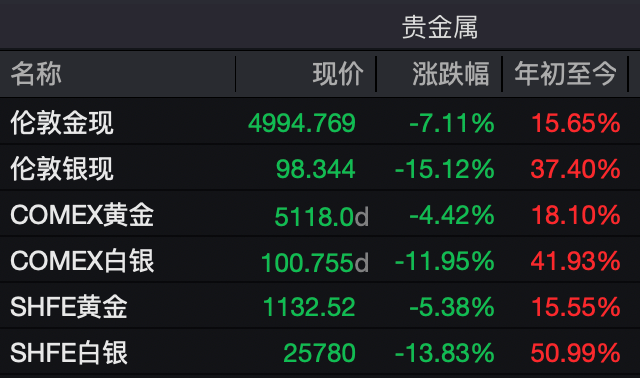
Group 1: Precious Metals - Gold and silver prices have significantly declined, with gold dropping over 7% to below $5000 and silver falling over 15% to below $100 [1] - Current prices for precious metals include London gold at $4994.769 (-7.11% YTD) and London silver at $98.344 (-15.12% YTD) [2] - Domestic futures for gold and silver also saw declines, with SHFE gold at 1132.52 CNY (-5.38% YTD) and SHFE silver at 25780 CNY (-13.83% YTD) [2] Group 2: U.S. Stock Market - Major U.S. stock indices experienced collective declines, with the Dow Jones down 0.36%, Nasdaq down 0.50%, and S&P 500 down 0.39% [3] - Specific sectors such as cruise lines, solar energy, and lithium battery stocks faced the largest drops, with the cruise index down 5.20% and the solar index down 4.62% [4] - The Nasdaq China Golden Dragon Index fell over 1%, indicating a broad decline in Chinese concept stocks [2] Group 3: Federal Reserve Leadership - President Trump nominated Kevin Walsh, a former Fed governor, as the next Federal Reserve Chair, raising concerns about monetary policy direction and Fed independence [4] - Walsh is known for his hawkish stance during his tenure but has shifted to support Trump's tariff policies and a quicker rate cut approach [4] - Market expectations for interest rate cuts by the Fed are projected to be between 50 to 100 basis points over the next year [4]

新股消息 | 欣旺达二次递表港交所 为全球最大的锂离子电池厂商
智通财经网· 2026-01-30 12:21
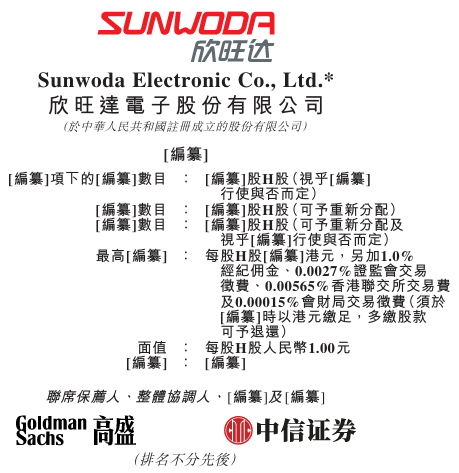
Core Viewpoint - XINWANDA ELECTRONICS CO., LTD. has submitted a listing application to the Hong Kong Stock Exchange, marking its second attempt to go public, with Goldman Sachs and CITIC Securities as joint sponsors. The company has been deeply involved in the lithium battery industry for nearly 30 years and is now the largest lithium-ion battery manufacturer globally based on projected shipments for 2024 [2][4]. Company Overview - XINWANDA is a leading innovator in lithium battery technology, focusing on sustainable and efficient integrated energy solutions. The company engages in the research, design, manufacturing, and sales of lithium batteries, offering a diverse product matrix that includes consumer batteries, power batteries, and energy storage systems [4]. - The company holds a dominant position in the global mobile phone battery market with a market share of 34.3% and is the second-largest manufacturer of batteries for laptops and tablets, with a market share of 21.6% [4]. - XINWANDA has expanded its business from consumer batteries to power batteries and energy storage systems, establishing a comprehensive integrated business layout from research and development to manufacturing and recycling [4]. Technological Advancements - The company is actively developing industry-leading battery technologies, including silicon anode high-energy batteries, semi-solid batteries, solid-state batteries, lithium manganese iron phosphate batteries, sodium-ion batteries, and SiP technology modularization, aiming to maintain a technological edge [6]. Production and Capacity - As of September 30, 2025, XINWANDA has 25 major production bases either operational or under construction, with 19 located in China and six overseas in India, Vietnam, Thailand, and Hungary. This strategic layout allows the company to respond promptly to domestic and international customer demands [6]. - The company has established a mature, standardized, flexible, and intelligent manufacturing capability, with 11 major overseas marketing and service centers to better serve and expand its international customer base [6]. Financial Performance - The company's revenue for the fiscal years 2022, 2023, 2024, and the nine months ending September 30, 2025, were approximately RMB 52.162 billion, RMB 47.862 billion, RMB 56.021 billion, and RMB 43.534 billion, respectively [8]. - Gross profit for the same periods was approximately RMB 6.285 billion, RMB 6.118 billion, RMB 8.203 billion, and RMB 7.073 billion, with corresponding gross profit margins of 12.0%, 12.8%, 14.6%, and 16.2% [7][9]. Industry Overview - The global consumer battery shipment volume is projected to grow from 3,936 million units in 2020 to 4,159 million units in 2024, with a compound annual growth rate (CAGR) of 1.4%. The market experienced a brief contraction in 2022 and 2023 due to declining mobile phone demand but is expected to recover strongly in 2024 [11]. - The global power battery shipment volume is expected to increase from 183 GWh in 2020 to 1,002 GWh in 2024, with a CAGR of 53.0%, and further grow to 3,237 GWh by 2030 [15]. - The global energy storage battery shipment volume is anticipated to rise from 29 GWh in 2020 to 315 GWh in 2024, with a CAGR of 82.3%, and is projected to reach 1,303 GWh by 2030 [17].

锂电板块集体回撤,通胀、通缩预期“对撞”
高工锂电· 2026-01-30 12:09
Core Viewpoint - The article discusses whether the price increases in the lithium battery supply chain signify the beginning of "lithium battery inflation" or are a precursor to profit downgrades in the battery and materials sectors [7]. Group 1: Market Performance - The lithium battery sector experienced a wave of "concurrent pullback" this week [2]. - Contemporary Amperex Technology Co., Ltd. (CATL) saw its stock price peak at 380.50 yuan on January 6, before dropping to 333.01 yuan by January 28, marking a nearly 10% fluctuation [3]. - EVE Energy Co., Ltd. faced a cumulative decline of 9.05% over four consecutive trading days, with a market capitalization of approximately 125.9 billion yuan [4]. - Guoxuan High-Tech also experienced a 9.23% drop over the same period, with a total market value of around 68.4 billion yuan [5]. - Xinwanda reported a cumulative decline of 7.61% over five days, with a market capitalization of about 43.3 billion yuan [6]. Group 2: Industry Dynamics - The fundamental question remains whether the price increases in the supply chain are indicative of "lithium battery inflation" or a sign of profit downgrades in the battery and materials sectors [7]. - The automotive industry's projected revenue for 2025 is approximately 11.18 trillion yuan, with profits of 461 billion yuan, resulting in a profit margin of only 4.1% [9]. - By December 2025, the profit margin is expected to drop to 1.8%, signaling ongoing repercussions from price wars [10]. - As terminal profit margins decline, it becomes more challenging for the battery sector to pass on costs to downstream players, potentially leading to profit downgrades in the battery and materials segments [11]. Group 3: Inflation Narrative - The term "lithium battery inflation" is more closely related to an upward shift in price levels and profit recovery rather than macroeconomic inflation [15]. - The core logic is based on two points: certain materials have seen significant price increases, and terminals like energy storage still have room for profit, allowing for price increases to be passed upstream [16]. - The internal rate of return (IRR) for energy storage projects in major provinces is generally above 8%, indicating potential for cost transmission [17]. - However, if terminal revenues are unstable or pricing mechanisms lead to increased cost exposure, the inflation narrative could transition into a precursor for profit downgrades [18]. Group 4: Pricing Mechanisms and Transmission - The debate highlights the complexity of pricing mechanisms and transmission chains within the industry [26]. - Companies like Honeycomb Energy have provided insights into how inflation and downgrades manifest through specific mechanisms, including the scope of linkage clauses and pricing cycles [26]. - Even if inflation narratives hold, cost transmission is likely to occur in layers, first affecting large commodity materials and then impacting non-linked items and processing fees [27]. - The potential for a "offset model" exists, where leading battery companies can mitigate some cost pressures through resource investments and operational efficiencies [29]. Group 5: Future Outlook - The ongoing discussion around "lithium battery inflation" versus "profit downgrades" serves as a pressure test for pricing power within the industry [32]. - The ability of large commodity-linked items to continue transmitting costs, and the effectiveness of energy storage pricing contracts in incorporating mature linkage mechanisms, will be critical [32]. - Short-term market adjustments are expected to focus on these changes in mechanisms rather than solely on the price fluctuations of individual materials [33].

国轩高科:预计2025年净利润同比增长107.16%至148.59%
Xin Lang Cai Jing· 2026-01-30 11:45
每经AI快讯,1月30日,国轩高科公告,预计2025年度净利润为25亿元至30亿元,同比增长107.16%至 148.59%。 每经AI快讯,1月30日,国轩高科公告,预计2025年度净利润为25亿元至30亿元,同比增长107.16%至 148.59%。 ...

新股消息 | 欣旺达(300207.SZ)二次递表港交所 为全球最大的锂离子电池厂商
智通财经网· 2026-01-30 11:33
智通财经APP获悉,据港交所1月30日披露,欣旺达电子股份有限公司(简称:欣旺达,300207.SZ)向港交所主板递交上市申请,高盛、中信证券为其联席保 荐人。这是该公司第二次递表港交所。深耕锂电池行业近30年,按2024年手机、笔记本计算机及平板计算机相关电池出货总量计,欣旺达已成为全球最大的 锂离子电池厂商。 公司简介 招股书显示,欣旺达是锂电池科技创新领军企业,致力于提供可持续及高效的新能源一体化解决方案。公司主要从事锂电池研发、设计、制造和销售,覆盖 包括消费类电池、动力类电池及储能系统在内的多元化产品矩阵,向客户提供自电芯、模块到系统以及电池检测及回收的全面解决方案。 根据灼识咨询的数据,按2024年出货量计,公司在全球手机电池市场独占鳌头,市占率高达34.3%。根据同一资料来源,公司也是全球第二大的笔记本计算 机及平板计算机电池厂商,市占率高达21.6%。此外,公司一直积极拓展动力类电池及储能系统业务,实现高速增长并迅速跻身行业前列。 欣旺达以消费类电池业务起步,逐步拓展到动力类电池、储能系统及其他相关领域,形成了从电池研发、设计、制造、销售到检测以及回收的全面一体化业 务布局。 公司还积极布局行 ...
国轩高科:预计2025年净利润同比增长107.16%-148.59%
Xin Lang Cai Jing· 2026-01-30 11:27
国轩高科公告,预计2025年度净利润为25亿元-30亿元,同比增长107.16%-148.59%。公司业绩增长主要 得益于新能源汽车及储能市场需求的快速增长,新一代高能量密度磷酸铁锂电池产品销量大幅提升,同 时公司推进国际化战略,优化客户和产品结构,提升盈利能力。 ...
天力锂能:预计2025年净亏损1.5亿元至2亿元
Ge Long Hui· 2026-01-30 11:23
格隆汇1月30日|天力锂能公告,预计2025年度净利润亏损1.5亿元至2亿元,上年同期净利润亏损4.29亿 元。2025年,受碳酸锂价格波动以及磷酸铁锂行业震荡调整等因素影响,公司部分生产线开工率不足, 产能利用率偏低,单位产品固定成本分摊较高,相关资产未来产生经济利益的能力下降。公司依据《企 业会计准则》的相关规定,对固定资产及在建工程等资产进行减值测试,并基于谨慎性原则计提了相应 的资产减值准备,对当期损益造成不利影响。 ...
欣旺达二次递表港交所
Zhi Tong Cai Jing· 2026-01-30 11:01
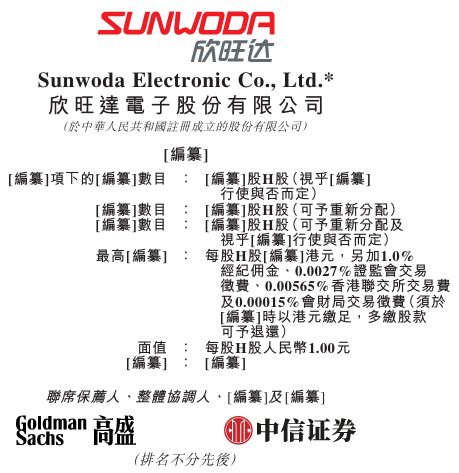
据港交所1月30日披露,欣旺达(300207)电子股份有限公司(简称:欣旺达,300207.SZ)向港交所主板 递交上市申请书,高盛、中信证券为其联席保荐人。这是该公司第二次递表港交所。招股书显示,欣旺 达是锂电池科技创新领军企业,致力于提供可持续及高效的新能源一体化解决方案。公司主要从事锂电 池研发、设计、制造和销售,覆盖包括消费类电池、动力类电池及储能系统在内的多元化产品矩阵,向 客户提供自电芯、模块到系统以及电池检测及回收的全面解决方案。按2024年手机、笔记本计算机及平 板计算机相关电池出货总量计,公司已成为全球最大的锂离子电池厂商。 | [項下的[編纂]數目 : [編纂]股H股(視乎[編纂] | | --- | | 行使與否而定) | | [編纂]數目 :[编纂]股H股(可予重新分配) | | 「編纂]數目 :「编纂]股H股(可予重新分配及 | | 視乎[編纂]行使與否而定) | | 最高[編纂] : 每股H股[編纂]港元,另加1.0% | | 經紀佣金、0.0027%證監會交易 | | 徵費、0.00565%香港聯交所交易費 | | 及0.00015%會財局交易徵費(須於 | | 「編纂]時以港元 ...
新股消息 | 欣旺达二次递表港交所
智通财经网· 2026-01-30 11:00
Group 1 - The core point of the article is that Sunwoda Electronic Co., Ltd. has submitted a listing application to the Hong Kong Stock Exchange, marking its second attempt to go public [1] - Sunwoda is recognized as a leading innovator in lithium battery technology, focusing on sustainable and efficient integrated energy solutions [1] - The company is engaged in the research, design, manufacturing, and sales of lithium batteries, offering a diverse product matrix that includes consumer batteries, power batteries, and energy storage systems [1] Group 2 - Sunwoda has become the largest lithium-ion battery manufacturer globally, based on the total shipment volume of batteries for smartphones, laptops, and tablets projected for 2024 [1] - The company provides comprehensive solutions to customers, ranging from self-developed chips and modules to systems, as well as battery testing and recycling services [1] - Goldman Sachs and CITIC Securities are acting as joint sponsors for the listing application [1]