工业互联网

Search documents
场景开放有大动作,多部门权威解读!
券商中国· 2025-11-10 15:22
Core Viewpoint - The article discusses the implementation of the State Council's opinions on accelerating the cultivation and opening of application scenarios, marking a systematic deployment of scenario cultivation in China [1][2]. Group 1: Definition and Importance of "Scenarios" - "Scenarios" are defined as specific contexts for the innovative application of new technologies, products, and business models, originating from the film industry and now applied across various sectors [3]. - The absence of scenarios can hinder the transition of innovative results from theory to market, emphasizing the need for scenario openness to bridge the gap between technology and industry [3]. Group 2: Key Areas for Scenario Development - The implementation opinions outline five main areas for scenario cultivation and opening: digital economy and AI applications, manufacturing and transportation upgrades, mining and emergency services, social governance, and enhancing livelihood applications [4]. - The Ministry of Industry and Information Technology plans to accelerate the cultivation of application scenarios in these five key areas [4]. Group 3: Specific Application Scenarios - The five highlighted application scenarios include: 1. "5G+" applications focusing on factory construction and integrated solutions [4]. 2. "AI+" applications extending AI into manufacturing processes [4]. 3. "Robotics+" applications promoting the use of robots in various industrial settings [5]. 4. "Industrial Internet+" applications integrating industrial internet with key industries [6]. 5. "Beidou+" applications enhancing the integration of Beidou technology in smart cities and agriculture [6]. Group 4: Strengthening Leading Technology Enterprises - The Ministry of Science and Technology aims to enhance the role of enterprises in technological innovation, promoting a rapid iteration mechanism from demand to application [7]. - The government encourages state-owned enterprises to open their scenarios to attract participation from private and small enterprises [7][8]. Group 5: Local Practices and Initiatives - Guangdong and Anhui provinces are leading in implementing these initiatives, with Guangdong establishing a comprehensive scene innovation mechanism and Anhui launching a city scene innovation promotion center [9]. - Anhui aims to develop 1,000 application scenarios by 2027, focusing on areas like quantum information and artificial intelligence [9].


事关场景培育开放!多部门权威解读,这场发布会,信息量满满
Zheng Quan Shi Bao· 2025-11-10 11:53
Core Viewpoint - The State Council of China has issued the "Implementation Opinions on Accelerating Scene Cultivation and Open Promotion for Large-Scale Application of New Scenes," marking the first systematic deployment of scene cultivation and openness in the country [1] Group 1: Definition and Importance of "Scenes" - "Scenes" are defined as specific contexts for the innovative application of new technologies, products, and business models, originating from the film industry and now applied across various sectors [2] - The absence of scenes can hinder the transition of innovative results from theory to practical application, emphasizing the need for scene openness to bridge the gap between technology and industry [2] Group 2: Key Directions for Scene Cultivation - The "Implementation Opinions" outline five main areas for scene cultivation and openness, including digital economy, artificial intelligence, manufacturing, emergency response, and social governance [3] - The Ministry of Industry and Information Technology plans to accelerate the cultivation of application scenes in five key areas: "5G+", "Artificial Intelligence+", "Robotics+", "Industrial Internet+", and "Beidou+" [3][4] Group 3: Technology Leadership and Enterprise Involvement - The Ministry of Science and Technology aims to strengthen the role of enterprises in technological innovation, promoting a rapid iterative innovation mechanism that includes demand-driven technology breakthroughs and scene validation [5][6] - Central enterprises have established over 800 AI application scenes and are expected to enhance the supply of high-value scenes, thereby facilitating the integration of technological and industrial innovation [6] Group 4: Local Practices and Initiatives - Guangdong has developed a "four-in-one" mechanism to foster a unified approach to scene innovation, focusing on major scene implementation and specialized services [7] - Anhui has established a city scene innovation promotion center and plans to implement the "thousand scenes" initiative in quantum information, aiming to create 1,000 application scenes by 2027 [7]
盘后利好!人工智能领域将出新政
Zheng Quan Ri Bao Wang· 2025-11-10 10:16
Core Viewpoint - The Chinese government is accelerating the cultivation and large-scale application of new scenarios in key industries, leveraging the country's vast market and complete industrial system to promote the development of emerging industries [1][2]. Group 1: 5G Applications - The Ministry of Industry and Information Technology (MIIT) is implementing the "Sail" action for the large-scale application of 5G, focusing on the construction of 5G factories for small, medium, and large enterprises [1]. - Key application scenarios include machine vision quality inspection, remote equipment control, and flexible manufacturing [1]. Group 2: Artificial Intelligence Applications - MIIT is developing a special action plan for "Artificial Intelligence + Manufacturing," aiming to extend AI applications across various manufacturing processes, including R&D, production, management, and maintenance [1]. - The initiative seeks to enhance technological innovation and integration of AI, maximizing its multiplicative effects [1]. Group 3: Robotics Applications - The "Robotics +" action plan aims to deepen and broaden the application of robots in industries, particularly in welding, assembly, spraying, and handling [2]. - The focus is on deploying industrial and humanoid robots in complex and harsh environments, such as mining and emergency response [2]. Group 4: Industrial Internet Applications - MIIT is formulating a plan to integrate industrial internet with AI, creating an upgraded version of "5G + Industrial Internet" [2]. - The initiative will promote collaboration between industrial internet and key industry chains, targeting sectors like steel, electricity, shipbuilding, and aviation [2]. Group 5: Beidou Applications - Policies are being developed to promote the development of the space-time information industry, with a focus on expanding the application of Beidou technology in smart cities, intelligent transportation, and precision agriculture [2]. - The integration of Beidou with mobile communications, inertial navigation, and high-precision vision technologies is emphasized [2].
工信部:将加速推动五大重点领域应用场景的培育
Zheng Quan Shi Bao Wang· 2025-11-10 08:23
Group 1 - The Ministry of Industry and Information Technology (MIIT) is accelerating the cultivation of application scenarios in five key areas [1][2] - The first area is 5G applications, focusing on large, medium, and small enterprises to deepen 5G factory construction and promote integrated solutions [1] - The second area is artificial intelligence applications, aiming to extend AI into various manufacturing processes and enhance innovation and integration [1] - The third area involves robotics, promoting the use of industrial and humanoid robots in factories, particularly in welding, assembly, and hazardous environments [1] Group 2 - The fourth area is industrial internet applications, which will integrate AI and industrial internet to enhance collaboration in key industries like steel and power [2] - The fifth area focuses on Beidou applications, promoting the development of spatial information industries and integrating Beidou with various technologies for smart city and agriculture applications [2]
新职业拓宽青年成才路
Zhong Guo Qing Nian Bao· 2025-11-08 01:51
Core Insights - The article highlights the emergence of new professions and the growing demand for skilled workers in various sectors, particularly in the context of the recent National Skills Competition, which showcased new career opportunities in fields like digital economy, modern services, and intelligent manufacturing [1][2][3] Group 1: New Professions and Employment Opportunities - The Ministry of Human Resources and Social Security has released 72 new professions and 328 national occupational standards during the 14th Five-Year Plan period, reflecting the rapid development of new industries and business models [1] - The National Skills Competition featured 17 new professional categories, including intelligent manufacturing engineering technology and IoT installation and debugging, demonstrating the strong appeal of these new careers in the job market [1][2] - Graduates from the drone application technology program at Henan Technician College are expected to achieve full employment by 2025, driven by the booming low-altitude economy and the demand for new roles such as drone operators and planners [2] Group 2: Skills Development and Training - The competition emphasizes the need for deeper integration of education and industry to bridge the gap between academic training and professional employment [2][3] - Participants in the IoT installation and debugging category faced challenges that required them to integrate IoT technology with artificial intelligence, highlighting the increasing skill requirements in the technology fusion sector [2][3] - The presence of high-educated participants, including 13 PhDs and 286 master's degree holders, indicates a shift towards a more diverse and higher-level skilled workforce, blurring the lines between traditional blue-collar and white-collar jobs [5][6] Group 3: Industry Trends and Future Directions - The competition serves as a platform to promote skills and highlight the importance of vocational training, reflecting the changing landscape of talent demand in response to industrial upgrades and societal needs [6] - Companies are encouraged to engage their technical staff in competitions to foster innovation and enhance competitiveness in the intelligent manufacturing sector [5] - The increasing participation of high-educated individuals in skill competitions signifies a trend towards a more multifaceted and advanced skilled labor force, aligning with the demands of new technologies and industries [5][6]
工业富联拟减持鼎捷数智 目前为公司第一大股东
Zheng Quan Shi Bao Wang· 2025-11-07 14:59
Core Viewpoint - Industrial Fulian plans to reduce its stake in Dingjie Smart by up to 8.09 million shares, representing no more than 2.98% of the total share capital, citing its own financial planning needs while expressing continued support for the company's development [1][2] Group 1: Shareholding and Reduction Plan - Industrial Fulian holds approximately 39.97 million shares in Dingjie Smart, accounting for 14.73% of the total share capital [1] - The reduction period is set from December 1, 2025, to February 27, 2026, starting fifteen trading days after the announcement [1] - Industrial Fulian, along with its concerted action parties, collectively holds 22.36% of Dingjie Smart's shares [1] Group 2: Historical Context and Strategic Collaboration - Industrial Fulian acquired its shares in Dingjie Smart through a share transfer agreement in 2020, obtaining about 15.01% of the company from Digital China Software [2] - The collaboration aims to enhance the smart manufacturing and industrial internet landscape, focusing on creating lighthouse factories and addressing digital needs of existing clients [2] - Future efforts will leverage strengths in industrial automation, software, big data, and intelligence to support the digital and intelligent transformation of China's manufacturing industry [2] Group 3: Financial Performance - For the first three quarters of 2025, Dingjie Smart reported revenue of 1.614 billion yuan, a year-on-year increase of 2.63% [2] - The net profit attributable to shareholders reached 51.09 million yuan, reflecting a 2.4% year-on-year growth [2] - As of November 7, Dingjie Smart's total market capitalization is approximately 13.4 billion yuan [2]


苏州市书写现代化产业体系建设新答卷
Sou Hu Cai Jing· 2025-11-06 23:11
Core Viewpoint - Suzhou is focusing on high-quality development of the service industry, achieving significant growth and establishing itself as a modern service hub, with a service industry value added reaching 1.4 trillion yuan in 2024, reflecting an average annual growth rate of 6.3% since the 14th Five-Year Plan [1][2][8]. Group 1: Service Industry Development - Suzhou's service industry has surpassed the 1 trillion yuan mark in 2020, with a value added of 14,008.3 million yuan in 2024 [1]. - The city has been recognized as a national comprehensive modern logistics hub, enhancing its service industry capabilities and achieving a container throughput of over 10 million TEUs in 2024 [2][3]. - The logistics costs in Suzhou have decreased to approximately 12% of the regional GDP, which is 0.8 percentage points lower than the provincial average, indicating improved efficiency [3]. Group 2: Integration of Manufacturing and Services - Suzhou is promoting deep integration between modern services and advanced manufacturing, focusing on key sectors such as inspection, certification, software, and technology services [4]. - The city has been recognized as a national-level service-oriented manufacturing demonstration city, with 81 provincial-level "two-industry integration" pilot projects [4]. - By 2024, the number of national-level service-oriented manufacturing demonstration enterprises is among the highest in the country, showcasing the city's commitment to enhancing service capabilities in manufacturing [4]. Group 3: Digital Transformation and New Service Models - Suzhou is leveraging industrial internet and digital transformation, with the industrial internet industry value added reaching 1,465.19 million yuan in 2024, growing by 12.5% [5]. - The city has established a strong presence in new service formats, including cultural and creative industries, with retail sales exceeding 1 trillion yuan in 2024 [7]. - Innovative consumer enterprises are emerging, such as the "Cat's Sky City" bookstore and the潮玩 brand, which highlight Suzhou's creative service capabilities [7]. Group 4: Future Development Focus - Suzhou is strategically positioning itself in emerging fields like low-altitude services, gene therapy, and quantum technology as part of its "1840" industrial system [8]. - The city aims to enhance its core competitiveness in the service industry and contribute to the integrated development of the Yangtze River Delta region [8].
南京江宁:深化“实数”融合,打造数字经济高质量发展新引擎
Xin Hua Ri Bao· 2025-11-05 15:34
Group 1 - The core objective of Jiangning District is to integrate the real economy with the digital economy, positioning itself as a pioneer in "Nanjing's new quality productivity" [1] - Jiangning District has established a three-year action plan for data infrastructure construction (2025-2027), focusing on "computing power support + data-driven + ecological collaboration" to enhance the business environment [2] - The total intelligent computing power in Jiangning District exceeds 13,000 P, with the Nanjing Intelligent Computing Center being the largest and highest-capacity domestic intelligent computing center in the Yangtze River Delta [2] Group 2 - Jiangning District aims to amplify the effects of digital economy empowerment to strengthen the foundation of the real economy, focusing on nurturing leading enterprises in technology innovation and data infrastructure [3] - As of May this year, Jiangning has 12 enterprises recognized as provincial-level industrial internet benchmark factories and 11 as industrial internet demonstration platforms [3] - The district is developing three major digital industry clusters: smart grid, information communication, and future networks, with over 100 related enterprises in the Qilin Science and Technology Park [3] Group 3 - Jiangning District is innovating its governance ecosystem to enhance digital governance capabilities, creating a collaborative digital transformation ecosystem involving various stakeholders [4] - The "Zhengqi Tong" 3.0 platform has been upgraded to improve data sharing and application, enhancing the precision and convenience of enterprise services [4] - Jiangning is promoting the construction of a high-quality data collection and secure data space, while encouraging the development of industry standards for industrial internet identification [4]
北路智控:核电应用领域目前尚未有相关订单落地
Mei Ri Jing Ji Xin Wen· 2025-11-05 07:55
Core Viewpoint - The company, Beilu Zhikong (301195.SZ), is focused on the industrial internet sector, integrating core technologies such as IoT, digital twins, software, AI, and communication into the entire manufacturing process, aiming for comprehensive interconnectivity and intelligent collaboration among people, machines, and objects [1] Group 1 - The company has not yet secured any orders related to nuclear power applications, although it maintains ongoing technical and market attention in this area [1] - Current products and solutions are primarily applied in industries such as coal mining, non-coal mining, and chemicals [1] - The company acknowledges the technical characteristics of nuclear power applications, which combine industrial IoT and specialized industry features [1]
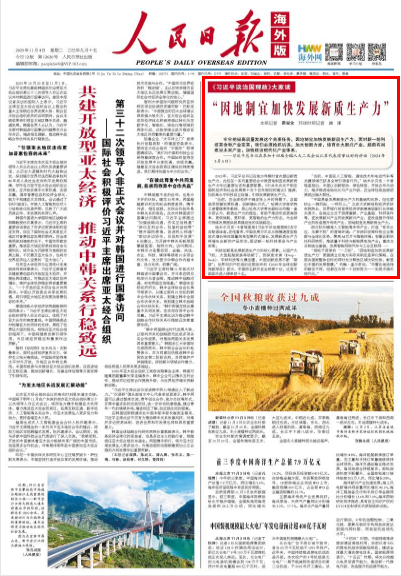
“因地制宜加快发展新质生产力”(《习近平谈治国理政》大家读)
Ren Min Ri Bao Hai Wai Ban· 2025-11-03 22:46
Core Viewpoint - The emphasis on high-quality development and the need to accelerate the development of new productive forces tailored to local conditions is highlighted by Xi Jinping's remarks during the 14th National People's Congress [1]. Group 1: Development of New Productive Forces - The concept of "new productive forces" was first introduced by Xi Jinping in 2023, emphasizing the need for innovation and the cultivation of emerging industries to build a modern industrial system [1]. - The Central Committee's proposal for the 15th Five-Year Plan stresses the importance of high-level technological self-reliance to lead the development of new productive forces [1]. Group 2: Global Context and Innovation - In the context of rising global economic uncertainty, countries must seize development opportunities and innovate growth methods, with new productive forces contributing to more efficient, lower-consumption, environmentally friendly, and intelligent production forms [1]. - The World Intellectual Property Organization's 2025 Global Innovation Index Report shows China has risen to 10th place, marking its first entry into the top ten [2]. Group 3: Regional Strategies and Implementation - Different regions in China are adopting tailored strategies to develop new productive forces based on local resources, industrial foundations, and research conditions, avoiding a one-size-fits-all approach [2]. - Examples include Hangzhou focusing on artificial intelligence, Shenzhen on AI chips and smart terminals, Hefei on quantum technology and new energy batteries, and Chongqing on smart connected vehicles and industrial internet [2].