
人工智能应用

Search documents
险资看好2026权益市场 掘金“硬科技”投资机会
Shang Hai Zheng Quan Bao· 2026-01-18 18:15
Group 1 - The influx of incremental funds is expected to act as a "catalyst" for market growth, with residents shifting their asset allocation from deposits to other assets due to low long-term deposit rates [1] - There is a noticeable increase in residents' enthusiasm for purchasing insurance, particularly dividend insurance products, which may channel funds into the stock market in the future [1] - The trend of "deposit migration" indicates that household savings are entering the capital market through various channels, with ordinary residents' funds likely becoming a major source of market entry by 2026 [1] Group 2 - Insurers are adopting a "barbell" asset allocation strategy, heavily investing in dividend assets while also allocating to growth assets, particularly in response to emerging structural opportunities in the equity market [2] - The market's profit growth rate is expected to rebound in 2026, with a focus on "hard technology" sectors such as AI computing power, industrial software, high-end machine tools, hydrogen energy, and aerospace support [2] - Technology and advanced manufacturing are identified as key investment themes for 2026, with firms like Huatai Asset actively positioning in AI, semiconductors, robotics, and new energy sectors while selectively investing in finance, cyclical, and consumer sectors [2] Group 3 - Mid-sized insurance companies are focusing on growth assets that can deliver tangible results, targeting three main areas: manufacturing with global competitive advantages, sectors experiencing accelerated domestic substitution with real demand, and early-stage industries supported by clear policies and capital [3] - Key sectors of interest include engineering machinery, new energy equipment, semiconductors, new materials, commercial aerospace, and AI applications [3]
全线回调,开年最热赛道突然刹车
3 6 Ke· 2026-01-16 12:12
Core Insights - The AI application sector experienced a significant downturn on January 16, with major stocks like Visual China hitting their daily limit down, despite being one of the hottest sectors at the beginning of the year [1][2]. Group 1: Recent Trends in AI Applications - The recent surge in AI applications was driven by the successful listings of large model companies MiniMax and Zhipu on the Hong Kong stock market, which boosted overall market enthusiasm [4]. - The listing of large model companies indicates a maturing commercial ecosystem for AI applications, leading to growth expectations [5]. - The acquisition of the AI application company "Butterfly Effect" by Meta for billions of dollars has increased the recognition of AI applications in China [6]. - The large-scale deployment of domestically developed inference chips has drastically reduced AI invocation costs, prompting many large model companies to lower their prices [7]. Group 2: Marketing and GEO - The initial excitement in AI applications has been concentrated in the marketing and media sector, particularly following Elon Musk's announcement to open-source the latest content recommendation algorithm for the X platform [9]. - Generative Engine Optimization (GEO) has emerged as a key focus, defined in a Princeton University paper as a method to enhance the visibility of optimized content in AI-generated responses [11]. - The shift towards AI search is expected to replace traditional search engines, with Gartner predicting that AI search will capture 50% of search engine traffic by 2028 [13]. Group 3: Market Potential and Growth - The global GEO market is projected to reach $11.2 billion and $1 billion in China by 2025, with compound annual growth rates (CAGR) of 55% and 53%, respectively [16]. - BlueFocus, a marketing company, reported a revenue of 51.098 billion yuan in the first three quarters of 2025, with a significant 310% increase in AI-driven business revenue [19]. - The AI-driven revenue for BlueFocus reached 1.57 billion yuan in the first half of the year, surpassing the total for the previous year, although it still accounted for less than 5% of total revenue [20]. Group 4: Future Outlook - The year 2026 is anticipated to be pivotal for AI applications, with advancements in model capabilities and the maturation of agent technology providing a fertile ground for AI applications [25]. - The Chinese government is promoting AI application implementation through various initiatives, aiming to cultivate influential enterprises and enhance industrial networks by 2028 [25]. - Companies like AppLovin have demonstrated the potential of AI in marketing, with a 71% year-on-year increase in advertising revenue in Q1 2025, validating AI's impact on the industry [26]. - The AI content production chain is being reshaped, leading to new content forms like AI-generated animated series, which are expected to create significant market opportunities [28][30]. Group 5: Conclusion - The AI sector is poised for continued growth, especially with the recent advancements in large models and the expected rise in AI application revenues [35]. - The investment logic in AI applications will focus on companies that can demonstrate a significant increase in AI revenue as a proportion of overall earnings [36].


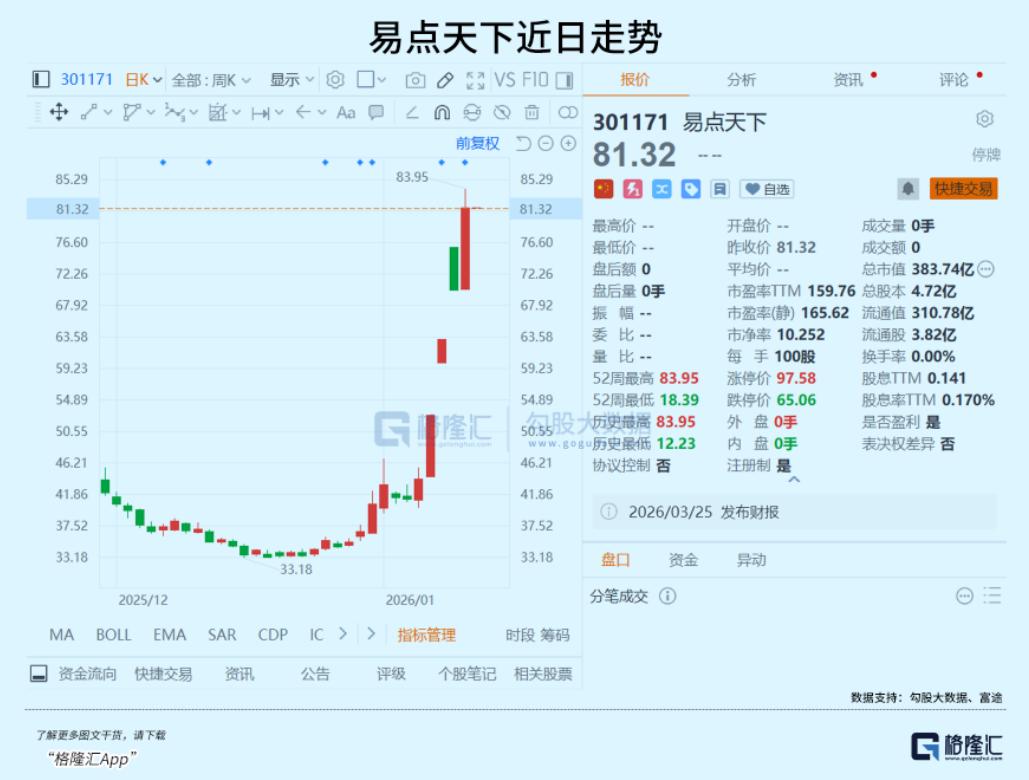
全线回调!开年最热赛道突然刹车
Ge Long Hui· 2026-01-16 09:37
Group 1 - The AI application sector experienced a significant decline on January 16, with major stocks like Vision China hitting the limit down, following a period of rapid growth at the beginning of the year [1] - The recent surge in AI applications was driven by the successful listings of large model companies MiniMax and Zhipu on the Hong Kong stock market, which increased market enthusiasm [3] - The acquisition of the AI application company "Butterfly Effect" by Meta for billions of dollars at the end of last year has enhanced the recognition of AI applications in China [4] Group 2 - The large-scale deployment of domestically developed inference chips has led to a drastic reduction in AI invocation costs, prompting large model companies to lower their prices [5] - AI application companies with established user bases and traffic pools have become new market hotspots as hardware valuations have soared [6] - The recent collective drop in AI applications raises questions about the sustainability of the initial enthusiasm, particularly in the marketing and media sector [7] Group 3 - Elon Musk's recent announcement to open-source the latest content recommendation algorithm for the X platform has sparked interest in Generative Engine Optimization (GEO), which aims to enhance brand content visibility in AI-generated responses [8][9] - Gartner predicts that by 2028, AI search will capture 50% of search engine traffic, indicating a significant shift in marketing dynamics [9] - The global GEO market is projected to reach $11.2 billion and $1 billion in China by 2025, with compound annual growth rates (CAGR) of 55% and 53% respectively [10] Group 4 - BlueFocus has shown impressive performance, with a revenue of 51.098 billion yuan in the first three quarters of 2025, reflecting a year-on-year growth of 12.5%, and a significant increase in AI-driven business revenue by 310% [13] - Despite the growth, AI-driven revenue still accounted for less than 5% of BlueFocus's total revenue of 32.36 billion yuan in the first half of the year [15] - The company's AI-driven revenue is currently small relative to its overall operations, indicating that while growth is notable, it does not yet significantly impact the company's financial health [16] Group 5 - The GEO model is expected to reshape the marketing industry, but it may take time for marketing companies to see significant performance improvements [13] - BlueFocus's proprietary marketing model, BlueAI, focuses on enhancing marketing efficiency, and if it can establish a closed-loop system, it may significantly elevate the company's profitability [17] - The competition with major tech firms for AI marketing capabilities poses a challenge for BlueFocus, as it relies on foundational models from companies like ByteDance and Alibaba [18] Group 6 - The year 2026 is anticipated to be pivotal for AI applications, driven by advancements in model capabilities and supportive policies [20] - The demand for AI applications is growing across various sectors, including marketing, where AI can generate personalized advertising materials and optimize strategies in real-time [23] - Companies like AppLovin have demonstrated the potential of AI in marketing, with a 71% year-on-year increase in advertising revenue in Q1 2025 [23] Group 7 - AI is transforming the entire content production chain, lowering creative barriers and increasing productivity, with new forms of content emerging [27] - AI-generated animated series are becoming a new trend, with significant production and consumption potential in the market [28] - The global AI visual generation application market is projected to reach $16.6 billion by 2027, indicating substantial growth opportunities [32] Group 8 - The integration of AI with traditional industries such as manufacturing and finance is expected to lead to a surge in AI applications, with companies showing a strong willingness to invest in AI for efficiency gains [34] - The focus on vertical applications that address specific industry pain points is becoming increasingly valuable, countering initial fears that large model giants would dominate the market [34] - The upcoming years will likely see significant investment opportunities in AI applications, particularly in niche markets that leverage unique technologies and data [35]



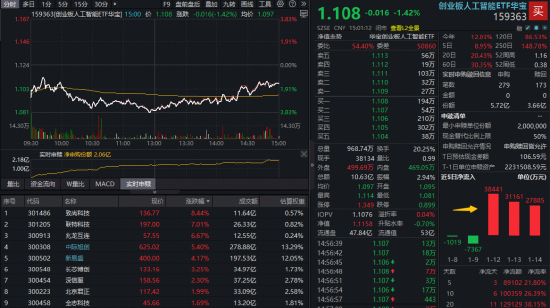
“易中天”尾盘短线拉升,创业板人工智能ETF顽强收阳!基金经理:业绩驱动下,光模块或成资金抱团方向
Xin Lang Cai Jing· 2026-01-15 11:20
Core Viewpoint - The AI sector is experiencing a rebound, with significant movements in the stock market, particularly in the AI application and computing power segments, indicating a strong market sentiment despite some short-term corrections [1][8]. Group 1: Market Performance - The ChiNext AI index showed a strong recovery, closing positively despite a notable drop in AI application stocks like BlueFocus and Toray, which fell over 10% [1][8]. - The computing power segment, particularly light modules, saw a late surge, with stocks like Zhongji Xuchuang and Xinyi Sheng rising over 5% and 4% respectively [1][8]. - The popular ETF tracking the ChiNext AI index (159363) experienced a net subscription of 206 million units in a single day, with total trading volume exceeding 1 billion yuan [1][8]. Group 2: Industry Insights - The light module industry is in a high prosperity cycle, driven by the explosive demand for AI computing power, with supply becoming a core issue [3][10]. - Major manufacturers in the light module sector are accelerating production in mainland China and Thailand, with expectations of significant capacity release by Q1 2026 [3][10]. - The ETF manager highlighted that the recent market corrections do not alter the strong performance expectations for the A-share market in the first half of the year, suggesting that light module stocks could be a good focus during this period [11]. Group 3: AI Application Developments - Alibaba's Qianwen App has integrated with various services within its ecosystem, marking a significant advancement in AI shopping capabilities [11]. - The AI industry is witnessing rapid developments, with new financing rounds for overseas AI companies and the introduction of domestic policies promoting "AI + manufacturing" [11]. - The commercialization of AI applications is accelerating, with a notable decrease in costs associated with inference and long-window models, leading to increased validation in commercial scenarios [11]. Group 4: ETF Performance and Strategy - The ChiNext AI ETF (159363) has been included in the Hong Kong Stock Exchange's mutual market access list, which is expected to enhance liquidity and trading activity [12]. - As of January 14, the ETF's total assets reached a record high of over 5.3 billion yuan, with an average daily trading volume of over 700 million yuan in the past six months, ranking first among eight ETFs tracking the ChiNext AI index [12].

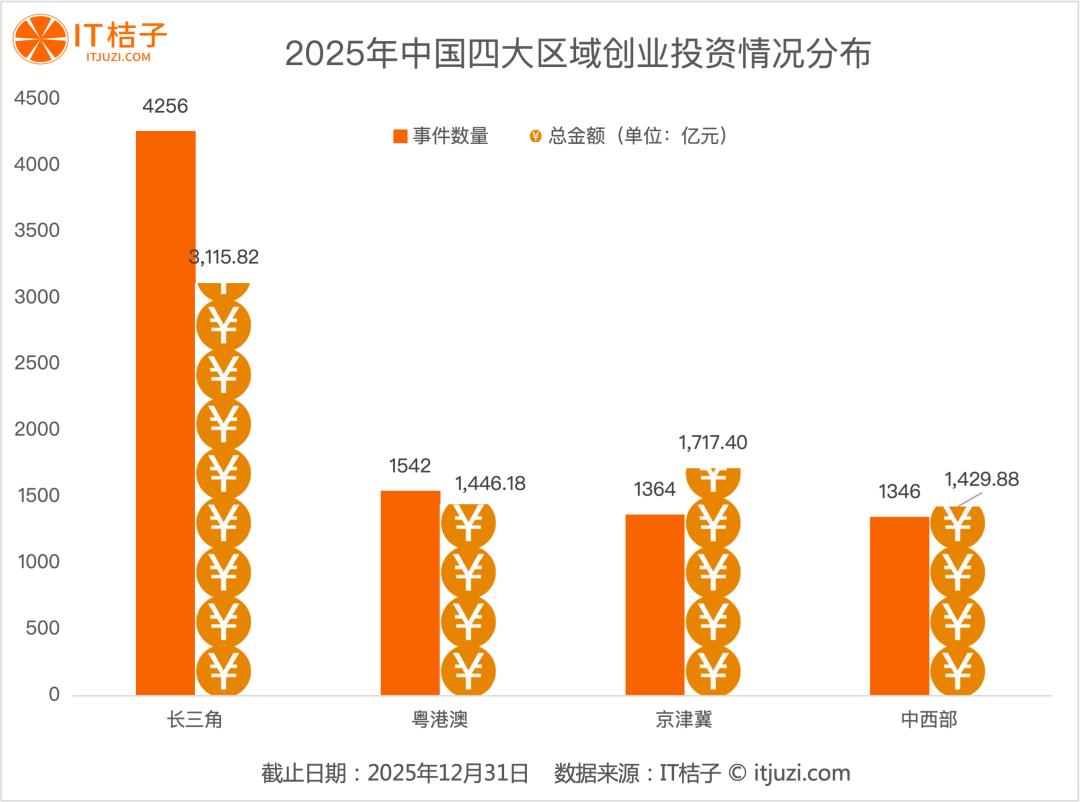
长三角融资占了全国的近半,京津冀屈居第2 梯队
3 6 Ke· 2026-01-13 12:16
Core Insights - The investment landscape in China's venture capital is characterized by a "one strong, many strong" and "similarity with differences" pattern, with the Yangtze River Delta leading significantly [1] - The article analyzes four major economic regions, highlighting their scale, investment consensus, and unique sectors, creating a comprehensive view of capital flow [1] Regional Investment Landscape - The primary market in China has formed a clear tiered structure, with the Yangtze River Delta as the most active venture capital center, recording 4,256 investment events and attracting 311.58 billion yuan [2][4] - The second tier includes the Beijing-Tianjin-Hebei, Guangdong-Hong Kong-Macau, and Central-Western regions, with investment events close in number: 1,364, 1,542, and 1,346 respectively, indicating increasing competition among these regions [4] Core Investment Consensus - Despite regional differences, there is a strong national consensus on seven key investment sectors: artificial intelligence applications, pharmaceuticals, biotechnology, medical devices, new energy, integrated circuits, and robotics [5][7] - Integrated circuits have the highest consensus, ranking among the top two investment hotspots in the Yangtze River Delta (597 events), Guangdong-Hong Kong-Macau (160 events), and Central-Western regions (110 events) [5] Unique Regional Advantages - Each region has developed differentiated sectors based on local resources, creating unique competitive advantages: - **Beijing-Tianjin-Hebei**: Notable for aerospace (76 events), AIGC (60 events), and AI foundational technologies (52 events), showcasing its role as a national technology innovation center [8][10] - **Yangtze River Delta**: Strong industrial chain collaboration, with new materials (332 events) as a significant sector, complementing the leading integrated circuit industry [10][13] - **Guangdong-Hong Kong-Macau**: Focus on intelligent equipment (88 events), reflecting a deep foundation in precision manufacturing and the integration of cutting-edge technology with industry [15] - **Central-Western Regions**: Actively converting local resource advantages into industrial momentum, with new materials (104 events) emerging as a key growth area [18] Conclusion - The 2025 venture capital landscape in China illustrates a dynamic picture of "concentration with dispersion, consensus with uniqueness," defining the direction of capital flow and presenting opportunities for entrepreneurs and investors [19]
港股异动 | 迈富时(02556)盘中再涨超8% GEO市场规模增长空间大 公司构建全链路AI原生营销闭环
智通财经网· 2026-01-13 02:05
Group 1 - The core viewpoint of the news is that the stock of Mai Fushi (02556) has seen significant gains, attributed to Elon Musk's announcement of open-sourcing the latest content recommendation algorithm for the X platform, which is interpreted as a move into the GEO (Geographic Engine Optimization) space [1][2] - Northeast Securities predicts that in the AI era, GEO will become a necessity for enterprise marketing, with substantial growth potential in market size. According to Semrush, AI search is expected to account for 52% of the market by January 2028, surpassing traditional search [1] - The global GEO market is projected to reach USD 11.2 billion by 2025 and USD 100.7 billion by 2030, while China's GEO market is expected to achieve USD 2.9 billion in 2025 and USD 24 billion by 2030 [1] Group 2 - Mai Fushi is recognized as a leading global AI application platform, having served over 210,000 enterprises across various industries, including retail, B2B manufacturing, automotive, home goods, health, tourism, and foreign trade [2] - The company recently upgraded its GEO intelligent assistant, enhancing its generative engine optimization (GEO) technology to create a full-cycle AI-native marketing loop, which aims to help enterprises capture traffic in the AGI (Artificial General Intelligence) era and solidify brand recognition assets [2]
港股AI应用板块爆发,港交所科技100指数涨超2%
Mei Ri Jing Ji Xin Wen· 2026-01-12 06:49
1月12日,港股科技板块走强,AI应用概念股集体爆发截至14:15,香港交易所科技100指数 该指数反映100家在香港交易所上市的市值最大的科技公司的整体表现,涵盖人工智能、生物科技及制 药、电动汽车及智能驾驶、资讯科技、互联网、机器人六大创新主题,突显了香港市场在推动新兴产业 发展方面的关键角色,同时指数成份股均符合南向交易资格,为投资者提供了有效且全面的投资工具, 助力其便捷把握港股科技板块投资机遇。 (文章来源:每日经济新闻) (HKEXT100)上涨2.4%,成分股中,迈富时涨超24%,第四范式涨近19%,金山云涨超14%,趣致集 团、美图公司涨约13%,阿里健康涨超10%。 此前,香港交易所正式推出香港交易所科技100指数,并宣布已与易方达基金签订授权协议。 ...
港股迈富时大涨超18%,9个交易日累计涨幅超40%,股价创近3个月新高
Jin Rong Jie· 2026-01-12 05:07
港股市场AI应用股集体飙升,其中迈富时(2556.HK)大幅上涨超18%,9个交易日累计涨幅超40%,报 45.88港元创近3个月新高,总市值117.5亿港元。 本文源自:金融界AI电报 ...
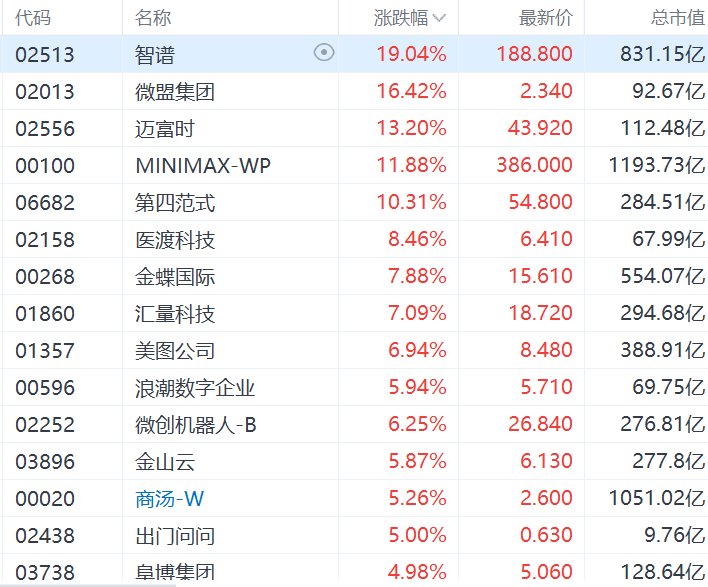
港股AI应用股集体飙升,微盟集团涨超16%,迈富时涨超13%
Ge Long Hui· 2026-01-12 02:49
Group 1 - The Hong Kong stock market saw a significant rise in AI application stocks, with notable increases in share prices for several companies [1] - Zhihui (智谱) surged by 19% to reach a new high since its listing, with a latest price of 188.800 and a total market capitalization of 831.15 billion [2] - Weimeng Group (微盟集团) increased by over 16%, with a latest price of 2.340 and a market cap of 92.67 billion [2] Group 2 - Mai Fushi (迈富时) rose by more than 13%, with a latest price of 43.920 and a market capitalization of 112.48 billion [2] - MINIMAX-WP (MINIMAX-WP) experienced an 11.88% increase, reaching a price of 386.000 and a total market value of 1193.73 billion [2] - Fourth Paradigm (第四范式) saw a growth of over 10%, with a latest price of 54.800 and a market cap of 284.51 billion [2] Group 3 - Yidu Technology (医渡科技) increased by 8.46%, with a latest price of 6.410 and a market capitalization of 67.99 billion [2] - Kingdee International (金蝶国际) rose by 7.88%, reaching a price of 15.610 and a total market value of 554.07 billion [2] - 汇量科技 (汇量科技) saw a 7.09% increase, with a latest price of 18.720 and a market cap of 294.68 billion [2] Group 4 - Meitu (美图公司) increased by 6.94%, with a latest price of 8.480 and a market capitalization of 388.91 billion [2] - Inspur Digital (浪潮数字企业) rose by 5.94%, reaching a price of 5.710 and a market cap of 69.75 billion [2] - 微创机器人-B (微创机器人-B) saw a 6.25% increase, with a latest price of 26.840 and a market cap of 276.81 billion [2]
港股异动 | AI应用全线飙升 迈富时(02556)涨幅扩大逾15%领涨板块
智通财经网· 2026-01-12 02:19
Group 1 - AI application concept stocks have surged across the board, indicating strong market interest in this sector [1] - Zhizhu (02513) has seen a significant increase of 20.37%, reaching HKD 190.9 [1] - Maifushi (02556) has risen by 15.57%, now priced at HKD 44.84 [1] - Huiliang Technology (01860) has experienced an 8.01% increase, trading at HKD 18.88 [1]