
卤味食品

Search documents
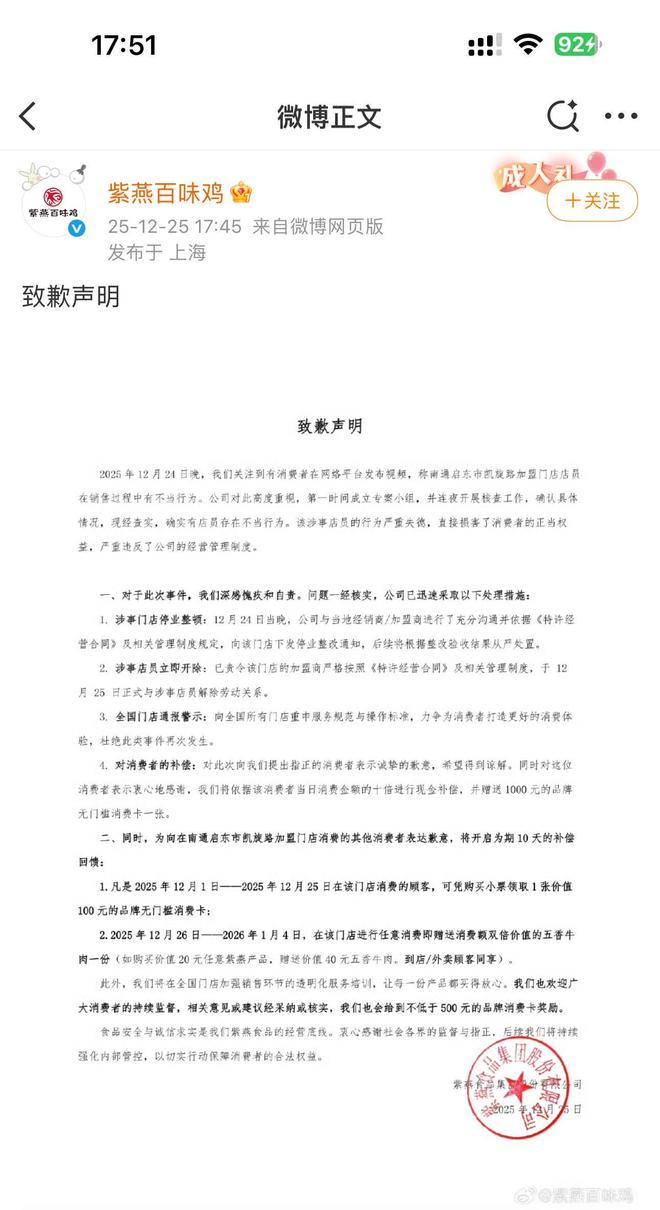
店员偷拿顾客牛肉!紫燕食品致歉,将补偿期间到该店消费顾客
Nan Fang Du Shi Bao· 2025-12-25 10:26
Core Viewpoint - The company, Ziyan Food, issued an apology statement on December 25, 2025, addressing an incident where a store employee was caught taking beef after weighing it for a customer, which violated company policies and harmed consumer rights [4][9]. Group 1: Incident Details - On December 24, 2025, a consumer posted a video on social media alleging that an employee at the Ziyan Bawei Chicken store in Nantong City engaged in improper behavior during a sale [7]. - The company took the allegations seriously and formed a special task force to investigate the claims, confirming that the employee's actions were indeed inappropriate [4][9]. Group 2: Company Response - The company expressed deep regret and self-blame regarding the incident and implemented several immediate measures: 1. The involved store was temporarily closed for rectification, with a notice issued to the franchisee based on the franchise agreement [5][9]. 2. The employee involved was immediately terminated from their position [5][9]. 3. A nationwide alert was issued to all stores to reinforce service standards and operational protocols [5][9]. 4. The company offered compensation to the affected consumer, promising ten times the amount of their purchase as cash compensation and a 1,000 yuan brand gift card [5][9]. Group 3: Compensation and Customer Engagement - To further express apologies to other customers who shopped at the Nantong store, the company initiated a 10-day compensation campaign: 1. Customers who made purchases between December 1 and December 25, 2025, could redeem a 100 yuan no-threshold gift card with their receipt [9]. 2. From December 26, 2025, to January 4, 2026, customers making any purchase at the store would receive double the value of their purchase in five-spice beef [9]. Group 4: Company Background and Financial Performance - Ziyan Food, the parent company of Ziyan Bawei Chicken, was listed on the Shanghai Stock Exchange on September 26, 2022, and specializes in various marinated products [10]. - As of June 30, 2024, the company operated 6,308 stores in China, with 29 being directly operated [10]. - The latest financial report indicated a 6.43% year-on-year decline in revenue to 2.514 billion yuan and a 44.21% drop in net profit to 248 million yuan for the first three quarters of the year [10].


行业承压下,紫燕食品股权激励成“空头支票”
Xin Lang Cai Jing· 2025-12-23 08:50
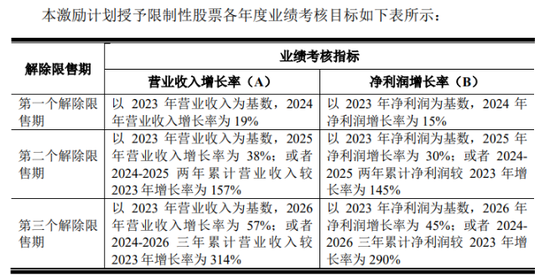
炒股就看金麒麟分析师研报,权威,专业,及时,全面,助您挖掘潜力主题机会! 来源:证券之星 因难以完成业绩考核指标,紫燕食品近期(603057.SH)公告称,宣布终止2024年推出的限制性股票激 励计划,相关股票也将回购注销。从公告推出到悄然落幕,这一决策距离该激励计划草案披露不足两 年。 卤味江湖近年来竞争愈发激烈,随着新老玩家的不断涌入,而消费者支出日趋理性,行业整体增速正明 显放缓。在此趋势下,行业头部品牌也在承压前行。证券之星注意到,有着"佐餐卤味第一股"之称的紫 燕食品,营收已连续两年呈现负增长,今年前三季度,公司经营疲软,营收与净利润双双"失守",下行 压力清晰可见。 01. "半价"股权激励,严苛解锁条件 2024年初,紫燕食品推出2024年限制性股票激励计划(下称"激励计划"),拟向核心员工、技术骨干等 授予限制性股票合计246.45万股,占激励计划草案公告时公司总股本的0.60%。同时,该激励计划的股 票授予价格为10.89元/股,约为草案公告前20个交易日公司股票交易均价的50%,激励力度颇大。 这份重金激励的另一面,是与之匹配的解锁条件。证券之星注意到,该计划以2023年的营收和净利润为 ...
套餐8.9元起,卤味巨头们集体“卖饭”
3 6 Ke· 2025-12-02 12:13
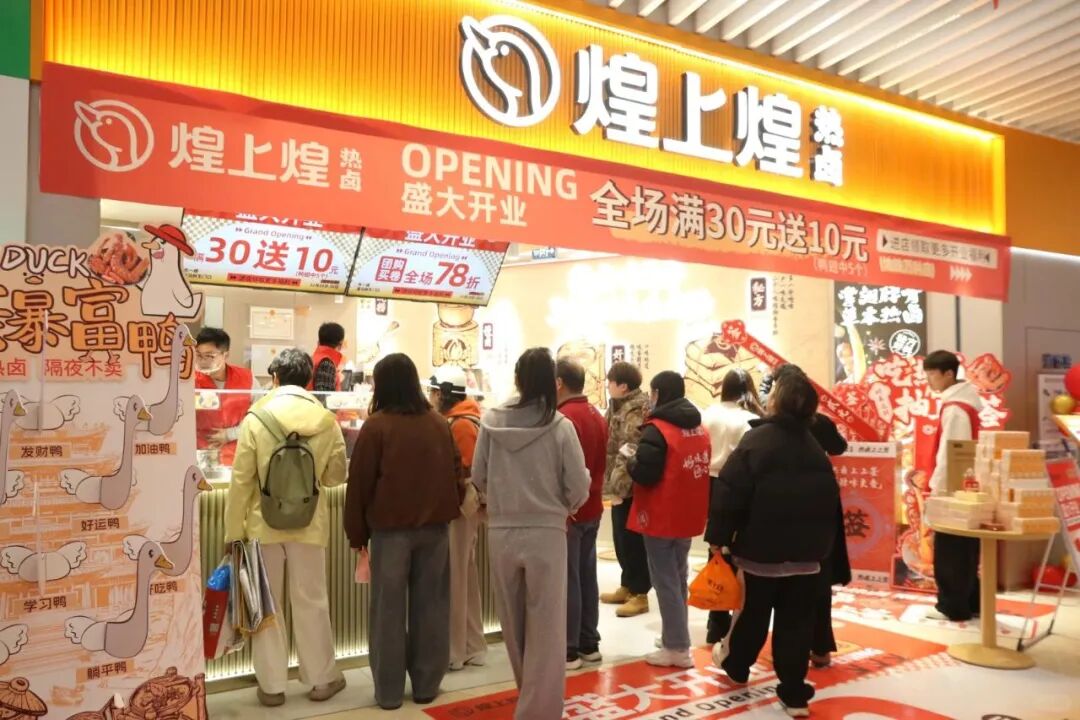
Core Viewpoint - The trend of "fast food" transformation among various braised food brands is emerging, with companies like Huang Shang Huang, Zhou Hei Ya, and Jue Wei Foods expanding their product lines to include staple foods and adopting a fast-casual dining model to adapt to the competitive market [1][7]. Group 1: Company Developments - Huang Shang Huang has opened a new hot braised food store in Nanchang, featuring a simplified design and a menu that includes hot braised dishes, rice, noodles, and drinks, aiming to attract customers with a dine-in experience [2][3]. - The new hot braised store offers over 30 SKUs, which is a reduction from the 50+ SKUs available at traditional Huang Shang Huang outlets, focusing on value through combo meals priced between 30-40 yuan per person [3][6]. - The company has previously tested the hot braised food market with its "Boiling Braised" project launched in April 2020, but significant investment in this area was lacking until recent developments [6]. Group 2: Industry Trends - The overall performance of the braised food sector is declining, with Huang Shang Huang's store count dropping from 4,627 in 2020 to 2,898 in the first half of this year, and a revenue decrease of 5.08% year-on-year to 1.379 billion yuan in the first three quarters [7]. - The braised food market is projected to grow at a slower rate, with a market size of 157.3 billion yuan in 2024, reflecting a decline in growth rate from 4.8% in 2023 to 3.7% [7]. - Competitors are also adapting by launching new store formats and product lines, such as Jue Wei Foods' "Jue Wei Fresh Braised" store and "Jue Wei Plus" outlets, which offer a wider variety of food items at lower price points [7][8].


从“活着”到“火着”:两家卤味店的抖音焕新记
Zhong Guo Shi Pin Wang· 2025-11-20 09:32
Core Insights - The article highlights the successful transformation of two traditional snack shops, Lao Lukou and Jiang E'er, through innovative marketing strategies on Douyin, showcasing how they adapted to modern consumer preferences and enhanced their business performance [1][43]. Group 1: Business Transformation - Lao Lukou started as a small roadside stall run by a couple, gradually evolving into a brand with multiple outlets and a factory, driven by a commitment to quality and customer satisfaction [2][20]. - Jiang E'er, with a heritage dating back to 1910, faced challenges in maintaining its brand identity and operational efficiency but successfully revitalized its business by leveraging its non-material cultural heritage status and engaging storytelling [21][42]. Group 2: Marketing Strategies - Both shops utilized Douyin's platform to reach a broader audience, with Lao Lukou's sales increasing significantly after engaging with influencers and creating appealing content [9][20]. - Jiang E'er capitalized on its historical significance and unique recipes, using live streaming and short videos to connect with customers and enhance brand loyalty [29][42]. Group 3: Customer Engagement - Lao Lukou's owner emphasized the importance of personal engagement in live broadcasts, which significantly boosted sales and customer interaction [13][20]. - Jiang E'er's strategy included sharing the story behind its dishes and the cultural significance of its offerings, fostering a deeper connection with local customers [33][42]. Group 4: Industry Implications - The success stories of these two shops illustrate a broader trend where traditional businesses can thrive by embracing digital platforms and innovative marketing techniques, providing a roadmap for other small and medium enterprises [43][44].

紫燕食品(603057):2025年三季报点评:增速转正,期待持续改善
Haitong Securities International· 2025-11-10 09:17
Investment Rating - The report maintains an "Outperform" rating for the company, with a target price of 25 RMB per share, reflecting a 15% upside potential based on a 50x PE for 2025 [4][8]. Core Insights - The company experienced a positive revenue turnaround in Q3 2025, with a revenue of 1.04 billion RMB, up 1.75% year-on-year, despite a significant decline in net profit [9]. - The gross profit margin (GPM) faced pressure, decreasing by 5.61 percentage points to 22.92%, primarily due to rising costs of imported beef [10]. - The company is focusing on expanding its store network, with a current total of 5,260 stores, targeting university towns and large factory canteens for new openings [12]. Financial Summary - Total revenue projections for 2023A to 2027E are as follows: 3,550 million RMB, 3,363 million RMB, 3,207 million RMB, 3,428 million RMB, and 3,760 million RMB, respectively, indicating a decline in the short term but potential growth in the long term [3]. - Net profit attributable to shareholders is projected to decrease significantly in 2025E to 205 million RMB, down 40.7% from 2024A [3]. - The earnings per share (EPS) forecast for 2025-2027 is 0.50 RMB, 0.62 RMB, and 0.73 RMB, respectively [4][8]. Product and Regional Performance - Fresh goods revenue showed a slight increase of 0.1% year-on-year to 874 million RMB in Q3 2025, with notable growth in other fresh goods, which increased by 27.4% [11]. - Regional performance varied, with East China revenue down 1.9%, while South China and overseas markets saw significant growth of 73.1% and 57.7%, respectively [11].
年轻人不吃鸭脖,门店一年关5600家,消费习惯大变了
Sou Hu Cai Jing· 2025-11-09 21:27
Core Insights - The article discusses the decline of the duck neck snack industry, highlighting the closure of 5,600 stores and the loss of consumer interest among young people [1] - Major brands like Juewei, Zhou Hei Ya, and Huang Shang Huang are facing significant challenges, including store closures, financial losses, and a drop in consumer trust [1][6] Group 1: Industry Overview - The duck neck snack was once a staple of nightlife, with brands rapidly expanding and attracting franchisees due to perceived profitability [1][3] - By 2019, the market began to saturate, leading to a decline in single-store revenue as competition increased [3] - In the first half of 2025, Zhou Hei Ya reported revenue of 1.223 billion, a decrease of 2.9% year-on-year, while Huang Shang Huang's revenue was 984 million, down 7.19% year-on-year [1] Group 2: Business Model Challenges - The franchise model initially appeared profitable due to upfront fees and bundled services, but market saturation led to diminishing returns for franchisees [3][8] - Zhou Hei Ya's focus on high-end locations resulted in high rental costs, making its business model vulnerable during economic downturns [3][6] - The number of franchise stores for Zhou Hei Ya decreased to 1,291 by the first half of 2025, indicating a contraction in its business [3] Group 3: Consumer Behavior and Market Trends - The menu offerings of these brands have remained stagnant, failing to innovate and attract younger consumers who prefer trendy and novel options [4][8] - Price increases have alienated consumers, as the cost of duck neck snacks has approached that of full meals, leading to a perception of reduced value [6][8] - The combination of quality control issues, lack of product innovation, and rising prices has contributed to a significant decline in brand loyalty and consumer interest [6][8] Group 4: Financial Impact - The combined revenue of the three major brands decreased by nearly 1 billion in the first half of 2025, reflecting a systemic contraction in the industry [8] - Juewei has faced severe financial issues, leading to its designation as ST (special treatment) in the capital market, with its market value evaporating by 80% from its peak [1][6] - Zhou Hei Ya has been forced to make layoffs and internal adjustments due to declining revenue and increased operational costs [6]

紫燕食品(603057):佐餐卤味龙头,二代接班启新程
Soochow Securities· 2025-11-03 15:38
Investment Rating - The report gives a "Buy" rating for the company, marking its first coverage [1]. Core Insights - The company is a leading player in the marinated food sector, with a strong focus on fresh products and a stable core product lineup. It has been transitioning from family management to modern corporate governance while expanding its market presence nationally and internationally [8][19]. - The marinated food market in China is characterized by a large market with many small enterprises, indicating significant growth potential for leading brands like the company, which holds a market share of 3.1% [48][57]. - The company is diversifying its operations, exploring new markets such as campus and B2B sectors domestically, and expanding internationally with a focus on establishing stores overseas and securing supply chains [8][19]. Summary by Sections 1. Company Overview - The company has evolved through three main stages: regional focus, national expansion, and the initiation of a global strategy. It was founded in 1989 and has grown to over 6,300 stores by mid-2024 [14][15]. - The product mix is heavily weighted towards fresh goods, which accounted for 83.4% of revenue in 2024, with core products like "Couple's Lung Slice" and "Whole Poultry" maintaining a stable market share [20][21]. 2. Market Landscape - The marinated food industry in China has seen a compound annual growth rate (CAGR) of 11.9% from 2018 to 2022, with the market size expanding from 1,498 billion yuan to 2,350 billion yuan [48][57]. - The company leads in store count among competitors, with over 5,000 stores, while the top five brands collectively hold only 5.1% market share, indicating low industry concentration and room for growth [57][64]. 3. Leadership Transition and Global Strategy - The second generation of leadership is actively pursuing a global strategy, with initiatives including the establishment of overseas stores and partnerships for sourcing raw materials [19][80]. - The company is also focusing on diversifying its domestic channels, particularly in the campus and B2B markets, to enhance brand visibility among younger consumers [19][34]. 4. Financial Analysis and Projections - Revenue projections for 2025-2027 are estimated at 31.6 billion yuan, 34.3 billion yuan, and 36.4 billion yuan, respectively, with corresponding net profits of 2.5 billion yuan, 2.9 billion yuan, and 3.4 billion yuan [1][8]. - The company's gross margin is closely tied to raw material prices, which have shown volatility but are expected to stabilize, allowing for potential margin improvements in the future [40][46].
彪马将再裁员900人;“绝味鸭脖们”越来越难卖了
Mei Ri Jing Ji Xin Wen· 2025-10-30 23:14
Group 1: Puma - Puma reported a 10.4% decline in sales to €1.9557 billion for Q3 2025, with a net loss of €62.3 million and earnings per share of -€0.42 [1] - The company plans to cut approximately 900 white-collar jobs globally by the end of 2026 due to anticipated significant sales declines and high operational costs [1] - Puma is facing challenges such as weak brand momentum, high inventory levels across channels, and low distribution quality, but still has potential to rank among the top three global sports brands if reforms are successful [1] Group 2: Douyin - Douyin announced ongoing efforts to combat the improper use of minors' images for profit, highlighting the need for continuous protection of minors online [2] - The platform has removed 37,000 videos and penalized 3,651 accounts for violations related to the exploitation of minors in the past month [2] - Douyin emphasizes the importance of cultivating a healthy online ecosystem through legal, technological, and familial support [2] Group 3: Snack Industry - The snack industry, particularly the braised food segment, is experiencing a slowdown in growth and significant adjustments, with major players like ST Juewei and Huangshanghuang reporting revenue declines [3] - Experts indicate that high prices and insufficient value-for-money in the braised food sector are facing substantial challenges amid changing consumer willingness [3] Group 4: Starbucks - Starbucks reported a revenue of $3.105 billion in China for the full fiscal year 2025, marking a 5% year-over-year increase [4] - The company has achieved continuous revenue growth for the fourth consecutive quarter and positive same-store sales growth for the second consecutive quarter [4] - Starbucks' performance indicates that it has successfully built a competitive advantage through product differentiation in a highly competitive coffee market [4]
“绝味鸭脖们”越来越难卖了
Di Yi Cai Jing· 2025-10-30 03:39
Core Viewpoint - The ready-to-eat food industry, particularly the marinated food segment, is experiencing a slowdown in growth and significant adjustments, as indicated by the declining revenues of major players like ST Juewei and Huangshanghuang [1][4]. Group 1: Company Performance - ST Juewei reported a revenue of 1.441 billion yuan for Q3 2025, a year-on-year decrease of 13.98%, with a net profit of 105 million yuan, down 26.46% [1]. - For the first three quarters of 2025, ST Juewei's revenue was 4.260 billion yuan, a decline of 15.04% year-on-year, and net profit fell by 36.07% to 280 million yuan [1]. - Huangshanghuang's revenue for the first three quarters decreased by 5.08% to 1.379 billion yuan, while net profit increased by 28.59% to 101 million yuan [1][2]. Group 2: Market Challenges - The marinated food industry is facing challenges due to changing consumer preferences, with high prices and insufficient cost-performance ratios impacting sales [1][4]. - ST Juewei attributed its declining net profit primarily to a decrease in sales volume of its main products due to adverse market conditions [1]. - Huangshanghuang noted that changes in consumption scenarios and a decline in single-store revenue contributed to its revenue drop, with a reduction of 762 stores from the previous year [2]. Group 3: Industry Trends - The overall price level of marinated food is considered high, and the lack of value for money is becoming more pronounced as consumer willingness to spend decreases [4]. - The industry is witnessing increased competition from new brands, which is eroding the market share of traditional marinated food brands [4]. - Health consciousness among consumers is rising, leading to reduced demand for high-salt and high-fat marinated products [4].
卤味越来越难卖了:绝味净利润跌三成,煌上煌扩产计划延期
Di Yi Cai Jing· 2025-10-30 03:04
Core Insights - The braised food industry, once thriving with the "ten thousand store model," is now facing a slowdown in growth and significant adjustments due to declining consumer willingness and high prices [1][4] Group 1: Company Performance - ST Juewei reported a revenue of 1.441 billion yuan for Q3 2025, a year-on-year decrease of 13.98%, with net profit down 26.46% to 105 million yuan [1] - For the first three quarters of 2025, ST Juewei's revenue was 4.260 billion yuan, down 15.04% year-on-year, and net profit decreased by 36.07% to 280 million yuan [1] - Huang Shanghuang's revenue for the first three quarters fell by 5.08% to 1.379 billion yuan, while net profit increased by 28.59% to 101 million yuan [1][2] Group 2: Market Challenges - The decline in sales for ST Juewei is attributed to a challenging market environment affecting the sales volume of its main products [1] - Huang Shanghuang's revenue drop is linked to changing consumer scenarios and a decrease in store numbers, with a reduction of 762 stores from the end of 2024 [2] - The overall high prices and insufficient cost-performance ratio of braised products are significant challenges for the industry, especially as consumer willingness to spend decreases [4] Group 3: Industry Trends - The growth of the braised food sector relies on demographic advantages and an increase in store numbers, but competition is intensifying with new brands emerging [3][4] - Consumer health awareness is rising, leading to reduced demand for high-salt and high-fat braised products, further impacting sales [4] - The overall price level of braised food is perceived as high, which, combined with declining consumer confidence, poses a substantial challenge to the industry [4]