
基建投资

Search documents
关税噪音掩盖的真实经济成色(国金宏观孙永乐)
雪涛宏观笔记· 2025-05-24 02:55
Core Viewpoint - The article discusses the current state of the domestic economy, highlighting three main lines: export under trade friction, investment and consumption driven by policy stimulus, and the real endogenous power of the economy. It notes a temporary phase of "grabbing exports 2.0" due to easing US-China trade tensions, with a focus on the resilience of the economy in the second quarter [2]. Group 1: Consumption Trends - There is a divergence in the growth rates of subsidized and non-subsidized consumption, with service consumption growth gradually declining, indicating little change in endogenous consumption momentum. From January to April, retail sales grew by 4.7% year-on-year, with "trade-in" consumption contributing 1.1 percentage points to this growth [3]. - The growth rate of service consumption has decreased from 20% in 2023 to 6.2% in 2024 and 5.1% in April 2025, suggesting a plateau after a rebound [3]. - The consumption subsidy policy is expected to support retail sales growth in the second quarter, with an anticipated increase of 4.5%-5% in retail sales and a final consumption growth of 4.3% [28]. Group 2: Real Estate Market - The 924 policy in real estate has shown a diminishing effect, with sales facing adjustment pressures. From January to April, the cumulative year-on-year change in domestic commercial housing sales area was -2.8%, a significant improvement from -17.1% in 2024 [12]. - The second-hand housing market has performed better, with a year-on-year increase of 21.1% in transaction area from October 2024 to March 2025, raising the proportion of second-hand housing sales [12]. - However, by April, second-hand housing sales began to cool down, with a year-on-year decrease of 22.6% in 11 sample cities, indicating a potential downturn in the market [12]. Group 3: Investment and Economic Growth - Despite little change in endogenous economic momentum, consumption subsidies and export initiatives are expected to significantly support the economy in the second quarter, with a projected GDP growth rate of 5.2% for the quarter [28]. - Fixed asset investment growth is expected to stabilize around 4%, supported by "equipment updates" and related projects, with manufacturing and infrastructure investments showing year-on-year increases of 8.8% and 10.9%, respectively [28]. - The article anticipates a 3%-5% growth in exports in the second quarter, despite facing high base effects [30].


前4个月广义基建投资同比增长10.9%,二季度有望维持高位|财税益侃
Di Yi Cai Jing· 2025-05-22 11:52
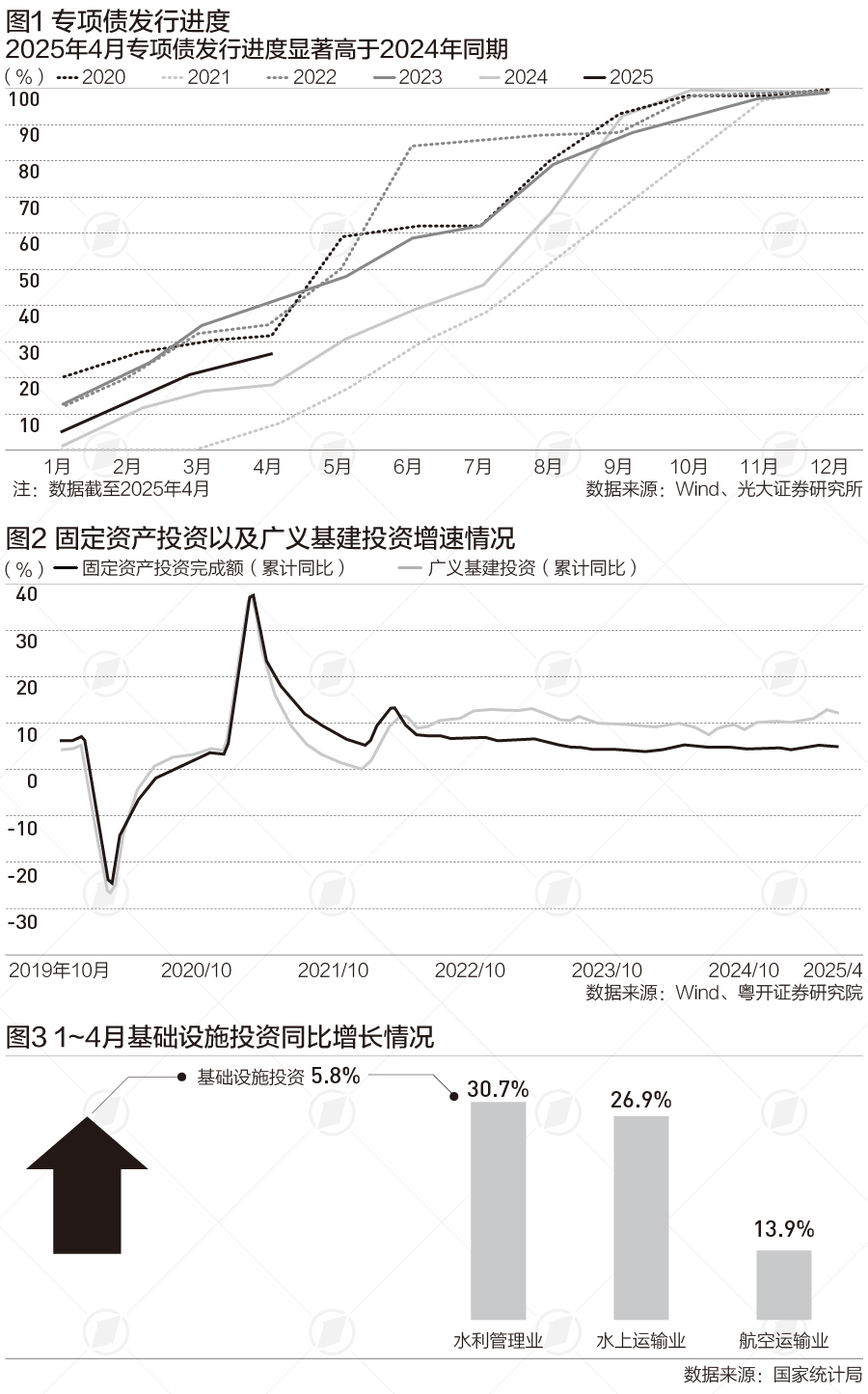
Core Viewpoint - Infrastructure investment in China has shown significant growth in the first four months of this year, contributing to economic stability amidst external pressures, with broad infrastructure investment increasing by 10.9% year-on-year, surpassing the fixed asset investment growth rate of 4% [1] Group 1: Infrastructure Investment Growth - Infrastructure investment (excluding electricity, heat, gas, and water production and supply) grew by 5.8% year-on-year in the first four months, which is 1.8 percentage points higher than the overall investment growth [1] - The contribution rate of infrastructure investment to overall investment growth is 32.6%, an increase of 2.3 percentage points from the first quarter [1] - Specific sectors such as water management, water transport, and air transport saw substantial investment growth rates of 30.7%, 26.9%, and 13.9% respectively [1] Group 2: Government Debt and Financing - The net financing of government bonds reached 4.85 trillion yuan in the first four months, an increase of 3.58 trillion yuan year-on-year [3] - Local governments issued approximately 1.2 trillion yuan in new special bonds, with 31% allocated to municipal and industrial park infrastructure, 20% to transportation infrastructure, and 9% to shantytown renovations [3] Group 3: Policy and Future Outlook - The issuance of local government special bonds has accelerated, with 27% of the annual quota of 4.4 trillion yuan completed in the first four months, which is significantly higher than the 19% completion rate in the same period of 2024 [6] - The Central Political Bureau has called for more proactive macro policies, including the accelerated issuance of special bonds and long-term treasury bonds [6] - Analysts expect that infrastructure investment will maintain a high level of activity, with a projected year-on-year growth rate of around 10% in the second quarter [7]
经济复苏的成色(国金宏观孙永乐)
雪涛宏观笔记· 2025-03-23 23:23
Core Viewpoint - The article discusses the mixed signals in China's economic recovery, highlighting the divergence in financial, inflation, and economic data, particularly in infrastructure, real estate, and consumption sectors [2][3][4]. Economic Performance - The GDP growth rate for the first quarter is projected to be around 5.3%, with a year-on-year increase in retail sales of 4% [2]. - CPI and PPI showed negative growth in January-February, with CPI at -0.1% and PPI at -2.2%, indicating weak demand [3]. Infrastructure Investment - Infrastructure investment grew by 9.9% year-on-year in January-February, but high-frequency data such as black metal prices and cement shipment volumes are low [4]. - The structure of infrastructure investment is skewed towards central government projects, with significant growth in water and energy sectors, while traditional sectors like road transport are lagging [4]. Real Estate Market - The real estate recovery is characterized by uncertainty, with second-hand home transactions in major cities up by 25.9%, contrasting with a decline in new home sales [5]. - There is significant internal divergence in second-hand home sales across cities, with some cities experiencing substantial growth while others see declines [5]. Consumer Spending - Consumer spending is showing signs of recovery, driven by policies like "trade-in" programs, but the sustainability of this recovery is in question [11]. - Retail sales growth is being supported by a rebound in service retail, but overall consumer sentiment remains cautious due to rising unemployment rates [16]. Policy Implications - The government is focusing on boosting consumption and stabilizing the real estate market, with plans for stimulus measures if external uncertainties increase [17].

迈向高质量投资——释放增长潜力,构建新发展格局
Da Gong Guo Ji· 2025-03-06 07:28
Investment Growth and Trends - Infrastructure investment in 2024 showed a year-on-year growth of 9.2%, with power, heat, gas, and water supply sectors leading at 23.9% growth[2] - Manufacturing investment also grew by 9.2% in 2024, outpacing overall fixed asset investment by 6 percentage points, highlighting its role as a key economic driver[3] - Real estate investment faced challenges, declining by 10.6% in 2024, with new housing sales down 12.9% and sales revenue down 17.1%[4] Challenges and Opportunities - Investment quality development is entering a new phase, facing challenges in addressing imbalances and enhancing core strengths[5] - China's per capita infrastructure capital stock is only 20% to 30% of that in developed countries, indicating significant investment needs in shortfall areas[4] - Despite traditional growth engines like real estate being under pressure, there is potential for resource optimization towards infrastructure and manufacturing[4] Future Outlook - Infrastructure investment is expected to remain robust, supported by special bonds and urban renewal policies, which will drive growth in 2025[6] - Manufacturing investment is poised for strategic opportunities, with significant investments in technology and digital infrastructure, such as Alibaba's plan to invest 380 billion RMB over three years[7] - Real estate investment is anticipated to recover with policy support, as financing mechanisms have already facilitated the construction of 14 million housing units[8]