基金代销

Search documents
10万亿基金代销江湖,银行系且战且退
3 6 Ke· 2025-09-17 23:20
Core Insights - The A-share market has stabilized and rebounded since 2025, leading to a reshuffling in the public fund sales landscape, with significant growth in non-monetary fund holdings surpassing 10 trillion yuan [1][2] - The top fund distribution institutions, such as Ant Fund and China Merchants Bank, dominate the market, holding over 25% of the total non-monetary fund scale [1][2] - A structural change in investor preferences is evident, with a shift towards more transparent and lower-fee products, particularly passive and fixed-income funds [2][3] Growth Structure - In the first half of 2025, the non-monetary fund holdings of the top 100 distribution institutions reached 10.2 trillion yuan, a 6.95% increase, while equity fund holdings grew by 5.89% to 5.14 trillion yuan [1][2] - Stock index funds saw a remarkable growth of 14.57%, nearing 2 trillion yuan, indicating a recovery in investor confidence driven by rising core indices [1][2] - Smaller institutions are struggling to balance scale and profitability, with a continuing trend of market concentration favoring larger players [2][3] Channel Dynamics - The distribution landscape is increasingly characterized by a three-way competition among banks, brokerages, and independent sales institutions, with a clear restructuring of their market shares [3][4] - Banks still hold over 40% of equity fund holdings, but their market share is declining, as younger investors prefer digital platforms [3][4] - Brokerages and third-party platforms are gaining ground due to their product flexibility and online capabilities, with brokerages increasing their market share in equity funds to 27.41% [4][5] Index Fund Surge - Stock index funds are the hottest category in the current fund growth, with brokerages maintaining a dominant position due to their trading advantages [5][6] - Banks are rapidly increasing their index fund sales, with a year-on-year growth of 99.2% in the first half of 2025, indicating a strategic response to market trends [5][6] - Major banks like Agricultural Bank and Industrial and Commercial Bank have significantly increased their index fund sales, showcasing their adaptability [5][6] Future Outlook - Despite positive growth data, the fund distribution industry remains cautious due to impending fee reforms that will impact revenue structures and product strategies [7][8] - The upcoming fee reductions are expected to challenge traditional sales models, pushing institutions to enhance their advisory services [7][8] - Regulatory changes are likely to encourage brokerages to invest more in equity product sales, further accelerating industry transformation [7][8]




10万亿基金代销江湖 银行系且战且退
经济观察报· 2025-09-17 11:50
Core Viewpoint - The non-monetary fund holding scale exceeding 10 trillion yuan marks a significant milestone in the maturity of China's public fund market, indicating a transformation in channels, products, and client structures that will shape future competition [1][15]. Group 1: Market Overview - As of mid-2025, the non-monetary fund holding scale of the top 100 distribution institutions reached 10.2 trillion yuan, a quarter-on-quarter increase of 6.95%, while equity fund scale grew by 5.89% to 5.14 trillion yuan [2][5]. - The stock index fund segment saw a remarkable growth of 14.57%, nearing 2 trillion yuan, reflecting a recovery in investor confidence amid a rising A-share market [5][6]. Group 2: Structural Changes - There is a notable differentiation in growth, with leading institutions like Ant Fund and China Merchants Bank holding over 25% of the market share, while smaller institutions struggle to balance scale and profitability [6][7]. - The growth in fund scale is primarily driven by passive products and fixed-income funds, indicating a shift in investor preference towards more transparent and lower-fee products [7]. Group 3: Channel Dynamics - The distribution landscape is increasingly characterized by a tripartite structure of banks, securities firms, and independent sales agencies, with banks holding over 40% of equity fund holdings but experiencing a decline [9][10]. - Securities firms and third-party platforms are gaining market share due to their product flexibility and online capabilities, with securities firms' market share in equity funds rising to 27.41% [9][10]. Group 4: Index Fund Growth - Index funds are the hottest category in the current fund scale growth, with securities firms maintaining a dominant position due to their trading attributes and customer structure [11][12]. - Banks are rapidly increasing their index fund sales, with a year-on-year growth of 99.2% in the first half of 2025, indicating a strategic response to market trends and changing client needs [11][12]. Group 5: Future Challenges - The upcoming third phase of public fund fee reforms is expected to significantly impact the income structure and product strategies of distribution institutions, necessitating a shift from sales-driven to service-driven models [14][16]. - Institutions must adapt to fee changes, enhance advisory capabilities, and optimize product structures to remain competitive in the evolving market landscape [14][16].


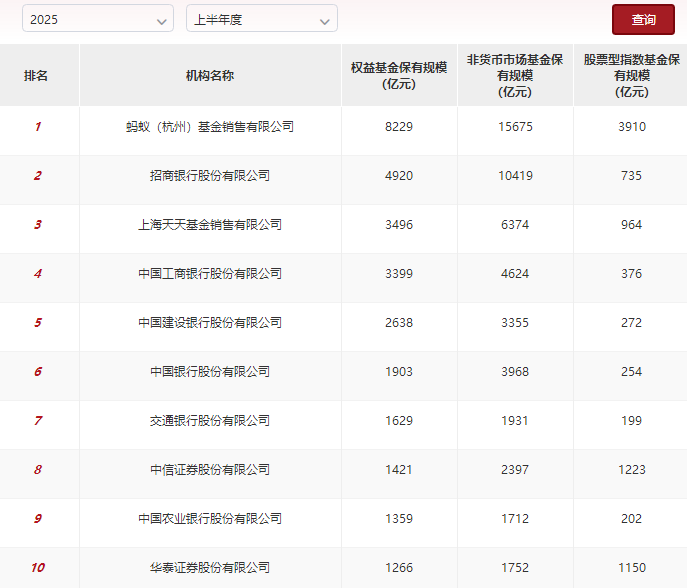
上半年基金代销百强名单出炉:蚂蚁基金、招商银行和天天基金排前三
Mei Ri Jing Ji Xin Wen· 2025-09-16 13:23
Core Insights - The China Securities Investment Fund Industry Association (CSRC) released the public fund sales retention scale for the first half of 2025, highlighting the dominance of top institutions in the market [1][2][3] Fund Sales Institutions - The top three fund sales institutions by equity fund retention scale are Ant Fund, China Merchants Bank, and Tiantian Fund, with retention scales of 822.9 billion, 492 billion, and 349.6 billion respectively [1][2] - A total of 9 institutions have equity fund retention scales exceeding 100 billion, with banks holding 5 of these positions, indicating a strong presence in the market [2] Market Trends - The top ten sales institutions account for 30.3 trillion in equity fund retention scale, representing 58.90% of the total scale of the top 100 institutions, showcasing a clear "Matthew Effect" in the industry [2] - Non-monetary market fund retention scales for Ant Fund and China Merchants Bank both exceed 1 trillion, reaching 1.57 trillion and 1.04 trillion respectively, with Tiantian Fund also surpassing 500 billion [2] Growth Metrics - The total retention scale of equity funds among these institutions reached 51.4 trillion, with a quarter-on-quarter increase of 285.6 billion, reflecting a growth rate of 5.89% [3] - The total retention scale of non-monetary market funds reached 10.2 trillion, with a quarter-on-quarter growth of 662.6 billion, indicating a 6.95% increase [3] Competitive Landscape - The "stronger get stronger" phenomenon is evident, as the gap between leading institutions and smaller ones continues to widen, with 43 institutions having equity fund retention scales below 10 billion [4] - The retention scale of stock index funds among leading companies has surpassed 1 trillion, while many smaller institutions remain at single-digit scales, suggesting a challenging environment for smaller players [4]
基金代销江湖变局:谁的份额萎缩?谁在加速抢食?
Jing Ji Guan Cha Wang· 2025-09-16 13:17
Core Insights - The A-share market has stabilized and rebounded since 2025, leading to a reshuffling in the public fund sales landscape, with dominant players like Hengqiang and some institutions carving out their unique niches [1][2] Group 1: Market Growth and Structure - As of mid-2025, the non-monetary fund holdings of the top 100 fund distribution institutions surpassed 10 trillion yuan, reaching 10.2 trillion yuan, a quarter-on-quarter growth of 6.95% [3] - The equity fund scale increased by 5.89% to 5.14 trillion yuan, with stock index funds seeing a remarkable surge of 14.57%, nearing 2 trillion yuan [3] - The recovery in investor confidence is reflected in the rise of core A-share indices, particularly the CSI 2000 index, which has increased by over 15% [3] Group 2: Institutional Dynamics - Leading institutions like Ant Fund and China Merchants Bank dominate the market, with their combined non-monetary fund scale accounting for over 25% of the total market [3] - Smaller institutions are struggling to balance scale and profitability, with the industry experiencing a growing Matthew effect [4] - Third-party sales platforms focusing on institutional clients, such as Jiyu Fund and Huicheng Fund, are improving their rankings by specializing in To B business [4] Group 3: Channel Landscape - The distribution channels are increasingly divided among banks, brokerages, and independent sales institutions, with banks holding over 40% of equity fund holdings but experiencing a decline [5] - Brokerages and third-party platforms are gaining market share due to their product flexibility and online capabilities, with brokerages' market share in equity funds rising to 27.41% [5] - The rapid growth of index funds is notable, with banks' sales of index funds increasing by 99.2% year-on-year in the first half of 2025 [7][8] Group 4: Future Challenges and Adaptations - The upcoming third phase of public fund fee reforms is expected to significantly impact the income structure and product strategies of distribution institutions [9] - Institutions need to shift from a sales-driven model to a service-driven approach, enhancing their advisory capabilities to create value [9] - The recent regulatory changes will encourage brokerages to invest more in equity product sales, accelerating industry transformation [9][10]
“二选一”阳谋:“排他性销售”引发公募基金代销合规战事
2 1 Shi Ji Jing Ji Bao Dao· 2025-09-16 06:01
Core Viewpoint - The recent controversy surrounding exclusive sales practices in the fund distribution industry, particularly involving China Merchants Bank (CMB), has raised questions about the fairness of sales channels and investor choice [1][2][4]. Fund Sales Practices - Several funds are reported to be "suspended for sale" on third-party platforms like Ant Financial and Tiantian Fund, while still available for purchase at CMB with standard fees [2][3]. - The phenomenon of exclusive sales is common in the fund industry, especially in a bank-dominated market [8][11]. - The new regulatory draft issued on September 5 aims to reform fund sales fee structures, potentially reducing the viability of exclusive sales practices [1][15]. Regulatory Changes - The new regulations propose to lower the maximum subscription fees for different fund types, which could diminish the profit margins for banks and encourage competition based on service rather than pricing [15][16]. - Industry insiders believe that the new rules will likely reduce the prevalence of exclusive sales and shift the focus towards service innovation among distribution channels [16][17]. Competitive Landscape - CMB's exclusive sales practices have been criticized as abnormal, with some funds only available through CMB while being unavailable on major platforms [4][6]. - The competition between CMB and internet platforms like Ant Financial is intensifying, with both sides employing different pricing strategies for fund sales [8][11]. - The operational costs associated with bank channels are higher, leading to a reluctance to offer discounts compared to internet platforms, which typically have lower costs [12][13]. Industry Dynamics - Fund companies face a dilemma in choosing sales channels, often having to decide between CMB and internet platforms based on product compatibility and market potential [9][10]. - The ongoing competition has led to a situation where fund companies may feel pressured to choose exclusive partnerships with banks or internet platforms, impacting their distribution strategies [10][11]. Future Outlook - The implementation of the new regulations is expected to create a more level playing field among distribution channels, potentially leading to a reduction in exclusive sales practices [16][17]. - The industry may see a shift towards enhanced service offerings and innovative solutions as channels adapt to the new regulatory environment and competitive pressures [17].
基金代销:蚂蚁、招行断层式领先,银行、第三方加码指数基金
Nan Fang Du Shi Bao· 2025-09-16 03:27
Core Insights - The China Securities Investment Fund Industry Association released the Top 100 list of public fund sales and retention scale for the first half of 2025, highlighting significant market players and trends in fund distribution channels [2][3]. Fund Sales Overview - The total non-monetary fund retention scale among the Top 100 institutions reached 10.2 trillion yuan, an increase of 6.9% compared to the end of the previous year [4]. - The equity fund scale was 5.1 trillion yuan, up 5.9%, while the fixed-income fund scale also reached 5.1 trillion yuan, increasing by 8.1% [4]. Channel Analysis Bank Channel - Banks maintained their leading position in the distribution of non-monetary funds, holding a 43% share, although this was a decline of 1.2 percentage points from the previous year [6]. - The non-monetary fund retention scale for banks was led by China Merchants Bank at 1.04 trillion yuan, followed by Industrial and Commercial Bank of China at 462.4 billion yuan [8]. - The bank channel saw significant growth in index funds, with a 38.7% increase in retention scale, outpacing third-party channels (16.0%) and securities firms (9.9%) [6]. Third-Party Channel - The third-party channel accounted for 35% of the total non-monetary fund retention scale, totaling 3.56 trillion yuan, with a growth of 8.9% [9]. - Ant Fund led the third-party channel with a retention scale of 1.57 trillion yuan, growing by 7.9%, while its fixed-income funds remained the strongest segment [9][10]. Securities Firm Channel - Securities firms held a total non-monetary fund retention scale of 2.09 trillion yuan, representing 20.4% of the market, with a slight increase of 0.4 percentage points [11]. - The stock index fund retention scale among securities firms reached 1.08 trillion yuan, growing by 9.9%, although their market share declined by 2.3 percentage points [11]. Fund Performance - The stock index fund scale reached 1.95 trillion yuan, increasing by 14.6%, while active equity funds saw a modest growth of 1.2% to 3.2 trillion yuan [5]. - The performance of active equity funds lagged behind the market index, with many investors still in recovery or redemption phases [5]. Regulatory Changes - The China Securities Regulatory Commission has proposed a revision to the management regulations for public fund sales fees, indicating a potential shift in focus towards equity products and the development of ETFs [13].


券商代销公募大展身手:57家跻身百强,股指代销“霸榜”
Xin Jing Bao· 2025-09-15 12:40
Group 1 - The public fund distribution landscape is undergoing changes, with 57 brokerage firms making it to the top 100 list, indicating a competitive environment in fund sales [1][2] - The total sales scale of non-money market funds by the top 100 institutions has surpassed 10 trillion yuan, reflecting a nearly 7% increase compared to the previous period [2] - The sales scale of equity funds reached 5.14 trillion yuan, with a 6% increase, while the sales scale of stock index funds grew by 15% to 1.95 trillion yuan [2][3] Group 2 - Among the top 10 institutions for equity fund sales, Ant Group leads with a scale of 822.9 billion yuan, followed by China Merchants Bank and Tiantian Fund, with only two brokerages, CITIC Securities and Huatai Securities, making the list [2] - In the top 10 for non-money market fund sales, no brokerages were present, contrasting with the stock index fund sales where brokerages occupied 7 out of 10 positions [2][3] Group 3 - The significant increase in stock index funds is evident, with the total net asset value of 3,209 stock funds reaching 5 trillion yuan, up from 4.07 trillion yuan at the beginning of the year [3][4] - 23 brokerages have a stock index fund sales scale exceeding 10 billion yuan, with six brokerages surpassing 50 billion yuan, led by CITIC Securities and Huatai Securities [4] Group 4 - The ongoing fee reduction in public funds is expected to reach 30 billion yuan, which may reshape the fund distribution landscape [5][6] - The new regulations aim to lower subscription fees and optimize redemption arrangements, potentially impacting the revenue sources for sales institutions [5][6] - The overall impact of the fee reform on brokerages is considered limited, as their income from fund distribution constitutes a small percentage of total revenue [6]



上半年公募代销机构百强出炉 股票型指数基金成发力重点
Zhong Guo Zheng Quan Bao· 2025-09-14 23:23
Core Insights - The report highlights a strong performance in the public fund sales sector in China, with significant growth in the assets under management (AUM) of top fund distribution institutions, particularly in equity funds and index funds [1][3]. Group 1: Rankings and Distribution - The top ten fund distribution institutions remain unchanged, featuring 24 banks, 57 brokerages, 18 third-party distributors, and 1 insurance company, with Ant Fund and China Merchants Bank showing substantial growth [2][3]. - The top ten in the bank distribution list includes China Merchants Bank, Industrial and Commercial Bank of China, China Construction Bank, Bank of China, and others, while the brokerage list is led by CITIC Securities and Huatai Securities [2]. Group 2: Growth in Assets Under Management - The total AUM of the top 100 equity funds reached 51,374 billion yuan, an increase of 2,856 billion yuan or 5.89% from the end of 2024 [3]. - Non-monetary market funds saw a total AUM of 101,993 billion yuan, up by 6,626 billion yuan or 6.95% [3]. - The AUM of stock index funds surged to 19,522 billion yuan, marking a significant increase of 2,483 billion yuan or 14.57% [3]. Group 3: Focus on Index Products - The report indicates a strong push towards index products, with the AUM of stock index funds growing significantly, particularly among brokerages, which dominate this segment [4][5]. - Brokerages hold a combined AUM of 10,804 billion yuan in stock index funds, accounting for over 55% of the total AUM of the top 100 [4]. - Commercial banks also increased their focus on index fund distribution, with their AUM in stock index funds rising by 38.69% to 2,667 billion yuan [5]. Group 4: Performance of Third-Party Distributors - Ant Fund, as a third-party distributor, reported an increase of 841 billion yuan in its equity fund AUM, with stock index funds contributing 709 billion yuan to this growth [6].
上半年公募代销机构百强出炉
Zhong Guo Zheng Quan Bao· 2025-09-14 20:14
Core Insights - The report highlights the strong performance of public fund sales institutions in China, with a significant increase in the scale of equity funds sold, particularly in the index fund segment [1][2][3] Group 1: Rankings and Market Dynamics - The top ten rankings of public fund sales institutions remained unchanged, with Ant Fund and China Merchants Bank showing substantial growth in their retained scale [1][2] - The top ten institutions include 24 banks, 57 brokerages, 18 third-party sales agencies, and 1 insurance company, indicating a diverse market landscape [1][2] Group 2: Fund Scale Growth - The total retained scale of the top 100 equity funds reached 51,374 billion yuan, an increase of 2,856 billion yuan, or 5.89%, compared to the end of 2024 [2][3] - Non-monetary market funds saw a total retained scale of 101,993 billion yuan, up by 6,626 billion yuan, or 6.95% [2] - The retained scale of stock index funds surged to 19,522 billion yuan, marking a significant increase of 2,483 billion yuan, or 14.57% [2] Group 3: Institutional Performance - Ant Fund and China Merchants Bank led the growth in equity fund retained scale, each increasing by over 80 billion yuan, with Ant Fund surpassing 1.5 trillion yuan and China Merchants Bank exceeding 1 trillion yuan [3][4] - The number of institutions with equity fund retained scales exceeding 1 trillion yuan rose to 11, while those with non-monetary market fund scales above 1 trillion yuan reached 26 [3] Group 4: Index Fund Development - The report notes a strong push towards index products, with a notable increase in the scale of stock index funds, driven by regulatory support and a growing variety of products [3][4] - Brokerages maintain a dominant position in the index fund market, with 57 brokerages in the top 100 equity fund sales institutions, and their stock index fund scale accounting for over 55% of the total scale [4] - Commercial banks are also increasing their focus on index fund sales, with their stock index fund scale rising by 38.69% to 2,667 billion yuan [4]
公募权益基金代销百强名单出炉,股票型指数基金成发力重点
Zhong Guo Zheng Quan Bao· 2025-09-14 14:54
Core Insights - The China Securities Investment Fund Industry Association reported significant growth in the public fund sales scale for the first half of the year, with Ant Fund and China Merchants Bank leading the way with increases exceeding 80 billion yuan each [1][6] - The top 100 distribution institutions saw a collective increase in equity fund holdings, particularly in stock index funds, which became a focal point for these institutions [1][7] Group 1: Distribution Institutions Overview - The top 100 distribution institutions include 24 banks, 57 securities firms, 18 third-party distributors, and 1 insurance company, with the number of banks and securities firms increasing by one each since the end of 2024 [2] - The top ten institutions in the distribution rankings remained unchanged from the end of 2024, highlighting a "stronger gets stronger" trend [2] Group 2: Fund Holdings Data - The total equity fund holdings of the top 100 distribution institutions reached 51,374 billion yuan, an increase of 2,856 billion yuan or 5.89% from the end of 2024 [6] - Non-monetary market fund holdings totaled 101,993 billion yuan, growing by 6,626 billion yuan or 6.95% [6] - Stock index fund holdings surged to 19,522 billion yuan, marking a significant increase of 2,483 billion yuan or 14.57% [6] Group 3: Institutional Performance - Ant Fund and China Merchants Bank each saw their equity fund holdings increase by over 80 billion yuan, with non-monetary market fund holdings rising by 1,146 billion yuan and 915 billion yuan, respectively [6][7] - The number of institutions with equity fund holdings exceeding 100 billion yuan rose to 11, while those with non-monetary market fund holdings above 100 billion yuan reached 26, up from 22 at the end of 2024 [6] Group 4: Index Fund Growth - The stock index fund holdings of the top 100 distribution institutions grew by 14.57%, significantly outpacing other fund types [7] - Securities firms maintained a dominant position in the index fund distribution sector, with 57 firms making it into the top 100 equity fund distributors [7] - Commercial banks also increased their focus on index fund distribution, with their stock index fund holdings rising by 38.69% to 2,667 billion yuan [7]