
非货基金

Search documents
国泰海通证券:预计一季度银行息差降幅显著收敛 板块投资重点把握三条主线
智通财经网· 2026-03-28 23:20
Core Viewpoint - The report from Guotai Junan Securities indicates that the revenue and net profit growth rates for sample banks in Q1 2026 are expected to be 2.7% and 2.2% respectively, with a trend of revenue growth recovery and stable profit growth driven by a significant reduction in the year-on-year decline of net interest margin and alleviation of other non-interest pressures [1] Group 1: Revenue and Profit Growth - Revenue growth for Q1 2026 is projected at 2.7%, while net profit growth is expected to be 2.2%, indicating a potential upward trend in revenue recovery [1] - The growth in revenue is attributed to a notable convergence in the year-on-year decline of net interest margin and reduced pressure from other non-interest income sources [1] Group 2: Loan and Asset Growth - The growth rates for interest-earning assets and loans are anticipated to be 7.77% and 7.62% respectively for Q1 2026, with a slight decrease in loan growth compared to the end of 2025 [2] - In January-February 2026, new RMB loans amounted to 5.61 trillion yuan, a year-on-year decrease of 0.53 trillion yuan, with corporate credit showing an increase while household credit decreased [2] Group 3: Net Interest Margin and Income - The net interest margin for Q1 2026 is expected to be 1.37%, a decrease of 3 basis points from 2025, with net interest income growth projected at 2.6% [3] - The stability in loan rates and the management of interbank deposit rates are expected to alleviate pressure on net interest margins, particularly for smaller banks [3] Group 4: Non-Interest Income and Asset Quality - Non-interest income growth is projected at -0.8% for Q1 2026, influenced by bond market fluctuations and a low base from the previous year [4] - The credit cost is expected to be 0.73%, with a slight year-on-year decrease, supporting stable profit growth, while the non-performing loan ratio is projected to decrease to 1.20% [4] Group 5: Investment Recommendations - The investment focus for the banking sector in 2026 should include: 1) Identifying targets with potential for improved or sustained high growth; 2) Emphasizing banks with expectations for convertible bond conversions; 3) Continuing dividend strategies [4]

2025H2公募基金销售机构保有数据点评:全品类规模均增长,头部集中度上行,积极布局指数产品
CMS· 2026-03-22 09:26
Investment Rating - The report maintains a positive investment rating for the industry, highlighting significant growth in fund holdings and a shift towards index products [6]. Core Insights - The overall fund holdings have shown substantial growth, with non-monetary fund holdings of the top 100 sales institutions reaching 11.7 trillion, a 14.7% increase from the previous half [2]. - Equity fund holdings have rebounded, with a 16.7% increase to 6.0 trillion, while fixed income holdings grew by 12.7% to 5.7 trillion [2]. - The growth rate of passive funds outpaces that of active funds, with stock index funds increasing by 23.7% to 2.4 trillion [2]. - The concentration of top institutions is rising, with 57 brokerage firms in the top 100, and notable entries and exits among various categories [3]. Summary by Sections Fund Holdings Growth - Non-monetary fund holdings of the top 100 institutions reached 11.7 trillion, up 14.7% from the previous half [2]. - Equity fund holdings increased to 6.0 trillion, a 16.7% rise, while fixed income holdings reached 5.7 trillion, up 12.7% [2]. Performance of Different Fund Types - The three major indices saw an average increase of 27.2%, with the Wind equity fund index rising by 23.5% [2]. - Passive equity funds grew significantly, while active equity funds saw a more modest increase of 12.4% [2]. Institutional Concentration - The top 100 institutions include 57 brokerage firms, 25 banks, and 17 internet firms, with notable changes in rankings [3]. - The market share of banks increased to 21.5%, while internet firms reached 17.7%, and brokerage firms accounted for 11.4% [3]. Internet Sector Insights - Ant Group maintains a strong position with a non-monetary scale of 1.8 trillion, a 15.5% increase, and a market share of 8.0% [4]. - There is a notable differentiation in fixed income and equity layouts among internet firms, with significant growth in specific funds [4]. Banking Sector Insights - China Merchants Bank leads the banking sector with a non-monetary scale of 1.2 trillion, a 19.8% increase, and a market share of 5.5% [10]. - The bank is actively embracing index products, with significant growth in its equity and fixed income holdings [10]. Brokerage Sector Insights - Brokerage firms have seen a strong increase in index fund holdings, with a total of 1.3 trillion, a 21.7% rise [11]. - There is a notable divergence in the performance of active equity funds among different brokerage firms, with some experiencing significant declines [11]. Investment Recommendations - The report suggests focusing on brokerage firms with strong wealth management capabilities, such as GF Securities and Guotai Junan, as the market evolves [11].






中金:居民资产配置切换迹象显现 资本市场有望迎万亿元潜在增量资金
Ge Long Hui A P P· 2025-12-15 08:49
Group 1 - The core viewpoint of the article indicates a noticeable slowdown in the growth of residents' fixed deposits since 2024, while there is a rapid increase in demand for current deposits, bank wealth management products, and non-monetary funds, reflecting a shift in residents' asset allocation [1] - According to the analysis by the research department of CICC, the trend of residents entering the market can be observed through the changing dynamics of their savings [1] - The research department estimates that due to the growth of rights-based products, by 2026, wealth management institutions are expected to increase their equity asset allocation (stocks + mixed equity funds) by 0.8 percentage points to 2.3% [1] Group 2 - By 2027, with continued investment in research resources for equity products, the allocation is expected to further increase to 3.5%, potentially bringing nearly 1 trillion yuan of incremental funds to the capital market [1]
中金-银行:理财2026年展望:存款搬家、资产配置新叙事
中金· 2025-12-15 01:55
Investment Rating - The report provides a positive outlook for the wealth management industry, projecting an 8% growth in 2026, with potential expansion to 36 trillion yuan, and possibly up to 37.4 trillion yuan if market conditions improve [12][14]. Core Insights - The wealth management industry is expected to benefit from the trend of deposit migration and the release of existing floating profits, leading to unexpected growth in 2025 [3][14]. - In 2026, wealth management institutions will have opportunities for multi-asset allocation and a further decline in household savings rates, but they will also face pressure from valuation adjustments [3][4]. - The report emphasizes the importance of understanding the changes in residents' risk preferences and the implications for asset allocation, indicating a shift towards more liquid deposits and asset management products [23][39]. Summary by Sections Resident Risk Preferences - The report suggests that in 2026, residents will have a slight increase in risk appetite, leading to a trend of liquid deposits and asset management products [4][23]. - The potential for increased allocation to rights products is noted, although the growth elasticity may not be significant at this stage [4][23]. Deposit Migration Trends - In 2025, the average decline in retail deposit rates was approximately 30 basis points, with a notable slowdown in the growth of fixed-term deposits [4][44]. - The report anticipates that in 2026, 32 trillion yuan of fixed-term deposits will mature, with a re-pricing range of 70-170 basis points, creating conditions for further deposit migration [4][45]. Fund Flow from Excess Savings - The report estimates that from 2020 to 2025, there will be a total of 14.4 trillion yuan in excess savings, with a potential additional 2-4 trillion yuan flowing into non-fixed deposit investment areas in 2026 [5][46]. - A decrease in the savings rate by 1 percentage point could lead to an additional 0.9 trillion yuan in new funds directed towards wealth management, funds, insurance, and real estate [5][46]. Wealth Management Asset Allocation Outlook - The report predicts that pure fixed-income wealth management products will grow by 7.5% to 24.9 trillion yuan in 2026, contributing significantly to the overall growth of the industry [13][14]. - The demand for public fund outsourcing, particularly for bond ETFs and rights funds, is expected to grow rapidly, driven by the need for enhanced returns [13][14]. Valuation Adjustment and Market Conditions - The report highlights that wealth management products will face "true" net value adjustment pressures starting in 2026, which may lead to increased product volatility [11][54]. - The need for wealth management institutions to effectively meet investor demands for stable value growth while managing expectations is emphasized as a key challenge [11][54].
中金2026年展望 | 理财:存款搬家、资产配置新叙事
中金点睛· 2025-12-10 23:51
Core Viewpoint - The wealth management industry is expected to achieve unexpected growth in 2025, driven by deposit migration and the release of existing floating profits, while facing valuation adjustment pressures in 2026 [2] Group 1: Resident Risk Preference Insights - In 2026, residents are expected to show a slight increase in risk appetite, leading to a trend of more liquid deposits and asset management products [4] - The average decline in retail deposit rates in 2025 was approximately 30 basis points, with a significant slowdown in new fixed-term deposits, while demand for liquid deposits and wealth management products increased [4] - A total of 32 trillion yuan in fixed-term deposits will mature in 2026, with a repricing range of 70-170 basis points, indicating potential for further deposit migration [4][19] Group 2: Fund Flow from Excess Savings - From 2020 to 2025, an excess savings of 14.4 trillion yuan was generated, with a projected decrease in the savings rate to around 14.6% in 2025 [5][26] - A 1 percentage point decrease in the savings rate could release approximately 0.9 trillion yuan into wealth management, funds, insurance, and real estate [5][26] - The potential for an additional 2-4 trillion yuan in activated funds flowing into non-fixed deposit investments in 2026 is anticipated [5][26] Group 3: Wealth Management Asset Allocation Outlook - The wealth management industry is expected to see a growth rate of 8% in 2026, expanding by 2.6 trillion yuan to reach 36 trillion yuan, despite challenges from valuation adjustments [29] - Low-volatility fixed-income products will remain the core offering, while the growth of rights-based wealth management products is expected to accelerate [30][31] - The supply of long-term closed-end wealth management products is anticipated to increase due to the need for stable liabilities and the development of retirement financial products [36] Group 4: Market Impact and Fund Inflows - Wealth management institutions are projected to increase their equity asset allocation by 0.8 percentage points to 2.3% in 2026, potentially bringing nearly 1 trillion yuan in incremental funds to the capital market [6][39] - The demand for bond ETFs and rights-based funds is expected to grow rapidly, driven by external collaborations and the need for wealth management institutions to enhance returns [6][39] - The third phase of public fund fee reform may lead to increased allocation of bond ETFs by wealth management institutions, while short-term pure bond funds may face redemption pressures [6][39] Group 5: Supply-Side Reform Opportunities - The supply-side reform in wealth management is accelerating, with smaller banks exiting the wealth management business, creating opportunities for leading institutions to increase market share [49] - The market share of the top five wealth management institutions is expected to rise as regulatory tightening continues to limit the issuance of new wealth management licenses [49]


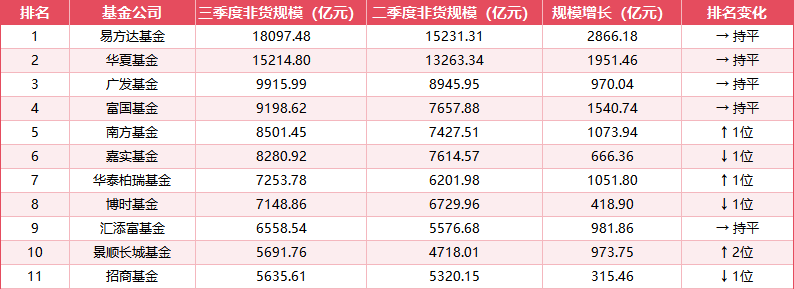
三季度基金公司非货规模十强座次生变:南方超越嘉实升至第5位 华泰柏瑞超越博时升至第7位
Xin Lang Ji Jin· 2025-10-30 02:12
Core Insights - The overall scale of public funds reached 36.45 trillion yuan as of October 28, 2025, marking a 7.07% increase from the previous quarter and a 14.96% increase year-on-year [1] - The non-monetary fund scale totaled 22.05 trillion yuan, with a quarter-on-quarter increase of 1.94 trillion yuan [1] - The top 10 fund companies collectively saw a growth of over 10.15 trillion yuan, solidifying their position as the main drivers of industry growth [1] Fund Company Rankings - E Fund and Huaxia Fund maintained their leading positions, with growth increments of 2866 million yuan and 1951 million yuan respectively, further expanding their competitive advantage [2] - The top 10 companies included seven that experienced a quarterly growth exceeding 950 million yuan, with five surpassing 1 billion yuan, indicating strong capital attraction capabilities during market recovery [3] - Southern Fund and Jiashi Fund swapped rankings, while Invesco Great Wall Fund moved up two places into the top ten, reflecting significant growth and performance [3] Competitive Landscape - The competition among mid-tier companies intensified, with several firms achieving notable growth, while招商基金 fell from 10th to 11th place due to relatively slower growth of 315.46 million yuan, approximately 5.9% [3] - The new entrant Invesco Great Wall Fund achieved a growth of 973.75 million yuan, over three times that of招商基金, highlighting the competitive nature of the rankings [3]
非银行金融期货公司分类评价修订,基金代销百强榜单发布
Shanxi Securities· 2025-09-18 10:20
Investment Rating - The report maintains an investment rating of "Leading the Market - A" for the non-bank financial industry [1] Core Viewpoints - The non-bank financial industry has shown significant performance over the past year, with a focus on the growth of equity and fund distribution [2][4] - The recent release of the "Classification Evaluation Regulations for Futures Companies" by the CSRC aims to enhance regulatory effectiveness and promote risk management within the industry [4][11] - The report highlights the growth in the scale of equity product distribution, with significant increases in various fund categories compared to the end of 2024 [5][12] Summary by Relevant Sections Investment Suggestions - The report emphasizes the importance of the newly released regulations for futures companies, which include improvements in the scoring mechanism and the optimization of the evaluation system to enhance service to the real economy [11][25] Market Review - The major indices experienced varying degrees of increase, with the Shanghai Composite Index rising by 1.52% and the CSI 300 Index by 1.38% during the week [13] - The non-bank financial index saw a slight increase of 0.28%, ranking 24th among 31 primary industries [13] Key Industry Data Tracking 1) Market Performance and Scale - The total trading volume in A-shares reached 11.63 trillion yuan, with an average daily trading volume of 2.33 trillion yuan, reflecting a decrease of 10.63% compared to the previous period [13][18] 2) Credit Business - As of September 12, the market had 3,017.37 billion shares pledged, accounting for 3.69% of the total equity, with a margin balance of 2.34 trillion yuan, showing a 2.33% increase [18] 3) Fund Issuance - In August 2025, new fund issuance reached 1,020.22 billion units, with a notable increase in equity fund issuance [18] 4) Investment Banking Business - The equity underwriting scale in August 2025 was 234.77 billion yuan, with IPOs amounting to 40.93 billion yuan [18] 5) Bond Market - The total price index of bonds has decreased by 1.94% since the beginning of the year, with the 10-year government bond yield rising by 25.93 basis points [18] Regulatory Policies and Industry Dynamics - The report discusses the CSRC's new regulations for futures companies, which aim to refine risk management and enhance the overall competitiveness of the industry [4][25] Key Announcements from Listed Companies - Notable transactions include the completion of the acquisition of Guorong Securities by Western Securities and the establishment of a new investment partnership by Zhongyuan Securities [27]



券商代销公募大展身手:57家跻身百强,股指代销“霸榜”
Xin Jing Bao· 2025-09-15 12:40
Group 1 - The public fund distribution landscape is undergoing changes, with 57 brokerage firms making it to the top 100 list, indicating a competitive environment in fund sales [1][2] - The total sales scale of non-money market funds by the top 100 institutions has surpassed 10 trillion yuan, reflecting a nearly 7% increase compared to the previous period [2] - The sales scale of equity funds reached 5.14 trillion yuan, with a 6% increase, while the sales scale of stock index funds grew by 15% to 1.95 trillion yuan [2][3] Group 2 - Among the top 10 institutions for equity fund sales, Ant Group leads with a scale of 822.9 billion yuan, followed by China Merchants Bank and Tiantian Fund, with only two brokerages, CITIC Securities and Huatai Securities, making the list [2] - In the top 10 for non-money market fund sales, no brokerages were present, contrasting with the stock index fund sales where brokerages occupied 7 out of 10 positions [2][3] Group 3 - The significant increase in stock index funds is evident, with the total net asset value of 3,209 stock funds reaching 5 trillion yuan, up from 4.07 trillion yuan at the beginning of the year [3][4] - 23 brokerages have a stock index fund sales scale exceeding 10 billion yuan, with six brokerages surpassing 50 billion yuan, led by CITIC Securities and Huatai Securities [4] Group 4 - The ongoing fee reduction in public funds is expected to reach 30 billion yuan, which may reshape the fund distribution landscape [5][6] - The new regulations aim to lower subscription fees and optimize redemption arrangements, potentially impacting the revenue sources for sales institutions [5][6] - The overall impact of the fee reform on brokerages is considered limited, as their income from fund distribution constitutes a small percentage of total revenue [6]




以高质量党建促进金融高质量发展
Zhong Guo Zheng Quan Bao· 2025-09-05 17:54
Core Viewpoint - The company emphasizes the importance of adhering to central government policies and enhancing party building to support high-quality development and improve operational performance [1][5]. Group 1: Party Building and Governance - The company has strengthened its party building efforts, focusing on the implementation of the Central Eight Regulations and promoting a culture of integrity and accountability among its employees [1][2]. - A comprehensive approach to education and feedback has been adopted, enhancing employee welfare and engagement while also fostering a strong sense of community and responsibility [2]. Group 2: Support for the Real Economy - The company has actively supported the real economy, achieving a financing scale of 495.3 billion yuan, a 30% increase year-on-year, with 41.7% of total financing directed towards the real economy [2][3]. - The company has enhanced its service capabilities for key clients, including state-owned enterprises and quality private enterprises, successfully completing significant projects such as IPOs and bond issuances [3]. Group 3: Financial Services and Innovations - The company has focused on providing comprehensive financial services across various sectors, including technology, green finance, and inclusive finance, with notable financing achievements in these areas [4]. - In the technology sector, the company facilitated 144 billion yuan in financing, while in green finance, it supported projects totaling 117.5 billion yuan [4]. Group 4: Future Strategic Directions - The company is committed to implementing the "Five Major Financial Articles" strategy, aiming to enhance its role in supporting technological innovation and new productive forces [3][4]. - The company plans to further strengthen its party leadership and governance to ensure high-quality development and effective service delivery in the financial sector [5].

公募基金管理规模再创新高 非货排位强者恒强
Cai Jing Wang· 2025-07-24 08:39
Core Insights - The public fund industry has achieved record highs in both overall scale and non-monetary scale as of the end of Q2 2025, reaching over 34 trillion yuan and 20 trillion yuan respectively [1][2] Group 1: Overall Fund Performance - A total of 162 public fund managers reported a combined scale of 34.05 trillion yuan, marking a 7.04% increase from Q1 2025 and a 10.76% increase year-on-year from Q2 2024 [2] - All eight major fund categories experienced quarter-on-quarter growth, with commodity funds and fund of funds (FOF) showing the highest increases of 47.79% and 10.28% respectively [2] - The total profit for all fund companies in Q2 exceeded 380 billion yuan, representing a more than 50% increase from the previous quarter [2] Group 2: Individual Fund Manager Performance - Among the 162 licensed public fund institutions, eight have assets under management (AUM) exceeding 1 trillion yuan, accounting for 4.94% of the total [3] - The top ten public fund managers collectively manage 13.33 trillion yuan, which is 40.13% of the total public fund scale, with E Fund leading at 2.04 trillion yuan [3] Group 3: Non-Monetary Fund Insights - The total non-monetary fund scale reached 20.11 trillion yuan, an increase of 1.29 trillion yuan from Q1 2025 [4] - Only two public institutions have non-monetary AUM exceeding 1 trillion yuan, while 43 institutions have AUM below 100 billion yuan [4] - The top ten non-monetary fund managers manage a combined 7.88 trillion yuan, representing 39.80% of the total non-monetary fund scale, with E Fund leading at 1.40 trillion yuan [4] Group 4: Equity Fund Contributions - Equity funds, particularly index funds, have made significant contributions, with E Fund showing the largest growth of 756.5 billion yuan in a single quarter [5] - ETFs have emerged as a major attraction, with major index ETFs like the SSE 50 ETF and CSI 300 ETF showing positive average returns in Q2 2025 [5] Group 5: Market Outlook - Multiple public funds express optimism for A-shares and Hong Kong stocks, highlighting structural opportunities in technology, consumption, and dividends [6] - The chief equity investment officer at Xinyuan Fund notes the resilience of the Chinese economy and the potential for new productivity driven by global technological revolutions [6] - Bosera Fund indicates that investor sentiment remains positive as the A-share market surpasses 3,500 points, with growth policies likely to slow but liquidity and risk appetite favoring the market [6]