数字广告

Search documents
焕新蝶变——上海普陀真如城市副中心发展掠影
Zhong Guo Jing Ji Wang· 2026-01-20 23:10
Core Viewpoint - The article highlights the rapid development and transformation of the Zhenru urban sub-center in Shanghai, showcasing its potential as a new highland for industrial aggregation and digital economy innovation [8]. Group 1: Urban Development - The Zhenru urban sub-center has evolved from the largest "urban village" in Shanghai to a vibrant area with significant industrial concentration [8]. - Key developments include the Shanghai Zhenru Huanyu City MAX and the China Overseas Center, contributing to a total area of nearly one million square meters of urban landmarks [8]. - The area aims to enhance the capabilities of Shanghai West Station and promote urban renewal projects such as "Zhenru Cui Valley" and "Zhenru Heart" [8]. Group 2: Economic and Industrial Focus - The Zhenru urban sub-center is positioned to become a hub for high-end business, a digital transformation demonstration zone, and a cultural commercial landmark [8]. - The development strategy focuses on integrating technology and industrial innovation, aligning with the Yangtze River Delta integration strategy [8]. - The area will leverage platforms like the "Innovation Lane" and the Shanghai International Digital Advertising Park to foster deep integration of technological and industrial innovation [8]. Group 3: Community and Ecological Considerations - The development approach emphasizes a people-centered philosophy, driven by industry and grounded in ecological sustainability [8]. - The Zhenru urban sub-center is envisioned as a model for urban development that integrates production and city life [8].


2026 品牌出海,解码海外消费者的“品牌挚爱公式”
Sou Hu Cai Jing· 2026-01-20 14:41
Core Insights - To succeed in the overseas market by 2026, brands must integrate seamless experiences, precise consumer signals, and deep emotional resonance to create a synergistic effect that breaks through competitive barriers [3][4]. Group 1: Marketing Strategies - The digital advertising market is expected to continue double-digit growth, with penetration reaching 81% of the overall advertising market by 2026, driven by the exploration of generative AI tools [3][4]. - Traditional interruptive advertising is losing effectiveness; successful brands now prioritize "information delivery" as a core component of user experience [3][4]. - Brands need to leverage interactive content and environmental technology to seamlessly integrate product information into consumers' daily lives [3][4]. Group 2: Emotional Connection and Authenticity - Authenticity and emotional connection with products are crucial, as highlighted by Amazon Live's high conversion rates driven by creator-generated content [4][5]. - Live streaming creates long-term effects, as emotional connections established during broadcasts can influence future purchasing decisions [4][5]. - The value of content lies not only in information delivery but also in achieving emotional sharing with consumers [4][5]. Group 3: AI and Personalization - The introduction of generative AI in advertising aims to create personalized experiences, with Alexa's new assistant designed to help users with shopping and daily tasks [5][6]. - Effective advertising should provide real value, such as information and entertainment, rather than conforming to traditional advertising formats [5][6]. - Brands must adapt to the shift from traditional web browsing to engaging in conversations with AI, presenting useful and informative content during these interactions [7][8]. Group 4: Complexity and Precision in Marketing - Marketing science is becoming more complex yet precise, transitioning from an art form to a data-driven approach that requires careful consideration of input-output ratios [8]. - The integration of experience, science, and art is essential for brands to establish core competitiveness in the current market landscape [8].

从算力到应用 2026资本正重仓AI营销新范式
智通财经网· 2026-01-20 12:43
Core Insights - The commercialization of AI applications is becoming a focal point in the capital market, with significant events indicating strong potential for business models and sustainable profit paths [1][2]. Group 1: Market Dynamics - Several domestic large model and AI application companies have successfully gone public in Hong Kong, validating their business models [2]. - The acquisition of Manus by Meta and the integration of generative AI into Walmart's shopping process highlight the growing potential of AI applications in the market [2]. - OpenAI's decision to test advertising in ChatGPT's free and paid versions marks a significant shift in how users access information, indicating the emergence of a new market driven by generative AI [3][7]. Group 2: Advertising Transformation - The shift from traditional keyword-based search to natural language interaction in AI is fundamentally changing the flow of information and advertising [4][6]. - Data shows that by December 2025, ChatGPT's monthly active users will reach 880 million, with over 80% of users forming habits of obtaining consumer information through AI [5]. - The introduction of GEO (Generative Engine Optimization) and GEM (Generative Engine Marketing) represents a new paradigm in advertising, focusing on capturing user intent rather than keyword bidding [6][9]. Group 3: Industry Growth Projections - The global application market is expected to exceed $300 billion by 2025, with China leading at a 45% growth rate [8]. - The GEO market is projected to reach $24 billion by 2026 and could grow to $100 billion by 2030, with a compound annual growth rate of approximately 53% [9]. Group 4: Investment Opportunities - The capital market is increasingly favoring AI applications, with significant investments flowing into related ETFs and companies like Zhizhu and MiniMax achieving market valuations exceeding 100 billion HKD [11]. - The transition from traditional search engine traffic to AI tools is expected to accelerate, with Gartner predicting that about 25% of traditional search engine traffic will shift to AI tools by 2026 [11]. - Companies that can effectively leverage AI applications and establish a strong technological foundation are positioned to lead in the new AI advertising era [12][18].
2026品牌出海,解码海外消费者的“品牌挚爱公式”
3 6 Ke· 2026-01-20 11:08
Core Insights - To succeed in the overseas market by 2026, brands must integrate seamless experiences, precise consumer signals, and deep emotional resonance to create a synergistic effect that drives consumer loyalty [3][4][5] Group 1: Marketing Strategies - The marketing path to winning the overseas market in 2026 emphasizes that relying solely on products is insufficient; brands must create a cohesive experience that resonates emotionally with consumers [3] - AI is becoming a decisive factor in marketing strategies, with predictions indicating that the global digital advertising market will continue to grow at a double-digit rate, reaching an 81% penetration in the overall advertising market by 2026 [3][4] - Brands are encouraged to rethink how they deliver information, focusing on integrating product information seamlessly into consumers' daily lives through interactive content and environmental technology [3][6] Group 2: Emotional Connection and Authenticity - Authenticity and emotional connection with products are crucial, as highlighted by Amazon Live's success in creating "real moments" that aid consumer decision-making [4][5] - The long-tail effect of live streaming is significant, as emotional connections established during live sessions can influence future purchasing decisions [4] - Brands should focus on creating content that is both educational and entertaining, leveraging influencer-generated content to build long-term brand loyalty [5][7] Group 3: AI and Personalization - The introduction of generative AI tools, such as Alexa+, aims to create a comprehensive AI assistant that personalizes user experiences across shopping and entertainment [5][6] - As consumer engagement shifts from browsing to interacting with AI, brands must present useful and informative content within these dialogues to remain competitive [7] - The integration of AI in advertising is transforming marketing into a blend of experience, science, and art, where brands must balance creativity with data-driven insights [7]

3300亿美元的字节太便宜了
Hua Er Jie Jian Wen· 2026-01-16 08:46
Core Insights - The valuation logic of ByteDance is being reassessed in the market after resolving regulatory issues concerning TikTok's U.S. operations [1] - ByteDance is considered undervalued compared to peers like Meta, despite having similar revenue figures and a strong position in AI [2][3] Valuation and Market Position - ByteDance's current valuation in the private secondary market is approximately $330 billion, significantly lower than Meta's $1.6 trillion valuation, despite both companies nearing $200 billion in annual revenue [1] - The revenue growth rate for ByteDance is projected at 25% for Q2 2025, reaching $48 billion, which surpasses Meta's 22% growth rate [3] - If ByteDance maintains a similar growth rate to Meta, its price-to-sales ratio would be less than 2 times the expected sales for 2026, compared to Meta's 7 times [3] AI and Profitability - ByteDance has established a leading position in AI, which is driving growth in its cloud business and attracting clients from competitors like Alibaba [2] - Despite a lower profit margin (21% for 2024) compared to Meta (38%), ByteDance's absolute profit is expected to reach $50 billion in 2025, a 51% increase from 2024 [5] Regulatory Developments - The resolution of TikTok's regulatory challenges in the U.S. has removed significant uncertainties, enhancing the company's market position and advertising potential [6] - ByteDance's agreement to sell 80.1% of its U.S. data security business has allowed it to comply with legal requirements, thus alleviating the threat of a ban [6] Future Outlook - The establishment of a joint venture for TikTok raises questions about revenue sharing, but ByteDance's relatively low valuation makes it an attractive candidate for an IPO [7] - Analysts predict that the removal of U.S. regulatory barriers could accelerate ByteDance's plans for an initial public offering [7]
昌平去年新设经营主体量全市第一
Xin Lang Cai Jing· 2026-01-14 20:45
Group 1 - The core viewpoint of the articles highlights the significant growth and innovation in Changping District, with 58,000 new business entities established since 2025, ranking first in the city [1] - Among the new businesses, 51,200 are newly established enterprises, with over 50% being technology-based [1] - The total number of existing business entities in Changping District has reached 262,500, leading in the Pingyuan New City [1] Group 2 - Changping District has created the first digital advertising innovation practice base in the city, incubating quality digital advertising companies and providing over 1,000 advertising practice positions [1] - The district has initiated a "no disturbance" pilot program for buildings and parks, with over 75% of the pilot buildings being "no disturbance" enterprises, covering more than 1,600 companies [1] - The "1+1+5+N" youth talent innovation and entrepreneurship service mechanism has been launched, leading to a year-on-year increase of 112.58% in newly established youth entrepreneurial companies [1] Group 3 - In the medical device sector, Changping District has pioneered a "cross-district operation + enterprise response" service model, reducing duplicate inspections by 265 times [1] - The time for new medical device enterprise licensing has been reduced by 51%, and the approval time for changes has been cut by 80%, achieving a 100% satisfaction rate among enterprises [1] - The district aims to establish a model for medical device approval services [1] Group 4 - Changping District has innovated a "reuse iteration, step-by-step rotation" model, completing flexible rotation of 625 electric meters in 5 communities, saving nearly 200,000 yuan in rotation costs [2]
预计营收同比增加300多亿元 2025年海南数字经济核心产业规上企业近500家
Zheng Quan Shi Bao Wang· 2026-01-11 01:33
Core Insights - The core viewpoint of the article is that Hainan Province is set to significantly expand its digital economy, with expectations of nearly 500 core enterprises in the sector by 2025 and an overall revenue increase of over 30 billion yuan compared to 2024 [1] Group 1: Digital Economy Development - Hainan Province aims to have nearly 500 enterprises in the digital economy core industries by 2025 [1] - The overall revenue scale of the digital economy is expected to increase by over 30 billion yuan compared to 2024 [1] Group 2: Government Initiatives - The Hainan Provincial Department of Industry and Information Technology will collaborate with key cities and parks to enhance the information software and internet service industries [1] - There will be a focus on expanding the business types and scales of value-added telecommunications in the context of the free trade port [1] Group 3: Industry Focus Areas - The development will emphasize digital marketing, satellite data annotation, and strengthening the digital advertising industry [1] - Key application scenarios include international data industry expansion related to digital content, automotive data, cross-border live streaming, and more [1] Group 4: Strategic Goals - The strategy aims to empower the construction of a smart Hainan and implement the "Strengthening through Digital" initiative [1] - The development will also focus on creating typical application scenarios and vertical models in sectors like biomedicine, deep-sea technology, aerospace, and seed industry [1]
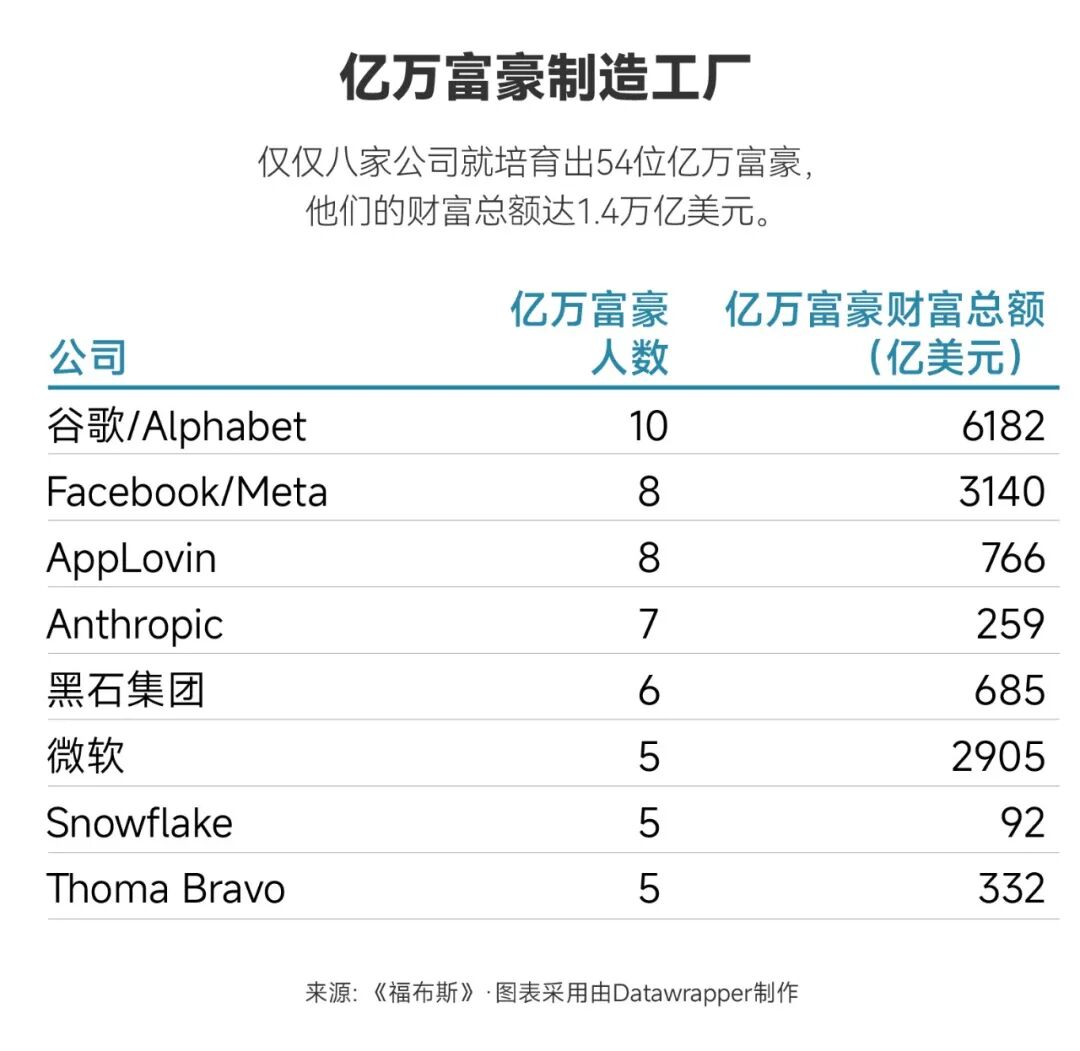
8家公司,54位亿万富豪:揭秘美国顶级“造富工厂”
3 6 Ke· 2026-01-09 12:33
Core Insights - Anthropic, an AI startup, is preparing to launch its Claude 4 chatbot in January 2025, aiming to compete with products like ChatGPT and Gemini while seeking over $60 billion in funding, making it one of the highest-valued AI companies globally [1][2] - The rise of billionaires in the tech industry is largely attributed to companies like Google, Meta, Microsoft, and emerging firms like Anthropic and AppLovin, which have seen significant stock price increases driven by investor enthusiasm for AI [2][3] - Alphabet, Google's parent company, has created the most billionaires, totaling 10 individuals with a combined wealth exceeding $600 billion [4][6] Company Summaries - **Anthropic**: Founded by former OpenAI employees, Anthropic has quickly entered the AI race with its chatbot Claude, achieving a valuation of $60 billion by early 2025 and creating seven billionaires among its founders [16] - **AppLovin**: This digital advertising company has produced eight billionaires since its NASDAQ listing in 2021, with its stock price increasing over 1000% since then, reaching a market cap close to $250 billion [2][14] - **Google/Alphabet**: The company has generated 10 billionaires, including co-founders Larry Page and Sergey Brin, with a total wealth of $618.2 billion among them [8][10] - **Meta**: Facebook's parent company has created eight billionaires, including Mark Zuckerberg, with a total wealth of $314 billion [12] - **Microsoft**: The tech giant has five billionaires, including Bill Gates and Steve Ballmer, with a combined wealth of $290.5 billion [19][21] - **Blackstone**: This investment firm has produced six billionaires, with a total wealth of $68.5 billion [17] - **Snowflake**: The cloud services company has five billionaires, with a total wealth of $9.2 billion [22] - **Thoma Bravo**: This investment firm has also created five billionaires, with a total wealth of $33.2 billion [24]




S&P500 2025年最牛Top 10&最熊TOP10,存储占最牛TOP4(详解)
美股IPO· 2026-01-01 10:30
Core Viewpoint - The S&P 500 index experienced an annual increase of 16.65% to 17% by the end of 2025, with significant gains in data storage and semiconductor sectors driven by AI investment trends [1][9]. Group 1: Top Gainers in S&P 500 - SanDisk (SNDK) achieved a remarkable annual increase of 559%, although it was not officially counted in the best stocks due to its late inclusion in the index [1][21]. - Western Digital (WDC) saw a stock price surge of 268%, benefiting from strong demand for high-capacity storage solutions driven by AI data centers [11][15]. - Micron Technology (MU) recorded a 227% increase, capitalizing on the AI data wave and exceeding market expectations in its financial performance [18]. - Seagate Technology (STX) experienced a rise of 219%, with its high-margin hard disk products in demand due to AI's impact on data storage needs [15]. - Robinhood Markets (HOOD) had a gain of 186% to 226%, operating in the financial services and online trading platform sector [5]. Group 2: Top Losers in S&P 500 - The Trade Desk (TTD) faced a significant decline of 67% to 70.1%, becoming the worst-performing stock in the S&P 500 due to economic uncertainties and high competition in the digital advertising sector [10][27]. - Fiserv (FISV) dropped by 67%, reflecting challenges in the fintech and payment industry [10][27]. - Deckers Outdoor (DECK) saw a decline of 49% to 56.7%, impacted by weak performance forecasts and analyst downgrades [10][27]. - Alexandria Real Estate (ARE) experienced a drop of 45% to 49%, affected by pressures in the real estate investment trust sector [10][27]. Group 3: Market Observations - The market winners in 2025 were concentrated in data storage and semiconductor sectors, benefiting from the AI-driven demand for data center infrastructure [9][10]. - Conversely, the losers were spread across digital advertising, consumer goods, real estate, and healthcare sectors, facing pressures from high interest rates and slowing consumer spending [9][10]. - The AI investment theme has shifted from technology breakthroughs to infrastructure development, indicating potential future investment opportunities in data storage and related sectors [23].



老年人辛苦刷手机赚 “白菜钱”背后的“温柔陷阱”
第一财经· 2025-12-30 08:15
Core Viewpoint - The article discusses the complexities and ethical dilemmas in the digital advertising ecosystem, particularly focusing on the mismatch between user engagement and actual conversion rates, highlighting the risks for both users and advertisers [1][2][3]. Group 1: User Engagement and Risks - Users, particularly from lower-tier cities and older demographics, are often lured into spending time on apps for minimal rewards, leading to a false sense of earning while contributing to a cycle of low conversion for advertisers [1][2]. - The rise of apps targeting these demographics has created a situation where users face physical risks from excessive screen time and potential financial exploitation through misleading advertising practices [4][5]. Group 2: Advertising Challenges - Advertisers are increasingly frustrated by high engagement metrics that do not translate into actual sales, as many interactions are driven by misleading ad designs that do not reflect genuine consumer interest [2][5]. - The digital marketing landscape is evolving, with a focus on lower-tier markets, but this has led to a misalignment of advertising strategies and user expectations, resulting in a "double loss" scenario for both users and advertisers [3][5]. Group 3: Platform Responsibilities - Platforms hold significant power in the advertising ecosystem, controlling rules, flow of traffic, and algorithms, which necessitates a higher ethical standard in balancing short-term profits with long-term ecosystem health [7][8]. - There is a call for platforms to implement stricter measures against misleading practices and to create a more user-friendly environment, especially for vulnerable groups like the elderly [8][9]. Group 4: Strategies for Advertisers - Advertisers are encouraged to develop clear strategies that align with their target demographics and product characteristics, ensuring that they understand the value of different traffic sources [9][10]. - Establishing comprehensive data capabilities is essential for advertisers to track the entire customer journey from exposure to conversion, allowing for more informed decision-making [9][10]. Group 5: Industry Evolution - The digital advertising industry is undergoing rapid changes due to advancements in AI technology and shifts in user behavior, requiring advertisers to adapt and build core competencies rather than relying on a single effective channel [9][10]. - A collaborative effort among platforms, advertisers, and regulators is necessary to foster a healthy advertising ecosystem that prioritizes ethical practices and user value [10].