智能消费设备制造

Search documents
V型反弹!12月工业企业利润增速大幅回升
Jin Rong Shi Bao· 2026-01-28 03:12
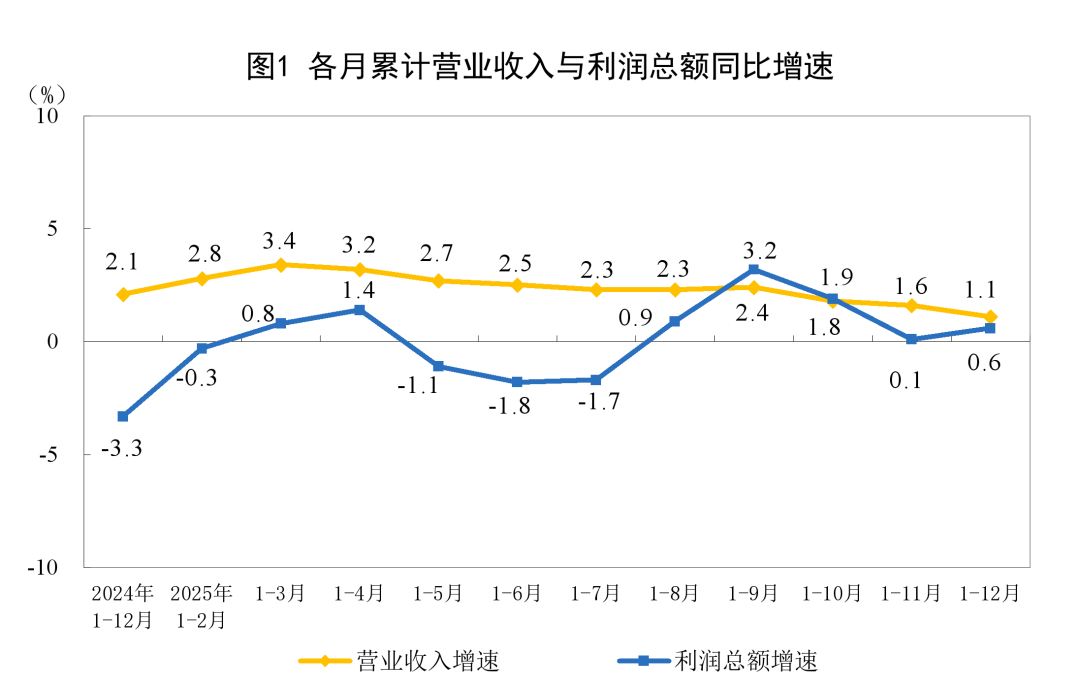
Core Insights - Overall, industrial enterprise profits are expected to show a "low first, high later, and fluctuating" trend in 2025, with a significant recovery in the medium to long term [2] - In 2026, industrial profits are anticipated to continue their recovery, transitioning from a phase of repair to moderate growth [2] Group 1: Profit Growth by Sector - Profit growth in 2025 is characterized by "two increases and one stable" among three major sectors: manufacturing is expected to grow by 5.0%, a significant rebound of 8.9 percentage points from 2024; the electricity, heat, gas, and water production and supply sector is projected to grow by 9.4%; while the mining sector is expected to decline by 26.2% [3] - Price improvements have offset the marginal decline in profit margins, allowing manufacturing profits to maintain positive growth [3] - The equipment manufacturing and high-tech manufacturing sectors are crucial for high-quality industrial development, with profits in the former expected to grow by 7.7% and in the latter by 13.3%, both exceeding the overall industrial profit growth of 12.7% [3] Group 2: Sector-Specific Profit Increases - The railway, shipbuilding, aerospace, and electronics industries are projected to see double-digit profit growth, with increases of 31.2% and 19.5% respectively; the smart electronics sector is expected to grow by 48.0% [4] - The semiconductor industry is experiencing rapid growth, with profits in integrated circuit manufacturing, semiconductor device manufacturing, electronic components, and sensors increasing by 172.6%, 128.0%, 49.1%, and 33.3% respectively [4] - In the healthcare sector, profits from genetic engineering drugs and vaccines, as well as biopharmaceuticals, are expected to rise by 72.7% and 37.1% respectively [4] Group 3: December Profit Recovery - In December 2025, profits for large-scale industrial enterprises rebounded by 5.3%, recovering from a 13.1% decline in November, indicating a "V-shaped rebound" [5] - This rebound is attributed to the combined effects of volume, price, and profit margin improvements, driven by effective growth policies and a recovery in both domestic and external demand [5] - December's industrial added value increased from 4.8% to 5.2% year-on-year, while the Producer Price Index (PPI) decline narrowed from 2.2% to 1.9%, contributing to improved revenue and profit margins [5] Group 4: Inventory and Receivables Management - By the end of December, industrial enterprise inventory growth slowed to 3.9%, and the average accounts receivable collection period decreased to 67.9 days, reflecting a proactive inventory reduction strategy amid weak demand [6] - Companies are adjusting production rhythms and focusing on order-based production to manage inventory effectively [6] Group 5: Future Outlook - Experts predict that as growth stabilization policies continue to take effect and overall demand gradually recovers, industrial enterprise profits are likely to maintain a recovery trend, supported by reduced cost pressures and optimized inventory structures [7]

我国工业经济发展质效不断提升
Ren Min Ri Bao· 2026-01-28 01:50
Group 1 - The core viewpoint of the article highlights the significant growth in profits for high-tech manufacturing industries in China, with a reported increase of 13.3% in 2025, surpassing the overall industrial profit growth by 12.7 percentage points [3] - In 2025, profits for large-scale industrial enterprises increased by 0.6%, reversing a three-year decline, with manufacturing sector profits rising by 5.0%, marking an 8.9 percentage point recovery from 2024 [2] - The equipment manufacturing sector showed a profit increase of 7.7% in 2025, contributing 2.8 percentage points to the overall profit growth of large-scale industrial enterprises, indicating its strong support for industrial upgrading [2] Group 2 - The smart electronics sector has driven a new wave of consumer trends, with profits in the smart consumer device manufacturing industry soaring by 48.0%, and specific sectors like smart unmanned aerial vehicle manufacturing and smart vehicle-mounted equipment manufacturing seeing profit increases of 102.0% and 88.8% respectively [3] - Traditional industries are also experiencing quality upgrades, with profits in the biochemical pesticide and information chemical manufacturing sectors growing by 20.7% and 15.2%, significantly above the average for the chemical industry [3] - In the chemical fiber and power sectors, profits for bio-based chemical fiber manufacturing and biomass power generation increased by 88.6% and 47.9%, respectively, exceeding the average profit growth in their respective categories by 93.1 and 34.0 percentage points [3]
信号!2025年工业企业利润时隔三年重回正增长
Shang Hai Zheng Quan Bao· 2026-01-27 18:36
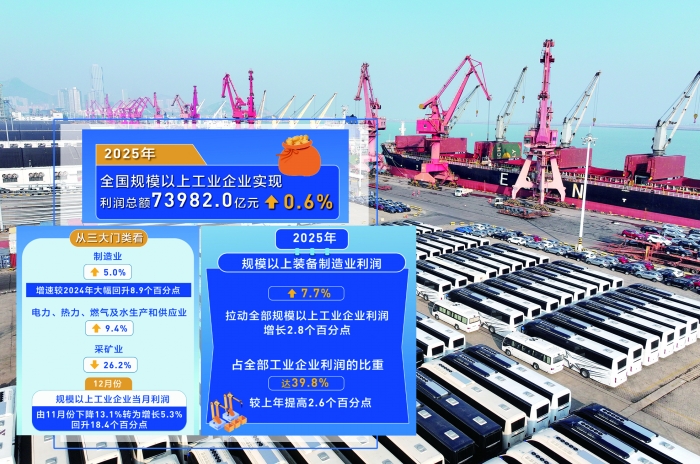
国家统计局1月27日发布的数据显示,2025年,全国规模以上工业企业利润较2024年增长0.6%,全年工 业企业利润以正增长收官,扭转了2022年至2024年连续三年的下降态势。工业利润结构持续向优,装备 制造业和高技术制造业成为主要支撑,多类经营主体利润有所改善。受访专家表示,2026年在需求改 善、综合整治"内卷式"竞争深入推进等作用下,工业企业利润有望延续回升态势。 ◎记者 陈芳 多类经营主体利润有所改善。2025年,在全国规模以上工业企业中,中小型企业、外商及港澳台投资企 业的利润增速均由负转正,全年利润较2024年分别增长1.4%、4.2% 1月27日,在江苏省连云港港东方港务分公司码头,大批车辆集港等待装船外运。新华社图 "展望未来,在2025年工业企业利润增速以正增长收官的背景下,2026年有望延续回升态势。从政策层 面来看,综合整治'内卷式'竞争系列举措改善了企业竞争环境,缓解了无序竞争对盈利的挤压;从需求 层面看,在大宗商品价格阶段性上行及出口维持较高景气度的背景下,相关行业需求和价格中枢得到支 撑,对工业利润形成一定提振。"中国银河证券首席经济学家章俊对上海证券报记者表示。 在于卫宁看来, ...
工业利润转正背后:高技术、装备制造业拉动显著 智能消费与半导体领域“加速跑”
Yang Shi Wang· 2026-01-27 07:10
Core Insights - In 2025, the total profit of industrial enterprises above designated size in China reached 73,982 billion yuan, marking a 0.6% increase from the previous year, reversing a three-year decline trend [1] Group 1: Overall Industrial Performance - The profit of industrial enterprises above designated size increased by 0.6% compared to the previous year [3] - The manufacturing sector saw a significant growth of 5%, rebounding by 8.9 percentage points from 2024 [3] - The equipment manufacturing sector was the strongest contributor to profit growth, with a 7.7% increase year-on-year [3] Group 2: High-Tech Manufacturing Sector - Profits in the high-tech manufacturing sector rose by 13.3% year-on-year, providing strong momentum for high-quality industrial development [7] - The smart consumer electronics sector drove a new consumption trend, with profits in smart consumer device manufacturing increasing by 48%, including a 102% rise in profits for smart unmanned aerial vehicle manufacturing and an 88.8% increase for smart vehicle-mounted equipment manufacturing [7] - The semiconductor industry experienced rapid growth, with profits in integrated circuit manufacturing and semiconductor device manufacturing increasing by 172.6% and 128%, respectively [7] - The medical sector showed significant high-quality development, with profits in gene-engineered drugs and vaccines manufacturing rising by 72.7% and in biopharmaceutical manufacturing by 37.1% [7] Group 3: Traditional Industries - The development of new productive forces in traditional industries continues to show results, with profits in biochemicals, microbial pesticides, bio-based chemical fibers, and biomass energy generation significantly exceeding the average profit levels of their respective categories [9]

研判2025!中国电容笔行业进入壁垒、市场政策汇总、产业链图谱、市场规模、竞争格局及发展趋势分析:主动式电容笔将成为技术发展主流[图]
Chan Ye Xin Xi Wang· 2026-01-13 01:25
Core Insights - The global capacitive pen market is rapidly growing, with a projected market size of $2.018 billion in 2024, reflecting a year-on-year growth of 0.9%, where active capacitive pens account for approximately 67% and passive capacitive pens for about 33% [1][6] Industry Overview - Capacitive pens are input devices designed based on capacitive touch technology, allowing operations like writing, drawing, clicking, and sliding on capacitive touch screens [2] - The industry is characterized by various classifications of capacitive pens, including active vs. passive, basic vs. pressure-sensitive, and universal vs. specialized types [2] Industry Barriers - The main barrier to entry in the capacitive pen industry is the technical protocol certification required by operating system manufacturers like Microsoft and Google, which is essential for signal interaction [2] - The development of high-performance capacitive pens requires significant R&D investment and technological accumulation due to the complexity of the product [2] Policy Environment - The Chinese government has implemented several policies to support the development of the smart consumer device manufacturing industry, creating a favorable environment for the growth of the capacitive pen sector [4] Industry Chain - The capacitive pen industry supply chain includes upstream suppliers of raw materials like ICs, plastic components, and electronic materials, while the midstream focuses on R&D, design, and production [5] Market Growth in China - The Chinese capacitive pen market is expected to reach 5.562 billion yuan in 2024, with a year-on-year growth of 12.8%, driven by the digital economy and educational informationization policies [8] Competitive Landscape - The Chinese capacitive pen market is highly competitive, featuring major players like Apple, Microsoft, and Huawei, alongside local brands such as Hanvon Technology and MAXEYE, with MAXEYE projected to hold an 8.5% global market share in 2024 [6][11] Development Trends - Future trends indicate a focus on technological upgrades in active capacitive pens, enhancing pressure sensitivity and reducing latency, while integrating AI and IoT technologies [12] - The application of capacitive pens is expanding beyond consumer electronics into various industry sectors, driven by digital transformation needs [12] - Local brands are expected to enhance their market competitiveness through technological innovation and ecosystem development, moving towards a more integrated hardware-software-content model [13] - The industry is also moving towards sustainable development, with a focus on using biodegradable materials and optimizing production processes to meet environmental standards [15]


前11月全国规上工业企业实现利润总额66268.6亿元 工业企业利润延续增长态势
Ren Min Ri Bao· 2025-12-29 01:54
Core Viewpoint - The profits of large-scale industrial enterprises in China continued to grow, reaching a total of 66,268.6 billion yuan from January to November, indicating a sustained upward trend supported by new industrial momentum [1][2]. Group 1: Profit Growth - From January to November, the profit of large-scale industrial enterprises increased by 0.1% year-on-year, marking four consecutive months of growth since August [2]. - The manufacturing sector achieved a profit total of 50,317.9 billion yuan, growing by 5.0% [2]. - The electricity, heat, gas, and water production and supply sector reported profits of 8,054.4 billion yuan, with an increase of 8.4% [2]. - The mining sector experienced a profit total of 7,896.3 billion yuan, showing a year-on-year decline of 27.2%, although the decline was slightly less severe than in the previous months [2]. Group 2: Revenue and Assets - Large-scale industrial enterprises generated operating revenue of 125.34 trillion yuan from January to November, reflecting a year-on-year growth of 1.6% [3]. - By the end of November, total assets of large-scale industrial enterprises reached 189.28 trillion yuan, up by 4.8% year-on-year [3]. - The total equity of these enterprises was 79.32 trillion yuan, increasing by 4.5% [3]. - The operating revenue per 100 yuan of assets was 74.4 yuan [3]. Group 3: New Momentum Industries - New momentum industries, particularly equipment manufacturing and high-tech manufacturing, showed rapid growth [4]. - The profit of large-scale equipment manufacturing increased by 7.7% year-on-year, contributing 2.8 percentage points to the overall profit growth of large-scale industrial enterprises [4]. - In the equipment manufacturing sector, seven out of eight major categories reported year-on-year profit growth, with the railway, shipbuilding, and aerospace industries seeing profits grow by 27.8% and 15.0% respectively [4]. - High-tech manufacturing profits grew by 10.0% year-on-year, surpassing the average growth rate of all large-scale industrial enterprises by 9.9 percentage points [4]. Group 4: Sector-Specific Growth - The "Artificial Intelligence+" initiative has positively impacted related equipment manufacturing sectors, with profits in the electronic industrial specialized equipment manufacturing sector increasing by 57.4% [5]. - The aerospace industry also saw significant profit growth, with profits in aerospace and related equipment manufacturing rising by 13.3% [5]. - Profits in smart consumer device manufacturing surged by 54.0%, driven by advancements in intelligent products [5]. Group 5: Industrial Economic Development - The overall profit growth reflects a steady advancement in the industrial economy, with a focus on achieving qualitative improvements and reasonable quantitative growth by 2025 [6][7]. - The high-tech manufacturing and equipment manufacturing sectors reported value-added growth of 9.2% and 9.3% respectively from January to November [6]. - The establishment of advanced and excellent smart factories, along with the expansion of 5G networks, supports the ongoing transformation and upgrading of traditional industries [7].
前11个月工业企业利润总体保持增长 高技术制造业等成为驱动主力
Shang Hai Zheng Quan Bao· 2025-12-28 23:41
Core Viewpoint - The cumulative profit growth rate of industrial enterprises has maintained growth for four consecutive months, with a year-on-year growth rate of 0.1% for the first 11 months, despite a decline compared to the previous months. New momentum industries, represented by equipment manufacturing and high-tech manufacturing, continue to grow rapidly [1][2]. Group 1: Profit Growth and Industry Performance - The revenue of industrial enterprises above designated size increased by 1.6% year-on-year, with a slowdown of 0.2 percentage points compared to the previous 10 months [1]. - The profit of industrial enterprises above designated size increased by 0.1% year-on-year, with a decline of 1.8 percentage points compared to the previous 10 months [1]. - Equipment manufacturing profits increased by 7.7% year-on-year, contributing 2.8 percentage points to the overall profit growth of industrial enterprises [2]. Group 2: Sector-Specific Insights - In the equipment manufacturing sector, seven out of eight major industries achieved year-on-year profit growth, with railways, shipping, aerospace, and electronics showing double-digit growth rates of 27.8% and 15.0%, respectively [2]. - High-tech manufacturing profits grew by 10.0% year-on-year, surpassing the average growth rate of all industrial enterprises by 9.9 percentage points [2]. - The smart consumer device manufacturing industry saw a remarkable profit increase of 54.0%, with specific segments like smart vehicle equipment and drones experiencing growth rates of 105.7% and 76.6%, respectively [2]. Group 3: Challenges and Future Outlook - Industrial enterprises face challenges such as increased finished goods inventory and longer average accounts receivable collection periods, with finished goods inventory at 6.92 trillion yuan, up 4.6% year-on-year [3]. - The average accounts receivable reached 28.40 trillion yuan, increasing by 5.5% year-on-year, with an average collection period of 70.4 days, up by 3.7 days [3]. - The central economic work conference emphasized the need to address "involution" competition, which may help stabilize and gradually improve industrial product prices, thereby supporting profit growth [3].
今日视点:解码高技术制造业利润增长的“含金量”
Xin Lang Cai Jing· 2025-12-28 23:20
Core Viewpoint - The latest data from the National Bureau of Statistics indicates that China's industrial economy continues to recover, with improving corporate profits. From January to November, the total profit of industrial enterprises above designated size reached 66,268.6 billion yuan, a year-on-year increase of 0.1%, maintaining positive growth for four consecutive months since August [1][5]. Group 1: High-Tech Manufacturing Performance - High-tech manufacturing has shown remarkable performance, with profits increasing by 10.0% year-on-year from January to November, accelerating by 2.0 percentage points compared to the first ten months, and outpacing the average growth rate of all industrial enterprises by 9.9 percentage points [1][6]. - The strong performance of high-tech manufacturing is attributed to the combined support of policy, market, and innovation factors [1][6]. Group 2: Policy Environment - The policy environment has been continuously optimized, with the State Council issuing the "Opinions on Deepening the Implementation of 'Artificial Intelligence+' Action" in August, which outlines six key action areas and sets development goals [2][6]. - The implementation of the "Artificial Intelligence+" action has injected strong policy momentum into related high-tech manufacturing sectors, boosting market confidence and guiding resources towards these fields. From January to November, profits in the electronic industrial equipment manufacturing sector increased by 57.4%, with semiconductor device manufacturing and electronic components manufacturing profits growing by 97.2% and 46.0%, respectively [2][6]. Group 3: Market Demand and Structural Upgrading - The acceleration of digital transformation across various industries has released market demand and created significant growth opportunities for related manufacturing sectors. For instance, profits in the smart consumer equipment manufacturing sector rose by 54.0% year-on-year from January to November, with smart vehicle equipment profits increasing by 105.7% and smart unmanned aerial vehicle profits rising by 76.6% [3][7]. - These figures reflect a trend of consumption upgrading and a positive cycle between technological advancement and market demand [3][7]. Group 4: Innovation and Growth - Breakthroughs in independent innovation have become a core engine for growth, particularly in high-tech manufacturing sectors like aerospace. From January to November, profits in aerospace-related equipment manufacturing and aviation-related equipment manufacturing increased by 192.9% and 36.3%, respectively [4][8]. - The rapid development of high-tech manufacturing signifies a steady transition of China's manufacturing industry towards the high end of the value chain, representing an important aspect of high-quality development [4][8].
解码高技术制造业利润增长的“含金量”
Zheng Quan Ri Bao· 2025-12-28 16:09
Core Viewpoint - The latest data from the National Bureau of Statistics indicates that China's industrial economy continues to recover, with improving corporate profits, particularly in the high-tech manufacturing sector, which shows significant growth driven by policy, market demand, and innovation. Group 1: Overall Industrial Performance - From January to November, the total profit of industrial enterprises above designated size reached 66,268.6 billion yuan, a year-on-year increase of 0.1%, maintaining positive growth for four consecutive months since August [1] - High-tech manufacturing profits increased by 10.0% year-on-year, accelerating by 2.0 percentage points compared to the first ten months, outpacing the average growth of all industrial enterprises by 9.9 percentage points [1] Group 2: Policy Support - The policy environment has been continuously optimized, with the State Council issuing guidelines in August for the implementation of the "Artificial Intelligence +" initiative, which outlines six key action areas and aims to boost market confidence and attract capital, talent, and technology to relevant sectors [1] Group 3: Market Demand and Structural Upgrades - The release of market demand and structural upgrades have significantly driven growth, with the smart consumer equipment manufacturing sector seeing a profit increase of 54.0% year-on-year, including a 105.7% increase in smart vehicle equipment and a 76.6% increase in smart unmanned aerial vehicle manufacturing [3] Group 4: Innovation and Core Technology - Breakthroughs in independent innovation have become the core engine for growth, with profits in aerospace-related equipment manufacturing increasing by 192.9% and aviation-related equipment manufacturing profits rising by 36.3% year-on-year, indicating that innovation in key technologies directly enhances industrial competitiveness and profitability [4]
中游一枝独秀——11月工业企业利润点评
一瑜中的· 2025-12-28 13:45
Core Viewpoint - The article emphasizes that the midstream sector is currently the standout performer in terms of profit growth and revenue, contrasting with the overall decline in industrial profits [4][5][24]. Group 1: Midstream Sector Performance - In November, the midstream sector showed a profit growth of 6.77%, the only sector with a positive growth rate among five sectors, while upstream and downstream sectors experienced declines of -9.52% and -48.04% respectively [5][13]. - The revenue growth for the midstream sector in November was 4.66%, outperforming other sectors [5][13]. - The equipment manufacturing sector, particularly in electronics, aerospace, and smart devices, significantly contributed to the midstream sector's profit growth, with specific industries seeing profits increase by 57.4% and 54.0% respectively [5][29]. Group 2: Overall Industrial Profit Data - In November, the overall profit of industrial enterprises decreased by 13.1%, a decline from the previous value of -5.5% [24]. - The inventory level as of November showed a year-on-year increase of 4.6%, up from 3.7% [24]. - The profit growth rates for state-owned enterprises, private enterprises, and foreign enterprises were -17.0%, -12.6%, and -7.3% respectively [24]. Group 3: Quantity and Price Analysis - The midstream sector's value-added growth rate in November was 7.36%, higher than the overall industrial growth rate of 4.8% [6][15]. - The Producer Price Index (PPI) for the midstream sector turned positive in November, marking the first month of positive growth since June 2024, with a month-on-month increase of 0.04% [7][18]. - The profit margin for the midstream sector in November was 5.7%, which is an improvement compared to the same period last year [7][18]. Group 4: Supply and Demand Dynamics - The supply-demand dynamics for the midstream sector have been improving, with a favorable difference between demand and investment growth rates compared to upstream and downstream sectors [8][22]. - The article predicts that midstream prices are likely to continue to recover, leading to further profit increases in the sector [8][22].