
智能网联汽车

Search documents
港股异动 | 部分智驾概念股早盘走高 智能网联汽车法规持续完善 机构指行业发展环境逐步规范化
智通财经网· 2026-02-13 02:14
Group 1 - The core viewpoint of the article highlights the positive market response to smart driving concept stocks, with notable increases in share prices for companies such as Zhejiang Shibao, Nexperia, Youjia Innovation, and Minth Group [1] - As of February 13, the Ministry of Industry and Information Technology has publicly solicited opinions on five mandatory national standards, including "Safety Requirements for Autonomous Driving Systems" [1] - The Shanghai Intelligent Connected Vehicle Testing and Demonstration Promotion Working Group has released the "Shanghai Intelligent Connected Vehicle Development Report (2025)" [1] Group 2 - By the end of last year, Shanghai had opened a total of 3,173 test roads spanning 5,238.82 kilometers for autonomous driving [1] - According to Cinda Securities, the regulatory environment for intelligent connected vehicles in China is becoming increasingly standardized, and domestic brands are accelerating the development of smart driving technologies [1] - The penetration rate of smart driving in the industry is continuously increasing, with the market size for Robotaxi expected to reach 270 billion yuan by 2030, and the incremental output value of the unmanned logistics vehicle industry projected to reach 594.8 billion yuan by 2030 [1]
从脑机接口到重点群体康复保障,这一批国家标准与你息息相关
Xin Hua She· 2026-02-12 09:24
Emerging Fields - The release of five national standards related to brain-computer interfaces and digital twins aims to clarify reference frameworks and data formats, supporting high-quality development in cutting-edge technology sectors [1] - A total of 47 national standards for new materials, including aluminum nitride single crystal polishing wafers and carbon fiber reinforced composites, are expected to foster innovation in the new materials industry [1] - Fifteen national standards for experimental animals, such as identification and evaluation techniques for animal models and methods for detecting dermatophytes, will enhance the support for biotechnology research and applications [1] Transportation and Logistics - Two national standards for intelligent connected vehicles focus on performance testing for autonomous driving and parking systems, enhancing the performance and safety of smart vehicles [1] - Six national standards related to automotive components, including door handles and adaptive cruise control systems, aim to improve road traffic safety and sustainability [1] - Two mandatory national standards for the postal industry address safety production operations and equipment configuration, enhancing safety governance in postal and express delivery services [1] Ecological and Environmental Protection - Six national standards, including general requirements for natural protected area signage and drone inspection techniques for forest and grassland fire prevention, provide support for national ecological security [2] - Two national standards for environmental due diligence assessments and environmental report verification are significant for promoting green development and improving environmental governance efficiency [2] - Two national standards related to greenhouse gas emission accounting and reporting will assist companies in accurately calculating and reporting their emissions, providing a framework for emissions management [2] Safety Production - Sixteen mandatory national standards in the fire safety sector, including outdoor fire hydrants and gas detectors, update technical requirements and inspection rules for fire safety products, providing guidelines for mitigating major fire safety risks [2] - Fourteen national standards for special equipment, such as gantry cranes and pressure vessels, ensure the safe and stable operation of these devices [2] Public Life - Four national standards for services related to disabled individuals, including single-arm walking aids and autism rehabilitation institutions, aim to improve the quality of rehabilitation aids and standardize services for vulnerable groups [2] - Eight national standards concerning medical laboratories and sterilization processes for medical devices will regulate practices in medical testing and manufacturing [2] Additional Standards - The market regulatory authority also released national standards related to transportation terminology, earth-moving machinery, and reciprocating internal combustion engines [3]
对话独角兽 | 东软睿驰助力汽车产业智能化发展:聚焦软件自研,联动生态协同
Di Yi Cai Jing· 2026-02-12 09:19
与之形成反差的是,作为汽车核心的汽车操作系统的国产化进程却相对滞后。根据中国汽车工业协会与赛迪顾问联合数据,2024年国内车用操作系统市场 中,国产操作系统占比不足15%,并且主要集中在后装市场与低阶前装车型,高端前装市场依然由外资品牌所主导。 汽车行业智能化转型推动基础软件需求激增,汽车操作系统作为连接硬件与应用的关键环节,适配多芯片、多场景成为产业核心需求。 长久以来,中国汽车产业位居全球产销量前列,据中国汽车工业协会数据,2025年汽车出口达709.8万辆,同比增长21.1%,其中新能源汽车出口261.5万 辆,同比增长1倍,产业规模与国际竞争力持续提升。 作为长期深耕新能源与智能网联汽车核心技术研发的企业,东软睿驰致力于为车企智能化创新升级提供高效、可靠的产品方案。目前由其自主研发的汽车基 础软件与整车操作系统NeuSAR已累计装车数千万套,成为推动中国智能汽车产业转型升级的重要力量,同时也成为推进汽车操作系统国产化替代的重要实 践样本。 打破生态壁垒,锚定产业适配核心需求 汽车行业智能化转型推动基础软件需求激增,汽车操作系统作为连接硬件与应用的关键环节,适配多芯片、多场景成为产业核心需求。但国内汽车 ...

多地严控教育类专业招生
第一财经· 2026-02-12 05:21
2026.02. 12 本文字数:1655,阅读时长大约3分钟 作者 | 第一财经 林靖 近年来,教育行业受到学龄人口变化的影响明显,师范类高校加快转型调整。 2月7日,安徽师范大学宣布成立智能信息与先进制造学院、智能材料与未来能源学院、人工智能学 院等3个新工科学院,同时成立的还有旨在培养"懂科技、懂产业、懂资本、懂市场、懂管理"的复合 型科技产业组织人才的科技商学院。 揭牌仪式上,该校与奇瑞控股集团有限公司签署战略合作框架协议。未来,新工科学院学生将深度参 与企业研发和应用场景,在智能网联汽车、先进制造、新能源材料等领域实现"学业-产业-就业"无 缝衔接,打造校企共建学院的"奇瑞标准"和"师大样板"。 安徽师范大学党委书记蒋家平表示,新工科学院的成立,将为学校注入新的发展动能,促进该校从师 范教育为主向"师范底蕴+工科硬核"双轮驱动的深度转型,也将有助于破解师范院校在服务国家战 略、支撑地方发展与坚守师范主业之间可能出现的"两张皮"问题。 在高校专业结构优化调整的进程中,多地提出严格控制教育类专业的布点增设和招生规模,多所师范 类院校加快了新工科人才培养的布局。 例如,2025年9月4日,淮北师范大学人工 ...

智能网联行业再迎利好 助力上海打造世界级汽车产业中心
Zheng Quan Ri Bao Wang· 2026-02-12 04:28
Core Insights - Shanghai's intelligent connected vehicle industry is set to benefit from significant policy support as outlined in the "14th Five-Year Plan" [1][2] - The plan emphasizes the development of six emerging pillar industry clusters, focusing on the integration of software and hardware to accelerate the growth of intelligent connected new energy vehicles [1] Group 1: Policy and Development Plans - The "14th Five-Year Plan" aims to establish Shanghai as a world-class automotive industry center, with key areas including Jiading, Pudong, Lingang, and Jinshan [1] - The plan highlights the importance of core technologies such as intelligent driving, intelligent cockpits, intelligent chassis, and solid-state batteries to support the development of intelligent connected new energy vehicles [1][2] Group 2: Industry Growth and Infrastructure - By the end of 2025, Shanghai plans to open 3,173 roads totaling 5,238.82 kilometers for autonomous driving testing, covering about one-third of the city's area [1] - The city has issued 932 various testing and demonstration licenses to 41 companies, with total testing mileage exceeding 34.55 million kilometers [1] Group 3: Future Projections - The intelligent connected vehicle industry in Shanghai is expected to enter a new phase of "city-wide integration" during the "14th Five-Year" period, promoting cross-regional collaboration and a multi-level scenario layout [2] - From 2025 to 2027, the integration of vehicle-road-cloud infrastructure is anticipated to accelerate, potentially leading to an explosion in the smart transportation industry [2] - By 2030, Shanghai is projected to become a global innovation hub for intelligent connected vehicles, forming a trillion-yuan industry cluster and solidifying its position as a domestic leader and international player in the sector [2][3]
研判2026!中国车载智能网联解决方案行业政策、产业链、收入规模、重要企业及发展趋势分析:受益于汽车智能化趋势,行业收入规模保持增长[图]
Chan Ye Xin Xi Wang· 2026-02-11 01:28
Core Insights - The article emphasizes the growth and significance of intelligent connected vehicles (ICVs) in China's future transportation system, driven by technological advancements, policy support, and market demand [1][6]. Industry Overview - Intelligent connected vehicles are seen as a crucial component of future transportation, with production steadily increasing in China. By 2025, the expected production volume is approximately 11.38 million units, with a market penetration rate of about 32.10% [1][7]. - The market for in-vehicle intelligent connected solutions is projected to grow significantly, reaching 169.3 billion yuan by 2025 and 236.5 billion yuan by 2026 [1][7]. Industry Definition and Categories - In-vehicle intelligent connected solutions rely on interactive wireless networks, integrating vehicle-mounted devices and sensors to create a comprehensive network among vehicles, infrastructure, and users. The solutions encompass six domains: connectivity, intelligent driving, cabin, chassis, power, and body [2][5]. Current Development Status - The intelligent connected vehicle sector is transforming the automotive industry, driven by advancements in technology and increasing demands for smart transportation systems. This sector is pivotal for the integration of automotive technology with AI and information communication [5][6]. Industry Value Chain - The value chain of in-vehicle intelligent connected solutions consists of hardware, software, and services. The upstream includes components like chips and sensors, while the downstream focuses on applications in passenger and commercial vehicles [7][8]. Policy Environment - The development of intelligent connected vehicles is supported by government policies aimed at promoting smart automotive technologies, which provide a solid foundation for the growth of in-vehicle intelligent connected solutions [8][9]. Competitive Landscape - The competition in the in-vehicle intelligent connected solutions industry is intensifying, shifting from product-based competition to a focus on comprehensive capabilities and ecosystem collaboration. Key players include Yundong Intelligent, Weihan Co., Lianyou Technology, and others [9][10]. Key Companies - Yundong Intelligent is a leading supplier in the sector, integrating various advanced technologies to enhance vehicle intelligence. In the first three quarters of 2023, the company reported revenues of 301 million yuan, with significant contributions from communication solutions [10][11]. - Weihan Co. specializes in high-reliability, low-cost wireless communication products and has successfully implemented its digital energy management solutions across various applications, achieving significant market penetration [10][11]. Development Trends - The in-vehicle intelligent connected solutions are evolving towards modular design, leveraging data on vehicle location, speed, and routes to create dynamic interactive wireless networks [11][12].



上海已开放超5200公里自动驾驶测试道路,将按需扩大开放范围
Xin Lang Cai Jing· 2026-02-10 11:49
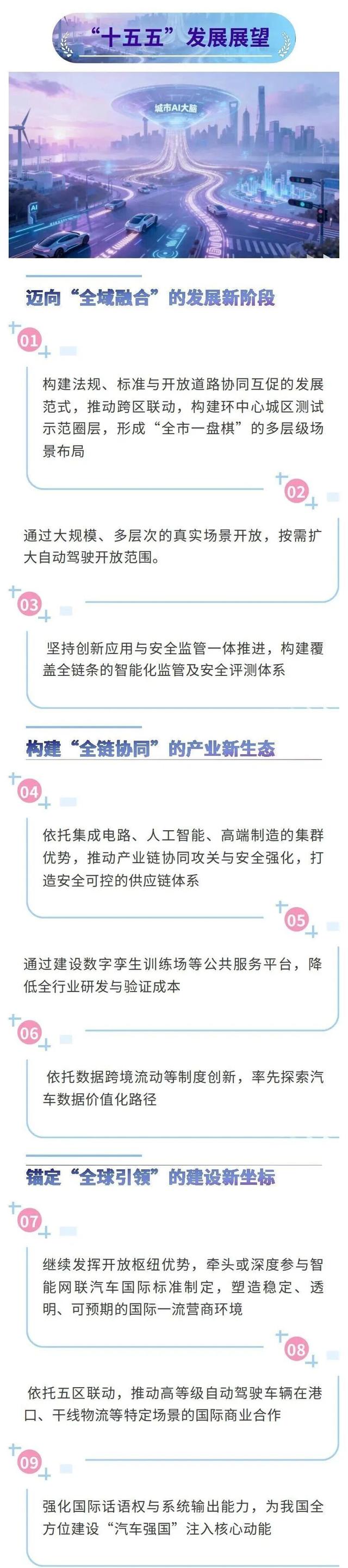
2月10日,智通财经记者从上海市经信委获悉,上海市智能网联汽车测试与示范推进工作小组近日编制 发布《上海市智能网联汽车发展报告(2025年度)》(以下简称"报告")。 报告显示,2025年,上海持续拓展智能网联汽车测试应用空间,稳妥推进场景开放。截至去年年底,全 市累计开放3173条5238.82公里自动驾驶测试道路,涉及2144平方公里,覆盖约1/3市域面积,打通各区 联通链路,形成跨区域联动、广域覆盖的测试路网格局。 上海测试示范与运营规模持续领跑,累计向41家企业932辆车颁发各类牌照,测试里程超3455万公里、 测试时长约188万小时。此外,产业创新支撑能力持续强化,打造国内首个自动驾驶实训场,累积1000 万个数据集片段。 "十五五"期间,上海将迈向"全城融合"的发展新阶段。构建法规、标准与开放道路协同互促的发展范 式,推动跨区联动,构建环中心城区测试示范圈层,形成"全市一盘棋"的多层级场景布局。通过大规 模、多层次的真实场景开放,按需扩大自动驾驶开放范围。 -五五"发展展望 迈向"全域融合"的发展新阶段 构建法规、标准与开放道路协同互促的发展 范式,推动跨区联动,构建环中心城区测试 示范圈层,形成 ...
403项重要国家标准发布 涉及新兴领域、安全生产等方面
Yang Shi Wang· 2026-02-10 09:57
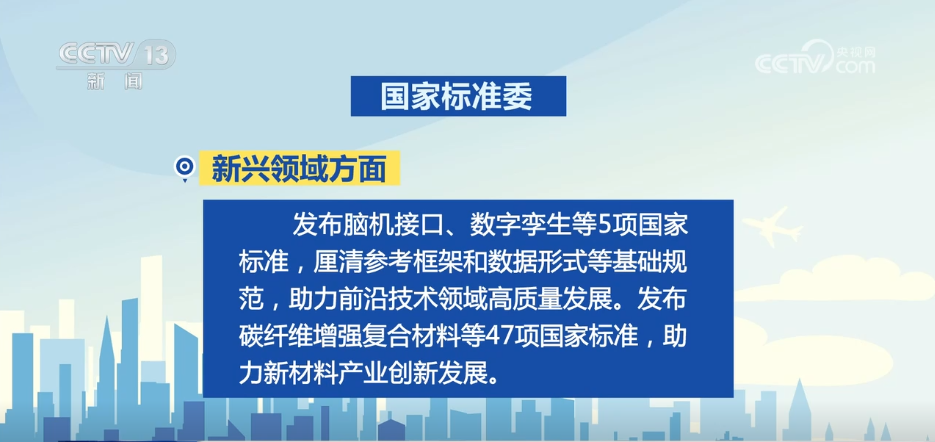
Emerging Fields - The National Standardization Administration has approved the release of 5 national standards related to brain-computer interfaces and digital twins, clarifying reference frameworks and data formats to support high-quality development in cutting-edge technology fields [3] - Additionally, 47 national standards for carbon fiber reinforced composite materials have been published to promote innovation in the new materials industry [3] Transportation and Logistics - Two national standards for intelligent connected vehicles have been released, focusing on performance testing for autonomous driving and automatic parking systems, which will enhance the performance and safety quality of intelligent connected vehicles [5] - Two mandatory national standards for the postal industry have been introduced, addressing safety production operations and equipment configuration for postal and express delivery companies, specifying safety operation norms and equipment requirements for various stages including collection, sorting, transportation, and delivery [5] Ecological and Environmental Protection - Two national standards related to greenhouse gas emission accounting and reporting requirements have been published, aiding companies in accurately calculating and reporting their greenhouse gas emissions, thus providing standard support for greenhouse gas emission management [7] Safety Production - Sixteen mandatory national standards in the fire safety sector have been released, updating technical requirements and inspection rules for related fire safety products, including outdoor fire hydrants and combustible gas detectors [9] Public Welfare - Four national standards for rehabilitation services for children with autism have been published, aimed at improving rehabilitation support for vulnerable groups such as people with disabilities, the elderly, and special children [11]
天津重磅发布:总投资1.82万亿元市级重点项目清单
Zhong Guo Fa Zhan Wang· 2026-02-10 05:48
Core Viewpoint - The Tianjin Municipal Development and Reform Commission has released a list of 1,112 key projects with a total investment of 1.82 trillion yuan to support high-quality development and achieve a good start for the 14th Five-Year Plan in 2026 [1] Group 1: Project Characteristics - The key projects for this year include 824 construction projects with a total investment of 1.4 trillion yuan and an annual planned investment of 202.19 billion yuan, along with 288 reserve projects totaling 422.47 billion yuan [2] - The projects exhibit five new characteristics, focusing on technology innovation, intelligent and green manufacturing, modern service industry enhancement, urban infrastructure improvement, and ensuring new guarantees for people's livelihoods [2][3][4] Group 2: Major Engineering Initiatives - Eight major engineering initiatives have been identified to drive quality and efficiency, including advanced manufacturing transformation, modern service industry expansion, and urban renewal [4][5] - The initiatives aim to deepen the integration of the Beijing-Tianjin-Hebei region and enhance infrastructure connectivity, with significant projects like the expansion of the airport and high-speed rail [4][5] Group 3: Innovation and Industry Development - Emphasis is placed on innovation as a core element for industrial transformation, with projects like the Tianjin University Synthetic Biology Research Institute and various national laboratories focusing on cutting-edge fields [5][6] - The manufacturing sector is prioritized for transformation and upgrading, with projects in new materials and intelligent manufacturing being accelerated to enhance competitiveness [7][8] Group 4: Modern Service Industry and Infrastructure - The modern service industry is being developed to support economic transformation, with financial services and logistics playing a crucial role in enhancing efficiency [8][9] - Infrastructure projects, including metro lines and urban drainage systems, are being expedited to improve urban resilience and service quality [9][10] Group 5: Social Welfare and Rural Development - Social welfare initiatives focus on education and healthcare improvements, with new schools and hospitals being constructed to enhance community services [13] - Rural revitalization efforts are being implemented to improve living conditions and promote sustainable agricultural practices [11][12] Group 6: Project Lifecycle and Support - The city is committed to providing comprehensive support throughout the project lifecycle, ensuring effective coordination among various stakeholders to facilitate project execution [14][15] - Key areas of focus include securing resources, expediting approvals, and aligning projects with national policy directions to maximize impact [14][15]
工信部征求意见,智能网联汽车数据安全国标将修订
Cai Jing Wang· 2026-02-10 03:34
2月9日,工业和信息化部公开征求《智能终端匿名标识符数据安全技术要求》强制性国家标准制修订计 划项目意见。其中明确,该标准文件适用于移动智能终端、智能网联汽车等终端设备匿名标识符及互联 网应用程序收集使用匿名标识符的设计、开发、测试和评估。 ...