
Nonferrous Metals

Search documents
有色ETF基金(159880)涨近1%,金银铂贵金属集体上涨
Xin Lang Cai Jing· 2025-12-22 02:01
Group 1 - Platinum prices reached a peak of $1987 per ounce on December 19, marking the highest level since late July 2008, with an annual increase of over 110% [1] - Silver prices surged above $67.49 per ounce, setting a new historical high [1] - The SHFE gold price hit 987 yuan per gram [1] Group 2 - The China Nonferrous Metals Industry Index (399395) rose by 0.96% as of December 22, 2025, with notable increases in stocks such as Yahua Group (002497) up 1.90%, and China Aluminum (601600) up 1.84% [1] - The Nonferrous Metals ETF (159880) increased by 0.77%, with the latest price at 1.84 yuan [1] - The top ten weighted stocks in the Nonferrous Metals Industry Index account for 52.34% of the index, including Zijin Mining (601899) and China Aluminum (601600) [2]




供需结构支撑强劲,机构看好行业景气,有色ETF基金(159880)盘中净申购700万份
Sou Hu Cai Jing· 2025-12-16 07:04
Core Viewpoint - The non-ferrous metals industry is expected to enter a new upward cycle, driven by macroeconomic recovery, supply chain disruptions, and liquidity easing from the Federal Reserve's interest rate cuts, which will enhance metal prices and industry performance [1]. Group 1: Market Performance - As of December 16, 2025, the non-ferrous metals industry index (399395) showed mixed performance among its constituent stocks, with Zhongtung High-tech (000657) leading the gains at 3.05%, followed by Yahua Group (002497) at 2.25%, and Xiamen Tungsten (600549) at 0.59% [1]. - The overall market is experiencing a pullback, but funds are strategically positioning in the non-ferrous sector [1]. Group 2: Future Outlook - According to China Galaxy Securities, the industry is expected to stabilize in 2024, with macroeconomic expectations improving in 2025, alongside supply chain disruptions due to resource control policies in other countries [1]. - The anticipated liquidity easing from the Federal Reserve's rate cuts is expected to drive up non-ferrous metal prices and enhance the profitability of non-ferrous metal companies, continuing the upward trend in the industry [1]. - The narrative around copper supply remains positive, and cobalt prices are expected to rise under policy adjustments in the Democratic Republic of Congo [1]. - The strategic value of rare earths is increasing, with a favorable supply-demand balance [1]. Group 3: ETF and Index Information - The non-ferrous ETF (159880) closely tracks the non-ferrous metals industry index, which includes 50 prominent securities in the sector, reflecting the overall performance of listed companies in the non-ferrous metals industry [2]. - As of November 28, 2025, the top ten weighted stocks in the non-ferrous metals industry index accounted for 52.34% of the index, including companies like Zijin Mining (601899) and China Aluminum (601600) [2].




中国材料 - 2026 年展望:传统材料对权益市场的影响-China Materials-2026 Outlook – Equity Implications Traditional Materials
2025-12-16 03:30
Summary of Key Points from the Conference Call Industry Overview - **Focus**: Traditional Materials in Asia Pacific for 2026 - **Preferred Commodities**: Gold, copper, and aluminum are favored due to supportive macro and micro factors [1][8] Core Insights Copper - **Demand Growth**: Strong demand growth expected from Energy Storage Systems (ESS), with suppliers reporting over 50% demand growth for 2026 [2] - **Supply Disruptions**: Anticipated widening of the global copper supply deficit due to three major supply disruptions [3] - **Investment Opportunities**: Companies like Zijin Mining and CMOC are highlighted for their expected 10-11% copper volume CAGR from 2025 to 2028 [3] Aluminum - **Supply Constraints**: Expected supply tightness due to potential shutdowns and delays in production restarts [4] - **Margin Expansion**: Anticipated sustainable margin expansion for aluminum smelters due to increasing demand and limited supply [4] - **Key Picks**: Chalco, Hongqiao, and China Shenhuo are identified as key investment opportunities in the aluminum sector [4] Gold - **Supportive Macro Environment**: Continued support for gold prices expected from US rate cuts and ongoing purchases by ETFs and central banks [5] - **Volume Growth**: Zijin Gold International is projected to achieve 30% volume growth in 2026, making it a key investment pick [5] Steel - **Production Cuts**: Limited production cuts expected in 2026, with demand anticipated to decline by over 2% [6] - **Export Quota Speculation**: Market expectations are rising regarding potential export quota systems in China [6] Coal - **Supply and Demand Dynamics**: Sufficient supply amid lukewarm demand is expected to pressure coal prices, with average prices projected at approximately Rmb720/t in 2026 [7] - **Renewable Energy Impact**: Anticipated continued market share gain for renewable power, leading to a slight drop in thermal coal demand [7] Additional Insights - **Market Ratings**: Various companies in the materials sector have been rated with Overweight (OW), Equal-weight (EW), and Underweight (UW) based on their expected performance and market conditions [9][12][13] - **Price Targets**: Adjustments to price targets for several companies have been made based on updated commodity price forecasts and market conditions [19][20] - **EPS Changes**: Significant changes in EPS estimates for various companies, reflecting adjustments in market expectations and commodity price forecasts [18][19] Conclusion - The outlook for traditional materials in Asia Pacific for 2026 is bullish, particularly for gold, copper, and aluminum, driven by strong demand and supply constraints. Investment opportunities are identified in specific companies within these sectors, while challenges remain in steel and coal markets.
ETF盘中资讯|中国为何会迎来“有色牛市”?有色企业顺势突围!有色龙头ETF(159876)近20日狂揽2亿元
Sou Hu Cai Jing· 2025-12-16 02:17
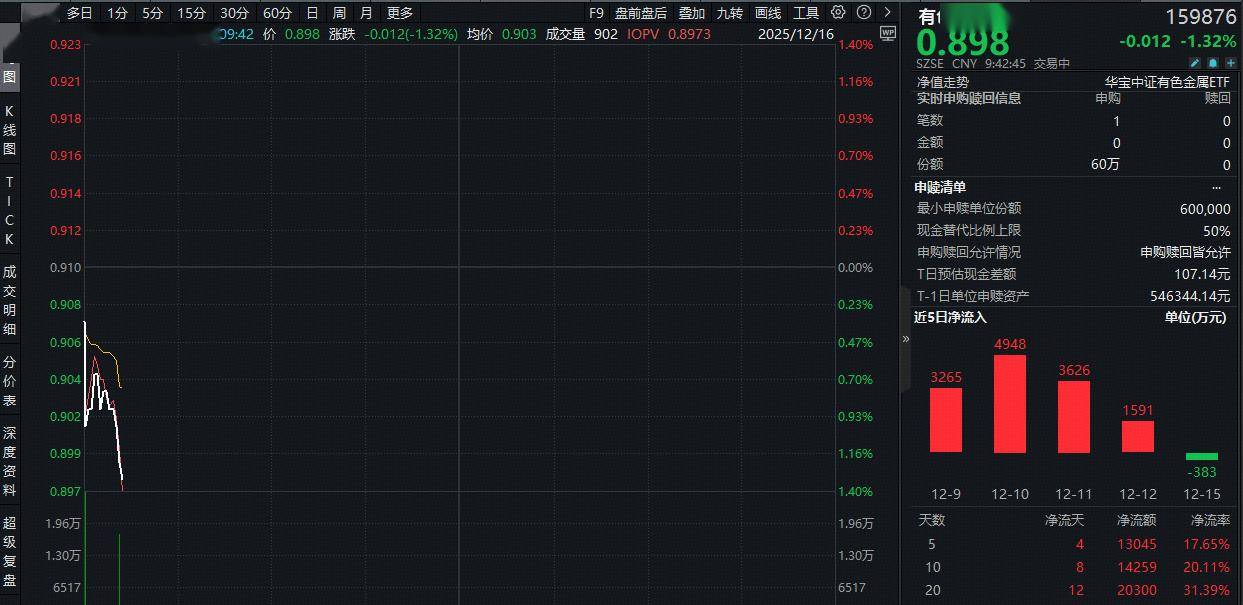
Core Viewpoint - The A-share market is experiencing a correction, with the major indices in the red, while the leading ETF in the non-ferrous metals sector has seen a decline of 1.32%. However, it has attracted a net inflow of 203 million yuan over the past 20 days, indicating positive sentiment towards the non-ferrous metals sector's future performance [1]. Group 1: Non-Ferrous Metals Sector Performance - The leading ETF in the non-ferrous metals sector (159876) has seen a price drop of 1.32% in the market, reflecting a broader market correction [1]. - Notable stocks within the ETF include Xiamen Tungsten, Luoyang Molybdenum, and Jiangxi Copper, which have shown gains, while companies like Western Superconducting and Chuangjiang New Material have experienced declines exceeding 4% [1]. Group 2: Investment Sentiment and Market Analysis - Analysts suggest that the positive investment sentiment in the non-ferrous metals sector is driven by China's ambition to transition from a manufacturing power to a manufacturing stronghold, with non-ferrous companies emerging as key players [2]. - China is the world's largest producer and consumer of gold, holding an 11% share of global gold production, with leading companies like Zijin Mining and Shandong Gold forming a competitive industry structure [2]. - In copper, Chinese companies have established a complete industrial chain, with a projected refined copper output of 13.64 million tons in 2024, accounting for 50% of global production [3]. - The aluminum sector benefits from low-cost electricity and a complete industrial chain, with China's electrolytic aluminum capacity reaching 44 million tons, representing 57% of global supply [3]. Group 3: Future Outlook - Institutions generally expect the non-ferrous metals sector to continue its bullish trend, with firms like Zhongtai Securities and CITIC Securities expressing optimism about the ongoing bull market in non-ferrous metals [3]. - The non-ferrous metals ETF (159876) and its associated funds provide comprehensive coverage across various metals, allowing for risk diversification and making it suitable for inclusion in investment portfolios [4].

A股早评:三大指数小幅低开,AI手机概念盘初活跃
Ge Long Hui· 2025-12-02 01:32
A股开盘,三大指数小幅低开,沪指低开0.14%报3908.46点,深证成指低开0.13%,创业板指低开 0.04%。盘面上,AI手机概念盘初活跃,黄金、有色金属板块低开。 ...
午评:深成指、创业板指均涨近1% 消费电子板块爆发
Feng Huang Wang· 2025-12-01 03:45
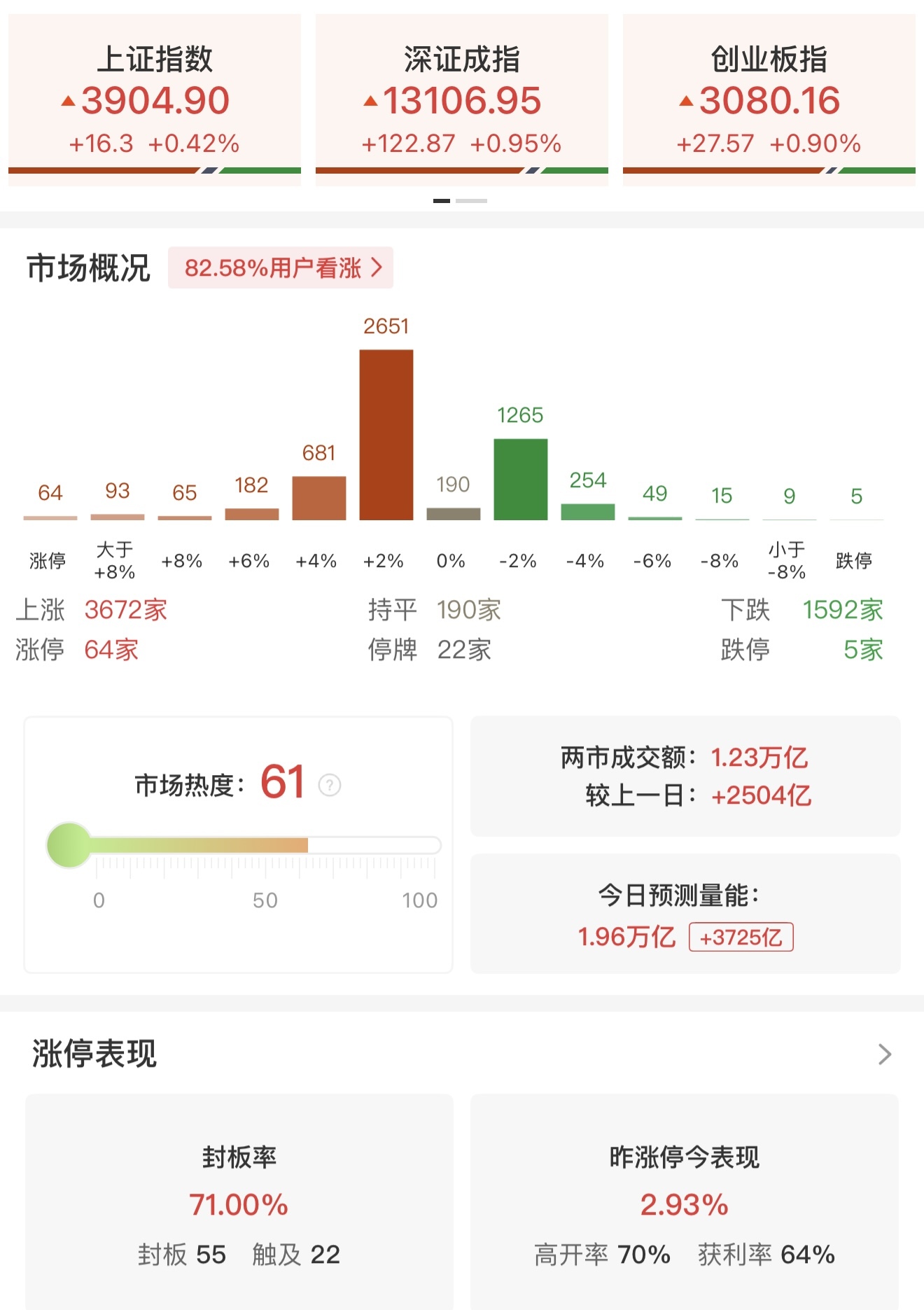
Market Overview - The market experienced a strong upward movement in early trading on December 1, with the Shenzhen Component Index and ChiNext Index both rising over 1%, while the Shanghai Composite Index returned above 3900 points [1] - The total trading volume in the Shanghai and Shenzhen markets reached 1.23 trillion yuan, an increase of 250.4 billion yuan compared to the previous trading day [1] - More than 3600 stocks in the market saw gains, indicating broad market participation [1] Sector Performance - The consumer electronics sector saw significant gains, with companies like ZTE Corporation, Tianyin Holdings, and Daoming Optics hitting the daily limit [1] - The non-ferrous metals sector was also active, with Silver Nonferrous and Minfa Aluminum reaching the daily limit [1] - The commercial aerospace concept continued its strong performance, with Aerospace Development achieving 8 limit-ups in 12 days [1] - Conversely, the wind power sector showed weakness, with Sany Renewable Energy dropping over 6% [1] Closing Summary - At the close of trading, the Shanghai Composite Index rose by 0.42%, the Shenzhen Component Index increased by 0.95%, and the ChiNext Index gained 0.9% [1]

华友钴业_花旗 2025 中国峰会新动态_2026 年硫酸锂项目投产助力锂成本下降
花旗· 2025-11-24 01:46
Investment Rating - The investment rating for Zhejiang Huayou Cobalt is "Buy" with a target price of Rmb51.40, implying a potential downside of 21.7% from the current price of Rmb65.610 [6][8]. Core Insights - The lithium output for Huayou Cobalt is projected to increase from 35kt in the first nine months of 2025 to 60-80kt in 2026 due to the ramp-up of the lithium sulfate project in Zimbabwe. The comprehensive production cost for lithium is currently less than Rmb70k/t LCE and is expected to decrease by Rmb10k/t LCE post ramp-up [2][4]. - Nickel intermediate output is not expected to see significant year-over-year growth in 2026, as both Huayue and Huafei projects have achieved over 100% capacity utilization. The Pomalaa project is anticipated to commence operations by the end of 2026 [3]. - Cobalt output primarily comes from MHP projects in Indonesia, with expectations of strong cobalt prices due to quota policies in the DRC, although increased output from Indonesian projects may exert long-term price pressure [4]. - NCM cathode sales volume reached approximately 70kt in the first nine months of 2025, representing an 80% year-over-year increase, with expectations to reach around 100kt in 2025 [5]. Summary by Sections Lithium - Lithium output is expected to rise significantly in 2026 due to the lithium sulfate project ramp-up, with production costs projected to decrease [2]. Nickel - Nickel output is stable with no significant increase expected in 2026, and the Pomalaa project is set to begin operations by year-end 2026 [3]. Cobalt - Cobalt prices are expected to remain strong due to policy impacts, but increased output from Indonesia may create long-term price pressures [4]. Cathode - NCM cathode sales are on a strong upward trajectory, with significant growth expected in 2025 [5].

葫芦岛锌业股份有限公司 关于第十一届董事会第十七次会议决议公告
Zhong Guo Zheng Quan Bao - Zhong Zheng Wang· 2025-11-22 02:01
Core Viewpoint - The board of directors of Huludao Zinc Industry Co., Ltd. convened a meeting to discuss and approve several key proposals related to futures hedging and related transactions for the years 2025 and 2026 [1][2][4][8]. Group 1: Futures Hedging Business - The board approved an increase in the futures hedging business quota for 2025 [2][3]. - The board also approved the proposal to conduct futures hedging business in 2026 [4][5]. - A feasibility analysis report for the futures hedging business was also approved [6][7]. Group 2: Related Transactions and Regulations - The board approved the expected ordinary related transactions for 2026, with related directors abstaining from the vote [8][9][10]. - The board approved the revision of the "Futures Hedging Business Management System" [10][11]. - The board approved the establishment of the "Information Disclosure Postponement and Exemption Management System" [12][13]. Group 3: Shareholder Meeting - The board approved the proposal to convene the second temporary shareholders' meeting of 2025 [14][15].

九江银行:廿五载扬帆追梦 乘风破浪立潮头
Zhong Guo Jin Rong Xin Xi Wang· 2025-11-19 07:53
Core Viewpoint - Jiujiang Bank has transformed its advantages in party building into development advantages, maintaining steady growth over 25 years while focusing on serving the real economy and creating diverse value for customers, employees, and society [1] Group 1: Service to the Real Economy - Jiujiang Bank aims to optimize financial service supply, focusing on the needs of Jiangxi and providing financial support to the real economy, thereby contributing to the construction of a modern industrial system [1] - The bank has innovated a "inventory pledge + supply chain finance" model to address the financing challenges faced by light-asset copper processing enterprises, successfully issuing a loan of 130 million yuan [2] - As of the end of October, the platform for industrial finance has achieved a cumulative transaction amount of 252.6 billion yuan, effectively addressing financing difficulties for small and medium-sized enterprises [2] Group 2: Technological and Green Finance - Jiujiang Bank has introduced a "technical flow" evaluation system and various financial products to support technology enterprises, with a technology loan balance of 44.706 billion yuan, an increase of 11.75% from the beginning of the year [3] - The bank established the first green finance department in the province, creating multiple green financial products to support energy-saving and carbon-reduction initiatives, with a green loan balance of 44.697 billion yuan, up 16.13% year-to-date [4] - The bank has successfully issued 4 billion yuan in green financial bonds and has been recognized for its contributions to green finance [4] Group 3: Commitment to Social Responsibility - Jiujiang Bank has launched "New Employment Group Service Stations" to provide essential services and financial education to new employment groups, reflecting its commitment to "finance for the people" [5][6] - The bank has developed an elderly-friendly banking service and launched a comprehensive financial service brand for elderly care, demonstrating its focus on meeting diverse customer needs [6] - The bank actively engages in charitable activities, having established a charity foundation and received recognition for its social contributions [6] Group 4: Future Development Strategy - Jiujiang Bank aims to continue its strategic positioning of "party leadership, distinctive operations, quality enhancement, technology-driven, talent empowerment, and strict governance" to achieve high-quality development in the future [7]
有色金属月度策略:Metal Futures Daily Strategy-20251106
Fang Zheng Zhong Qi Qi Huo· 2025-11-06 07:04
1. Report Industry Investment Rating The report does not provide an overall industry investment rating. However, it offers specific investment suggestions for each metal: - Copper: Recommended to gradually buy on dips, with a short - term pressure range of 89,000 - 90,000 yuan/ton and support range of 84,000 - 85,000 yuan/ton. Consider selling near - month slightly out - of - the - money put options [3]. - Zinc: Consider buying on dips and selling out - of - the - money put options. The upper pressure is around 22,800 - 23,000, and short - term support is around 22,300 - 22,400 [4]. - Aluminum Industry Chain: For aluminum, recommended to buy on dips; for alumina, short positions should be held cautiously; for recycled aluminum alloy, take a bullish approach [5]. - Tin: Suggested to wait and see, with an upper pressure range of 290,000 - 300,000 and a support range of 260,000 - 270,000. Consider buying out - of - the - money put options for protection [6][7]. - Lead: Consider a double - selling option strategy, with short - term support around 17,300 - 17,400 and upper pressure around 17,800 - 18,000 [8]. - Nickel and Stainless Steel: For nickel, wait and see the support at the lower range and consider selling out - of - the - money put options on dips; for stainless steel, it is in a weak shock, with support around 12,500 - 12,600 and upper pressure around 13,000 - 13,200 [9]. 2. Core Viewpoints - The overall upward trend of the non - ferrous sector remains unchanged, but the weak manufacturing data in China and the US and the uncertainty of interest rate cuts have affected the upward pace of non - ferrous metals. The recent rebound of the US dollar index has put pressure on risk assets [12]. - Different non - ferrous metals have different supply - demand situations. For example, copper has supply constraints and is expected to enter a demand peak season; zinc has a strong mine end and weak demand; aluminum has production capacity changes and a transition from peak to off - peak season; tin has supply shortages and limited demand recovery; lead has supply recovery and demand decline; nickel and stainless steel have weak supply - demand fundamentals [14][15][16][17][18]. 3. Summary by Directory 3.1 First Part: Non - ferrous Metals Operating Logic and Investment Suggestions - **Macro Logic**: The overall non - ferrous sector is still in an upward trend, but the focus has shifted from macro - narrative to real demand. The weak manufacturing data in China and the US and the uncertainty of interest rate cuts have affected the upward pace. The rebound of the US dollar index has put pressure on risk assets. The voices of the Fed officials after the October resolution are divided on interest rate cuts [12]. - **Investment Suggestions for Each Metal**: See the content in the "Report Industry Investment Rating" section above [3][4][5][6][7][8][9]. 3.2 Second Part: Non - ferrous Metals Market Review - Copper closed at 85,670 yuan/ton with a decline of 0.08%; zinc closed at 22,650 yuan/ton with a decline of 0.09%; aluminum closed at 21,395 yuan/ton with a decline of 0.33%; alumina closed at 2,772 yuan/ton with an increase of 0.07%; tin closed at 282,090 yuan/ton with a decline of 0.58%; lead closed at 17,475 yuan/ton with an increase of 0.34%; nickel closed at 120,030 yuan/ton with an increase of 0.28%; stainless steel closed at 12,535 yuan/ton with a decline of 0.08%; cast aluminum alloy closed at 20,830 yuan/ton with a decline of 0.62% [18]. 3.3 Third Part: Non - ferrous Metals Position Analysis - The report provides the latest position analysis of non - ferrous metals, including the net long - short strength comparison, net long - short position differences, net long - position changes, net short - position changes, and influencing factors of various varieties such as Shanghai lead, industrial silicon, alumina, etc. [21][22]. 3.4 Fourth Part: Non - ferrous Metals Spot Market - The report lists the spot prices and price changes of various non - ferrous metals, such as copper, zinc, aluminum, alumina, nickel, stainless steel, tin, lead, and cast aluminum alloy [23]. 3.5 Fifth Part: Non - ferrous Metals Industry Chain - The report presents various charts related to the industry chain of each non - ferrous metal, including inventory changes, processing fees, price trends, etc. For example, for copper, there are charts of exchange copper inventory changes and LME copper inventory; for zinc, there are charts of zinc inventory changes and zinc concentrate processing fee changes [25][27]. 3.6 Sixth Part: Non - ferrous Metals Arbitrage - The report shows various charts related to non - ferrous metals arbitrage, such as copper's Shanghai - London ratio changes, the spread between Shanghai copper and London copper, zinc's Shanghai - London ratio changes, etc. [54][56]. 3.7 Seventh Part: Non - ferrous Metals Options - The report provides various charts related to non - ferrous metals options, such as copper option historical volatility, weighted implied volatility, trading volume and open interest changes, etc. [72][73].