
在线教育

Search documents
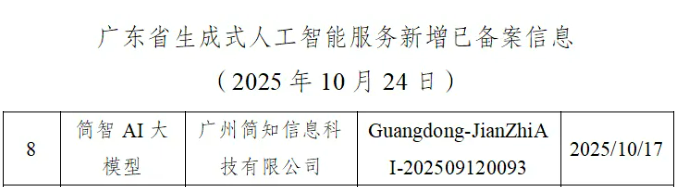
简知科技“简智AI大模型”通过国家备案,以生成式AI重构兴趣教育闭环
Huan Qiu Wang· 2025-11-15 00:22
Core Viewpoint - JianZhi Technology's "JianZhi AI Model" has received official approval for generative AI services, marking a significant step in building an intelligent education ecosystem for all age groups [1] Group 1: Company Overview - JianZhi Technology is recognized as a national high-tech enterprise and a "specialized, refined, and innovative" small and medium-sized enterprise in Guangdong [1] - The company has a focus on the "AI + interest learning" strategy, aiming to enhance educational experiences through technology [1] Group 2: Product Features - The "JianZhi AI Model" is designed around the user interest growth cycle, providing a comprehensive support system that includes interest discovery, systematic learning, capability advancement, and practical application [2] - The model offers personalized learning paths and quality course resources for beginners, AI feedback and specialized training for advanced users, and practical application recommendations based on user interests [2] Group 3: Target Audiences - The "JianZhi AI Model" is integrated into various platforms, such as "JianXiaoZhi" for youth, which enhances learning efficiency through intelligent analysis and real-time feedback [2] - For the elderly demographic, the "JianCheng" platform utilizes a companion teaching model that combines AI assistance with dedicated consultants, fostering a community based on shared interests [3] Group 4: Future Plans - JianZhi Technology aims to optimize its integrated capabilities of intelligent recommendation, learning paths, and real-time feedback, further merging AI with educational scenarios [6] - The company plans to collaborate with more industry partners to create a comprehensive cultivation ecosystem from interest stimulation to community advancement, promoting lifelong learning [6]

KeyBanc Maintains Overweight on Udemy, Lowers Target to $9
Yahoo Finance· 2025-11-13 18:38
Core Insights - Udemy, Inc. is recognized as a promising EdTech stock, with KeyBanc maintaining an Overweight rating while lowering the price target to $9 from $11 due to an accelerated shift towards subscription models [1][3]. Financial Performance - For Q3 2025, Udemy reported revenue of approximately $195.7 million, slightly exceeding expectations, with a strong emphasis on the transition to recurring subscription revenue [2][3]. - The company highlighted continued traction in its subscription businesses, which aligns with its strategic update earlier in the year [3]. Market Position and Strategy - Udemy operates a global learning marketplace and an enterprise offering, Udemy Business, providing curated course libraries and hands-on learning tools to organizations worldwide [4]. - The commentary surrounding the Q3 results focused on the implications of the subscription mix for both near-term growth and long-term sustainability [2][3].

在线英语大课包重现
Bei Jing Shang Bao· 2025-11-13 15:45
Core Viewpoint - The article discusses the issues surrounding the sale of large course packages by online education institutions, particularly LingoAce, which are seen as a means of binding consumers to long-term commitments and potentially violating regulatory guidelines on prepayment for educational services [1][10][11]. Group 1: Course Package Issues - Many parents report difficulties in finding smaller course packages, with institutions primarily promoting large packages that exceed 60 hours, contrary to regulations [1][3][10]. - LingoAce previously offered a smaller package of 36 hours but discontinued it due to low demand, indicating a trend towards larger packages [4]. - Other institutions also offer large packages, with some reaching up to 186 hours and costing over 30,000 yuan, reinforcing the trend of promoting long-term commitments [5]. Group 2: Consumer Rights and Regulatory Compliance - Parents express concerns that the lack of smaller packages limits their choices and may be driven by the institutions' desire to secure cash flow and customer retention [5][6]. - Legal experts highlight that institutions must comply with domestic regulations, which prohibit charging for more than 60 hours of instruction at once, regardless of whether they operate cross-border [10][11]. - The article notes that institutions may not adequately inform consumers about course expiration dates and mandatory consumption rules, potentially infringing on consumer rights [7][9]. Group 3: Regulatory Framework - The Ministry of Education has established clear guidelines regarding prepayment for educational services, emphasizing that institutions must not charge for more than 60 hours at a time [10][11]. - Institutions like LingoAce are criticized for using promotional courses to artificially inflate total hours, which could be seen as a violation of these regulations [11].

中国高科:公司医学在线教育业务进行了战略调整
Zheng Quan Ri Bao Wang· 2025-11-13 13:15
Group 1 - The core viewpoint of the article indicates that China High-Tech (600730) is experiencing a decline in market share and revenue in its medical online education business due to a trend of consumer downgrade in the overall market and the competitive marketing advantages of new media rivals [1] - The company's revenue in the medical online education sector has decreased compared to the same period last year [1] - Strategic adjustments in the medical online education business have led to a temporary significant increase in personnel placement costs, contributing to the overall decline in performance compared to the previous year [1]

被爆炒的线上英语一对一|万元大课包频现,有效期内学不完作废
Bei Jing Shang Bao· 2025-11-13 12:07
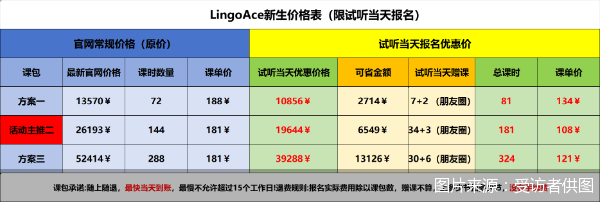
Core Viewpoint - The article highlights concerns regarding online education institutions, particularly LingoAce, which are accused of violating regulations by promoting large course packages that exceed the allowed 60 class hours, effectively binding consumers to long-term commitments [1][10][11]. Group 1: Course Package Issues - Many parents report difficulties in finding smaller course packages, with institutions primarily promoting large packages that often exceed 60 hours, contrary to regulations [2][4]. - LingoAce's smallest course package reportedly consists of 72 hours, which, when including bonus classes, totals 81 hours, indicating a trend towards larger packages [3][4]. - Institutions justify the promotion of large packages by claiming that long-term learning is necessary for effective education, which some parents view as a means to ensure cash flow and customer retention [5][6]. Group 2: Regulatory Compliance - The Ministry of Education has issued clear guidelines prohibiting the collection of fees for more than 60 class hours at once, which many institutions, including LingoAce, appear to violate [10][11]. - Legal experts assert that regardless of whether an institution operates cross-border, it must comply with domestic regulations when providing services within China [11]. - The practice of offering large packages with bonus classes is seen as a way to circumvent the regulations, leading to potential legal repercussions for the institutions involved [11]. Group 3: Consumer Rights and Transparency - There are allegations that sales personnel do not adequately inform parents about the terms of course packages, including expiration dates and mandatory consumption rules, which could infringe on consumer rights [6][7]. - The lack of transparency regarding course expiration and mandatory usage requirements has led to complaints from parents who feel pressured to complete courses within tight timelines [6][7]. - Legal interpretations suggest that failure to disclose such critical information may violate consumer rights under Chinese law, allowing for potential complaints to regulatory bodies [7]. Group 4: Institutional Responses - LingoAce has stated that it is working on local compliance measures to align its offerings with Chinese regulations, indicating an awareness of the regulatory landscape [5][11]. - The company claims that its course structure and pricing strategies are designed to provide a consistent learning experience across different regions, but this has raised questions about its adherence to local laws [5][11].
当一个9岁小孩有了AI老师
3 6 Ke· 2025-11-13 07:52
Group 1: Impact of AI on Education - AI is transforming the educational landscape, influencing parent-child relationships and communication methods in learning environments [2][5][18] - AI serves as a communication facilitator between parents and children, helping to resolve conflicts and enhance understanding [2][3][5] - The introduction of AI in education is seen as a way to provide personalized learning experiences and new perspectives for children [3][18] Group 2: Challenges and Limitations of Current Educational Tools - Existing educational tools, such as photo-based question search applications, have limitations in their ability to provide comprehensive support for students' learning needs [8][9] - These tools often rely on a fixed question database, which can lead to mismatches and inadequate explanations for students [8][9] - The need for tools that can analyze students' learning conditions and provide targeted guidance is becoming increasingly apparent [8][9][19] Group 3: Technological Advancements in Educational Tools - The development of AI-driven educational tools aims to improve the accuracy of homework grading and provide deeper insights into students' learning processes [9][10][19] - The transition from basic question-answering tools to more sophisticated AI systems capable of understanding and correcting students' answers is underway [9][10][19] - Continuous feedback from parents and users is essential for refining these educational tools and enhancing user experience [13][14] Group 4: Promoting Educational Equity - The rise of online education and AI technologies is helping to bridge the educational resource gap between urban and rural areas [16][18] - AI education tools are designed to democratize access to quality educational resources, making them available to students regardless of their geographical location [18][19] - The ultimate goal of AI in education is to create a more equitable learning environment where every child can receive personalized support and guidance [19]


俞敏洪宿命
首席商业评论· 2025-11-13 04:36
Core Viewpoint - The departure of Sun Dongxu from Dongfang Zhenxuan marks a significant shift in the company's leadership dynamics, reflecting ongoing challenges in management and succession planning within New Oriental [4][6][7]. Group 1: Departure of Sun Dongxu - Sun Dongxu's exit was officially announced by Yu Minhong, who expressed gratitude for Sun's contributions and hinted at a possible return in the future [6][8]. - Speculation about Sun's departure had been circulating since August 2023, following a management shake-up and his removal as CEO, although he remained as a senior advisor [8][9]. - The official statement from Dongfang Zhenxuan indicated that Sun left for personal reasons, despite Yu's attempts to retain him, highlighting a trend of key personnel departures from New Oriental [9][10][22]. Group 2: Leadership Challenges - Yu Minhong has a history of nurturing successors who eventually leave, creating a cycle of leadership instability within New Oriental [20][22]. - The management structure has seen multiple high-profile exits, including Chen Xiangdong and now Sun Dongxu, leading to questions about Yu's leadership style and decision-making [16][22]. - The recent departures have resulted in significant market repercussions, with Dongfang Zhenxuan's stock price dropping substantially following these leadership changes [19][22]. Group 3: Historical Context - The narrative of Sun Dongxu's rise within New Oriental parallels that of other key figures, such as Chen Xiangdong, who also left after being entrusted with significant responsibilities [10][21]. - The company's history is marked by a series of leadership changes that have often coincided with external pressures, such as regulatory challenges and market competition [16][20]. - Yu Minhong's management approach has been characterized by a reluctance to enforce strict measures, which may contribute to the ongoing issues with retaining key talent [23].


港股股票回购一览:1只个股获公司回购
Mei Ri Jing Ji Xin Wen· 2025-11-13 01:20
Core Viewpoint - As of November 12, 2023, a total of 245 Hong Kong stocks have conducted share buybacks this year, with 58 stocks having repurchased over 100 million HKD [1] Group 1: Company Buybacks - On November 12, only one Hong Kong stock, Fenbi, was repurchased for 620,000 HKD [1] - The largest cumulative buyback amounts this year were by Tencent Holdings (60.965 billion HKD), HSBC Holdings (30.257 billion HKD), and AIA Group (17.693 billion HKD) [1]



押注AI自主学习 洋葱学园拆解 AI教育 “破壁”逻辑
Zhong Guo Jing Ying Bao· 2025-11-12 17:05
Core Insights - The integration of AI in education is becoming a leading trend, with the AI education market expected to grow from $1.77 billion in 2023 to $17.28 billion by 2032, reflecting a compound annual growth rate (CAGR) of 37.2% from 2024 to 2032 [1] - Onion Academy's co-founder Yang Linfeng emphasizes a shift from "tool efficiency" to "capability shaping" in AI education, aiming to foster autonomous learning skills in students [1][2] Industry Trends - AI education is currently at a crossroads, with two distinct paths: "task completion" products focused on speed and efficiency, and "long-term capability cultivation" models, with Onion Academy firmly choosing the latter [2] - Yang Linfeng identifies four dimensions of autonomous learning: awareness, practical action, transferable skills, and the value of enjoyable learning, contrasting with existing products that primarily serve as "Q&A tools" [2] Product Development - Onion Academy's latest product, AI Smart Companion, consists of multiple intelligent agents, each serving different functions such as content analysis, real-time Q&A, cognitive guidance, learning planning, behavioral motivation, and emotional support, creating a comprehensive self-learning ecosystem [3] Technological Framework - The adoption of a multi-agent collaborative architecture is driven by advancements in AI models, which enhance task accuracy and quality through division of labor and cooperation [4] - Yang Linfeng argues that the depth of understanding in educational contexts is crucial, as vertical education companies can effectively translate AI capabilities into actionable teaching plans [5] AI's Evolving Role - The role of AI in education is transitioning from a "performer" to a "commander," capable of understanding user intent and planning complex tasks, thus enabling personalized learning strategies [6] - This evolution aligns with the industry trend of moving from "tool-based" to "partner-based" AI applications [6] Teacher's Role - Yang Linfeng asserts that teachers are irreplaceable, with AI serving as a collaborator rather than a replacement, integrating seamlessly into existing educational frameworks [7] - Onion Academy aims to address concerns about student dependency on AI by providing high-quality feedback at critical moments, rather than fostering constant engagement [7] Future Outlook - The vision for the future includes preparing individuals for uncertainties through a systematic autonomous learning framework, which is increasingly supported by favorable policies [8] - The Chinese government's recent policies advocate for the integration of AI in education, promoting a shift from knowledge transmission to capability enhancement, positioning Onion Academy as a potential leader in defining new industry paradigms [8]
不再急于商业化?教育智能体换道疾行
2 1 Shi Ji Jing Ji Bao Dao· 2025-11-12 10:57
Core Insights - The popularity of educational large models is declining, with chat-based apps losing their prominence in the market [1][2] - The industry is becoming more rational, recognizing the limited short-term commercialization potential and focusing on long-term development of higher-quality intelligent agents [2] Market Trends - In October, only three educational apps made it to the top 30 in monthly active users, each with fewer than 3 million users, indicating a significant drop in engagement for chat-based educational products [3] - The head of general large models has surpassed 100 million monthly active users, which has squeezed the survival space for vertical educational products [3] Product Development - Educational companies are shifting from developing standalone chat-based apps to integrating large models into traditional products, focusing on multi-agent collaboration [5][6] - Multi-agent systems enhance learning interaction diversity and depth, moving beyond the limitations of single-agent models [5] Commercialization Challenges - Despite ongoing technological upgrades, the commercialization of educational intelligent agents has not shown significant improvement, with some apps generating only tens of millions in revenue [8][9] - The focus is shifting towards the usage frequency and quality of educational intelligent agents rather than immediate revenue generation [10] Investment in R&D - Companies like Huatu Education have significantly increased R&D spending, with a 160.41% year-on-year rise to 145 million yuan, primarily to expand their research teams [11] - The investment in high-quality data and user engagement is seen as a necessary step to build future barriers in the educational intelligent agent market [12][13] Future Outlook - Huatu Education plans to develop a digital companion for exam training, aiming to create a comprehensive ecosystem of intelligent agents [14]