互联网科技

Search documents
港股黄金股走强
第一财经· 2025-12-12 01:43
| 名称 | 现价 | 涨跌幅 ▼ | | --- | --- | --- | | 京东健康 | 59.600 | 3.20% | | 蔚来-SW | 40.100 | 2.24% | | 网易-S | 213.600 | 1.91% | | 海尔智家 | 26.400 | 1.69% | | 零跑汽车 | 49.920 | 1.63% | | 快手-W | 67.800 | 1.57% | | 美的集团 | 89.500 | 1.47% | | 同程旅行 | 21.200 | 1.44% | | 携程集团-S | 549.000 | 1.39% | | 阿里巴巴-W | 152.700 | 1.39% | | 地平线机器人-W | 8.780 | 1.15% | | 小米集团-W | 42.660 | 1.14% | 黄金股走强,紫金矿业、 灵宝黄金 涨超3%, 中国白银集团涨近3% 。 锂电池板块高开,宁德时代涨近3%,赣锋锂业、天齐锂业涨超2%。 编辑 |心一 12月12日,恒生指数高开0.9%,恒生科技指数涨1.02%。 | 名称 | 现价 | 涨跌幅 | | --- | --- | --- | | ...


港股再现回购热潮 科技龙头引领估值修复
Zheng Quan Ri Bao· 2025-12-11 16:08
值得关注的是,港股此轮回购潮中,龙头科技公司的带头引领作用更强。自今年11月份以来,港股市场回购金额居前两位 的公司是腾讯控股和小米集团。另外,快手、金山软件等科技公司近期回购金额也较多。 陈雳表示,本轮港股回购呈现显著特点,一是主体高度集中,以腾讯、小米为代表的科技龙头主导,单日回购规模超6亿 港元;二是力度持续攀升,11月份回购股数达7亿股,12月上旬超3亿股,头部企业连续回购已成常态;三是资金性质明确,均 使用闲置自有资金且未占用经营资金,形成"龙头大规模持续回购、中小企业阶段性回购"的分化特征。 本报记者 孟珂 今年11月份以来,龙头科技公司回购活跃,引领港股市场掀起新一轮回购潮。 据Wind资讯统计,今年11月份,港股市场上市公司合计回购股份数量超过7亿股,而8月份至10月份,港股市场每月回购股 份数量分别为2.6亿股、5.3亿股和5.3亿股。 进入12月份,港股市场回购活跃的趋势得以延续,仅12月上旬短短几个交易日累计回购股份数量已超过3亿股。 川财证券总裁助理、首席经济学家、研究所所长陈雳对《证券日报》记者表示,港股新一轮回购潮的核心原因在于,当前 股价与企业内在价值错配,企业通过回购直接向市场 ...


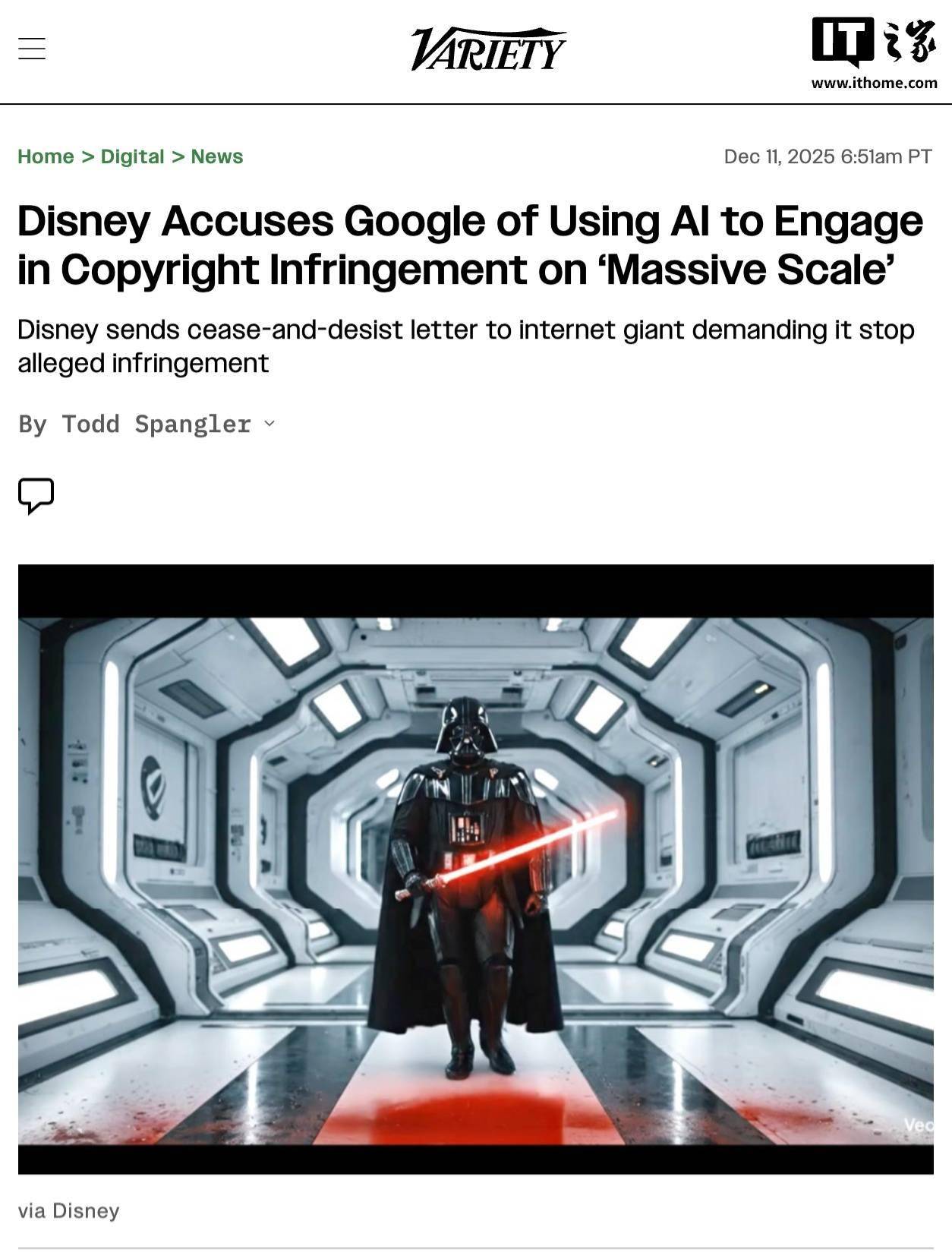
因AI生成大量未经许可的经典卡通形象,迪士尼指控谷歌侵犯版权
Sou Hu Cai Jing· 2025-12-11 15:40
Core Viewpoint - Disney has accused Google of large-scale copyright infringement by using AI models and related services to generate and distribute images and videos without authorization, prompting Disney to send a cease-and-desist letter to Google [1][4]. Group 1: Legal Actions - Disney's lawyers have sent a letter to Google's Chief Legal Officer, claiming that Google has copied a significant amount of Disney's works as training material for its AI systems [1]. - The letter includes examples of AI-generated content that allegedly infringes on Disney's copyrights, specifically mentioning characters from popular films such as "Frozen," "The Lion King," and "Star Wars" [4]. Group 2: Demands from Disney - Disney demands that Google immediately cease the copying, displaying, distributing, or creating derivative content based on Disney characters across all Google AI output products, including YouTube and YouTube Shorts [4]. - The company insists that Google implement technical restrictions in its AI services to prevent the future generation of infringing content [4]. Group 3: Context of the Accusation - This accusation against Google follows similar cease-and-desist letters Disney has sent to Meta and Character.AI, and aligns with Disney's joint lawsuit with NBCUniversal and Warner Bros. Discovery against Midjourney and Minimax for copyright infringement [4]. - Disney argues that Google's market position is being strengthened by distributing AI services that exploit the notoriety of Disney's copyrighted works, causing further harm to Disney [4].


纽约的科技和媒体公司,和我们有哪些不一样?
虎嗅APP· 2025-12-11 13:57
Core Insights - The article discusses the contrasting media and technology ecosystems in the United States and China, highlighting the supportive environment for content creators in the U.S. compared to the restrictive nature in China [8][9][10]. Group 1: Media Ecosystem - The U.S. has a content creator-friendly ecosystem, exemplified by platforms like Substack, which allows creators to retain 90% of their subscription revenue [8]. - In contrast, Chinese platforms often impose restrictive payment terms on creators, leading to a less favorable environment for content production [9]. - The New York Times' team operates with a focus on content creation without the pressure of revenue concerns, showcasing a different operational model compared to Chinese media [13][20]. Group 2: Creator Support and Engagement - U.S. media companies maintain strong relationships with creators, allowing for collaboration even when creators move to larger platforms [10]. - The N+1 publisher, despite having a small subscriber base, thrives on donations and focuses on nurturing new creators, demonstrating a commitment to quality over quantity [11]. - High renewal rates for subscriptions, such as 80% for some Substack creators, indicate a strong willingness among U.S. audiences to pay for quality content [10]. Group 3: Work Culture and Environment - Companies like Google provide exceptional employee benefits, contributing to a relaxed work culture, with employees typically working from 11 AM to 6 PM [18][19]. - Amazon, while more demanding, still offers a relatively comfortable work environment compared to Chinese standards [20]. - The overall atmosphere in U.S. companies appears more relaxed, which may foster innovation, contrasting with the more intense work culture in China [21]. Group 4: Podcasting Landscape - The podcasting industry in the U.S. has evolved into a mainstream medium, with a clear distinction between high-profile and niche shows, leading to a "middle collapse" phenomenon where mid-tier shows struggle for attention [22]. - U.S. podcasters can afford to take their time in developing content, focusing on quality rather than immediate commercial success, unlike the more frantic pace in China [24][25]. - The article emphasizes the importance of seizing early opportunities in emerging media, suggesting that the current podcasting landscape in China is still in its infancy [26][28].


谷歌应对人工智能军备竞赛的举措 —— 提拔数据中心技术幕后推手
Xin Lang Cai Jing· 2025-12-11 09:25
据塞马福(Semafor)率先报道、后经科技博客 TechCrunch 证实的一份备忘录显示,谷歌在人工智能基 础设施军备竞赛中迈出重大一步,将阿明・瓦赫达特提拔为人工智能基础设施首席技术专家。这是一个 新设立的职位,直接向首席执行官桑达尔・皮查伊汇报。此举标志着,随着谷歌计划到 2025 年底将资 本支出提高至 930 亿美元(其母公司字母表预计明年这一数字还会大幅增长),相关基础设施工作已变 得至关重要。 瓦赫达特并非行业新人。这位拥有加州大学伯克利分校博士学位的计算机科学家,早在 20 世纪 90 年代 初就曾在施乐帕克研究中心担任研究实习生,过去 15 年来一直在默默搭建谷歌的人工智能技术根基。 2010 年以工程研究员兼副总裁身份加入谷歌前,他曾任杜克大学副教授,后又担任加州大学圣迭戈分 校教授及科学应用国际公司讲席教授。他的学术履历十分亮眼 —— 发表的论文数量约达 395 篇,且其 研究方向始终聚焦于实现大规模计算机的高效运行。 瓦赫达特在谷歌内部本就拥有较高关注度。就在 8 个月前的谷歌云大会(Google Cloud Next)上,他还 以机器学习、系统及云人工智能领域副总裁兼总经理的身份登 ...
富瑞:中国强劲盈利动能驱动15%上行空间 看好高增长科技制造业
智通财经网· 2025-12-11 05:57
Group 1 - The core viewpoint of the report is that Asian stock markets have risen approximately 25% this year, driven by a revaluation of price-to-earnings ratios, with strong support from a resilient macro environment and robust corporate earnings momentum [1] - The report highlights that South Korea and China maintain strong momentum, while India's stock market continues to reach new highs. Japan remains attractive amid accelerated reforms, and the Australian market shows steady performance [1] - The report anticipates that by mid-2026, the reality of AI returns will be tested, with a peak in the US dollar exchange rate, which will help Asian and emerging markets outperform the broader market [1] Group 2 - In China, strong earnings momentum is expected to drive a 15% upside potential, with a consensus forecast of 16% earnings growth per share by 2026. The private sector and high-tech manufacturing are expected to lead this growth [2] - The report identifies key sectors for 2026, including alternative energy (lithium batteries, solar), automotive, beauty, healthcare, industrial automation, internet technology, and semiconductors, while maintaining a cautious stance on materials and durable consumer goods [2] Group 3 - The report recommends several thematic stocks for 2026, including Tencent, CATL, Sungrow Power Supply, Mindray, Yili, Geely, Galaxy Entertainment, Huahai Pharmaceutical, Yihua Healthcare, and InnoCare Pharma [3]




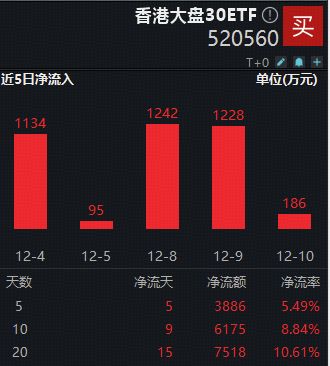
ETF盘中资讯 阿里频现利好!通义千问Qwen3-TTS迎来升级!自带哑铃策略的——香港大盘30ETF(520560)近5日吸金3886万元
Jin Rong Jie· 2025-12-11 05:57
Core Viewpoint - The Hong Kong stock market shows resilience with the Hong Kong Large Cap 30 ETF (520560) performing positively despite overall market declines, indicating investor confidence in future performance [1][3]. Group 1: Market Performance - The Hong Kong Large Cap 30 ETF (520560) has attracted a total of 38.86 million yuan in the last five days and 75.18 million yuan over the past 20 days, reflecting a positive outlook for the Hong Kong stock market [1]. - Major stocks such as Yum China, Meituan, China Merchants Bank, Ping An Insurance, Xiaomi Group, Pop Mart, and BeiGene have shown gains [1]. Group 2: Macroeconomic Factors - The Federal Reserve's decision to cut interest rates by 25 basis points is expected to weaken the US dollar, which may lead to a decrease in Hong Kong dollar interest rates and encourage foreign capital inflow, improving liquidity in the Hong Kong stock market [3]. - The upgrade of the Qwen3-TTS voice synthesis model by Tongyi Qianwen and its use by Meta to optimize AI models highlights the strength of Alibaba's open-source model capabilities [3]. Group 3: Dividend Trends - Six major state-owned banks have announced their mid-term dividend distribution dates for 2025, with a total proposed distribution of 204.657 billion yuan, indicating a trend of increasing quantity, faster pace, and stable strength in bank dividends [3][4]. - The number of banks planning mid-term dividends has increased, with many maintaining stable dividend rates and some enhancing their payout ratios, reflecting the robust dividend value of the banking sector [4]. Group 4: Investment Strategies - The recommendation for a "barbell strategy" suggests a combination of stable value assets and growth-oriented assets in the Hong Kong stock market, indicating a balanced approach to investment [4]. - The Hong Kong Large Cap 30 ETF (520560) is highlighted as an ideal long-term investment tool, combining high-growth tech stocks with stable, high-dividend stocks [5].
港股早评:三大指数高开,科技股普涨,有色金属股继续强势
Ge Long Hui· 2025-12-11 01:28
Core Viewpoint - The Federal Reserve announced a 25 basis point interest rate cut and indicated a pause on further rate cuts in the near future, leading to a collective rise in U.S. stock markets [1] Group 1: Market Reactions - U.S. stock markets experienced a collective increase following the Fed's announcement [1] - Hong Kong's three major indices opened higher, with the Hang Seng Index rising by 0.66%, the National Index by 0.58%, and the Hang Seng Tech Index by 0.55% [1] Group 2: Sector Performance - Major technology stocks in Hong Kong saw a general increase, with Alibaba, NetEase, Kuaishou, and Tencent each rising by 1% [1] - Precious metals continued to perform strongly, with silver prices reaching new highs, while gold and copper stocks also remained robust [1] - Broader sectors such as Apple-related stocks, airline stocks, and insurance stocks experienced widespread gains [1] Group 3: Underperforming Stocks - Gaming and telecommunications stocks faced declines, with ZTE Corporation dropping nearly 3% [1]
港股收评:恒指涨0.42%,内房股、黄金股走强
Ge Long Hui· 2025-12-10 08:43
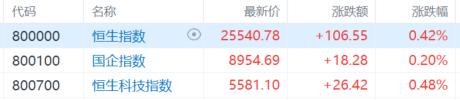
Market Overview - The Hong Kong stock market saw a rebound in the afternoon, with the Hang Seng Index and the Hang Seng China Enterprises Index rising by 0.42% and 0.2% respectively, ending a two-day decline [1] - The Hang Seng Tech Index increased by 0.48%, indicating a recovery in market sentiment [1] Stock Performance - Major technology stocks mostly rose, with Horizon Robotics up over 3% and Meituan up over 2% [4] - Vanke Enterprises led the surge in property stocks, rising over 13%, while other property stocks like Sunac China and China Jinmao also saw significant gains [7][8] - Gold stocks performed strongly, with Lingbao Gold up over 9% and several others rising more than 7% [6] - Pork stocks were among the top gainers, with WH Group up over 10% and Huisheng International up over 9% [9] Sector Analysis - The afternoon saw a broad rally in heavyweight technology stocks, contributing to the market's rebound [2] - Consumer electronics stocks declined, with major player Semtech down over 7% [2] - Shipping stocks experienced significant declines, with Pacific Basin Shipping down over 6% [13] - Oil stocks continued to fall, with PetroChina and Sinopec both dropping over 1% [16] New Listings - Two new stocks were listed today, with Baoji Pharmaceutical-B surging 138.82% on its debut and Tudatong rising 33% [2] Future Outlook - According to research from交银国际, the global economy is expected to show resilience in 2025, with ongoing AI technology cycles and supportive monetary policies [22] - The report suggests that the Hong Kong stock market will continue to see earnings growth, with a reasonable valuation and improving liquidity conditions [22]





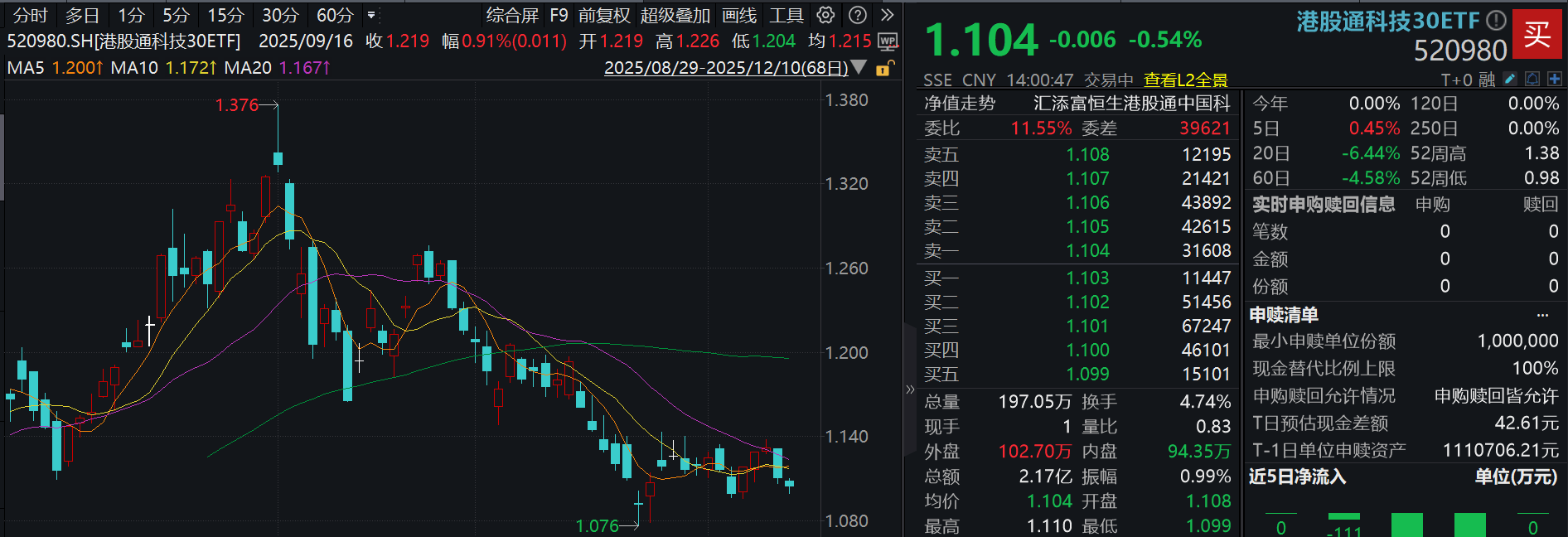
美联储今晚议息,阿里巴巴成立千问C端事业群!港股通科技30ETF(520980)回调,恒生科技ETF基金(513260)连续29日获资金净申购!
Sou Hu Cai Jing· 2025-12-10 07:04
数据显示,为响应投资者投资需求,自12月9日起,恒生科技ETF基金(513260)单日净申购上限已上调至3000万份! 今日(12.10),港股科技再度调整,100%纯度的港股通科技30ETF(520980)跌0.54%,盘中成交额突破2.2亿元!截至12月9日,最新规模超46亿元! 同类唯一15BP最低档管理费的恒生科技ETF基金(513260)连续第二日回调,盘中成交额已逼近3亿元。资金面上,恒生科技ETF基金(513260)近20日累 计"吸金"超3亿元,已连续29个交易日"吸金"超4.3亿元,最新规模达70.61亿元,基金最新融资余额超1.6亿元! 消息面上,北京时间周四凌晨03:00,美联储在结束两天的政策会议后将宣布最新的利率决定,并发布货币政策声明。半小时后,美联储主席鲍威尔将召开 货币政策新闻发布会。 事实上,交易员们当前已不再关注降息决定本身,因为他们认为本周降息已经是板上钉钉之事,尽管联邦公开市场委员会(FOMC)内部对于是否降息仍然 存在严重分歧。相反,他们将密切关注美联储主席鲍威尔在利率决议公布后的官方声明,以及他在新闻发布会上答问环节的措辞与语气变化,因为这关系到 美联储明年的货币政 ...