在线旅游

Search documents
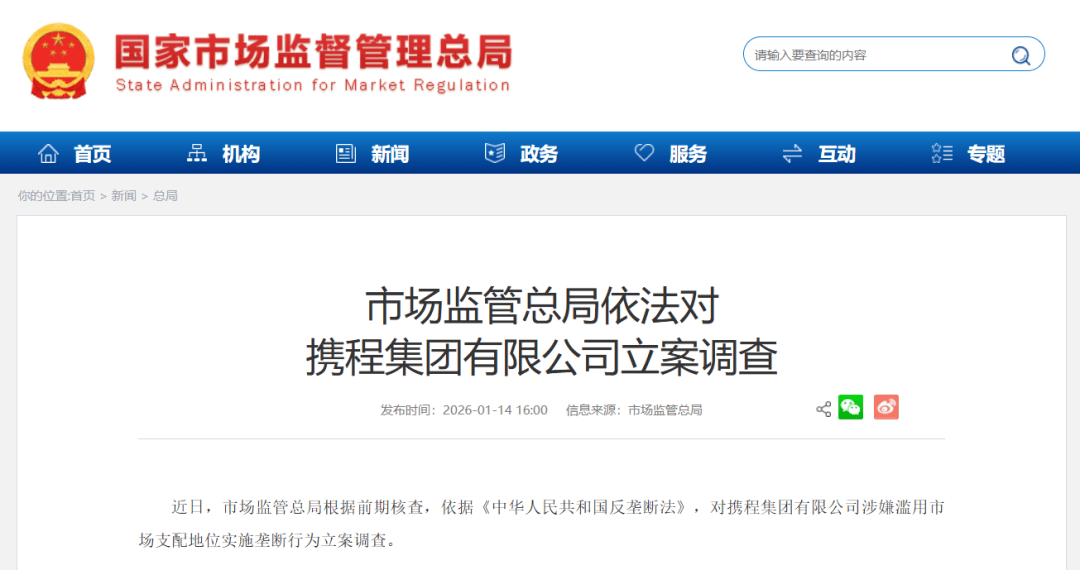
携程,被立案调查!
Sou Hu Cai Jing· 2026-01-19 10:14
Core Viewpoint - The State Administration for Market Regulation has initiated an investigation into Ctrip Group for suspected monopolistic behavior due to abuse of market dominance [3][14]. Group 1: Investigation Details - The investigation is based on prior checks and is conducted under the Anti-Monopoly Law of the People's Republic of China [3]. - Ctrip has been previously warned multiple times for practices such as unauthorized price changes and setting unreasonable trading conditions [10]. - In August 2025, the Guizhou Provincial Market Supervision Administration held a meeting with Ctrip and other travel platform companies to address price irregularities and potential issues like "choose one from two" practices [11]. - In September 2025, the Zhengzhou Market Supervision Administration conducted an administrative interview with Ctrip for unreasonable restrictions on transaction prices and practices [12]. - In December 2025, the Yunnan Provincial Tourism Homestay Industry Association initiated anti-monopoly protection efforts against online travel agencies, citing Ctrip's unfair trading conditions [13]. Group 2: Company Response - Ctrip has acknowledged the investigation and stated it will cooperate with regulatory authorities while ensuring normal business operations [15]. - The company emphasizes its commitment to providing quality services to users and partners [15].


春运首日车票多趟车次售罄
Cai Jing Wang· 2026-01-19 09:09
Group 1 - The core point of the article highlights the high demand for train and flight tickets during the Spring Festival travel season, with many train routes from Beijing to cities like Changchun and Shenyang already sold out for the first day of travel [1] - The data from Tongcheng Travel indicates that the average price of domestic flight tickets is expected to rise significantly after February 2, reaching a peak around February 14 [1]
顺丰与极兔近83亿港元战略互持|财富周历 动态前瞻
Sou Hu Cai Jing· 2026-01-19 00:16
A股 Market Updates - On January 15, multiple A-share companies released their performance forecasts for 2025, with many expecting significant profit increases. SAIC Motor Corporation anticipates a net profit growth of up to 558%, while companies like Shengnuo Biological and Zhenghai Magnetic Materials expect increases exceeding 200% [2] - Jiamei Packaging announced that its stock has triggered redemption clauses due to its closing price being above 130% of the conversion price for 15 out of the last 30 trading days [2] - ST Chengchang and Zhizhi New Materials announced their resumption of trading after completing investigations into recent abnormal stock price fluctuations [2] - ST Aowei reported that its stock closed at 0.99 CNY per share, warning that if it remains below 1 CNY for 20 consecutive trading days, it may face delisting from the Shenzhen Stock Exchange [2] Logistics and E-commerce - SF Holding and Jitu Express announced a strategic mutual shareholding agreement, involving an investment transaction amounting to nearly 8.3 billion HKD [3] - Ctrip is under investigation by the State Administration for Market Regulation, leading to a significant drop in its stock price, with a 6.49% decline on the day of the announcement and a further 20% drop the following day, resulting in a market value loss exceeding 100 billion CNY [3] Financial Data - In 2025, the total number of new A-share accounts reached 27.44 million, a 10% increase year-on-year, marking a three-year high, with total A-share investors exceeding 250 million [4] - The People's Bank of China reported that by the end of 2025, the social financing scale reached 442.12 trillion CNY, growing by 8.3% year-on-year, while the RMB loan balance was 271.91 trillion CNY, up 6.4% [5] - The China Securities Regulatory Commission approved an adjustment to the margin ratio for financing, increasing the minimum margin requirement from 80% to 100%, effective January 19, 2026 [5] Gold Reserves - As of the end of November 2025, non-U.S. countries' official gold reserves exceeded 900 million troy ounces, valued at approximately 3.82 trillion USD [6] Infrastructure and Technology - The State Grid Corporation announced that its fixed asset investment is expected to reach 4 trillion CNY during the 14th Five-Year Plan, a 40% increase from the previous plan [7] - Alibaba's Qianwen App has integrated with various Alibaba ecosystem services, launching over 400 AI functionalities to enhance user experience in daily tasks [7] - Shanghai's new action plan aims to implement L4 autonomous driving technology in various scenarios by 2027, targeting over 6 million passenger trips and 800,000 TEU in freight transport [7] Housing Policy - A joint announcement from the Ministry of Finance, State Taxation Administration, and Ministry of Housing and Urban-Rural Development extended personal income tax policies supporting housing purchases from January 1, 2026, to December 31, 2027 [8] Trade Performance - China's total foreign trade in 2025 reached 45.47 trillion CNY, a 3.8% increase, setting a historical record and maintaining its position as the world's largest goods trading nation [8]



学生寒假引爆“春节档”预订 第一批“抢跑”学生已出发
Yang Shi Wang· 2026-01-18 22:58
Core Insights - The tourism market is experiencing a surge as the winter vacation and the 2026 Spring Festival holiday approach, with students starting to travel early for the holiday season [1][4] Group 1: Travel Trends - The beginning of the winter vacation typically marks the start of the Spring Festival booking peak, with significant increases in travel bookings observed [4][5] - Data from Qunar indicates a notable increase in flight bookings for the period from January 12 to January 19, with a nearly 30% week-on-week growth in bookings from travelers aged 18-22, accounting for over 20% of total bookings [4] - The number of travelers flying during the winter vacation is expected to increase by 20% compared to the previous weekend, with the fastest growth seen in the 0-17 age group, which has doubled week-on-week [4] Group 2: Accommodation and Family Travel - Hotel bookings for popular cities during the Spring Festival have increased by 70% year-on-year, with family travel making up over 30% of bookings [5][7] - The demand for family-oriented accommodations is rising, with over 44% of bookings for vacation rentals made by the 30-45 age group, and more than 80% of these bookings include children [5] - The average booking duration for vacation rentals has increased by 35% year-on-year, with popular destinations for long stays including Sanya, Xishuangbanna, and Dali [6] Group 3: Cultural and Experience-Based Travel - There is a growing interest in culturally rich destinations, with hotel bookings in cities known for intangible cultural heritage experiences, such as Huangshan and Jingdezhen, seeing significant year-on-year growth [9] - The trend of "off-season travel" is gaining traction, with southern cities like Shantou and Sanya leading in booking increases, indicating a preference for warmer climates during the winter [8] Group 4: International Travel - The outbound travel market is highlighted as a significant trend, with Southeast Asia remaining a top choice for travelers during the Spring Festival, showing a 45% year-on-year increase in long-haul bookings [10] - The number of inbound tourists during the Spring Festival has doubled compared to last year, with a notable increase in bookings from countries like Malaysia and South Korea [15]

崔传刚:反垄断监管让市场回归公平竞争本源
Sou Hu Cai Jing· 2026-01-18 22:52
Core Viewpoint - The recent actions by China's market regulatory authorities in various sectors indicate a robust and precise approach to antitrust regulation, aimed at fostering a unified and competitive market system while addressing specific industry challenges [1][2][3] Group 1: Regulatory Actions - The regulatory body has initiated discussions with the photovoltaic industry association and leading companies to halt price coordination and market segmentation under the guise of "self-discipline" [1] - A competition assessment was launched for the food delivery platform industry to address "involution" subsidy issues [1] - An official investigation was opened against Ctrip for alleged abuse of market dominance, showcasing a commitment to stringent enforcement against monopolistic practices [1][2] Group 2: Antitrust Policy Significance - The essence of antitrust regulation is to ensure the healthy operation of the market economy and to support high-quality development, as fair competition is crucial for optimal resource allocation [2][3] - Over-reliance on market self-regulation can lead to risks, necessitating a differentiated and precise approach to antitrust policies to balance regulation and development [2] Group 3: Benefits of Strengthening Antitrust Regulation - Strengthening antitrust oversight creates a virtuous cycle benefiting consumers, empowering businesses, and enhancing national interests, leading to a solid foundation for high-quality development [3] - For consumers, it means more transparent pricing, diverse choices, and a fair competitive environment, while for small and medium enterprises, it removes barriers to growth and fosters innovation [3] Group 4: Misconceptions about Antitrust - Antitrust measures are not aimed at suppressing large enterprises or denying market competition but are intended to correct market distortions and eliminate unfair competitive barriers [4] - Compliance with antitrust regulations is essential for sustainable business development, as evidenced by various cases in different sectors, reinforcing that fair competition stimulates innovation and efficiency [4]
内部炸锅!追觅员工怒怼CEO“药嗑多了”
Sou Hu Cai Jing· 2026-01-18 12:55
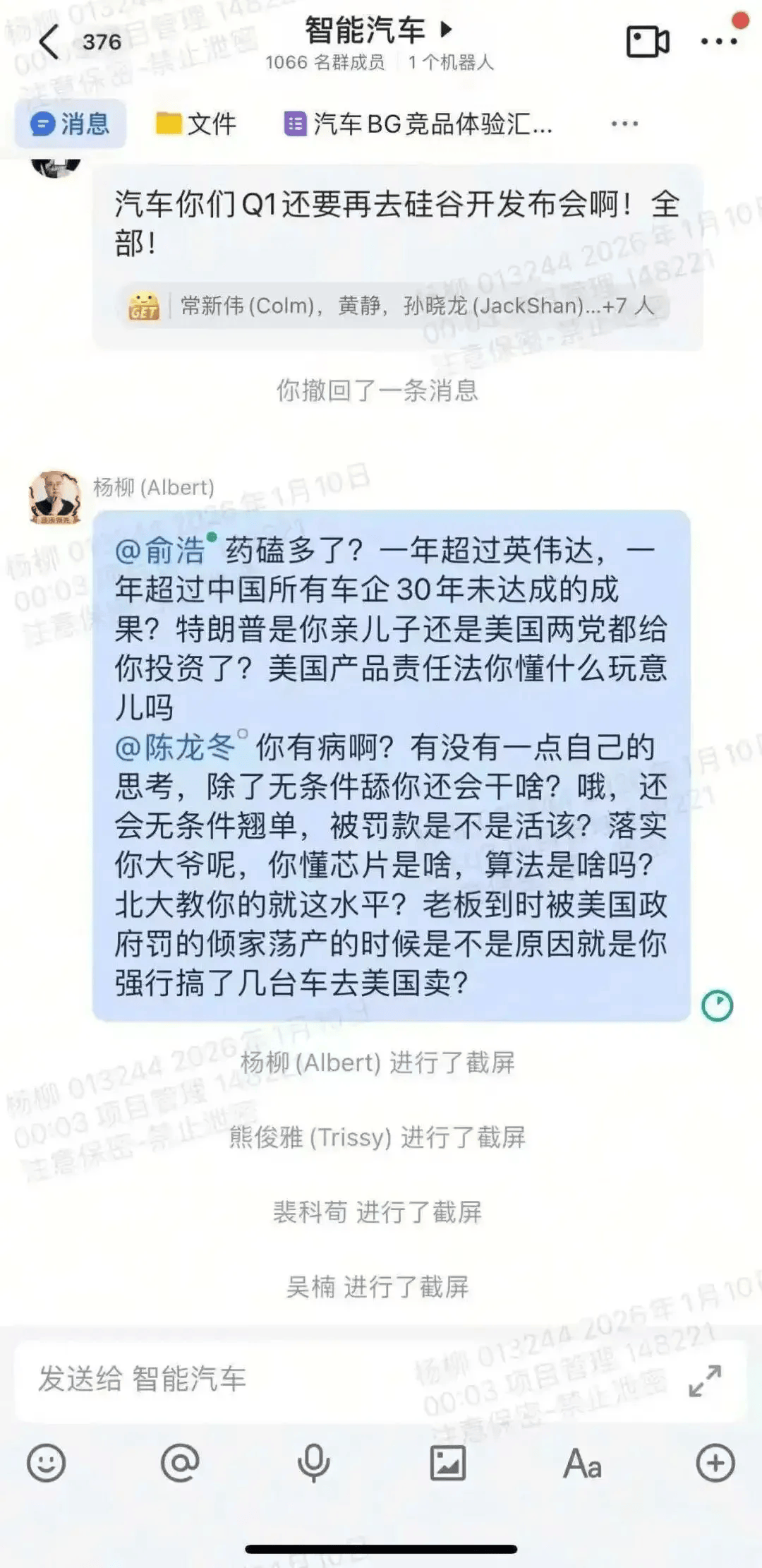
Core Viewpoint - Recent internal disputes at Chasing Technology have raised concerns about the feasibility of its ambitious goals, particularly in the automotive sector, as an employee publicly questioned the company's claims and strategies [1][4][10]. Group 1: Employee Concerns - An employee criticized CEO Yu Hao's claims of surpassing Nvidia and achieving results unattainable by Chinese car manufacturers in 30 years, warning of potential legal repercussions in the U.S. market [1]. - The employee also targeted Chen Longdong, the legal representative of Xingchen Future (the actual operating entity of Chasing Automotive), questioning his professional competence and independent thinking [1]. - The employee's comments were made in a group chat on January 10, and the screenshot was shared after Yu Hao's "trillion-dollar ecosystem" statement gained media attention [6]. Group 2: Company Response - Yu Hao responded to the controversy by joking about his WeChat being taken over by the PR department and announced plans to enter the online travel market, seemingly dismissing the employee's concerns about the automotive strategy [7]. - He clarified that his goal of creating the world's first trillion-dollar company is a long-term vision, not something to be achieved within a year [10]. - Yu Hao emphasized that whether or not the goal is fully realized, it would still benefit everyone by providing a valuable observation sample in the current market environment [11]. Group 3: Company Background and Expansion - Chasing Technology, founded in 2017, initially focused on smart home appliances and has rapidly expanded into various sectors, including automotive, since late 2025 [15]. - The company reported a global sales volume of 3.96 million units for its vacuum cleaners in 2024, marking a nearly 60% year-on-year increase, with overseas revenue accounting for 65% of total sales [15].
员工公开群“怒怼”追觅CEO?俞浩发声:专项整改!携程回应被立案调查;“死了么”APP征新名:谐音梗玩脱了?| Q资讯
Sou Hu Cai Jing· 2026-01-18 07:16
Group 1: Company Developments - The CEO of Chasing Technology, Yu Hao, aims to create the world's first company valued at one trillion dollars, expressing that this goal is not expected to be achieved within a year [1][2] - Ctrip announced it is under investigation by the State Administration for Market Regulation for suspected monopolistic behavior, stating that it will cooperate fully with the investigation while maintaining normal business operations [5] - Elon Musk is suing OpenAI and Microsoft for damages ranging from $79 billion to $134 billion, claiming that OpenAI has deviated from its non-profit mission and engaged in fraudulent activities [7] Group 2: Industry Trends - Google has filed an appeal against a court ruling that found it guilty of illegal monopoly in the search and search advertising sectors, which could delay regulatory measures requiring changes to its business model [9] - The "Dead or Alive" app is seeking a new Chinese name, inviting users to contribute ideas and offering a cash reward for the best suggestion [8][9] - OpenAI plans to test targeted advertising within the ChatGPT application, marking a significant shift in its revenue strategy ahead of a potential IPO [11] Group 3: Technological Innovations - The upcoming Spring Festival Gala will feature advanced AI technologies, including real-time scene adaptation and immersive experiences, showcasing the country's technological progress [10] - ByteDance is developing a new generation of AI headphones, which will be manufactured by GoerTek, indicating a strategic shift in its hardware approach [12] - Qianwen App has integrated with Alibaba's ecosystem, allowing users to perform various tasks through AI, highlighting the competitive landscape for AI service platforms [13]



携程闹乌龙,误发通知全员都被离职了。
猿大侠· 2026-01-18 04:11
Group 1 - The core incident involves a miscommunication at Ctrip, where employees received unexpected layoff notifications due to a system error during a software shutdown [2] - Ctrip clarified that the incident was a mistake related to a system test and there was no actual layoff plan, apologizing to affected employees [2] - The incident sparked various reactions on social media, with some users mocking the situation and others suggesting it was a clever marketing move by Ctrip [2]

大数据“杀熟”再引争议,“看人下菜碟”式价格歧视该休矣!
凤凰网财经· 2026-01-17 13:00
Core Viewpoint - The online travel industry leader, Ctrip, is facing multiple crises, including a wrongful termination notice, an antitrust investigation, and allegations of price discrimination through data manipulation, reflecting a broader consumer discontent with internet platforms [4][5]. Group 1: Pricing Discrimination Issues - Consumers have reported experiences of price discrimination, such as significant price differences between accounts or devices, abnormal price increases after repeated searches, and higher prices for long-term users compared to new users [4]. - The algorithmic pricing strategy employed by platforms like Ctrip is a form of price discrimination based on user characteristics, utilizing big data to analyze consumer habits and willingness to pay [4][5]. - Traditional economic theories suggest that reasonable price discrimination can expand market size and efficiency, benefiting both producers and consumers, as seen in practices like discounted afternoon tea in Hong Kong [4]. Group 2: Algorithmic Pricing and Market Dynamics - In the context of platform economies, algorithmic pricing has deviated from optimizing resource allocation and has become a tool for platforms to exploit information asymmetry, leading to consumer trust erosion [5][6]. - Consumers often lack a clear understanding of how pricing mechanisms work, while platforms leverage their data advantages to implement dynamic pricing that consumers may not notice, undermining fairness in the digital market [5]. - Examples of pricing anomalies include varying delivery fees based on smartphone brand and model, and ride-hailing prices that increase based on the user's phone battery level, indicating a shift from efficiency tools to profit extraction mechanisms [6]. Group 3: Regulatory Response and Industry Implications - The Chinese government has initiated regulatory measures, including the issuance of guidelines to standardize pricing behaviors on internet platforms, aiming to protect consumer and operator rights [6]. - Ctrip's recent investigation is not an isolated incident but signals a critical industry-wide issue regarding algorithmic pricing practices, emphasizing the need for transparency and fairness in pricing strategies [6]. - The long-term value of a business is rooted in consumer trust, and sacrificing this trust for short-term gains can undermine the foundation of the digital economy [6].

携程被立案调查背后,谁在博弈
Di Yi Cai Jing Zi Xun· 2026-01-17 10:37
Core Viewpoint - The online travel agency (OTA) industry is facing significant scrutiny as Ctrip Group is under investigation for alleged monopolistic practices, which may impact its operations and market dynamics [2] Group 1: Regulatory Actions - The State Administration for Market Regulation has initiated an investigation into Ctrip Group for suspected abuse of market dominance under the Anti-Monopoly Law of the People's Republic of China [2] - Ctrip has stated that its business operations are normal and that it will cooperate with regulatory authorities to ensure compliance [2] - Ctrip has faced multiple regulatory discussions since 2025, including issues related to "choose one from two" practices and price manipulation [2] Group 2: Financial Performance - In Q3 2025, Ctrip reported a net operating revenue of 18.3 billion RMB, a year-on-year increase of 16% and a quarter-on-quarter increase of 24% [3] - For the first three quarters of 2025, Ctrip's total revenue reached 47.011 billion RMB, with a net profit attributable to shareholders of 29.013 billion RMB [3] - The accommodation booking segment contributed over 40% of Ctrip's revenue [3] Group 3: Market Dynamics - The hotel industry in China has approximately 570,000 facilities and 19.27 million rooms, with a chain rate of 26.75% for hotels and 40.09% for rooms, indicating significant room for growth compared to developed countries [3] - The low chain rate suggests many hotels lack strong direct sales capabilities, relying heavily on large OTAs for room distribution, which strengthens the market position of major OTAs [3] Group 4: Pricing and Competition Issues - Some OTAs exert pressure on hotels regarding pricing, promotion, and platform rankings, leading to conflicts where hotels may have to subsidize lower prices while OTAs profit [4][5] - Smaller accommodation providers, such as guesthouses, face challenges without reliance on large OTAs, exacerbating the power imbalance between platforms and merchants [5] - The imbalance in revenue and commission structures has led to dissatisfaction among merchants, particularly in the hospitality sector [5] Group 5: Regulatory Framework - In December 2025, new regulations were issued to govern pricing behaviors on internet platforms, emphasizing that platform operators cannot force merchants to lower prices or impose unfair fees [6] - These regulations reflect a governmental effort to address conflicts between channels and merchants, ensuring fair practices in the OTA industry [6][7] Group 6: Future Considerations - The necessity of OTAs and e-commerce platforms is acknowledged, but there is a call for a balanced approach to commission structures to prevent merchant losses and market shrinkage [7] - The rise of live streaming and fragmented sales channels may divert consumers and merchants from traditional OTAs, prompting a need for these platforms to explore diversified business models [7]