手机

Search documents
以色列手机威胁,中国手机成安全保障!
Jin Tou Wang· 2025-09-18 09:36
Group 1 - Israeli Prime Minister's statement implies that owning a mobile phone equates to holding a part of Israel, raising global concerns about surveillance and control [1][4] - The Israeli intelligence agency Mossad has previously executed operations using communication devices, highlighting the potential for remote manipulation of electronic devices [2][3] - Israel's dominance in the global mobile supply chain, particularly in chip development, allows it to exert influence despite not having a prominent mobile brand [5] Group 2 - Israel's significant investment in technology, with R&D spending as a high percentage of GDP, positions it as a leader in chip design and development [5] - The response from Chinese companies indicates a robust domestic supply chain that mitigates the perceived threats from Israeli technology [6] - The situation emphasizes the importance of security awareness among consumers regarding mobile device usage and data protection [6]
业绩“失速”下的“非洲手机之王”:控股股东拟套现18.66亿,38人共享 “财富盛宴”
Guo Ji Jin Rong Bao· 2025-09-18 06:57
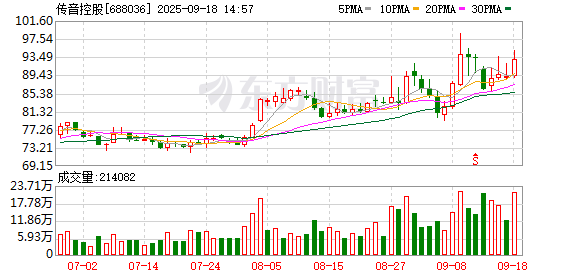
Core Viewpoint - Transsion Holdings' controlling shareholder, Transsion Investment, successfully completed a share transfer, selling 22.807 million shares at a price of 81.81 CNY per share, raising approximately 1.866 billion CNY, which represents a discount of about 8.36% compared to the closing price on September 17 [1][2] Group 1: Share Transfer Details - Transsion Investment's shareholding was diluted to 49.15% prior to the transfer due to stock incentive plans, and after the transfer, it decreased to 47.15%, maintaining control over the company [1] - The share transfer involved 426 institutional investors, with 31 valid bids received, and 20 institutions allocated shares, including major players like Xingzheng Global Fund, which invested 832 million CNY [1][2] Group 2: Financial Performance - Transsion Holdings reported a significant decline in financial performance for the first half of 2025, with revenue of approximately 29.077 billion CNY, down 15.86% year-on-year, and net profit of about 1.213 billion CNY, down 57.48% [5][6] - The company has distributed substantial dividends, totaling 13.23 billion CNY since its IPO in 2019, with a cash dividend of 9.12 billion CNY in the first half of 2025, representing 75.22% of its net profit [5] Group 3: Market Position and Competition - Transsion Holdings, known as the "King of African Mobile Phones," has seen its market growth slow down, particularly in Africa, where revenue growth was only 2.97% last year compared to 6.74% in 2023 [6] - Despite still holding a 51% market share in Africa with 9.7 million units shipped in Q2 2025, the company's growth rate has significantly lagged behind competitors like Xiaomi and Honor, which reported growth rates of 32% and 161%, respectively [6]

美联储宣布降息25个基点!鲍威尔重磅发声;事关组合驾驶辅助!工信部征求意见;西贝被曝招聘品牌传播、法务主管;万科组织架构大调整丨每经早参
Mei Ri Jing Ji Xin Wen· 2025-09-17 21:57
Group 1 - The Federal Reserve has lowered the federal funds rate target range by 25 basis points to 4.00%-4.25%, marking its first rate cut since December 2024 [4] - The Fed predicts an additional 50 basis points cut by the end of the year and 25 basis points cuts in each of the following two years [4] - Inflation risks are on the rise while employment risks are declining, with Powell stating that most inflation expectations will align with the 2% target after next year [4] Group 2 - U.S. stock indices closed mixed, with the Dow Jones up 0.57%, while the Nasdaq and S&P 500 fell by 0.33% and 0.1% respectively [5] - Chinese concept stocks mostly rose, with the Nasdaq China Golden Dragon Index increasing by 2.85%, and Baidu rising over 11% [5] Group 3 - International gold futures fell by 0.82% to $3694.60 per ounce, while silver futures dropped by 2.15% to $41.99 per ounce [6] - U.S. oil prices decreased slightly, with WTI crude oil down 0.85% to $63.97 per barrel [7] Group 4 - The National Development and Reform Commission is increasing support for projects in elderly care, childcare, and cultural tourism to meet the demand for high-quality living [9] - The Ministry of Commerce plans to conduct pilot projects in about 50 cities to expand new consumption formats and models [10] Group 5 - NIO announced the completion of a $1.16 billion financing round, which will be used for core technology development and infrastructure expansion [27] - Ningde Times plans to achieve mass supply of sodium-ion batteries next year, highlighting advantages in low-temperature performance and safety [17] Group 6 - Huawei has reduced prices for three flagship smartphone series, with discounts up to 2000 yuan, aiming to attract more consumers [19] - Vanke has undergone a significant organizational restructuring to explore new business pathways [25]





乔布斯:从被逐到王者归来,创业投资的不朽启示
Sou Hu Cai Jing· 2025-09-16 12:06
Core Insights - Steve Jobs' journey exemplifies resilience and vision in the face of adversity, transforming setbacks into opportunities for innovation and growth [2][3][5] Group 1: Early Career and Setbacks - In 1985, Steve Jobs was ousted from Apple, marking a significant setback in his career, which he later transformed into a chance for reinvention [2] - Jobs recruited John Sculley from PepsiCo with a compelling vision, but internal conflicts led to his removal from Apple [2][3] Group 2: Second Ventures - After leaving Apple, Jobs invested millions in Pixar and NeXT, despite initial failures, demonstrating a long-term investment strategy focused on future value [3][4] - Pixar's success with "Toy Story," which grossed $373 million, marked a turning point for both the company and the animation industry [3] Group 3: Return to Apple - Upon returning to Apple in 1997, Jobs implemented the Pareto principle, cutting 70% of the product line to focus on core offerings, leading to a profitable turnaround [4] - The launch of the iMac in 1998 sold 800,000 units in five months, contributing to Apple's profitability of $309 million that year [4] Group 4: Innovation and Growth - Under Jobs' leadership, Apple introduced groundbreaking products like the iPod, iPhone, and iPad, significantly increasing its market value to $350 billion by 2010 [4] - By the time of Jobs' passing in 2011, Apple's market capitalization reached $2.9 trillion, solidifying its status as the most valuable company in history [5] Group 5: Lessons for Entrepreneurs and Investors - Entrepreneurs should maintain unwavering belief in their vision and prioritize innovation to meet evolving consumer demands [5][6] - Investors are encouraged to adopt a long-term perspective, recognizing potential in emerging sectors and diversifying investments to mitigate risks [5]



四大证券报精华摘要:9月16日
Xin Hua Cai Jing· 2025-09-16 00:06
Group 1: Medical and Health Sector - China Electronics' subsidiary, Zhongdian Yun Brain, launched the country's first domestic non-invasive brain-machine interface smart headset, with nearly 200,000 units in procurement intentions and over 100,000 units under formal contracts within a month of release [1] - Central enterprises are driving innovation in the medical health industry, focusing on breakthroughs in brain-machine interfaces, micro-light night vision technology, and the establishment of a computing power platform to support cutting-edge research [1] Group 2: AI and Semiconductor Industry - The demand for AI computing power is rapidly increasing, leading to quick iterations in core components and packaging technologies, with a significant focus on the integration of AI and optical communication at recent exhibitions [2] - Domestic AI chip manufacturers are seizing the market opportunity during the supply instability of Nvidia chips, with companies like Cambricon and Moore Threads showing promising product capabilities in AI inference chips [3] Group 3: Automotive Industry - The China Automobile Industry Association proposed a payment initiative for automotive manufacturers to pay small suppliers in cash or bank acceptance bills, with major companies like SAIC and BYD responding positively to build a healthier financial order in the supply chain [4] Group 4: Energy Storage Industry - The newly released action plan for large-scale construction of new energy storage aims to double the domestic storage installation capacity by 2027, providing strong support for the industry amid increasing overseas demand [5] Group 5: Robotics and Automation - Huike's subsidiary, Huizhi Wulian, signed a strategic cooperation agreement to deploy over 1,000 embodied intelligent robots in its global production bases, with a cooperation order amounting to nearly 500 million yuan [6] Group 6: Foreign Exchange and Investment - The State Administration of Foreign Exchange announced reforms to cross-border investment and financing management, including measures to facilitate foreign direct investment and increase cross-border financing limits [8] Group 7: Storage Market - The storage market is experiencing a new round of price increases, with major companies like SanDisk and Micron raising prices, leading to a significant rise in the stock prices of related companies [9] Group 8: Film and Entertainment Industry - The film and cinema stocks are active ahead of the upcoming National Day holiday, with several films set to release, leading to optimistic expectations for box office performance [10] Group 9: Consumer Market - The upcoming long holiday period is expected to boost consumer spending, supported by various government policies aimed at enhancing consumer capacity and willingness [11] Group 10: Offshore Wind Power - New policies are accelerating the development of offshore wind power projects, with significant market potential expected in the coming years [12] Group 11: AI Ecosystem in Mobile Industry - Mobile manufacturers are intensifying competition in the AI ecosystem, with companies like Meizu and others making significant advancements in integrating AI with their products [13][14]
手机厂商打响AI全生态竞争战
Zheng Quan Ri Bao· 2025-09-15 16:08
Group 1 - Meizu announced a comprehensive upgrade of its smart ecosystem, including the launch of the Meizu 22 flagship smartphone and AI camera glasses StarV Snap, along with updates to its Flyme AIOS and Flyme Auto systems [1] - The upgrades reflect a strategic push towards AI and ecosystem integration, indicating a shift in the smartphone industry towards competition based on "ecosystem capability + scenario experience" rather than just individual products [1] - Industry experts note that competition among smartphone manufacturers is evolving into a new phase characterized by "end-cloud collaboration + scenario integration," with major players like Huawei, Xiaomi, and OPPO also advancing their AI ecosystem strategies [2] Group 2 - The competition among smartphone manufacturers is now defined by three new characteristics: AI becoming a standard feature in operating systems, accelerated cross-device integration, and hardware innovation focused on specific scenarios like photography and travel [2] - The collaboration between smartphone manufacturers and other industries is increasing, with a focus on creating integrated solutions that enhance user experience across devices [2] - Experts emphasize the need for industry alliances to promote interoperability and the establishment of national or international standards to address systemic issues in device connectivity [3]
【闲聊杂谈】行业研究框架之地图
Xin Lang Cai Jing· 2025-09-15 10:06
Core Concept - The article presents a comprehensive framework for industry research, focusing on the industry lifecycle, business models, market size, and competitive landscape, providing investors with essential tools for informed decision-making [2][4][21] Industry Lifecycle - Industries can be categorized into four stages based on revenue: introduction, growth, maturity, and decline, reflecting changes in customer demographics and market dynamics [4][5] - The introduction phase features innovative products with uncertain market potential, while the growth phase sees an increase in user adoption and revenue [4][5] - In the maturity phase, revenue growth slows as new customer acquisition diminishes, leading to increased competition and potential market share consolidation [5][6] - The decline phase is characterized by stagnant user growth and the emergence of substitutes, where only companies with significant scale or cost advantages can maintain competitiveness [5][6] Research Focus by Lifecycle Stage - In the introduction phase, the primary concern is the feasibility of the business model, assessing real demand and sustainable profitability [7][10] - For the growth phase, the focus shifts to estimating market size and potential growth over the next 3-5 years to ensure sufficient growth opportunities [7][14] - In the maturity phase, evaluating the industry's competitive advantages and potential for new market opportunities becomes crucial [8][15] - During the decline phase, research should pivot towards substitutes and alternative investment opportunities [8][19] Market Size and Concentration - Market size is typically measured by sales revenue, with larger markets being essential for the emergence of significant companies [13][14] - Different market size metrics are relevant at various lifecycle stages: Total Addressable Market (TAM) in the introduction phase, Serviceable Available Market (SAM) and Serviceable Obtainable Market (SOM) in the growth and maturity phases [13][14] - Industry concentration levels impact profitability, with higher concentration often leading to better profit margins [20] Competitive Landscape - The competitive landscape is critical in determining future profitability, with horizontal competition (among peers) and vertical relationships (upstream and downstream) both influencing market dynamics [19][20] - Understanding market share and industry concentration helps gauge profitability potential, with high concentration indicating better profit prospects [20] - The ability to maintain a competitive edge through unique advantages, such as brand strength or cost leadership, is vital for long-term success [15][16]

曝法拉第股价靠虚假订单、换标中国MPV拉升,贾跃亭回应;滴滴24年平均抽成14%,官方:抽成不等于利润;微信将关闭京东购物入口
雷峰网· 2025-09-15 00:23
Key Points - Didi announced an average commission rate of 14% for all orders in 2024, clarifying that commission does not equate to profit as most funds are used for subsidies and platform maintenance [4] - Didi's platform saw a year-on-year growth of 12.4% in Q2, reaching 3.376 billion orders, with an average daily order volume of 37.1 million [4] - Faraday Future (FF) faces allegations of using fake orders to support its stock price, with the company’s founder, Jia Yueting, denying these claims and stating that legal action will be taken [7] - Neta Auto held its first creditor meeting after announcing bankruptcy restructuring, revealing a total debt of approximately 51 billion yuan with only 15.5 million yuan in cash [8] - Lingxin Qiaoshou aims to reduce the price of its dexterous hands to below 500 yuan within three years, having recently completed a multi-hundred million yuan angel round of financing [9] - Alibaba's acquisition of AutoNavi is highlighted as a strategic move to compete against Meituan, with significant developments in local services and map integration [10] - WeChat will close the JD shopping entry as of September 30, following the expiration of a three-year strategic cooperation agreement [11] - Xiaopeng Motors plans to invest 500 billion yuan annually in R&D, with 300 billion yuan allocated to AI, aiming for profitability in Q4 [14] - Tesla is accused of favoring visa employees over American citizens to reduce labor costs, with a lawsuit filed alleging systematic discrimination [22] - Amazon is set to launch consumer-grade AR glasses by late 2026 or early 2027, with plans for a specialized version for delivery drivers [24]


那些社交媒体上的“网红”品牌官:爆料、辟谣、营销和危机公关,“KOL化”催生劳动关系新课题
Mei Ri Jing Ji Xin Wen· 2025-09-10 11:34
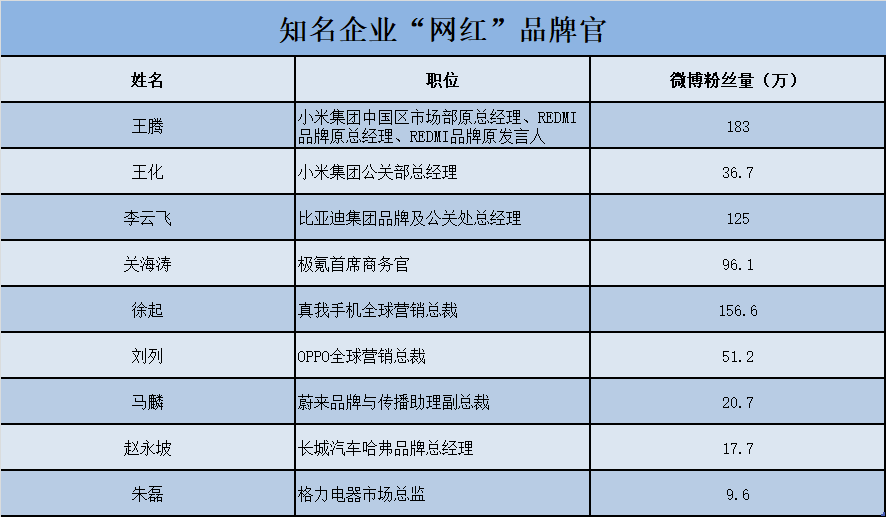
Core Viewpoint - The rise of "internet celebrity" brand executives, who serve dual roles in advertising and public relations, is reshaping corporate communication strategies and management practices in the industry [1][7][9]. Group 1: Company Actions and Events - Xiaomi Group terminated Wang Teng, the former General Manager of the China Market Department, due to serious violations including leaking confidential company information [1]. - Wang Teng had a significant online presence with 1.83 million followers on Weibo, highlighting the influence of brand executives in the digital space [3]. - The incident has sparked discussions about the responsibilities and risks associated with brand executives acting as key opinion leaders (KOLs) [1][9]. Group 2: Brand Executive Roles - Brand executives are increasingly taking on the role of KOLs, engaging directly with consumers and leveraging their personal brands to enhance corporate messaging [2][5]. - Executives like Xiaomi's Wang Hua and BYD's Li Yunfei utilize social media to communicate product information and respond to public concerns, thereby deepening customer trust [8][9]. - The trend of KOLization among brand executives raises questions about the balance between internal management duties and external representation [7][9]. Group 3: Industry Trends - The shift towards KOLization reflects a broader trend in corporate communication, where companies are adapting to the rise of social media and the demand for authentic engagement [5][6]. - Executives are now seen as vital assets in marketing strategies, with their personal brands often overshadowing official corporate accounts [9]. - The dynamic between personal and corporate branding is evolving, necessitating new approaches to human resource management and corporate governance [7][9].