
煤炭开采

Search documents
潞安环能涨2.10%,成交额3.10亿元,主力资金净流入2688.71万元
Xin Lang Zheng Quan· 2026-01-22 05:49
Core Viewpoint - Lu'an Environmental Energy has shown a significant increase in stock price and trading volume, indicating positive market sentiment despite a decline in revenue and net profit for the year 2025 [1][2]. Group 1: Stock Performance - As of January 22, Lu'an Environmental Energy's stock price increased by 2.10% to 13.13 CNY per share, with a trading volume of 310 million CNY and a turnover rate of 0.80%, resulting in a total market capitalization of 39.277 billion CNY [1]. - The stock has risen by 11.27% year-to-date, with a 4.70% increase over the last five trading days and an 8.51% increase over the last 20 days, although it has decreased by 11.22% over the past 60 days [1]. Group 2: Financial Performance - For the period from January to September 2025, Lu'an Environmental Energy reported a revenue of 21.1 billion CNY, representing a year-on-year decrease of 20.82%, and a net profit attributable to shareholders of 1.554 billion CNY, down 44.45% year-on-year [2]. Group 3: Shareholder Information - As of January 10, the number of shareholders for Lu'an Environmental Energy reached 83,000, an increase of 2.47%, while the average number of circulating shares per person decreased by 2.41% to 36,041 shares [2]. - The company has distributed a total of 25.851 billion CNY in dividends since its A-share listing, with 14.505 billion CNY distributed over the last three years [3]. - Notable institutional shareholders include Guotai Junan CSI Coal ETF, which is the third-largest shareholder with 47.291 million shares, and Hong Kong Central Clearing Limited, which is the fourth-largest shareholder with 39.944 million shares, having decreased its holdings by 4.797 million shares [3].

分化盘整,黄金再创新高
Ge Long Hui· 2026-01-22 05:10
Market Performance - The three major indices experienced a slight increase, with the Shanghai Composite Index rising by 0.16%, the Shenzhen Component Index by 0.76%, and the ChiNext Index by 0.85% [1] - Over 2,900 stocks in the two markets saw gains, with a total trading volume of 1.63 trillion yuan [1] Sector Performance - The consumer sector collectively weakened, with notable declines in the liquor and tourism hotel sectors; Li Qun shares fell by 5.16%, and other companies like Yonghui Supermarket, Jiuhua Tourism, and Jinhui Liquor saw declines exceeding 4% [3] - The coal sector also faced a downturn, with Dayou Energy dropping nearly 8% [3] - Other sectors such as dairy, cement, and electricity followed suit in terms of declines [3] Emerging Trends - Precious metals concepts continued to surge, with Hunan Silver achieving two consecutive trading limits [3] - The chip industry chain saw expanded gains, with over ten stocks including Huatians Technology, Longxin Zhongke, and Zhizheng shares hitting the daily limit [3] - Lithium mining concepts experienced a rebound, with companies like Shengxin Lithium Energy and Dazhong Mining reaching the daily limit [3] Notable News - Alibaba's Qianwen derivative model surpassed 200,000, becoming the first open-source large model to achieve this milestone globally; the Qianwen series models have been downloaded over 1 billion times, averaging 1.1 million downloads per day [3] - Spot gold prices rose to $4,830 per ounce, increasing by 1.5% within the day and over 10% for the month [3]


山东能源梁家煤矿:以“减”提效 以“控”促增
Qi Lu Wan Bao· 2026-01-22 03:16
Core Viewpoint - Shandong Energy Lvxin Mining's Liangjia Coal Mine focuses on enhancing operational efficiency and sustainable development through cost control and system optimization Group 1: System Optimization and Cost Control - The mine has implemented a series of "slimming" measures to reduce operational costs, including optimizing the ventilation system to lower negative pressure by 740 Pa, which significantly reduces energy consumption [2] - Adjustments to the mining area layout will lead to the closure of completed mining areas, resulting in a projected 1.3% reduction in overall electrical consumption [2] - The mine plans to remove over 8,000 meters of water and drainage pipelines, saving approximately 310,000 yuan in maintenance costs [2] Group 2: Lean Management and Efficiency Improvement - The mine has established a material consumption ledger and implemented a "daily clearing" system to analyze and control material usage, achieving an 11% reduction in material costs compared to the previous year [3] - By conducting market research for procurement, the mine has managed to reduce contract costs by over 3% [3] - The mine aims to save an additional 600,000 yuan this year through meticulous management of controllable expenses [3] Group 3: Risk Management and Financial Efficiency - The mine adheres to strict "dual control" requirements to enhance the efficiency of fund utilization and manage small expenses through a categorized approach [4] - The implementation of a "six precision, six improvement" initiative aims to identify and eliminate waste in production processes [4] - The mine is actively leveraging tax incentives to maximize financial benefits from resource tax reductions and VAT deductions [4] Group 4: Employee Engagement and Cost Reduction Culture - The mine encourages all employees to participate in cost-saving initiatives through activities like "cost-saving idea collection" and lean management training [5] - Employees have proposed various cost-saving measures, resulting in a cumulative savings of 320,000 yuan from 15 implemented ideas [5] - The mine's leadership emphasizes collective effort to enhance operational quality and reduce risks, aiming for high-level development and low-risk operations by 2026 [5][6]
【广发宏观贺骁束】核心线索渐变,价格潜流蓄势:2026年通胀环境展望
郭磊宏观茶座· 2026-01-21 12:14
Group 1 - The core viewpoint of the article is that the inflation landscape for 2025 is characterized by a bottoming out and stabilization, with the GDP deflator index showing a decline of -1.2% year-on-year in Q2, the lowest since 2010, and a slight recovery to -1.0% in Q3 [1][11] - The article highlights that the manufacturing investment, as a representative of productive capital expenditure, has seen a decline, leading to a gradual easing of supply-demand pressure [1][11] - Key price increase signals have emerged in sectors such as storage, non-ferrous metals, and phosphorous chemicals, indicating a potential recovery in prices [1][12] Group 2 - For 2026, the article discusses the technical detail of the base period rotation for the PPI, which will be based on 2025, with updates to the survey directory and weight adjustments reflecting the latest industrial revenue proportions [2][14] - The macro logic for 2026 includes a likely recovery from the low investment gap in the first year of the 14th Five-Year Plan, stabilization of the real estate market, and a narrowing consumption gap, all of which are expected to positively influence prices [2][17] - The financial logic indicates that leading indicators such as M1 suggest a continuation of price recovery for domestic industrial products, with global liquidity conditions remaining supportive [2][20] Group 3 - The article identifies four key industrial factors influencing prices for 2026, including the pig cycle, the easing of capacity pressure in key industries, the cumulative effects of anti-involution policies, and the profit cycle indicating limited expansion in manufacturing investment [3][23] - The manufacturing sector's contribution to PPI decline is significant, with eight key industries accounting for 88% of the cumulative impact, particularly in automotive, electrical machinery, and computer communication electronics [3][26] - The article emphasizes the importance of upstream commodities, such as coal, steel, copper, and oil, in analyzing PPI, noting that price volatility in these commodities can significantly affect PPI contributions [4][30] Group 4 - The article outlines five key signals regarding CPI for 2026, including favorable base effects, the impact of core goods and services, and the expected recovery in medical service prices due to aging population needs [5][34] - The potential influence of gold prices on CPI is discussed, with projections indicating a reduced contribution compared to the previous year, reflecting a high base effect [5][37] - Housing prices are highlighted as a critical variable, with expectations for stabilization in the second half of 2026, influenced by policy measures aimed at stabilizing the real estate market [6][39] Group 5 - The comprehensive assessment of price data for the year indicates a moderate recovery in both PPI and CPI, with CPI expected to rise to a peak in Q1 before stabilizing in subsequent quarters [7][43] - The baseline scenario predicts average CPI and PPI values of 0.8% and -0.6% respectively, with variations in conservative and optimistic scenarios also presented [7][44] - Structural price increase signals for 2026 include the impact of anti-involution policies, new energy industries, and the aging population's influence on service prices [8][47][48]

核心线索渐变,价格潜流蓄势:2026年通胀环境展望
GF SECURITIES· 2026-01-21 11:07
Economic Overview - The inflation environment for 2025 is characterized by a bottoming out and stabilization, with the GDP deflator index dropping to -1.2% in Q2, the lowest since 2010, and improving to -1.0% in Q3[4][17]. - The manufacturing investment growth rate fell from 9.0% in February to 1.9% in November, indicating a slowdown in capacity expansion[4][5]. Price Trends - The PPI has shown signs of recovery, with a five-month consecutive increase from July to December, marking the first positive growth since June 2022[4][5]. - Key price increases in sectors such as storage chips (up 478%), copper (up 25.2%), and lithium hexafluorophosphate (up 248.2%) were noted from July to December 2025[4][20]. Structural Changes - The PPI base year will shift in 2026, with significant updates to the survey directory and weight adjustments, particularly increasing the weight of non-ferrous metal processing and computer communication electronics[4][28]. - The new PPI structure will better reflect emerging industries and technological advancements, potentially leading to a more pronounced impact on price readings[4][28]. Investment and Consumption - The "14th Five-Year Plan" is expected to stimulate investment, particularly in infrastructure, which will support raw material prices in the construction sector[5][12]. - Consumer spending is anticipated to increase due to policies aimed at enhancing consumption rates, with a focus on public service equalization and short-term incentives for service consumption[5][12]. Global Economic Factors - Global liquidity conditions remain supportive, with M2 growth in major economies rising from 2.4% to 8.0% year-on-year, indicating a favorable environment for commodity prices[6][12]. - The export environment is projected to remain stable, with expected growth rates of 3-4% for exports, contributing to a balanced pricing scenario for major export products[5][12]. Risks and Uncertainties - Potential risks include unexpected downward pressure on the domestic economy, uncertainties in real estate policies, and fluctuations in global commodity prices[12][14]. - The impact of the pig cycle and other agricultural price trends may also influence inflation dynamics in 2026, with expectations of a price bottoming out in the first half of the year[10][12].
超200股已跌破“924”!千亿市值权重占一成,这些板块临近行情起点
Xin Lang Cai Jing· 2026-01-21 09:28
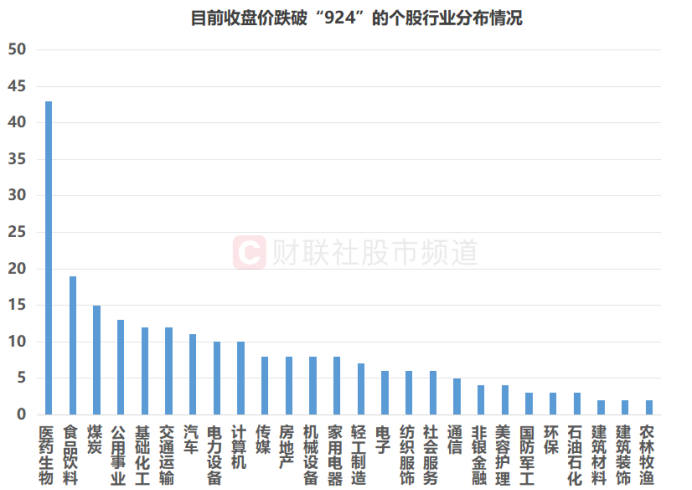
Core Viewpoint - The A-share market has shown overall stability, but nearly 230 stocks have seen their closing prices fall below the level recorded on September 24, 2024, accounting for approximately 4.3% of the total market [1]. Industry Analysis - The pharmaceutical sector has the highest number of stocks below the September 24 closing price, making up 18.7% of the total. Other sectors with significant representation include food and beverage, coal, public utilities, basic chemicals, and transportation, each exceeding 10% [2]. - Among the sub-sectors, stocks in the liquor, traditional Chinese medicine, thermal coal, coking coal, and residential development categories are the most affected, with a notable presence of chemical preparations, in vitro diagnostics, and medical consumables [2]. Market Capitalization Insights - The average total market capitalization of the over 200 stocks currently below the September 24 closing price is approximately 43.6 billion, with a median market capitalization of 10.8 billion. Stocks with a market capitalization below 5 billion account for nearly 30%, while those above 100 billion represent close to 10% [5]. - Notably, China Mobile, the only stock with a market capitalization exceeding 1 trillion, has seen a decline of about 3.7% from its September 24 closing price, currently fluctuating around 96 yuan [5]. Performance of Major Stocks - Key large-cap stocks that have fallen below the September 24 closing price include China Petroleum, Yangtze Power, China Telecom, Wuliangye, and others. Six stocks, including Pizaihuang and Daqin Railway, have experienced declines exceeding 10% [7]. - The performance of the dividend index has lagged behind the broader market, with a cumulative increase of only 5.9% since September 24, while other indices have shown more substantial gains [8]. Index Performance Overview - As of January 21, all 31 first-level industry indices are above their September 24 levels, with an average increase of approximately 58.12% and a median increase of 53.42%. The communication, non-ferrous metals, electronics, and comprehensive sectors have seen increases exceeding 130% [10]. - Conversely, sectors such as coal, food and beverage, public utilities, banking, and transportation have shown relatively lower growth, with the coal sector only increasing by 0.6% [10].





煤炭开采板块1月21日跌1.77%,大有能源领跌,主力资金净流入1.36亿元
Zheng Xing Xing Ye Ri Bao· 2026-01-21 09:08
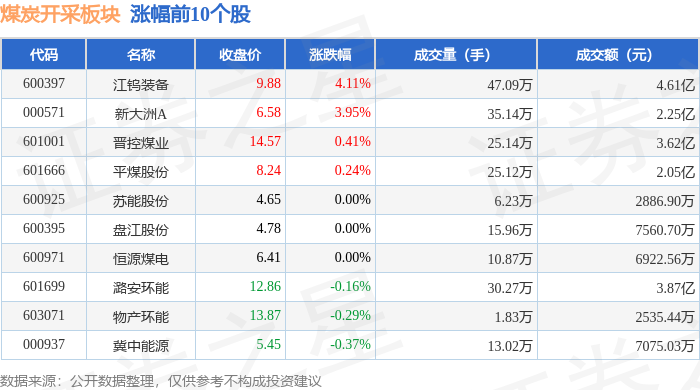
Group 1 - The coal mining sector experienced a decline of 1.77% on January 21, with Dayou Energy leading the drop [1] - The Shanghai Composite Index closed at 4116.94, up 0.08%, while the Shenzhen Component Index closed at 14255.12, up 0.7% [1] - Key stocks in the coal mining sector showed varied performance, with Jiangte Equipment rising by 4.11% and Dayou Energy falling by 8.31% [1][2] Group 2 - The coal mining sector saw a net inflow of 136 million yuan from institutional investors, while retail investors experienced a net outflow of 257 million yuan [2] - Major stocks like Shaanxi Coal and China Shenhua had significant net inflows from institutional investors, indicating potential interest despite overall sector decline [3] - The trading volume for Dayou Energy was 953,600 shares, with a transaction value of 649 million yuan, reflecting its significant market activity despite the price drop [2][3]





爆量!突发,乌龙指?
中国基金报· 2026-01-21 07:58
【导读】宽基ETF爆量,石化ETF出乌龙指 中国基金报记者 泰勒 兄弟姐妹们啊,隔夜海外市场腥风血雨,今日A股稳中向好,三大指数震荡上涨。 一起看看发生了什么事情。 1月21日,A股全天冲高回落,三大指数小幅上涨。截至收盘, 沪指涨0.08%,深成指涨0.7%,创业板指涨0.54%。 全市场共 3096只个股上涨,88只个股涨停,2197只个股下跌。 | 880005 涨跌家数 | | | | --- | --- | --- | | 日 | 涨停 | 888 | | 涨幅 | > 7% | 194 | | 涨幅 | 5-7% | 153 | | 涨幅 | 3-5% | 373 | | 涨幅 | 0-3% | 2376 | | 跌幅 | 0-3% | 1967 | | 跌幅 | 3-5% | 158 | | 跌幅 | 5-7% | 42 | | 跌幅 | > 7% | 30 | | 其中 跌停 | | 11 | | | | 3096 | | | | 2197 | | 上競賽 武威時期 台成交流 | | 180 | | | | 5473 | | | | 26237.47亿 | | 总成交量 | | 147027. ...

“煤海大脑”指挥准能百里矿区高效运转
Zhong Guo Neng Yuan Wang· 2026-01-21 03:14
Core Insights - The production command center of the Zhuaneng Group plays a crucial role in the efficient operation of the Heidaigou and Hala'usu open-pit coal mines, acting as the "smart brain" behind their operations [1][11] Group 1: Operational Efficiency - The command center operates continuously, even at midnight, ensuring real-time monitoring and quick response to operational issues, such as equipment malfunctions [3][5] - An intelligent scheduling system provides real-time data on equipment status, location, and production progress, enhancing operational oversight [3][9] - Coordination during extreme weather events, such as heavy snowfall, demonstrates the command center's ability to implement emergency plans effectively, ensuring coal transportation remains uninterrupted [5][11] Group 2: Safety and Technology Integration - The installation of 100 mobile cameras enhances safety monitoring, allowing for immediate intervention in high-risk situations [9][13] - The integration of experienced operators' knowledge with modern data-driven approaches fosters a unique culture of mentorship and responsibility within the workforce [9][13] - The command center aims to advance towards a fully intelligent mining operation through the application of 5G, artificial intelligence, and big data analytics [13][15] Group 3: Commitment to Production Goals - The command center is responsible for coordinating production plans and ensuring alignment with national energy directives, contributing to an annual output of over 60 million tons of coal [11][13] - The dedication of the operators ensures that every piece of equipment runs safely and efficiently, delivering high-quality coal on time [13][15] - The ongoing commitment to enhancing operational intelligence reflects the industry's focus on sustainable energy supply and economic development [15]

宝城期货资讯早班车-20260121
Bao Cheng Qi Huo· 2026-01-21 02:20
1. Report Industry Investment Rating No relevant content provided. 2. Core Viewpoints of the Report - The GDP growth in Q4 2025 was 4.5%, and the full - year growth target of 5% was achieved, meeting market expectations. The market will discuss the economic growth expectations for 2026 and the Two Sessions' target settings. For the bond market, the central bank's attitude is the key factor in 2026, and a total interest - rate cut is expected in Q2 [27]. - The central bank's resumption of bond - buying may be a long - term consideration, and the continuity of bond - buying is high. In 2026, the imbalance between supply and demand in the bond market needs attention, with the core being demand. The bond market still needs to consider the impacts of "imbalance between supply and demand, expectations of rising prices, and re - balancing of asset allocation due to capital diversion" [28]. 3. Summary by Directory 3.1 Macro Data Quick View - In December 2025, GDP at constant prices had a quarterly - on - quarterly growth of 4.5%, lower than the previous quarter's 4.8% and the same period last year's 5.4% [1]. - The manufacturing PMI in December 2025 was 50.1%, up from 49.8% in the previous month and the same as the same period last year [1]. - The non - manufacturing PMI for business activities in December 2025 was 50.2%, up from 50.0% in the previous month but lower than 52.2% in the same period last year [1]. - The monthly value of social financing scale in December 2025 was 2207.5 billion yuan, down from 3529.9 billion yuan in the previous month and 2853.7 billion yuan in the same period last year [1]. - Various monetary indicators such as M0, M1, M2, and new RMB loans also showed different trends in December 2025 compared with the previous month and the same period last year [1]. - CPI in December 2025 had a year - on - year growth of 0.8%, up from - 0.3% in the previous month and 0.1% in the same period last year; PPI was - 1.9%, up from - 2.3% in the previous month and the same period last year [1]. - The cumulative year - on - year growth of fixed - asset investment completion in December 2025 was - 3.8%, down from - 0.5% in the previous month and 3.2% in the same period last year [1]. - The cumulative year - on - year growth of total retail sales of consumer goods in December 2025 was 3.7%, down from 4.5% in the previous month but up from 3.5% in the same period last year [1]. - The year - on - year growth of export and import amounts in December 2025 was 6.60% and 5.70% respectively, down from 8.20% and 7.40% in the previous month and 10.67% and 0.84% in the same period last year [1]. 3.2 Commodity Investment Reference 3.2.1 Comprehensive - The National Development and Reform Commission is planning major high - tech projects for the 15th Five - Year Plan period, formulating an implementation plan for the strategy of expanding domestic demand from 2026 - 2030, and considering setting up a national - level merger and acquisition fund. It will also promote the expansion and quality improvement of the service industry [2]. - The LPR in January 2026 remained unchanged for the 8th consecutive month, with the 1 - year LPR at 3.0% and the 5 - year - plus LPR at 3.5% [2]. - Shanghai introduced 18 measures to enhance the influence of non - ferrous metal commodities and global pricing, including supporting settlement through the Commodity Clearing Link and opening up futures and options varieties [3]. - The Shanghai Futures Exchange adjusted the trading margin ratios and price limit ranges for copper, aluminum, gold, and silver futures contracts [3]. - The Shanghai International Energy Exchange Center adjusted the trading margin ratios and price limit ranges for international copper futures contracts [4]. - On January 20, 37 domestic commodity varieties had positive basis, and 32 had negative basis, with significant differences in basis among different varieties [4]. 3.2.2 Metals - On the morning of January 21, New York gold futures exceeded $4780 per ounce, and domestic gold jewelry prices also increased, with some brands' pure gold prices exceeding 1450 yuan per gram [5]. - "Investment copper bars" have become popular recently, with a 1000 - gram copper bar costing 180 - 288 yuan in Shenzhen Shuibei Market [5]. - The Polish central bank approved a plan to buy up to 150 tons of gold, increasing its gold reserves to 700 tons [5]. - On January 19, the inventories of lead, tin, zinc, and copper in the London Metal Exchange reached new highs, while the inventories of cobalt and aluminum reached new lows [6]. - As of January 20, the holdings of the world's largest gold ETF, SPDR Gold Trust, decreased by 0.37%, or 4.01 tons, to 1081.66 tons [6]. 3.2.3 Coal, Coke, Steel, and Minerals - During the 14th Five - Year Plan period, Shanxi produced 65 billion tons of coal, with an output of over 13 billion tons in 2025, an increase of 19 billion tons compared with the 13th Five - Year Plan [8]. - The first shipment of nearly 200,000 tons of Simandou iron ore arrived in China on January 17, enhancing global iron ore supply [8]. 3.2.4 Energy and Chemicals - Domestic gasoline and diesel prices increased by 85 yuan per ton from January 20, 24:00, due to rising international oil prices [9]. - The US government obtained 50 million barrels of oil from Venezuela and sold part of it on the open market [9]. - Venezuela officially launched the export of liquefied petroleum gas [9]. 3.2.5 Agricultural Products - Brazil's corn and soybean exports in January 2026 are expected to be 3.45 million tons and 3.79 million tons respectively, higher than the previous week's forecasts, while soybean meal exports are expected to be 1.82 million tons, the same as the previous week [10]. - As of January 15, the EU's soft wheat exports in the 2025/26 season were 11.8 million tons, slightly lower than the same period last year [10]. - The US export inspection volumes of soybeans, wheat, and corn were 1,336,684 tons, 392,611 tons, and 1,483,622 tons respectively [11]. 3.3 Financial News Compilation 3.3.1 Open Market - On January 20, the central bank conducted 324 billion yuan of 7 - day reverse repurchase operations, with a net withdrawal of 34.6 billion yuan due to 358.6 billion yuan of reverse repurchase maturities [12]. 3.3.2 Key News - A package of policies to promote domestic demand through fiscal - financial coordination was introduced, including a 500 - billion - yuan special guarantee plan for private investment and loan interest - subsidy policies for small and medium - sized enterprises [13]. - The National Development and Reform Commission stated that in 2026, macro - policies will focus on strengthening the domestic cycle, expanding domestic demand, and promoting high - tech projects [13]. - The Ministry of Finance said that in 2026, the fiscal deficit, debt scale, and expenditure will remain at necessary levels, and ultra - long - term special treasury bonds will continue to be issued [14]. - The Ministry of Natural Resources and the Ministry of Housing and Urban - Rural Development introduced measures to support urban renewal [15]. - The preferential tax policies for community - based family services such as elderly care, childcare, and housekeeping were extended from January 1, 2026, to December 31, 2027 [16]. - The latest LPR remained unchanged for the 8th consecutive month since May 2025, and experts believe that the stable macro - economy is the main reason [17]. - Beijing's 2026 construction land supply plan was announced, with specific land allocations for commercial and affordable housing and a focus on urban renewal [18]. - Guangzhou is promoting legislation for the renewal of state - owned land housing, with a planned fixed - asset investment of 120 billion yuan for urban village renovation in 2026 [18]. - The Greenland crisis and fiscal pressure concerns led to a global bond market sell - off, with significant fluctuations in Japanese and US bond yields [18]. - The Japanese Finance Minister tried to calm the bond market, emphasizing the responsibility and sustainability of fiscal policies [18]. - All Japanese central bank observers predict that the benchmark interest rate will remain unchanged on Friday, and the government may intervene in the foreign exchange market if the yen depreciates [19]. - There were several bond - related events, including payment due dates and corporate management changes [19]. 3.3.3 Bond Market Summary - China's bond market showed positive trends, with falling yields on spot bonds and rising prices of bond futures. The money market was generally stable, but the DR001 rate increased due to the tax period [20]. - The exchange - traded bond market had different performances among different bond types, with some bonds rising and some falling [21]. - The CSI Convertible Bond Index and the Wind Convertible Bond Equal - Weighted Index both declined, with significant differences in individual bond performances [22]. - Most money market interest rates and Shibor short - term rates increased [22]. - Bank - to - bank repurchase fixed - rate and silver - bank repurchase fixed - rate also showed upward trends [23]. - The winning bid yields and multiples of financial bonds issued by the Agricultural Development Bank and the National Development and Reform Commission were announced [23][24]. - European and US bond yields generally increased [24][25]. 3.3.4 Foreign Exchange Market - The on - shore RMB against the US dollar rose 33 basis points to 6.9603 at 16:30, and the central parity rate rose 45 basis points to 7.0006 [26]. - At the New York close, the US dollar index fell 0.50% to 98.55, and most non - US currencies rose [26]. 3.3.5 Research Report Highlights - CITIC Securities believes that the central bank's attitude is crucial for the 2026 bond market, and a total interest - rate cut is expected in Q2 [27]. - Shenwan Hongyuan Fixed - Income believes that the central bank's bond - buying is likely to be continuous, and in 2026, attention should be paid to the imbalance between supply and demand in the bond market, with the interest rate level expected to be lower in the first half and higher in the second half [28]. 3.4 Stock Market Key News - On Tuesday, the A - share market adjusted, with a style shift from high - valuation growth sectors to value sectors. The Shanghai Composite Index fell 0.01%, and the trading volume increased [30]. - The Hong Kong stock market continued to adjust, with technology stocks leading the decline and real - estate stocks rising. Southbound funds had a net purchase of nearly HK$3.7 billion [31]. - As of January 20, over 500 A - share companies had disclosed 2025 performance forecasts, with about 200 expecting growth and over 100 expecting a net profit increase of over 100%. However, some sectors such as photovoltaic, liquor, and pig farming faced performance pressure [31]. 3.5 Today's Reminders - On January 21, 230 bonds will be listed, 122 bonds will be issued, 82 bonds will be settled, and 207 bonds will pay principal and interest [29].


