
农业科技

Search documents
富邦科技:公司目前经营情况正常,各项业务有序开展
Zheng Quan Ri Bao Zhi Sheng· 2025-11-07 09:12
Core Viewpoint - Fubon Technology reported stable operational performance and financial health, focusing on strategic investments to enhance core competitiveness and seize opportunities in modern agriculture [1] Group 1: Business Operations - The company is actively developing core customer relationships, innovating product models, and building a reserve of professional talent [1] - Fubon Technology is implementing the "Tian Sheng Dan" project, a technology-assisted agricultural demonstration covering one million acres, and is expanding into overseas markets to establish a long-term competitive advantage [1] Group 2: Financial Management - The company is strengthening its accounts receivable credit control system and increasing efforts to accelerate cash collection through a series of improvement measures [1] - Regular evaluations of goodwill value are conducted, with adjustments made based on market changes and internal factors to enhance the existing goodwill monitoring mechanism [1] Group 3: Risk Management - Fubon Technology has established a global supply chain resilience management mechanism to address potential risks, aiming for balanced development in domestic and international operations [1] - The company plans to enhance its risk resistance capabilities through diversified market strategies and localized operations, striving to deliver better performance to investors [1]

关于培育农业科技领军企业,这场现场会指明新思路
Nan Fang Nong Cun Bao· 2025-11-07 00:35
Core Viewpoint - The meeting emphasizes the importance of cultivating leading agricultural technology enterprises to enhance innovation and support the goal of achieving high-level agricultural self-reliance and strength in China [4][7][9]. Group 1: Meeting Objectives and Importance - The Ministry of Agriculture and Rural Affairs is focusing on strengthening the role of agricultural enterprises in technological innovation [4][6]. - The meeting aligns with the directives from the 20th National Congress of the Communist Party of China, highlighting the need for high-level technological self-reliance [5][9]. - Cultivating leading agricultural technology enterprises is identified as a major task to break through key core technologies [10][16]. Group 2: Strategies for Cultivation - The meeting calls for innovative institutional mechanisms and increased support for the "Hundred Million" agricultural technology enterprise cultivation project [17][18]. - A gradient cultivation mechanism for leading agricultural technology enterprises will be established, focusing on tailored support for different types of enterprises [20][21]. - The integration of agricultural enterprises with research institutions is encouraged to foster innovation alliances and collaborative research [23][24]. Group 3: Financial and Policy Support - The meeting stresses the need for improved financial services for agricultural technology enterprises, including establishing financing mechanisms that align with their lifecycle needs [28][30]. - Local agricultural departments are urged to prioritize the cultivation of leading agricultural technology enterprises and develop supportive policies [29][31]. - Strengthening intellectual property protection for agricultural innovations is highlighted as essential for safeguarding the rights of innovative entities [32].


“把最好最新的产品送到进博会”
Ren Min Ri Bao· 2025-11-06 21:55
Group 1 - The eighth China International Import Expo (CIIE) showcased numerous global new products, technologies, and services, becoming a key platform for companies' global strategies [1] - Abbott's new wireless cardiac pacemaker, first unveiled at the sixth CIIE, has been successfully implanted in multiple hospitals in China, highlighting the event's role in facilitating market access for innovative medical devices [2] - The event has enabled companies like Boston Scientific and Dematic to transition from importing to local production and export, demonstrating the CIIE's impact on the supply chain [2] Group 2 - The Canadian company Ainas Sleep has experienced explosive growth in China, establishing a regional headquarters and a research center, showcasing the potential for international companies to expand through the CIIE [3] - The CIIE has facilitated collaborations, such as the flying car project with Hebei Jianxin Flying Car Technology Co., which has led to product upgrades and market entry [3] - Bayer Crop Science launched nine new corn seed varieties at the CIIE, emphasizing the event's role in promoting agricultural innovation and sustainable development through partnerships [4] Group 3 - The CIIE has allowed various international agricultural products, such as Afghan pine nuts and Ecuadorian kiwifruit, to enter the Chinese market, indicating its effectiveness in opening new market opportunities [5] - Major brands like Danone and Nestlé have launched products specifically for the Chinese market at the CIIE, further illustrating the event's significance in market expansion [5] - The CIIE has become a vital platform for accelerating the commercialization of new products and fostering collaboration among global companies [5]

云南川流农业科技有限公司成立 注册资本200万人民币
Sou Hu Cai Jing· 2025-11-06 21:11
Core Viewpoint - Yunnan Chuanliu Agricultural Technology Co., Ltd. has been established with a registered capital of 2 million RMB, focusing on fertilizer production and related agricultural activities [1] Company Overview - The legal representative of the company is Li Yiou [1] - The registered capital is 2 million RMB [1] Business Scope - The company is involved in the production of fertilizers, specifically bio-organic fertilizers [1] - It also engages in the sale of fertilizers and new organic active materials [1] - The company conducts research and development on agricultural waste resource utilization and soil pollution remediation services [1] - Additional activities include fruit planting (excluding rare and unique species in China), crop straw processing, and biomass fuel sales [1] - The company provides various technical services related to agriculture, including technology transfer and ecological resource monitoring [1]
进博引力场:4108家企业背后的中国机遇
Huan Qiu Wang· 2025-11-06 10:10
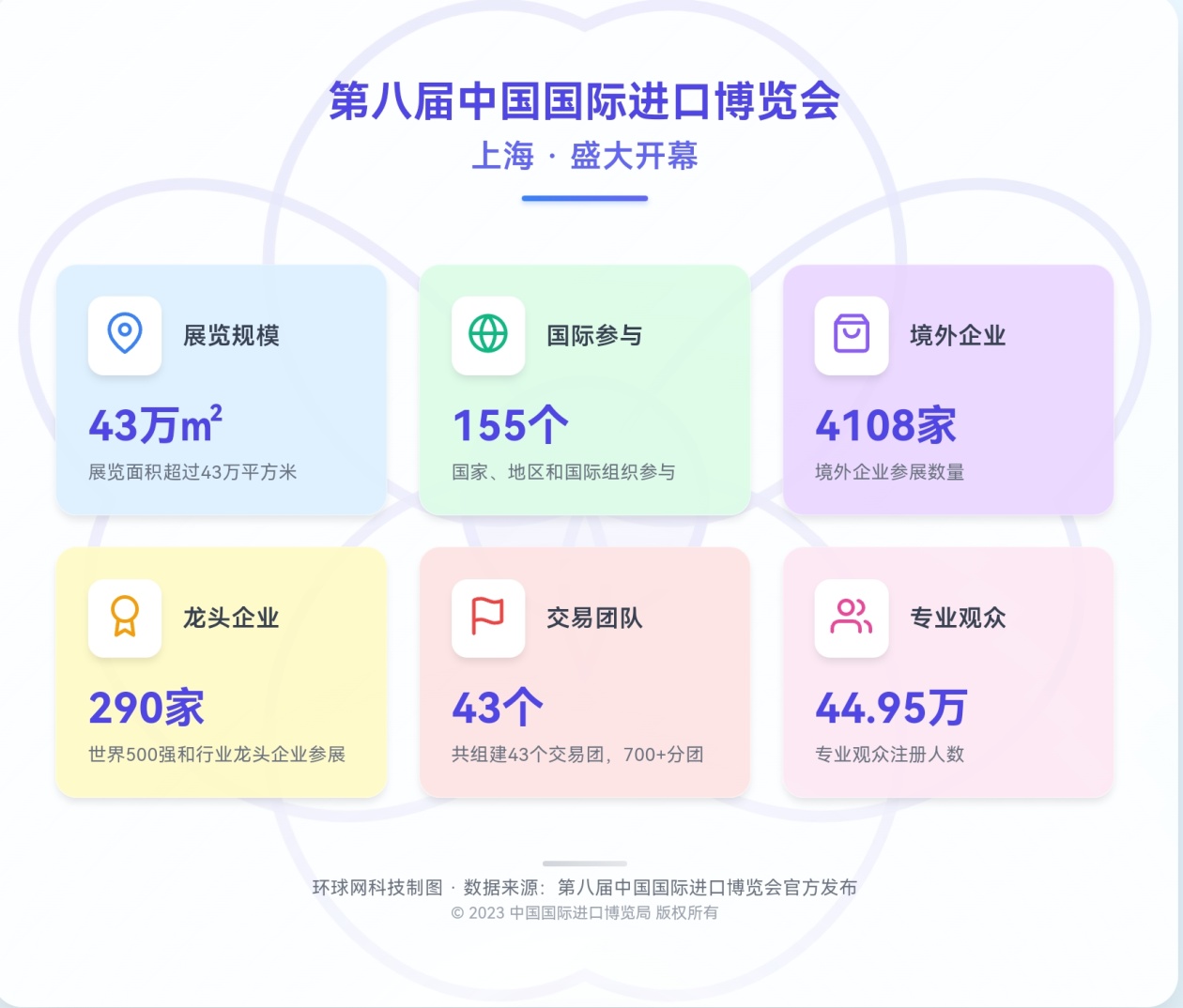
Core Insights - The 8th China International Import Expo (CIIE) will take place from November 5 to 10, 2025, in Shanghai, featuring participation from 155 countries and regions, with 4,108 foreign enterprises exhibiting, marking a record exhibition area of over 430,000 square meters [1][15]. Group 1: Participation and Growth - The number and quality of participating enterprises have significantly increased, with 290 Fortune Global 500 and industry-leading companies across various sectors such as healthcare, automotive, consumer goods, and technology [3][15]. - The number of enterprises from Belt and Road Initiative countries has increased by 23.1% year-on-year, highlighting the expo's inclusivity and leadership as a global public product [3]. Group 2: Exhibition Highlights - The exhibition area has surpassed 430,000 square meters, equivalent to 60 standard football fields, indicating high demand for exhibition space, with many companies securing their spots a year in advance [3][15]. - Over 400 new products, technologies, and services are expected to debut globally or in Asia, covering cutting-edge fields such as green energy, life sciences, and artificial intelligence [5]. Group 3: Notable Exhibitors and Innovations - Burberry showcased a Shanghai limited edition collection, emphasizing its commitment to the Chinese market and the importance of the CIIE as a platform for brand engagement [4]. - Siemens Healthineers presented three new photon-counting CT devices, with two expected to be produced locally in China by 2026, enhancing China's capabilities in high-end medical equipment manufacturing [7][8]. Group 4: Long-term Commitment and Market Confidence - Companies like Bayer and Siemens have demonstrated long-term commitment to the Chinese market, with Bayer launching a new crop health brand and Siemens focusing on integrating AI into industrial applications [12][13]. - The presence of "full attendance" companies at the expo reflects their recognition of the platform's value and their confidence in the Chinese market's potential [9][13].
极飞科技发布新一代智慧农业机器人
Zhong Guo Zheng Quan Bao· 2025-11-06 03:13
Core Insights - The conference held by XAG Technology focused on "Smart Farms, Continuous Evolution," showcasing new agricultural robots aimed at transforming agricultural production methods [1] - XAG Technology has been addressing real farmer needs for 18 years, bridging the digital divide between urban and rural areas, and lowering the barriers for farmers to adopt technology [1] Product Launches - The newly launched P Series 2026 agricultural drones include P200, P150 Ultra, and P120 models, designed for diverse tasks such as spraying, sowing, and aerial surveying, facilitating a transformation in agricultural practices [2] - The P200 model has a maximum takeoff weight of 149.9 kg and features a quick-release design for task system switching, while the P150 Ultra can carry 80 kg and is optimized for high-frequency operations [2] - The P120 model has a maximum load of 55 kg, with a 50-liter pesticide tank and a 90-liter material tank, catering to various operational needs [2] Smart Farming Solutions - The FBV 2026 smart electric valve enhances leak-proof performance and allows precise control of water and fertilizer flow for more uniform irrigation, with automated features accessible via the XAG Farm App [2] - The intelligent fertilization system integrates automatic fertilizer dissolution, precise application, and remote management, enabling farmers to perform tasks without frequent field visits [2] Autonomous Agricultural Equipment - The APC 4 autonomous driving device is crucial for establishing a fully automated agricultural operation system, with a simple installation process that takes only 20 minutes and compatibility with various agricultural machinery [3] - The flagship version of the APC 4 features enhanced computing power, a 5-megapixel ultra-high-definition camera, and mapping capabilities, allowing for the automatic generation of high-definition farm maps and intelligent route planning [3]

高效转化农业科技创新成果
Jing Ji Ri Bao· 2025-11-05 22:00
Group 1 - The core viewpoint emphasizes the importance of accelerating the efficient transformation and application of major scientific and technological achievements in agriculture to enhance innovation, competitiveness, and overall productivity [1] - The establishment of a comprehensive agricultural science and technology innovation and promotion service system, which includes over 800 agricultural research institutions, more than 120,000 researchers, and 400,000 grassroots agricultural technology promotion personnel, is highlighted [1] - The contribution rate of agricultural technology progress in China exceeds 63%, indicating a strong foundation for food security and rural modernization [1] Group 2 - The strategy focuses on leveraging the advantages of a new type of national system to strengthen agricultural science and technology strategic forces, emphasizing the need for a well-structured innovation system [2] - The plan aims to cultivate a large number of professionals who are knowledgeable and passionate about agriculture, ensuring that research effectively supports the agricultural industry [2] Group 3 - Key agricultural technologies, particularly in seed and soil management, are identified as critical areas for innovation to overcome existing challenges [3] - The importance of enhancing the quality of arable land through technological advancements is underscored, along with the need for breakthroughs in various agricultural technologies [3] Group 4 - The need to improve the mechanism for the transformation of scientific achievements is stressed, aiming to bridge the gap between research and production [4] - The integration of research, production, and market demands is essential for the effective application of agricultural scientific achievements [4]
镇江8项成果斩获“中国好技术”称号 获奖规格和数量均创历史之最
Zhen Jiang Ri Bao· 2025-11-04 23:35
Group 1 - The 2024 "China Good Technology" selection results have been announced, with 8 technologies awarded the title and all 10 submitted achievements included in the project database, marking a historic high for Zhenjiang's technological innovation [1] - The "China Good Technology" selection is initiated by the China Productivity Promotion Center Association, aimed at discovering innovative technologies that are close to daily life and benefit the public, promoting the transformation of scientific and technological achievements [1] - The submission process involved customized one-on-one guidance and full-process tracking by the Zhenjiang Productivity Promotion Center, incorporating enterprises, research institutes, and medical institutions for a diversified application model [1] Group 2 - Since organizing participation in 2018, the Zhenjiang Productivity Promotion Center has facilitated 43 units to submit projects, with 29 achievements awarded the "China Good Technology" title and 22 included in the project database [2] - The center aims to continue providing services for industry-academia-research collaboration and the transformation of scientific and technological achievements, stimulating the vitality of various innovative entities [2] - The goal is to convert more "good technologies" into "good products," injecting new momentum into the deep integration of technological and industrial innovation in Zhenjiang [2]
石家庄万保合农业科技有限公司成立 注册资本10万人民币
Sou Hu Cai Jing· 2025-11-04 23:12
Core Viewpoint - The establishment of Shijiazhuang Wanbaohe Agricultural Technology Co., Ltd. indicates a growing focus on agricultural technology and sustainable practices in the industry [1] Company Summary - Shijiazhuang Wanbaohe Agricultural Technology Co., Ltd. has been recently founded with a registered capital of 100,000 RMB [1] - The legal representative of the company is Wang Yaliang [1] Business Scope - The company’s business scope includes general projects such as agricultural scientific research and experimental development, research and development of composite microbial fertilizers, and bio-organic fertilizers [1] - It also focuses on wastewater treatment and its recycling, livestock manure treatment and utilization, and the resource utilization of agricultural and forestry waste [1] - Additional activities include the sale of fertilizers and chemical fertilizers, solid waste management, soil pollution control and remediation services, and comprehensive utilization of agricultural and forestry waste [1] - The company is authorized to produce fertilizers and feed, provide urban household waste management services, and handle kitchen waste, subject to necessary approvals [1]
促进小农户和现代农业发展有机衔接
Ren Min Ri Bao· 2025-11-04 22:02
Core Insights - The modern agricultural industrial park model aims to enhance agricultural productivity and value through a combination of production, processing, technology, sustainability, and branding [1] - As of the end of 2024, the average output value of these parks is projected to be nearly 9 billion yuan, demonstrating significant industrial agglomeration effects [1] Group 1: Achievements - A total of 400 modern agricultural industrial park projects have been approved by the Ministry of Agriculture and Rural Affairs and the Ministry of Finance [1] - The ratio of agricultural processing value to total agricultural output in these parks averages 3.2:1, surpassing the national average [1] - Nearly 60 agricultural brands, such as Wuchang rice and Anhua black tea, have been developed, each valued over 10 billion yuan [1] - The parks have established 1,830 research and innovation platforms, including expert workstations and technology institutes, leading to innovations like autonomous high-power agricultural machinery [1] - Over 10 million people have found employment in these parks, with more than 70% of farmers establishing benefit-sharing relationships with new agricultural operators [1] - The average disposable income for farmers in these parks is 33,000 yuan, which is higher than the national average [1] Group 2: Challenges and Future Directions - The construction of these parks faces challenges such as insufficient extension of the industrial chain, inadequate resource aggregation, and low levels of specialized management [2] - The "14th Five-Year Plan" emphasizes the need for high-quality development of modern agricultural industrial parks, focusing on integrating technological, green, quality, and brand agriculture [2] - There is a call to strengthen the industrial chain and promote the integration of resources to enhance overall agricultural production capacity and quality [2]