
金融市场

Search documents
5%军费目标背后的冰冷事实:欧洲“国防支出潮”难当经济增长引擎
智通财经网· 2025-07-15 10:04
Group 1 - European leaders' commitment to significantly increase military spending is not primarily driven by economic growth motives, but it is expected to support the European economy from 2025 onwards, preventing a deep economic recession [1] - The MEGA (Make Europe Great Again) initiative has gained traction among investors, with European stock markets outperforming U.S. markets, driven by military investment and a favorable valuation setup compared to high U.S. stock valuations [1][2] - Military and defense stocks have seen substantial inflows, with military spending being a key driver for the European stock market's performance relative to the U.S. [2] Group 2 - NATO's military spending in Europe is projected to rise from 2% to 5% of GDP by 2035, but historical data suggests that defense spending does not significantly boost economic output [3][4] - The fiscal multiplier for military spending in Europe is estimated to be low, with a potential increase of only 0.5% in GDP for every 100 euros spent on defense [3][4] - The actual increase in military spending may not lead to a robust economic recovery, especially for countries with stagnant economies [4] Group 3 - The effectiveness of military spending depends on financing methods; borrowing for military expenses may yield better economic growth than tax increases [6] - Investment in research and development is crucial, as the EU currently allocates only 4.5% of its military budget to R&D, compared to 16% in the U.S. [6] - European countries need to focus on domestic production of military equipment, as over 80% of current procurement relies on imports, primarily from the U.S. [6][7] Group 4 - The disparity in economic benefits from military spending among European countries is evident, with Germany poised to benefit more due to its early commitment to increase defense spending [7] - France and the UK face fiscal constraints that may limit their ability to achieve significant economic growth from military expansion [7] - The focus on GDP targets may lead to misguided defense policies, emphasizing spending without addressing actual equipment needs and costs [7][8]
大类资产早报-20250715
Yong An Qi Huo· 2025-07-15 08:11
Report Summary 1. Report Industry Investment Rating - No information provided in the given content. 2. Core View of the Report - No clear core view is presented in the provided text. It mainly offers data on global asset market performance, including bond yields, exchange rates, stock indices, and trading data for stock and bond futures. 3. Summary by Related Catalogs Global Asset Market Performance - **10 - Year Treasury Bond Yields**: On July 14, 2025, the 10 - year Treasury bond yields in the US, UK, France, etc., showed different levels and changes. For example, the US yield was 4.435 with a latest change of 0.024, a one - week change of 0.054, a one - month change of - 0.013, and a one - year change of 0.075 [2]. - **2 - Year Treasury Bond Yields**: The 2 - year Treasury bond yields of the US, UK, Germany, etc., also had various values and fluctuations. For instance, the US yield was 3.860 on July 14, 2025, with a latest change of 0.000, a one - week change of - 0.020, a one - month change of 0.160, and a one - year change of - 0.880 [2]. - **Dollar Exchange Rates Against Major Emerging Economies' Currencies**: The dollar exchange rates against currencies like the Brazilian real, Russian ruble, etc., had different changes. For example, the exchange rate against the Brazilian real was 5.588 on July 14, 2025, with a latest change of 0.51% and a one - week change of 1.84% [2]. - **Stock Indices of Major Economies**: Stock indices such as the S&P 500, Dow Jones, etc., had different closing prices and percentage changes. For example, the S&P 500 closed at 6268.560 on July 14, 2025, with a latest change of 0.14%, a one - week change of 0.62%, a one - month change of 3.90%, and a one - year change not provided [2]. - **Credit Bond Indices**: Different credit bond indices, including US investment - grade, euro - zone investment - grade, etc., had different changes. For example, the US investment - grade credit bond index had a latest change of - 0.01%, a one - week change of - 0.25%, a one - month change of 0.75%, and a one - year change of 5.51% [2]. Stock Index Futures Trading Data - **Index Performance**: Data on A - shares, CSI 300, SSE 50, ChiNext, and CSI 500 index performance were presented, but closing prices and percentage changes were not provided [3]. - **Valuation**: The PE (TTM) of CSI 300, SSE 50, CSI 500, S&P 500, and German DAX were 13.33, 11.41, 29.47, 26.66, and 20.67 respectively, with corresponding环比 changes [3]. - **Risk Premium**: The risk premium of S&P 500 was - 0.68 and that of German DAX was 2.11, with corresponding环比 changes [3]. - **Fund Flow**: The latest values of fund flow for A - shares, the main board, small - and medium - sized enterprise board, ChiNext, and CSI 300 were - 624.53, - 461.96, not provided, - 140.10, and - 139.09 respectively, and the 5 - day average values were also presented [3]. Treasury Bond Futures Trading Data - **Closing Prices and Percentage Changes**: The closing prices of Treasury bond futures T00, TF00, T01, and TF01 were 108.730, 105.920, 108.775, and 106.005 respectively, with percentage changes of - 0.01%, 0.00%, - 0.00%, and 0.00% [4]. - **Funding Rates**: The funding rates R001, R007, and SHIBOR - 3M were 1.4837%, 1.5426%, and 1.5610% respectively, with daily changes of - 3.00, 3.00, and 0.00 BP [4].
突发!全线大跌,特朗普关税威胁
Zhong Guo Ji Jin Bao· 2025-07-11 10:32
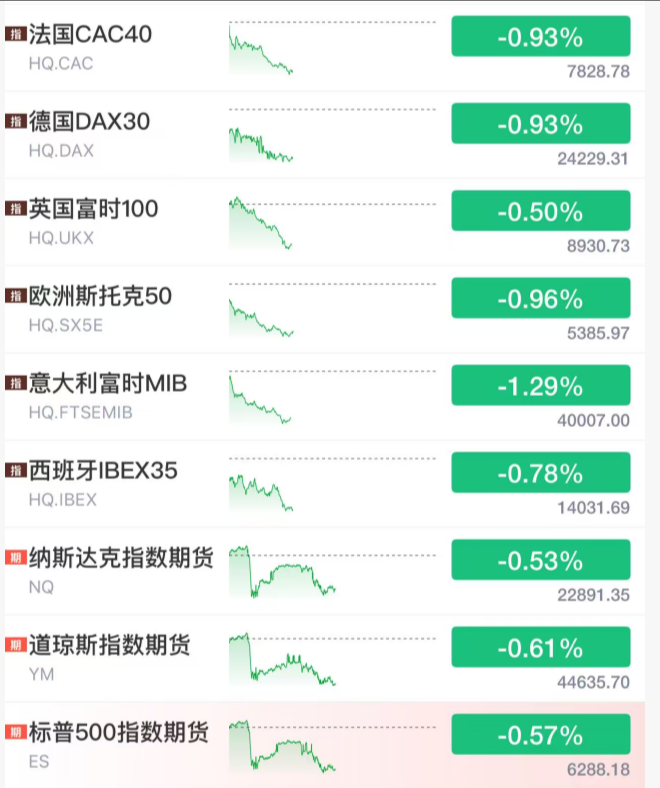
Group 1 - European stock markets experienced a decline, with the Italian FTSE MIB index falling approximately 1.3% and dropping below 40,000 points. The Euro Stoxx 50 index, German DAX index, French CAC40 index, and UK FTSE 100 index also saw declines of about 1%, 1%, 0.93%, and 0.5% respectively [1][2] - Concerns over tariffs were a significant factor behind the collective drop in European stock markets, as President Trump announced plans to impose blanket tariffs of 15% or 20% on most trading partners [2][3] - Trump indicated that the current standard for blanket tariffs is 10%, and he expressed confidence that these tariffs would be well-received, despite the potential negative impact on the stock market and inflation [3][4] Group 2 - The U.S. Labor Statistics indicated that inflation has eased since the COVID-19 pandemic but remains above 2.3%. Trump dismissed concerns raised by the CEO of Hasbro regarding potential price increases for toys due to tariffs, suggesting that domestic production would mitigate such price hikes [5][6] - Trump sent letters to 22 countries establishing tariff rates, including a 50% tariff on imports from Brazil and copper imports, with plans for implementation next month. This action is part of a broader strategy that has yet to yield any formal trade agreements [5][6] - The EU, as the largest trading partner of the U.S., imported over $600 billion worth of goods from the U.S. last year, while Canada imported over $400 billion. The EU is prepared to implement over $100 billion in retaliatory tariffs targeting goods from Republican-controlled states [6]

突发!全线大跌,特朗普关税威胁!
中国基金报· 2025-07-11 10:14
【导读】 白宫料将向欧盟发出关税信,欧洲股市应声下跌 中国基金报记者 泰勒 大家好,关注一下欧洲股市的消息。 北京时间7月11日傍晚,欧洲股市跌幅扩大,意大利富时MIB指数失守40000点,日内跌约 1.3%。欧洲斯托克50指数、德国DAX指数跌约1%,法国CAC40指数跌0.93%,英国富时 100指数跌0.5%。 欧洲股市集体下跌的背后,是对关税的担忧。 特朗普周四表示,他计划对大多数贸易伙伴征收15%或20%的普遍性关税(blanket tariffs),并淡化了进一步加征关税可能对股市或通胀造成负面影响的担忧。 特朗普在电话采访中说:"我们会宣布,剩下的所有国家都要缴纳,不管是20%还是15%,我 们现在会把这个定下来。"目前普遍性关税的标准是10%。 特朗普还说:"我认为这些关税受到了非常好的欢迎。今天股市创下新高。" 标普500指数周四收盘创下历史新高,但这是在经历了几个月剧烈震荡之后出现的。今年4月 2日特朗普宣布首轮全球关税后,标普500指数在接下来的几天内经历了历史上最快速的20% 跌幅之一。 当天,特朗普还无视孩之宝CEO关于关税可能导致玩具价格在今年晚些时候上涨的警告。 特朗普说:"如果 ...

大类资产早报-20250711
Yong An Qi Huo· 2025-07-11 09:04
Report Information - Report Title: Global Asset Market Performance Report - Report Date: July 11, 2025 - Research Team: Research Center Macro Team [2] Global Asset Market Performance 10 - Year Treasury Yields of Major Economies - On July 10, 2025, yields in the US, UK, France, etc. were 4.351%, 4.595%, 3.397% respectively. Yields in Japan, Brazil, China were 3.873%, 6.548%, 1.660% respectively. - Latest changes ranged from 0.003% (US) to 0.123% (France). Weekly changes ranged from - 0.010% (US) to 0.241% (Spain). Monthly changes ranged from -0.495% (Italy) to 0.348% (US). Annual changes ranged from -0.870% (Japan) to 0.398% (Germany) [3] 2 - Year Treasury Yields of Major Economies - On July 10, 2025, yields in China (1Y), US, UK were 3.900%, 3.853%, 1.887% respectively. - Latest changes ranged from -0.022% (US) to 0.120% (China). Weekly changes ranged from 0.008% (Korea) to 0.119% (Australia). Monthly changes ranged from -0.042% (Italy) to 0.150% (China). Annual changes ranged from -1.374% (Japan) to 0.398% (Germany) [3] US Dollar to Major Emerging - Economy Currency Exchange Rates - On July 10, 2025, exchange rates against the US dollar for Brazil, Russia, South Africa were 5.532, 108.000, 17.747 respectively. - Latest changes ranged from -0.73% (Brazil) to 0.00% (Russia). Weekly changes ranged from -0.14% (Korea) to 2.27% (Brazil). Monthly changes ranged from -0.16% (South Africa) to 1.23% (Korea). Annual changes ranged from -11.28% (Thailand) to 0.00% (Russia) [3] RMB Exchange Rates - On July 10, 2025, on - shore RMB was 7.178, off - shore RMB was 7.179, and the mid - price was 7.151. - Latest changes ranged from -0.05% (off - shore RMB) to 0.07% (12 - month NDF). Weekly changes ranged from -0.02% (mid - price) to 0.13% (12 - month NDF). Monthly changes ranged from -0.41% (mid - price) to 0.09% (12 - month NDF). Annual changes ranged from -1.75% (off - shore RMB) to 0.31% (mid - price) [3] Major Economies' Stock Indexes - On July 10, 2025, the Dow Jones was 6280.460, S&P 500 was 44650.640, and NASDAQ was 20630.660. - Latest changes ranged from -0.79% (Spanish index) to 1.23% (UK index). Weekly changes ranged from -1.99% (Mexican index) to 2.18% (German DAX). Monthly changes ranged from -1.88% (Mexican index) to 4.92% (NASDAQ). Annual changes ranged from 4.83% (French CAC) to 34.64% (German DAX) [3] Emerging Economies' Stock Indexes - On July 10, 2025, the Malaysian index was 1536.520, Australian index was 8826.717, and another index was 1231.260. - Latest changes ranged from 0.28% to 0.56%. Weekly changes ranged from -0.81% to -0.08%. Monthly changes ranged from 0.35% to 2.37%. Annual changes ranged from -3.84% to 14.03% [3] Credit Bond Indexes - Latest changes ranged from -0.11% (Emerging economies high - yield credit bond index) to 0.09% (US high - yield credit bond index). - Weekly changes ranged from -0.16% (Emerging economies high - yield credit bond index) to 0.33% (US high - yield credit bond index). - Monthly changes ranged from 0.15% (Emerging economies high - yield credit bond index) to 1.53% (Eurozone high - yield credit bond index). - Annual changes ranged from 6.41% (Emerging economies high - yield credit bond index) to 15.38% (Eurozone high - yield credit bond index) [3] Stock Index Futures Trading Data Index Performance - On July 10, 2025, the A - share index closed at 3509.68, with a 0.48% increase. The CSI 300 closed at 4010.02, with a 0.47% increase [4] Valuation - PE (TTM) of CSI 300 was 13.34, with a 0.07% increase. PE (TTM) of S&P 500 was 26.71, with a 0.08% increase [4] Risk Premium - The risk premium of CSI 300 was 3.70, with no change. The risk premium of S&P 500 was -0.61, with a -0.03% change [4] Fund Flow - The latest A - share fund flow was -256.13, and the 5 - day average was -339.44. The latest CSI 300 fund flow was 120.60, and the 5 - day average was 33.10 [4] Trading Volume - The latest trading volume of the Shanghai and Shenzhen stock markets was 14941.48, with a -110.28 change. The latest trading volume of CSI 300 was 3478.37, with a 424.38 change [4] Main Contract Premium/Discount - The basis of IF was -38.02, with a -0.95% discount. The basis of IH was -16.53, with a -0.60% discount [4] Treasury Bond Futures Trading Data Closing Prices and Changes - On July 10, 2025, the closing prices of T00, TF00, T01, TF01 were 108.845, 105.990, 108.890, 106.095 respectively, with changes of 0.03%, 0.02%, 0.03%, 0.01% respectively [5] Funding Rates - R001 was 1.3870%, with a -11.00 BP change. R007 was 1.5208%, with a 2.00 BP change. SHIBOR - 3M was 1.5590%, with no change [5]
【环球财经】被加征50%关税后 巴西金融市场震荡
Xin Hua Cai Jing· 2025-07-11 00:29
Group 1 - The announcement by President Trump to impose a 50% tariff on all exports from Brazil has led to significant volatility in the Brazilian financial market, with the Ibovespa index falling by 0.54% to 136,743.26 points and the USD/BRL exchange rate rising by 0.69% to 5.5416 BRL [1] - The new tariff, effective from August 1, is a substantial increase from the previously proposed 10% tariff announced in April, raising concerns about the impact on Brazil's industrial exports and the overall economic relationship between the two countries [1][2] - Brazil's Vice President Alckmin criticized the tariff increase, stating that Brazil's trade with the U.S. is balanced and that the measure is unfair, potentially harming the U.S. economy as well [1] Group 2 - The Brazilian economy is facing greater policy coordination challenges due to the sudden shift in external trade conditions and increasing inflationary pressures, as indicated by the rising consumer price index [3]
初步数据显示,欧洲STOXX 600指数收涨0.51%,报552.75点。欧元区STOXX 50指数收跌0.11%,报5439.75点。
news flash· 2025-07-10 15:40
欧元区STOXX 50指数收跌0.11%,报5439.75点。 初步数据显示,欧洲STOXX 600指数收涨0.51%,报552.75点。 ...
特朗普关税威胁震动巴西市场,股汇双双下跌
news flash· 2025-07-10 12:50
Core Viewpoint - The threat of a 50% tariff on all goods from Brazil by Trump has caused significant turmoil in the Brazilian financial markets, leading to declines in both currency and stock indices [1] Market Reaction - The Brazilian real fell by 0.8% against the US dollar, continuing its previous day's decline [1] - Stock index futures dropped by 1.5% [1] - Interest rate swap contracts experienced a widespread decline [1] - In the New York market, the iShares MSCI Brazil ETF saw a pre-market drop of 3.2% [1] Trade Policy Implications - Brazil has re-entered Trump's trade policy focus after months of relative calm, leading to expectations of increased market volatility in the short term [1] - The proposed tariff is significantly higher than the previously anticipated 10% base rate [1] - Uncertainty remains regarding how effective negotiations between the two countries can be conducted [1] Analyst Insights - Analyst Ilan Albertman from Ativa noted that this tariff threat adds new risk factors to Brazilian local assets, potentially leading to greater volatility [1] - Companies with significant exposure to the US market may need to reassess their cash flows and valuations in light of this development [1]
“互联互通”新十年,两地资本市场规则或将趋于一致
Sou Hu Wang· 2025-07-09 01:42
Group 1 - The year 2025 marks the beginning of a new decade for the interconnection between mainland and Hong Kong capital markets, with expectations for deeper integration [1] - Since the launch of the Shanghai-Hong Kong Stock Connect in 2014, the range of interconnected financial products has expanded from stocks to various other financial instruments, including ETF Connect and Bond Connect [1] - The average daily trading volume for northbound and southbound trading has increased significantly, with a 21-fold and 40-fold growth respectively compared to the first month of operation in 2014 [1] Group 2 - Industry experts emphasize the need to simplify trading processes and align institutional, informational, and technical elements to enhance the integration of stock markets [1] - Current rules for the Hong Kong Stock Connect are complex, leading to difficulties for investors in understanding the criteria for inclusion and exclusion of stocks [1][2] - The calculation method for market capitalization under the Hong Kong Stock Connect has not been updated to align with the new methodology adopted by the Hang Seng Index, which could lead to misinterpretations by investors [2] Group 3 - The adjustment in the Hang Seng Index's calculation method is seen as more scientific, potentially increasing the quality of stocks eligible for the Hong Kong Stock Connect [2] - There are expectations that the rules for the Hong Kong Stock Connect will be revised to match the Hang Seng Index's calculation method by the second half of 2025 [3] - The deepening of interconnectivity is viewed as crucial for the development of both capital markets, enhancing their international competitiveness and facilitating high-quality growth [3]
央行金融市场司江会芬:债券通“南向通”参与投资者将扩容至非银机构
news flash· 2025-07-08 05:57
Group 1 - The People's Bank of China announced three new measures to enhance the interconnection between the mainland and Hong Kong financial markets, supporting the development of the offshore RMB market [1] - The measures include improving the operational mechanism of the Bond Connect "Southbound" channel, allowing more domestic investors to invest in the offshore bond market [1] - The scope of domestic investors will soon be expanded to include four types of non-bank institutions: securities firms, funds, insurance companies, and wealth management [1]