工业机器人

Search documents
维尔利:与Primech Holdings Ltd.签署战略合作框架协议
Xin Lang Cai Jing· 2025-12-12 10:54
Core Viewpoint - The company has signed a Strategic Cooperation Framework Agreement with Primech Holdings Ltd. to collaborate on industrial robot technology innovation and application in high-risk and complex environments [1] Group 1: Agreement Details - The agreement involves the establishment of a joint venture with a registered capital of 1 million Singapore dollars, where the company holds a 70% stake and PMEC holds a 30% stake [1] - The company has also secured an equity subscription option for PMEC's subsidiary, Primech AI, with a total investment not exceeding 9 million US dollars [1] - The cooperation period is set for 5 years from the date of signing the agreement [1]

成长与周期共舞
HTSC· 2025-12-11 05:47
Group 1: Engineering Machinery - Domestic demand for excavators is expected to recover to around 120,000 units in 2025, with a year-on-year increase of 19.6% in the first ten months of 2025 [1][15] - The export of excavators reached 93,800 units in the first ten months of 2025, showing a year-on-year increase of 14.4%, with an expected annual growth rate of around 15% [1][29] - The recovery in domestic demand is primarily driven by small excavators, reflecting increased demand for machinery in rural and small-scale water conservancy projects [15][20] Group 2: Shipbuilding and Offshore Engineering - The global shipbuilding industry saw a decline in new orders, with a total of 9,483.31 million deadweight tons in the first ten months of 2025, down 44.67% year-on-year [2] - The shipbuilding price index has shown a general decline, but there is a recovery in orders for bulk carriers and oil tankers in October 2025 [2] - The upcoming replacement cycle in shipbuilding, combined with tightening global environmental policies, is expected to drive a new round of demand growth [2] Group 3: Cyclical Industries - The cyclical sector is showing signs of recovery in 2025, supported by low baselines and the expansion into new industries [3] - The industrial control market is rebounding, with a notable increase in the OEM market, while project-based markets are showing weaker performance [3] - The industrial robot market is expected to grow by over 10% year-on-year in 2025, indicating a sustained recovery [3] Group 4: AI and Robotics - The AI sector is driving significant changes in various industries, with a focus on humanoid robots, data center equipment, and vertical applications [4] - The demand for data center backup power sources is increasing due to global capacity shortages, with domestic alternatives expected to accelerate [4] - The introduction of humanoid robots is becoming a reality, with significant production plans announced by companies like Tesla for 2026 [4] Group 5: Investment Recommendations - The report recommends focusing on the engineering machinery sector, particularly companies like SANY Heavy Industry, XCMG, and LiuGong, which are expected to benefit from domestic and international demand [5][9] - In the shipbuilding and offshore engineering sector, China International Marine Containers (CIMC) is highlighted as a potential beneficiary of the recovery [5][9] - The AI and robotics sector presents investment opportunities in companies like Weichuang Electric and Jack Technology, which are positioned to benefit from the ongoing industrial transformation [5][9]





朝阳科技:2023年成立星联技术主营连接器,聚焦新能源汽车等领域
Jin Rong Jie· 2025-12-10 03:41
Group 1 - The core business of the company includes acoustic products (headphones, speakers) and precision components, serving globally recognized terminal brand clients [1] - In 2023, the company established a subsidiary, Xinglian Technology, focusing on connectors for sectors such as new energy vehicles, energy storage, industrial robots, and consumer electronics [1] - Xinglian Technology is actively integrating resources, conducting product research and development, expanding customer outreach, and advancing trial and mass production based on customer needs [1] Group 2 - The company aims to enhance its connector business by strengthening product development, diversifying product selection, and improving customer development and service [1] - The future order volume is contingent on customer demand and the company's business expansion efforts, indicating a level of uncertainty [1]

追“风”弄“潮”启新程——广东揭阳打造粤东高质量发展新增长极见闻
Xin Hua Wang· 2025-12-10 02:11
Group 1: Offshore Wind Power - The average annual wind speed over the sea is approximately 7.2 meters per second, with the most powerful wind turbine generating 21.6 degrees of electricity per rotation. The installed capacity of offshore wind projects in Jieyang has exceeded 900,000 kilowatts [1] - Three offshore wind power projects have been put into operation by the company in Jieyang, contributing to the local green electricity supply [1] Group 2: Green Petrochemical Industry - The company has built an oil terminal in Jieyang that has received over 60 million tons of crude oil from regions including the Americas, the Middle East, and Africa over the past three years [3] - The integrated refining and chemical project is the only domestic facility capable of processing low-quality heavy oil, with over 3 million tons of various refined products exported this year [3] - The Dannan Sea Petrochemical Industrial Zone aims to create a trillion-level green petrochemical industry cluster by promoting a full industrial chain from raw materials to end products [3] Group 3: E-commerce and Traditional Industries - The Guangdong Ming Shu Ling Nan Cross-border E-commerce Industrial Park provides one-stop services for over 30 small and medium-sized enterprises, leveraging e-commerce and live streaming to boost sales of traditional textile and apparel products [4] - The cross-border e-commerce import and export volume from Puning is expected to exceed 53 million yuan in 2024 [4] Group 4: Cultural Heritage and Tourism - The Nanshan Yingge Cultural Heritage Base in Puning has gained international attention, with performances scheduled in London, showcasing the local intangible cultural heritage [6] - A large-scale live-action show titled "Yingge Emotion," with an investment of 120 million yuan, attracted over 30,000 viewers during the 2025 Spring Festival, significantly boosting local dining and accommodation sectors by 102% [6] - The renovation of the ancient city of Jieyang is ongoing, with a focus on restoring historical buildings and enhancing cultural tourism experiences [7]

解码埃斯顿的价值跃升之路,三重引擎驱动“工业机器人第一股”
Ge Long Hui· 2025-12-10 01:28
Core Viewpoint - Estun Automation's successful filing for a Hong Kong IPO marks a significant step in its strategy to establish an "A+H" dual capital platform, positioning the company to leverage the rapid growth of the global industrial automation market and China's manufacturing sector [1] Group 1: Technology-Driven Competitive Edge - Estun's core strategy is to achieve full control over the industrial chain, from key components to complete robots and industry solutions, underpinned by a strong technological foundation [2] - The company has significantly increased its R&D investment from 402 million yuan in 2022 to 503 million yuan in 2024, with R&D accounting for 12.5% of revenue, well above the industry average [4] - Estun has a robust R&D team of over 1,000 employees, holding 610 patents and 433 software copyrights, and has participated in multiple significant national projects, showcasing its technological strength [6] - The company has developed a 700kg heavy-duty industrial robot that has been recognized as a benchmark product in China, achieving 100% localization of core components [6] - Estun's robots have received the first TÜV CE functional safety certificate in China, enhancing its credibility in international markets, particularly in Europe [7] Group 2: Global Expansion Strategy - Estun's overseas revenue has consistently accounted for about 34% of total revenue, with gross profit contribution from international markets rising from 31.2% to 39.1% over three years, indicating strong market presence [10][11] - The company operates 75 service points and 7 manufacturing bases globally, with a new facility in Poland set to enhance its European production capabilities [12] - Strategic acquisitions have accelerated Estun's global expansion, including the purchase of high-end motion control and welding technology companies, which have strengthened its market position [12] Group 3: Dual Capital Platform for Long-Term Growth - The Hong Kong IPO is timely, coinciding with a booming global industrial robot market projected to grow from $14.7 billion in 2020 to $25.4 billion in 2024, with a CAGR of 15.4% [14] - Funds raised will be directed towards global capacity expansion, upstream and downstream investments, and R&D projects, particularly in integrating AI with robotics [15] - Estun is also venturing into humanoid robotics, aiming to lead in the field of embodied intelligence, with the launch of its second-generation humanoid robot [15] - The establishment of an innovation center aims to consolidate industry resources and accelerate the application of cutting-edge technologies [16] - The dual capital platform enhances Estun's international visibility and governance, allowing for more strategic resource allocation and long-term investment in technology [17]

埃斯顿港股IPO获中国证监会备案
Zhi Tong Cai Jing· 2025-12-09 12:17
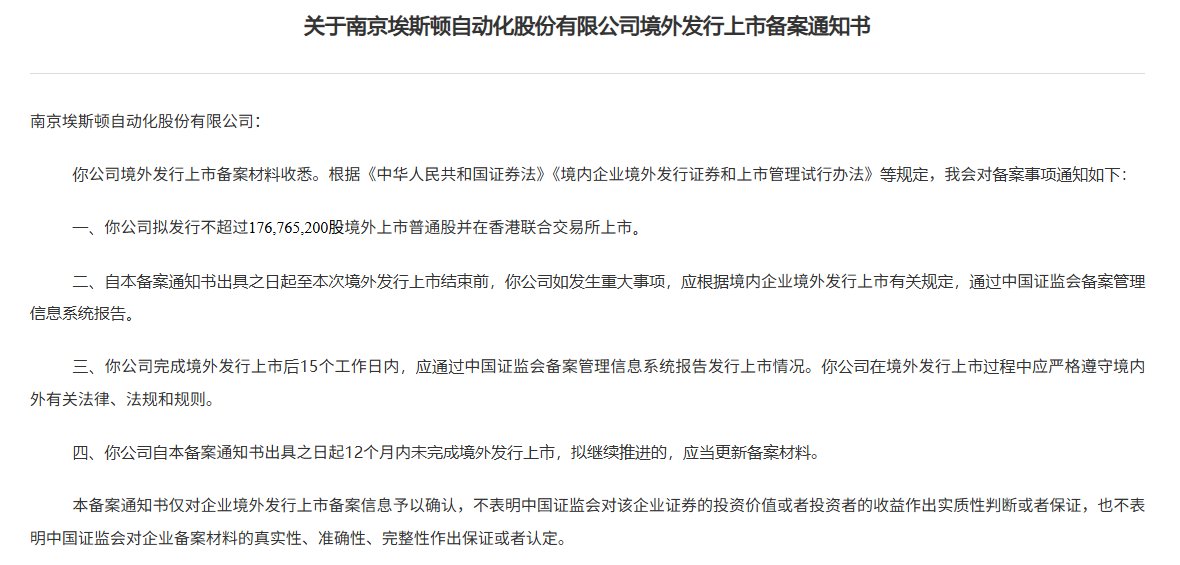
Group 1 - The China Securities Regulatory Commission has issued a notice regarding Nanjing Estun Automation Co., Ltd.'s overseas issuance and listing, with plans to issue no more than 176,765,200 overseas listed ordinary shares on the Hong Kong Stock Exchange [1] - Estun is recognized as a leading Chinese industrial robotics company, maintaining the highest shipment volume among domestic enterprises in the Chinese industrial robotics solutions market for several consecutive years [3] - According to Frost & Sullivan, Estun is projected to achieve a historic milestone in Q1 2025, surpassing foreign brands in domestic industrial robot shipments, becoming the first domestic robot company to lead the Chinese market [3] Group 2 - Financially, Estun reported revenues of approximately 3.881 billion RMB, 4.652 billion RMB, and 4.009 billion RMB for the years 2022, 2023, and 2024, respectively [3] - The company's net profits for the same years were approximately 184 million RMB, 134 million RMB, and a loss of 818 million RMB [3]

新股消息 | 埃斯顿港股IPO获中国证监会备案
Zhi Tong Cai Jing· 2025-12-09 12:17
Group 1 - The core viewpoint of the news is that Nanjing Estun Automation Co., Ltd. plans to issue up to 176,765,200 overseas listed ordinary shares and list them on the Hong Kong Stock Exchange [1] - Estun is recognized as a leading domestic industrial robot company in China, maintaining the highest shipment volume among domestic enterprises in the industrial robot solutions market for several consecutive years [3] - According to Frost & Sullivan, Estun is expected to achieve a historic milestone in Q1 2025, surpassing foreign brands in domestic industrial robot shipments and becoming the first domestic company to lead the Chinese industrial robot solutions market [3] Group 2 - Financially, Estun reported revenues of approximately 3.881 billion RMB, 4.652 billion RMB, and 4.009 billion RMB for the years 2022, 2023, and 2024, respectively [3] - The net profits for the same periods were approximately 184 million RMB, 134 million RMB, and a loss of 818 million RMB for 2022, 2023, and 2024, respectively [3]
新股消息 | 埃斯顿(002747.SZ)港股IPO获中国证监会备案
智通财经网· 2025-12-09 12:10
智通财经APP获悉,12月9日,中国证监会国际合作司发布《关于南京埃斯顿自动化股份有限公司境外发行上市备案通知书》。埃斯顿(002747.SZ)拟发行不 超过176,765,200股境外上市普通股并在香港联合交易所上市。 据招股书,埃斯顿是一家中国工业机器人企业。根据弗若斯特沙利文的资料,该公司在中国工业机器人解决方案市场的国产企业中,出货量连续多年保持第 一。根据同一机构的资料,该公司于2025年第一季度取得历史性突破,国内市场上工业机器人出货量超越外资品牌,成为首家登顶中国工业机器人解决方案 市场的国产机器人企业。 财务方面,于2022年度、2023年度以及2024年度,埃斯顿实现收入分别约为38.81亿元、46.52亿元、40.09亿元人民币;同期年内利润分别约为1.84亿元、1.34 亿元、-8.18亿元人民币。 ...
外贸韧性+政策发力 夯实中国经济“十五五”良好开局根基
Yang Shi Wang· 2025-12-09 07:53
Group 1 - China's total goods trade import and export value reached 41.21 trillion yuan in the first 11 months of this year, a year-on-year increase of 3.6%, with November exports growing by 5.9% [1] - Despite challenges such as international trade friction, China's foreign trade continues to show strong resilience and growth momentum, with expectations for robust export performance to continue into next year [3] - The role of private enterprises in foreign trade has become more prominent, with significant achievements in diversifying market development and the rapid growth of new trade formats and models [6] Group 2 - International institutions, including the OECD, Standard Chartered, and Goldman Sachs, have raised their economic growth forecasts for China, citing strong exports and supportive macro policies as key factors [9] - The Central Political Bureau of the Communist Party of China emphasized the need for a good start to the 14th Five-Year Plan, focusing on better coordination of domestic economic work and international trade, with plans for more flexible economic policies next year [12]
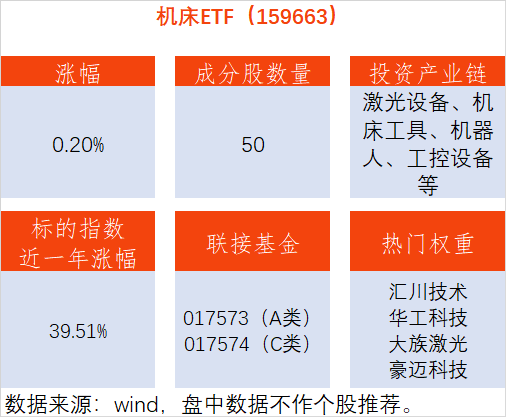
工业机器人快速增长!机床ETF(159663)上涨0.20%,鼎泰高科涨5.35%
Mei Ri Jing Ji Xin Wen· 2025-12-09 03:50
Group 1 - The A-share market showed mixed performance on December 9, with the Shanghai Composite Index down by 0.13%, while sectors such as office supplies, electronic components, and communication equipment saw gains [1] - The machine tool sector remained active, with the Machine Tool ETF (159663) rising by 0.20%. Notable individual stock performances included Ding Tai Gao Ke up by 5.35%, Xin Jie Electric up by 5.10%, and Hao Mai Technology up by 4.08% [1] Group 2 - In 2023, China's industrial robot production and sales maintained rapid growth, with cumulative production reaching 602,700 units, a year-on-year increase of 28.80%, and cumulative sales at 652,700 units, up by 42.51%, surpassing last year's total [3] - Jiang Hai Securities forecasts that domestic companies will benefit from the industry's sustained growth due to factors such as global economic recovery and increasing demand for high-precision, intelligent, and flexible production equipment [3] - The Machine Tool ETF (159663) closely tracks the China Machine Tool Index, which encompasses key areas of high-end equipment manufacturing, including laser equipment, machine tools, robots, and industrial control equipment [3]