保险业

Search documents
音频 | 格隆汇1.8盘前要点—港A美股你需要关注的大事都在这
Xin Lang Cai Jing· 2026-01-07 23:12
1、中国央行连续第14个月增持黄金; 2、商务部:对原产于日本的进口二氯二氢硅发起反倾销立案调查; 3、工信部等八部门联合发文,事关"人工智能+制造"! 4、央行:1月8日开展11000亿元买断式逆回购操作,期限为3个月; 5、机构:内存市场已进入"超级牛市" 一季度将再涨40%-50%; 6、上期所调整白银期货相关合约交易保证金比例和涨跌停板幅度; 7、国内部分焦企召开市场分析会:主动与钢厂沟通稳定价格 对于再提降价的坚决停止发货; 8、离岸人民币兑美元跌130点,报6.9935元; 9、中信证券收盘集合竞价现14.5亿元压盘大单; 10、平安人寿举牌农业银行H股; 11、多家上市公司公告:2025年业绩预亏; 12、"AI六小虎"之一的智谱暗盘收涨6.02% 精锋医疗涨近40% 天数智芯涨超37%; 13、今日港股天数智芯、精锋医疗-B及智谱上市; 14、公告精选︱四川长虹:子公司拟在墨西哥投资建设电视生产工序项目;南京熊猫:尚无与脑机接口 相关的成熟产品,亦未形成相关销售收入; 15、A股投资避雷针︱贝斯美:子公司永安化工收到检察机关起诉书;振芯科技:控股子公司收到违规 处理决定。 来源:格隆汇APP ...
全球大公司要闻 | Anthropic洽谈按3500亿美元估值融资100亿美元
Wind万得· 2026-01-07 23:08
Group 1 - Eli Lilly announced the acquisition of biopharmaceutical company Ventyx Biosciences for over $1 billion to enhance its innovative drug pipeline and R&D capabilities in relevant therapeutic areas [2] - Qualcomm is in talks with Samsung Electronics regarding the outsourcing of 2nm chip manufacturing, planning to shift the Snapdragon 8 Elite processor from TSMC's 3nm to Samsung's 2nm process, with chip design completed and expected to enter mass production soon [2] - Nvidia is collaborating with Lenovo to launch the "Lenovo AI Cloud Super Factory" to accelerate AI deployment and expansion, and is also partnering with Caterpillar to transform heavy industry using physical AI and robotics technology [2] Group 2 - Ping An Life announced that its asset management arm will invest in Agricultural Bank of China H-shares, reaching a 20% stake by December 30, 2025, triggering a stake increase [5] - Baidu Kunlun Chip plans to raise up to $2 billion through a Hong Kong IPO to expand its AI chip business, aiding in technology development and market expansion [5] - Zhipu AI listed on the Hong Kong Stock Exchange under the code "2513," becoming the "first global large model stock" with a valuation expected to reach HKD 51.1 billion [5] Group 3 - Morgan Stanley has reached an agreement to take over Apple’s credit card business from Goldman Sachs, which plans to divest approximately $20 billion in outstanding credit card debt at a discount of over $1 billion [8] - Amazon's Ring will launch a commercial mobile surveillance vehicle priced at $5,000, equipped with 360-degree cameras and wireless connectivity, expected to enter the commercial security market this spring [8] - Alphabet's market capitalization reached $3.88 trillion, surpassing Apple for the first time since 2019, driven by growth in its search engine and AI business [8] Group 4 - Samsung Electronics reported an operating profit of 16.9 trillion KRW (approximately $12.7 billion) for Q4 2025, a 160% year-on-year increase, and announced a stock buyback of 250 trillion KRW (approximately $19 billion) for employee compensation [11] - Toyota's annual sales in the U.S. exceeded 2 million units, with strong performance in SUVs, while GAC Toyota is the only growth driver for GAC Group in 2025 [11] - Hyundai Motor selected Italy's Danieli to supply $650 million worth of metallurgical equipment for its U.S. green factory, accelerating its electrification transition [11]



具身智能机器人把我弄伤了,谁来赔?
Mei Ri Jing Ji Xin Wen· 2026-01-07 13:10
Core Insights - The emergence of embodied intelligent robots is accelerating their penetration into various application scenarios, highlighting the need for insurance coverage as these devices become more prevalent in public spaces [1][3] - Major insurance companies have begun to develop specialized insurance products for robots, covering property damage, third-party liability, and product quality risks, thereby establishing a risk management framework for their commercial use [1][2] Group 1: Insurance Product Development - Leading insurance companies have launched products that cover core risks such as robot body damage and third-party liability, with coverage limits reaching several hundred thousand yuan per unit [2] - The insurance for robot body damage operates on a "full coverage" logic similar to auto insurance, encompassing various scenarios including operational errors and cyber-attacks [2] - Third-party liability insurance includes coverage for design defects, external interaction module failures, and accidents during use, with flexible terms for different stakeholders [2][6] Group 2: Market Demand and Trends - The commercialization of embodied intelligent robots is driving a surge in insurance demand, with predictions that the robot leasing market could reach 10 billion yuan by 2026 [3][4] - The insurance landscape is evolving to address new risks associated with robots, extending coverage from basic operational errors to include disaster incidents and transportation damage [4][5] Group 3: Challenges in Insurance Services - The insurance sector faces challenges in data accumulation, with confidentiality of core technology data raising the bar for risk assessment [6] - The mismatch between the flexible needs of startup robot manufacturers and traditional insurance models creates barriers to product innovation and implementation [6] - The current conservative pricing of insurance products is attributed to a lack of real data, necessitating ongoing adjustments as more operational and risk data becomes available [7]


【财闻联播】11000亿元!央行,明日操作!市场监管总局:CCC认证模式将调整
券商中国· 2026-01-07 12:19
★ 宏观动态 ★ 央行:明日开展11000亿元买断式逆回购操作 央行公告,为保持银行体系流动性充裕,2026年1月8日,中国人民银行将以固定数量、利率招标、多重价位中 标方式开展11000亿元买断式逆回购操作,期限为3个月(90天)。 国家外汇局:截至2025年12月末我国外汇储备规模为33579亿美元 国家外汇管理局统计数据显示,截至2025年12月末,我国外汇储备规模为33579亿美元,较11月末上升115亿美 元,升幅为0.34%。 2025年12月,受主要经济体货币政策、宏观经济数据等因素影响,美元指数下跌,全球金 融资产价格涨跌互现。汇率折算和资产价格变化等因素综合作用,当月外汇储备规模上升。我国不断巩固拓展 经济稳中向好势头,经济长期向好的支撑条件和基本趋势没有改变,有利于外汇储备规模保持基本稳定。 工信部:到2028年推动不少于5万家企业实施新型工业网络改造升级 工信部印发《工业互联网和人工智能融合赋能行动方案》。目标到2028年,工业互联网与人工智能融合赋能水 平显著提升。满足人工智能工业应用高通量、低时延、高可靠、低抖动通信需求的新型工业网络规模持续扩 大,在原材料、装备制造、消费品、电子信 ...

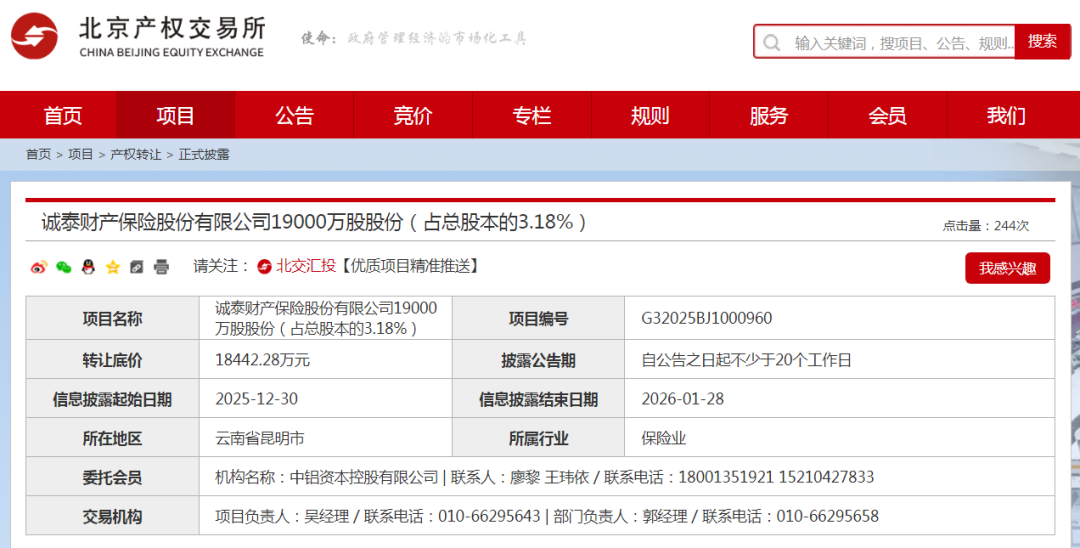
底价1.84亿元!诚泰财险1.9亿股股份再寻接盘方
Guo Ji Jin Rong Bao· 2026-01-07 11:24
Group 1 - The core issue is the frequent listing of equity stakes from small and medium-sized insurance companies, with a specific focus on the transfer of 190 million shares (3.18% of total equity) of Chengtai Property Insurance Co., Ltd. at a base price of 184.42 million yuan [1][2] - Yunnan Metallurgical Group, the transferor, has previously attempted to sell its shares in Chengtai Insurance, with the transfer price decreasing from 156 million yuan to 125 million yuan, but these attempts ended in failure [2][4] - The current market condition for small and medium-sized insurance companies is characterized by a lack of buyers, leading to a situation described as "having a price but no market" [3][5] Group 2 - Yunnan Metallurgical Group, established in 1990, is a state-controlled enterprise and one of the original shareholders of Chengtai Insurance, which has seen its stake diluted from 19% to 3.18% over time [4][6] - The recent equity transfer actions are seen as a response to the "retreat from finance" directive issued by the State-owned Assets Supervision and Administration Commission, which emphasizes focusing on core business and limiting non-core investments [4][5] - Many state-owned enterprises have begun to divest their stakes in insurance companies, indicating a broader trend in the industry [4][5] Group 3 - Chengtai Insurance has faced significant financial challenges, transitioning from profitability to a net loss of 248 million yuan in 2023, with losses expected to increase to 297 million yuan in 2024 [8] - However, there are signs of recovery in 2025, with a reported insurance business revenue of 1.763 billion yuan, a year-on-year increase of 15.86%, and a net profit of 19 million yuan [8][9] - The company has a complex ownership structure, with 56.96% of its shares under pledge or freeze, indicating potential liquidity issues [6][7] Group 4 - To enhance competitiveness, small and medium-sized insurance companies are advised to focus on differentiation, utilize AI and big data for operational efficiency, strengthen capital through various financial strategies, and deepen partnerships with intermediaries and technology platforms [9]
华康洁净:股东阳光人寿拟减持不超3%股份
Mei Ri Jing Ji Xin Wen· 2026-01-07 10:56
Group 1 - The core point of the article is that Huakang Clean (301235) announced that its shareholder Sunshine Life Insurance Co., Ltd. plans to reduce its holdings by no more than 3.1311 million shares, which accounts for 3% of the total share capital after excluding shares in the company's repurchase account [1] - The reduction will be executed through centralized bidding and block trading methods [1] - The reason for the reduction is stated as operational development needs, with the reduction period set from January 13, 2026, to April 12, 2026, which is three months after the announcement [1]

消费维权除了12315,还有哪些可靠途径?
Xin Lang Cai Jing· 2026-01-07 08:56
Core Viewpoint - Consumers have multiple formal channels to protect their rights beyond the official 12315 hotline, which can enhance the efficiency and targeting of their claims [1][9]. Group 1: Administrative Regulatory Channels - Consumers can file complaints through specific administrative regulatory departments based on the industry, in addition to the national 12315 platform, which has legal authority to investigate and penalize violations [10][1]. - These administrative channels are effective for addressing clear violations of laws and regulations [10]. Group 2: Industry Self-Regulation and Mediation Organizations - Many industries have established self-regulatory organizations and professional mediation institutions that are familiar with industry rules and can handle similar issues efficiently [11][1]. Group 3: Public Online Complaint Platforms - Internet platforms like "Black Cat Complaints" provide convenient and transparent complaint services, supplementing administrative channels [12][1]. - These platforms allow users to submit complaints through various channels and track the progress of their complaints in real-time [12]. - The platform also features a "collective complaint" function to increase pressure on companies and offers an AI legal assistant for free legal advice [12]. Group 4: Judicial and Arbitration Channels - When other channels fail, judicial avenues serve as the final recourse, with small claims procedures and online litigation services reducing the cost of rights protection [14][1]. - Arbitration can provide a more efficient resolution for disputes, especially when contracts include arbitration clauses [16]. Group 5: Choosing the Right Channel for Rights Protection - A "ladder" strategy is recommended, starting with negotiation with the merchant and preserving all evidence [16][1]. - If negotiations fail, consumers should select appropriate administrative or industry channels based on the nature of the issue [16]. - Utilizing online complaint platforms can increase the visibility of the problem [16]. Group 6: Prevention Over Rights Protection - Consumers are encouraged to conduct research before making purchases, such as checking the complaint history and user reviews of merchants on public platforms [15][1]. - Understanding and effectively using these formal channels can help consumers protect their rights and encourage businesses to improve service quality [15].
牛脸能贷款,海域有“身份证”?广西这样唤醒“沉睡资产”→
Jin Rong Shi Bao· 2026-01-07 04:56
Core Insights - The article highlights the transformation of rural assets in Guangxi, China, through innovative financial practices that awaken dormant resources and stimulate economic growth [1] Group 1: Challenges Faced by Rural Industries - Rural industries in Guangxi face multiple challenges, including the difficulty of asset realization and the lack of standardized valuation systems for livestock, which limits access to financing [2][3] - Natural disasters and market volatility pose significant risks to agricultural production, making it difficult for farmers to sustain their livelihoods [4] Group 2: Financial Innovations and Solutions - Innovative financial practices, such as the issuance of property rights certificates for aquaculture, have enabled farmers to secure loans by transforming previously unrecognized assets into collateral [5][6] - The introduction of technology, such as AI-based identification systems for livestock, has improved the efficiency of insurance and financing processes, allowing for better risk management [6][12] Group 3: Integration of Financial Services - The development of supply chain finance and tailored credit products has facilitated better access to funding for rural enterprises, addressing issues of weak collateral and fragmented supply chains [7][8] - Collaborative efforts between banks, insurance companies, and local governments have created a supportive ecosystem for agricultural financing, enhancing the resilience and sustainability of rural economies [10][11] Group 4: Systematic Approach to Rural Development - Guangxi has shifted from targeted assistance to a more systematic approach in promoting rural development, with policies that encourage financial resources to flow into agriculture [10][12] - The establishment of digital credit profiles for farmers has enabled the provision of unsecured loans, fostering financial inclusion and supporting agricultural growth [11][13]

举保险之力筑牢农业强国建设根基
Jin Rong Shi Bao· 2026-01-07 02:44
Group 1 - The core focus of the Central Rural Work Conference is on agricultural modernization and the construction of an agricultural powerhouse, with key tasks outlined for the new round of grain production capacity enhancement actions, disaster prevention capabilities, and the establishment of mechanisms to prevent poverty [1] - Agricultural insurance is emphasized as a stabilizer for risk management in agriculture, requiring comprehensive upgrades in quality, service models, and system construction to support the foundation of agricultural powerhouse construction [1] - The meeting highlights the importance of food security, urging agricultural insurance to align with the grain production capacity enhancement actions to ensure a stable food supply for the population [1] Group 2 - The traditional agricultural insurance model is shifting from post-disaster compensation to a comprehensive prevention approach, necessitating the establishment of a closed-loop model for monitoring, risk intervention, and rapid claims [2] - Future implementation of this model requires deeper collaboration between insurance and meteorological/agricultural departments, expanding coverage of weather index insurance and catastrophe insurance [2] - The integration of disaster prevention costs into insurance coverage is essential to encourage proactive risk management among farmers, enhancing the resilience of agricultural production [2] Group 3 - Consolidating the achievements of poverty alleviation is a baseline task for rural revitalization, with natural disasters and economic fluctuations identified as key risks for returning to poverty [3] - The establishment of a regular mechanism to prevent poverty is crucial for extending the service chain of agricultural insurance and expanding its coverage [3] - The insurance industry is encouraged to connect with national poverty monitoring systems to dynamically identify and provide risk warnings for vulnerable groups [3] Group 4 - Developing new agricultural productivity fundamentally involves enhancing production efficiency and quality through technological empowerment, requiring a shift from traditional service models in agricultural insurance [4] - Key strategies include building a standardized agricultural insurance database, integrating digital technologies like AI and blockchain, and creating collaborative service platforms for new agricultural productivity forms [4] - The agricultural insurance sector is expected to innovate continuously to support the construction of an agricultural powerhouse, ensuring a stable path towards agricultural modernization [4]
A股董责险渗透率升至32% 高赔付案件主要来源于少数保司
2 1 Shi Ji Jing Ji Bao Dao· 2026-01-07 02:34
Group 1 - The core viewpoint of the article highlights the increasing enthusiasm for D&O insurance among A-share listed companies, with 643 companies disclosing their plans to purchase such insurance in 2025, marking a 19% year-on-year increase [4][5] - The report indicates that 256 of these companies are disclosing their D&O insurance plans for the first time, reflecting a growing recognition of the importance of this insurance in corporate governance [4][5] - By the end of 2025, the proportion of listed companies purchasing D&O insurance is expected to rise by 4 percentage points compared to the end of 2024, indicating a trend of increasing acceptance [4][5] Group 2 - D&O insurance, which covers civil liability for directors and senior management, has seen a significant increase in uptake due to heightened awareness of risk management among companies following various risk events [3][5] - The actual claims paid out under D&O insurance have risen sharply in recent years, driven by stricter regulations and increased litigation risks faced by directors and executives [5][6] - The report notes that in 2025, 17 companies were delisted due to information disclosure violations, with 7 of them having purchased D&O insurance, highlighting the growing relevance of this insurance in mitigating legal risks [6] Group 3 - The market for D&O insurance is currently experiencing a soft cycle, characterized by lower premium rates due to an oversupply of insurance capacity and insufficient recognition of risks by some insurers [8] - The average premium rates for D&O insurance have decreased from 20%-30% to around 5% since 2022, indicating a shift in market dynamics and competition among insurers [8] - The increasing complexity of corporate governance and the expansion of directors' responsibilities, coupled with the rise of digital transformation risks, are driving companies to seek D&O insurance as a means of risk transfer [5][8]