
加密货币

Search documents
RadexMarkets瑞德克斯:比特币回撤背后的逻辑
Xin Lang Cai Jing· 2026-01-21 11:28
Core Insights - The cryptocurrency market has experienced significant volatility, with Bitcoin erasing all gains since January 2026 and dropping below the $88,000 mark [1][2] - A total of $1.8 billion in liquidations occurred within 48 hours, with approximately 93% of positions being long, indicating a rapid reversal in market sentiment under extreme pressure [1][2] - The adjustment is attributed to a combination of macro geopolitical risks and a global liquidity turning point, prompting investors to reassess the short-term pricing logic of high-risk assets [1][2] Market Data - Bitcoin has declined approximately 10% from its yearly high and has fallen below the critical 50-day Exponential Moving Average (EMA) [3] - The total market capitalization of cryptocurrencies has shrunk by $225 billion, currently standing at around $3.08 trillion [3] - The recent surge in Japan's 10-year government bond yields, which rose nearly 19 basis points in two days, reflects extreme anxiety regarding tightening liquidity [3] Investment Trends - The volatility in the Japanese bond market is seen as a deeper underlying cause of the current market conditions, with analysts suggesting that the situation resembles a "capital war" where funds are rapidly exiting traditional premium assets [4] - Bitcoin, often referred to as "digital gold," is particularly sensitive to liquidity conditions, leading it to bear the brunt of selling pressure during tightening periods [4] - Investors are advised to remain cautious and closely monitor developments in Japanese bond yields and geopolitical policies to navigate potential ongoing market fluctuations [4]


沪金突破1100元,黄金股狂飙,*ST立方退市边缘离奇20CM涨停
21世纪经济报道· 2026-01-21 07:24
Market Overview - A-shares saw all three major indices close in the green, with the Shanghai Composite Index briefly turning negative before ending slightly up. The Shenzhen Component rose by 0.7%, and the ChiNext Index increased by 0.54% [1] - The total trading volume in the Shanghai and Shenzhen markets was 2.62 trillion yuan, a decrease of 180.5 billion yuan compared to the previous trading day. Over 3,000 stocks in the market experienced gains [1] Index Performance - Shanghai Composite Index: 4116.94 (+3.29, +0.08%) [2] - Shenzhen Component Index: 14255.13 (+99.50, +0.70%) [2] - ChiNext Index: 1862.69 (+42.21, +2.32%) [2] - Total A-shares Index: 6797.35 (+38.42, +0.57%) [2] - ChiNext Index: 3295.52 (+17.54, +0.54%) [2] - CSI 300 Index: 4723.07 (+4.19, +0.09%) [2] Sector Performance - The semiconductor and AI computing power sectors experienced a collective surge, with stocks like Huada Technology, Longxin Technology, and Zhizheng Co. hitting the daily limit [3] - The photolithography machine index continued to strengthen, with stocks such as Chipbond Microelectronics rising by 16% and Jianghua Microelectronics hitting the daily limit [3] - Gold stocks also saw a surge, with Sichuan Gold and Zhaojin Gold hitting the daily limit, while sectors like beverages, liquor, and duty-free shops faced declines [4] Gold Market Insights - Gold prices surged due to geopolitical instability, with spot gold reaching a daily high of $4888 per ounce, approaching the $4900 mark. The main futures contract for gold in Shanghai surpassed 1100 yuan, increasing by 4.54% [5] - Institutions are optimistic about gold prices, with Citigroup and HSBC predicting a potential rise to $5000 [5] Cryptocurrency Market - Major cryptocurrencies mostly declined, with Bitcoin experiencing a 1.45% drop, remaining below $90,000. Over the past 24 hours, more than 170,000 individuals faced liquidation, totaling $943 million (approximately 6.657 billion yuan) [5]

“木头姐”2026展望:“里根经济学”升级版,美股继续“黄金时代”,美元走高压制黄金
3 6 Ke· 2026-01-21 02:52
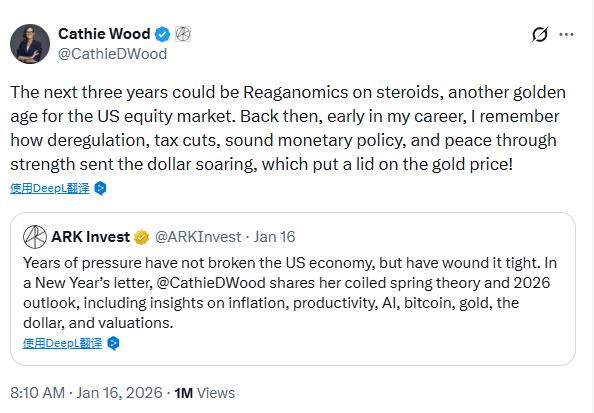
Group 1 - Cathie Wood predicts a "golden age" for the US stock market driven by deregulation, tax cuts, sound monetary policy, and innovative technologies, referring to it as "Reaganomics on steroids" [1][2] - The US economy is currently in a "coiled spring" state, having experienced a rolling recession, but is expected to rebound strongly in the coming years [2][4] - Wood anticipates nominal GDP growth rates in the US to remain between 6% and 8%, primarily driven by productivity improvements rather than inflation [2][31] Group 2 - The effective corporate tax rate is projected to drop to around 10%, providing significant policy benefits for economic growth [2][13] - Inflation is expected to be controlled and may even turn negative, with Wood suggesting that the current inflation rate could fall to unexpectedly low levels [2][15] - The housing market has seen a significant decline, with existing home sales dropping 40% from January 2021 to October 2023, indicating a tightly compressed economic environment [4][20] Group 3 - Wood does not believe an AI bubble has formed, asserting that high price-to-earnings ratios will be offset by earnings growth driven by technological advancements [2][49] - The capital expenditure related to AI and digital assets is expected to reach unprecedented levels, with significant investments projected for data center systems [42][45] - The correlation between Bitcoin and gold is low, suggesting Bitcoin could be a viable diversification option for investors seeking higher risk returns [38][39] Group 4 - The dollar is expected to strengthen significantly, potentially mirroring the nearly doubling of its value seen in the early 1980s, driven by improved investment returns in the US [40][41] - The productivity growth driven by technological innovations is anticipated to accelerate, potentially reaching annual rates of 4-6% [27][31] - The overall economic environment is expected to resemble the major technological revolution period leading up to 1929, characterized by synchronized short-term interest rates and nominal GDP growth [31][32]
比特币失守9万美元关口,概念股跌麻了,Strategy刚刚加仓21亿美元
Zhi Tong Cai Jing· 2026-01-21 00:24
Group 1 - The decline in Bitcoin prices has negatively impacted cryptocurrency-related stocks, with significant drops observed in companies like Strategy, SharpLink Gaming, and MARA Holdings, which fell more than the broader market [1][2] - Bitcoin's price fell below $90,000, reaching a low of $89,281, while Ethereum dropped below $3,000, leading to increased trading activity with a 14% rise in Bitcoin's 24-hour trading volume to $68.6 billion [1] - The market is experiencing heightened volatility due to the recent geopolitical uncertainties, particularly related to Trump's tariff proposals, which add pressure to the already fragile market conditions [2] Group 2 - Strategy announced a $2.1 billion investment to increase its Bitcoin holdings, yet its stock price fell over 6% to $160.23 after opening [2] - SharpLink Gaming's stock dropped by 9.59% to $9.945, despite holding approximately $2.4 billion in Ethereum, which the CEO referred to as "permanent capital" [2] - MARA Holdings' stock decreased by 8.71% to $10.37, following a recent agreement with MPLX for natural gas supply to its Texas data center [2] Group 3 - Analysts suggest that the decline in Bitcoin prices tends to have a more pronounced effect on mining companies' stock prices, indicating that the current drop is more of a consolidation phase rather than a free-fall [3] - The psychological support level at $90,000 is critical; failure to maintain this level could lead to a potential test of the $85,000 mark [3]



US Treasury Secretary Revives Trade-War Inflation Risk at Davos as Crypto Sinks
Yahoo Finance· 2026-01-20 23:07
Core Viewpoint - Global markets are experiencing a risk-off sentiment due to US Treasury Secretary Scott Bessent's reaffirmation of the Trump administration's use of tariffs as a primary geopolitical tool, raising concerns about trade-driven inflation and impacting cryptocurrency markets [1][2]. Group 1: Tariffs as a Geopolitical Tool - Bessent emphasized that tariffs are a central component of US foreign policy, framing them as an effective strategy rather than a last resort [2]. - He indicated that President Trump could impose a 10% tariff as early as February 1 if Denmark and allied countries do not cooperate regarding Greenland, signaling a potential escalation in trade tensions [3]. Group 2: Economic Implications of Tariffs - Bessent defended the economic effectiveness of tariffs, claiming they have generated "hundreds of millions of dollars" in revenue, despite contrasting research indicating that US consumers bear most of the tariff costs [5]. - New data suggests that tariffs function more like a hidden consumption tax, which could tighten household liquidity over time, affecting discretionary spending and speculative capital flows into high-volatility assets like cryptocurrencies [6]. Group 3: Impact on Cryptocurrency Markets - Following Bessent's remarks, Bitcoin fell below $90,000 and Ethereum slipped under $3,000, as investors reassessed macroeconomic risks associated with rising trade tensions [1].
比特币失守9万美元关口 概念股跌麻了 Strategy(MSTR.US)刚刚加仓21亿美元
智通财经网· 2026-01-20 22:22
Group 1 - The decline in Bitcoin prices has negatively impacted cryptocurrency-related stocks, with significant drops observed in companies like Strategy, SharpLink Gaming, and MARA Holdings, which fell more than the broader market [1][2] - Bitcoin's price fell below $90,000, reaching a low of $89,281, while Ethereum dropped below $3,000, leading to increased trading activity with a 14% rise in Bitcoin's 24-hour trading volume to $68.6 billion [1] - The market is also reacting to geopolitical uncertainties, particularly related to tariffs proposed by former President Trump, which adds pressure to the already volatile environment [2] Group 2 - Strategy announced a $2.1 billion investment in Bitcoin but still saw its stock price drop over 6% to close at $160.23 [2] - SharpLink Gaming's stock fell by 9.59% to $9.945, despite holding approximately $2.4 billion in Ethereum, which the CEO described as "permanent capital" [2] - MARA Holdings experienced an 8.71% decline in stock price to $10.37, despite plans to supply natural gas for its Texas data center [2] Group 3 - Analysts suggest that the drop in Bitcoin prices tends to have a more significant impact on mining companies' stock prices, indicating that the current decline may not signal a "free-fall" but rather a consolidation phase [3] - The psychological support level at $90,000 is crucial, as failure to maintain this level could lead to a potential test of the $85,000 mark [3]
美股异动丨比特币跌破91000美元,加密货币概念股集体走低
Jin Rong Jie· 2026-01-20 15:41
Core Viewpoint - Bitcoin has fallen below $91,000, experiencing a daily decline of over 2% [1] Group 1: Cryptocurrency Market Impact - Cryptocurrency-related stocks have collectively declined, with Bit Origin dropping nearly 33% and hitting a trading halt [1] - MARA Holdings and Bitfarms both fell by over 9% [1] - Strategy saw a decline of over 8%, while Bit Digital and Riot Platforms dropped nearly 7% [1] - Canaan Creative (嘉楠科技) experienced a decline of over 6% [1] - TeraWulf and Circle both fell by over 4% [1]
FPG 财盛国际:2026 加密市场展望
Xin Lang Cai Jing· 2026-01-20 15:23
Core Insights - The cryptocurrency market is showing significant signs of recovery, with Bitcoin's price surpassing last year's low, reaching a high of $97,000 and stabilizing around $93,000, reflecting a year-to-date increase of approximately 7% [1][5] - FPG Cai Sheng International believes the current market rebound is not an isolated event but a result of geopolitical uncertainties, macro liquidity excess, and fundamental market structure changes [1][5] - The traditional "four-year halving cycle" theory is facing challenges as the market transitions from speculative frenzy to mature asset allocation, necessitating a reevaluation of crypto asset valuation logic and allocation strategies [1][5] Market Environment Analysis - The surge in global money supply and the rise in precious metals highlight the market's urgent demand for non-sovereign value storage assets, with Bitcoin increasingly aligning with this trend [2][6] - Over the past 12 months, gold prices have risen over 70%, while Bitcoin's rebound in early 2026 shows strong catch-up momentum, although its gains are not as high as gold's [2][6] - The traditional market transmission mechanism of "Bitcoin rises → Ethereum rises → Altcoins rally" has notably broken down in 2025, primarily due to the "walled garden" effect of institutional funds locking capital in major assets, limiting flow to smaller market cap coins [2][6] Halving Cycle Discussion - The effectiveness of the "four-year halving cycle" has been widely questioned after the anticipated rebound in 2025 did not materialize, indicating a shift in market maturity [3][7] - As institutional investors become the dominant force, their investment logic focuses more on long-term asset value and risk management rather than short-term speculative opportunities tied to halving events [3][7] - Historical data shows that the post-halving price increase cycles for Bitcoin are lengthening and experiencing reduced volatility, closely linked to the stable allocation strategies of institutional funds [3][7] Future Outlook - FPG Cai Sheng International identifies three core catalysts that will determine whether the cryptocurrency market can break its current consolidation phase and enter a full bull market in 2026 [4][8] - The expansion of institutional presence, particularly through the approval of more altcoin ETFs, could enhance market liquidity and disrupt the current concentration of funds in major assets [4][8] - The transmission of "wealth effect" requires sustained strong price increases in Bitcoin or Ethereum to generate excess returns that can uplift the entire altcoin market, contingent on macroeconomic conditions and sustained market sentiment [4][8] - A return of retail investor sentiment, indicated by increased stablecoin inflows and a genuine rise in risk appetite, will inject new vitality into the market [4][8]
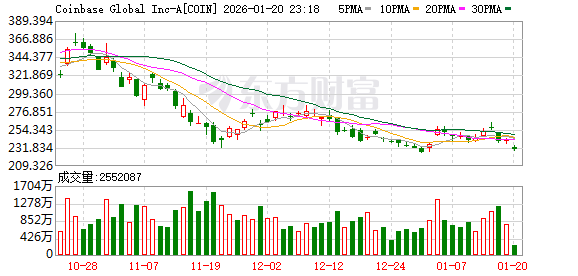
比特币下跌2.6%至一周低点,加密货币股下跌,COINBASE下跌3.9%
Mei Ri Jing Ji Xin Wen· 2026-01-20 15:18
Core Viewpoint - Bitcoin experienced a decline of 2.6%, reaching a one-week low, which also led to a drop in cryptocurrency stocks [2] Group 1: Market Performance - Bitcoin fell by 2.6% to a one-week low [2] - Coinbase's stock decreased by 3.9% [2] - Bitfarms' stock dropped by 5.5% [2] - Strategy's stock declined by 6.9% [2]

OEXN:期权偏斜预示比特币下行风险
Xin Lang Cai Jing· 2026-01-20 15:18
Core Viewpoint - The cryptocurrency market, particularly Bitcoin, is facing a potential valuation correction due to changing investor sentiment and geopolitical tensions, with a notable increase in the probability of Bitcoin dropping below $8,000 by June 2026 to 30% [1][3]. Group 1: Market Sentiment and Price Movements - Bitcoin reached a high of $9,500 but has since fallen below $9,100 due to renewed risk aversion in global financial markets, influenced by strong rhetoric regarding international trade tariffs, especially concerning Europe [1][3]. - The pricing data for options indicates a shift towards caution among investors, with a significant concentration of put options on decentralized trading platform Derive.xyz in the $7,500 to $8,000 range, suggesting traders are actively buying "insurance" against potential sharp declines [1][3]. Group 2: Technical Analysis and Volatility - The comparison of bullish and bearish forces is showing subtle changes, with the activity of put options significantly exceeding that of call options, indicating greater market concern about prices reverting to levels seen in April 2025, with only a 19% probability of rising to $12,000 [2][4]. - The volatility mechanism shift triggered by geopolitical factors has not yet been fully absorbed in the spot market, indicating that the current negative skew is not just a reflection of sentiment but also a warning of future liquidity risks [5]. Group 3: Investment Recommendations - Investors are advised to closely monitor changes in the options market, particularly positions with strike prices around $8,000, as the wide fluctuations in Bitcoin's price are likely to continue until macroeconomic uncertainties are resolved [5]. - Understanding the skew logic in the options market is deemed crucial for managing downside risks in digital asset portfolios during this sensitive period [5].