航天科技

Search documents
飞向月球,新战略与Equatys合资企业共促长期增长
Haitong Securities International· 2025-09-21 14:33
Group 1: Company Overview - Space42 is an AI aerospace technology company based in the UAE with total assets of nearly $3 billion[2] - The company achieved an EBITDA margin of 42% last year, with a long-term target of maintaining around 40%[2] - Major shareholders include G42 (approximately 42%), Mubadala Investment Company (29%), and International Holding Company (about 8%)[2] Group 2: Business Segmentation - Space42's business is currently divided into space services (86.5%) and smart solutions (13.5%), with plans to achieve a 50%/50% split in the medium term[8][9] - The company operates six geostationary satellites and has two more planned for launch[2] Group 3: Strategic Initiatives - Space42 has outlined four strategic pillars aimed at long-term growth, including becoming a preferred partner for geospatial data and leading in geospatial AI services[3] - The company aims to double its revenue by the end of this decade compared to 2023 levels[3] Group 4: Market Growth Potential - The satellite services market is expected to grow at a double-digit rate, while the smart solutions segment is projected to exceed 20% growth across various sub-sectors[3] - Growth is primarily driven by advancements in AI and geospatial imaging analysis[3] Group 5: Equatys Joint Venture - Space42 and Viasat announced a joint venture, Equatys, to provide satellite and ground network services based on 3GPP non-terrestrial network standards[4] - The joint venture aims to support over 160 markets and provide reliable global communication services, targeting commercialization by 2028[4]
航天宏图(688066.SH):自主研发的PIE-Engine时空云计算平台是公司空间计算的基础平台
Ge Long Hui· 2025-09-18 07:48
Core Viewpoint - The company is focusing on the development of space computing capabilities, transitioning from traditional data processing methods to in-orbit data processing, which enhances efficiency and application in various fields [1] Group 1: Space Computing Infrastructure - Space computing refers to deploying data processing facilities, such as servers and AI chips, in space to handle massive data in orbit, moving from "ground processing" to "in-space processing" [1] - The company's self-developed PIE-Engine cloud computing platform serves as the foundational platform for space computing, providing data and computing power [1] Group 2: Technological Advancements - The PIE-Engine cloud platform integrates with the DeepSeek model, achieving a disaster recognition accuracy rate of 92%, showcasing strong data processing and analytical capabilities [1] - The VR/XR team leverages its experience in virtual reality to support future space computing initiatives alongside the three-dimensional platform [1] Group 3: Strategic Framework - The company has established a three-dimensional strategy combining satellite operations, low-altitude economy, and data elements, creating a closed loop of "data collection - processing - application" [1] - Through the "Nüwa Constellation," the company collects data, processes it on its platform, and applies it across multiple sectors, positioning itself to benefit from the growth of the space computing industry [1]

俄国家航天集团:俄轨道站首个舱段将于2028年升空
Xin Hua She· 2025-09-18 03:20
Core Points - The Russian space station, named the Russian Orbital Service Station, is set to launch its first module in 2028 [1] - The station will serve as a "springboard" for lunar missions, focusing on the development of "autonomous technologies" [1] - Autonomous technologies refer to hardware and software solutions that can make independent decisions and complete tasks without continuous human intervention [1] Group 1 - The first module of the Russian Orbital Service Station is scheduled for launch in 2028 [1] - The station aims to establish facilities on the Moon to ensure the safety of astronauts' life support systems [1] - The development of the Russian Orbital Service Station is a crucial step towards deploying lunar facilities [1] Group 2 - The Russian space station will help maintain manned space activities after the International Space Station's mission ends [1] - The station will be instrumental in developing key technologies for future missions to other planets [1]
宇宙“保洁”有新招:新型推进器实现非接触清除太空垃圾
Ke Ji Ri Bao· 2025-09-16 04:07
Core Viewpoint - The increasing risk of collisions due to space debris threatens satellite operations and space missions, prompting the development of a new non-contact, efficient debris removal technology by a Japanese research team [1][2]. Group 1: Space Debris Issue - The problem of space debris is becoming severe, with numerous defunct satellites, rocket remnants, and tiny fragments traveling at speeds exceeding that of bullets, posing significant threats to active satellites and spacecraft [1]. - The uncontrolled debris significantly increases the risk of sustainable human activities in space, necessitating effective removal solutions [1]. Group 2: Innovative Technology Development - The research team has proposed and validated a novel solution that utilizes plasma ejected from satellites to slow down space debris, encouraging it to re-enter the atmosphere and burn up [1][2]. - Traditional single-direction plasma ejection generates strong recoil, which can destabilize the removal satellite; thus, a "bidirectional plasma jet non-electrode plasma thruster" has been developed to counteract this recoil and maintain stability [1][2]. Group 3: Efficiency and Economic Viability - To enhance deceleration efficiency, a special magnetic field structure called "spike" has been introduced to confine the plasma plume and prevent its dispersion, achieving a deceleration force three times greater than previous studies [2]. - The propulsion system uses inexpensive and abundant argon gas as the propellant, demonstrating good economic feasibility and practicality [2].
新型推进器实现非接触清除太空垃圾
Ke Ji Ri Bao· 2025-09-15 23:15
【总编辑圈点】 曾有实验室用可视化装置对地球上空的空间碎片进行可视化动态呈现。直观来看,地球仿佛被各种线条 缠绕包裹,太空垃圾可谓密密麻麻。这些太空垃圾迟早会成为大麻烦,清理地球轨道势在必行。此次, 科研人员提出一种新方案,让卫星可在保持自身稳定的同时,发射等离子体,使太空垃圾减速并重返大 气层。这一系统高效、安全,且成本较低,具有可推广性。清理太空垃圾是人类的责任,我们必须以对 未来负责的态度严肃面对这一课题。 研究团队此次提出并验证了一种创新解决方案。该方法通过清除卫星发射的等离子体,减缓太空垃圾运 行速度,促使其脱离轨道并在重返大气层时燃烧殆尽。然而,传统单向喷射会产生强烈反冲,导致清除 卫星偏离目标,削弱减速效果。为此,他们开发出一种"双向等离子体喷射型无电极等离子体推进器", 可同时向太空垃圾方向和相反方向喷射两股等离子体流,从而抵消反冲力,保持清除卫星稳定。 为增强减速效率,团队还引入名为"尖点"的特殊磁场结构,用以约束等离子体羽流,防止其扩散。在模 拟太空环境的真空管实验中,该系统不仅实现了自我平衡,还使减速力提升至此前研究报道的三倍。 此外,该推进系统采用廉价且丰富的氩气作为工质,具备良好的经 ...
美国重返月球计划为何一拖再拖?
Huan Qiu Shi Bao· 2025-09-14 22:46
Group 1: Artemis Program Overview - The Artemis program aims to return humans to the Moon and establish a long-term presence, ultimately paving the way for Mars exploration [2][3] - The program's complexity involves multiple launches and in-orbit docking, contrasting with the direct launch method used in the Apollo program [2] - The first four missions of the Artemis program have been confirmed, with Artemis 1 successfully completing an uncrewed test in 2022 [3] Group 2: Mission Delays and Challenges - Artemis 2, originally scheduled for 2024, has been delayed to April 2026, raising concerns about the timeline for Artemis 3 [3][4] - Technical issues with the Space Launch System (SLS) rocket and Orion spacecraft have contributed to the delays, with SLS facing fuel leak problems [4][5] - The lunar lander, developed by SpaceX, is significantly behind schedule, impacting the overall timeline of the Artemis missions [4][5] Group 3: Lunar Lander and Technical Hurdles - The lunar lander requires advanced capabilities for landing and takeoff on the Moon, with significant engineering challenges due to the lunar environment [5] - SpaceX's plan involves launching multiple Starship rockets to create a fuel depot in low Earth orbit for the lunar lander, but this technology has not been tested [5] - The development of a backup lunar lander by Blue Origin is also lagging behind schedule, compounding the issues faced by the Artemis program [5] Group 4: Spacesuit Development Issues - The new generation of lunar spacesuits is facing delays, which are critical for astronaut safety and functionality during extended missions on the Moon [6][8] - NASA has outsourced spacesuit development to Axiom Space due to internal delays, with prototypes being tested but still requiring significant work [9][10] - The AxEMU spacesuit is expected to undergo critical design reviews and integration testing with the lunar lander, but this process has contributed to project delays [9][10] Group 5: Long-term Goals and Nuclear Power Plans - The Artemis program aims to establish a long-term presence on the Moon, including plans for a nuclear reactor to provide energy [10][11] - NASA is targeting the deployment of a 100-kilowatt nuclear reactor by 2030, but experts express skepticism about meeting this timeline due to technical challenges [11][12] - The development of a biological life support system is also critical for long-term lunar habitation, with current systems relying on supply missions [12]

太空算力:苍穹之上的算力新纪元
GOLDEN SUN SECURITIES· 2025-09-12 06:55
Investment Rating - The report maintains an "Accumulate" rating for the space computing industry [6] Core Insights - Space computing represents a new paradigm for AI computing infrastructure, extending capabilities from terrestrial to orbital environments, leveraging unique conditions in space for enhanced efficiency and autonomy [12][17] - The demand for computing power is expected to surge, with projections indicating that global AI data center (AIDC) electricity demand could reach 347 GW by 2030, highlighting the urgent need for innovative solutions like space computing to address energy and cooling challenges [2][67] - Several companies, including Starcloud and ADA Space, are actively developing space computing projects, indicating a strong market potential and commercial viability for this technology [3][15] Summary by Sections What is Space Computing? - Space computing involves deploying data centers in low or medium Earth orbit, utilizing modular server nodes capable of AI inference and training, thus forming "orbital data centers" [17][20] - It is distinct from edge computing, as it integrates distributed AI architecture in space, enhancing real-time processing and collaboration capabilities [20] Energy Constraints and Cooling Challenges - The report emphasizes that the explosive growth in computing demand is straining existing energy supplies, particularly in the U.S., where electricity infrastructure has not kept pace with demand [13][69] - Space computing offers significant advantages in energy efficiency and cooling, as it can harness solar energy continuously and utilize the vacuum of space for effective heat dissipation [14][14] Global Deployment Progress - Numerous companies are initiating space computing projects, with notable examples including Starcloud's plans for a gigawatt-scale data center in space and ADA Space's launch of AI satellites [3][15] - The report suggests that space computing is transitioning from conceptual validation to engineering implementation, with strong commercial prospects [3][15] Investment Recommendations - The report advises investors to focus on companies that are strategically positioning themselves within the space computing supply chain, such as SOCE, RKLB in the U.S., and Shunhao Co., Hangang Co., Putian Technology, and China Satellite in China [4][15]


欧盟要去月亮上挖矿?还有这些国家也在推动太空资源挖掘
Di Yi Cai Jing· 2025-09-11 10:29
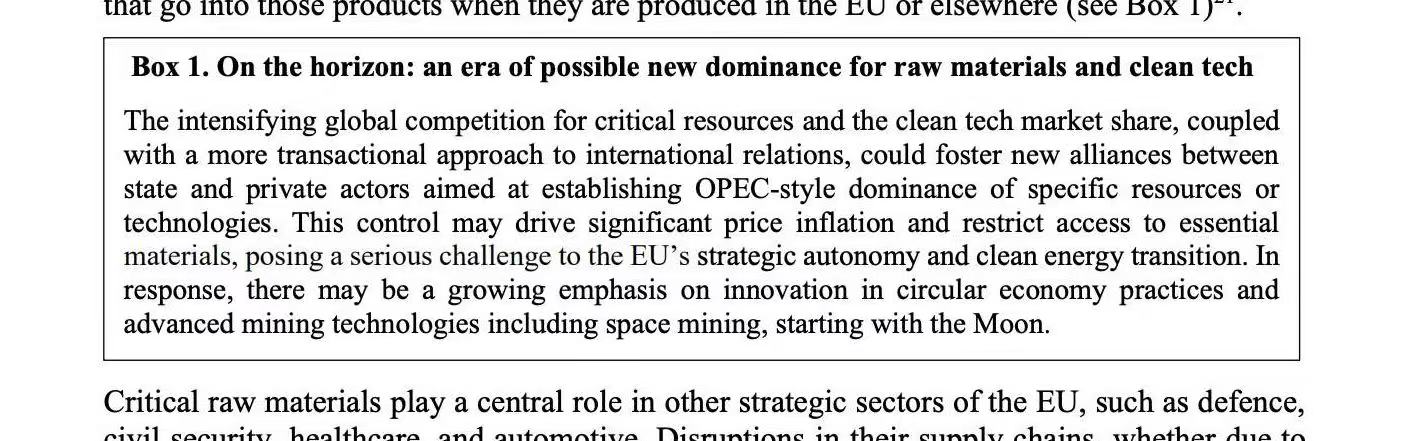
Core Viewpoint - The European Union (EU) is exploring space mining, particularly targeting the Moon, as a potential source for raw materials essential for renewable energy technologies due to reliance on non-EU countries being challenged [1][3]. Group 1: Space Mining Initiatives - The EU Commission's annual Strategic Foresight Report highlights the need for advanced mining technologies, including space mining, to secure critical materials like lithium, copper, nickel, and rare earth metals [1][3]. - Luxembourg is positioned as a hub for space mining in Europe, planning to utilize robotics for extracting resources from the Moon and asteroids, which are rich in practical metals and precious metals [3][4]. - The European Space Resources Innovation Centre (ESRIC) was established in 2020 to focus on the scientific, technological, and economic aspects of space resource utilization [4]. Group 2: Demand for Key Minerals - The demand for key minerals is surging due to the energy transition, with estimates indicating that the global copper mining requirement over the next 25 years will equal the total mined in history [5]. - The EU anticipates a 12-fold increase in lithium demand for batteries by 2030 compared to 2020 levels, and a 21-fold increase by 2050, while currently lacking any lithium mining operations within its borders [5]. - The EU is heavily reliant on imports for rare earth materials, with nearly 100% dependence, which poses risks of supply disruptions and price volatility [5]. Group 3: Challenges in Resource Recovery - Despite the strategic importance of rare earth recycling, a facility established by Heraeus in Germany to recover rare earth magnets is struggling to achieve full production capacity and is currently operating at a loss [6].
世界首富换人,但只有1天!被甲骨文创始人短暂超越后,马斯克重夺世界首富宝座?
Sou Hu Cai Jing· 2025-09-11 09:20
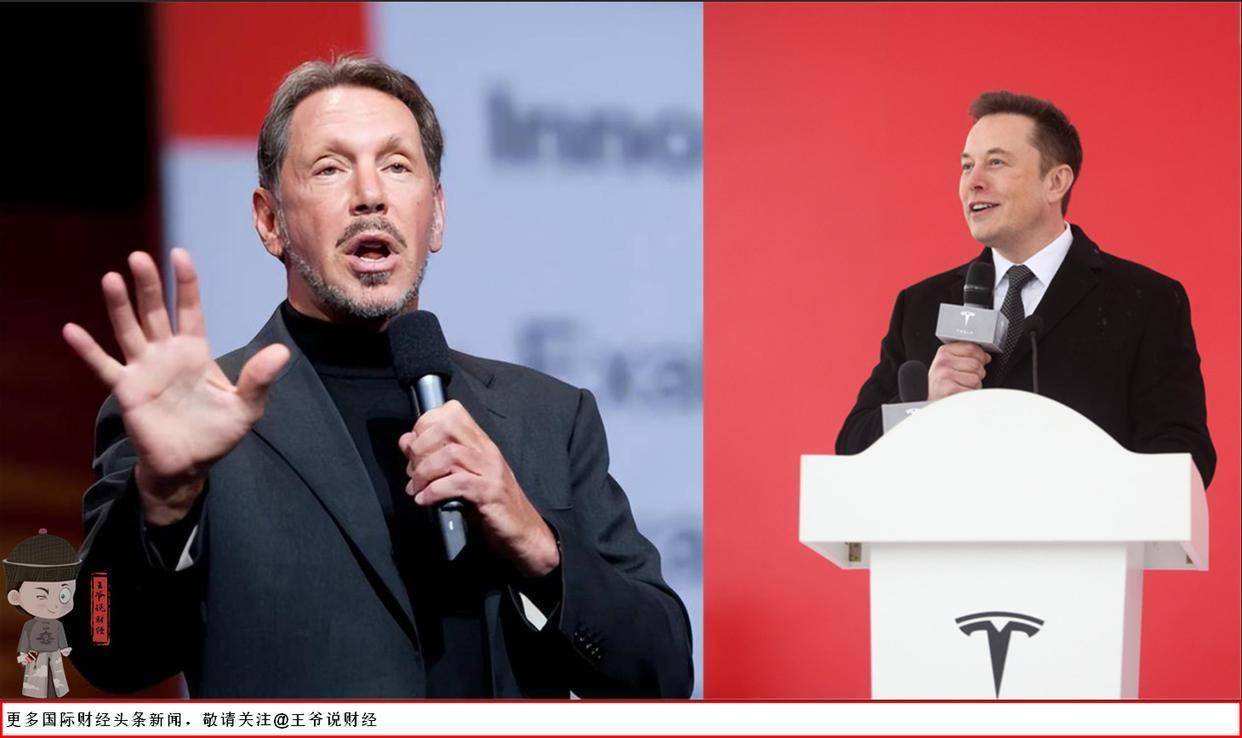
Group 1 - The core event involved a brief change in the title of the world's richest person, with Larry Ellison of Oracle briefly surpassing Elon Musk after a significant stock price increase [3] - Ellison's wealth surged by $98 billion in one day due to Oracle's stock rising 35%, pushing his net worth to $393 billion, while Musk's net worth was $385 billion at that time [3][5] - Musk regained the title by the end of the trading day, driven by a rebound in Tesla's stock and an increase in SpaceX's valuation [3][5] Group 2 - Musk's wealth recovery was attributed to three main factors: 1. Tesla's stock price rebounded over 3% due to positive market expectations regarding the Cybertruck and Full Self-Driving technology, restoring its market cap to $1.2 trillion [5][6] 2. SpaceX's valuation soared to over $350 billion, supported by the growth of Starlink users and progress in Mars plans [6] 3. The successful financing of Musk's AI company xAI and a recovery in advertising revenue from Twitter (X platform) created a synergistic effect for Musk's business empire [7] Group 3 - The future of Musk and Ellison's wealth is contingent on key variables: 1. For Musk, the performance of Tesla's electric pickup sales and the successful rollout of Full Self-Driving technology are critical [9] 2. For Ellison, the ability of Oracle to fulfill AI orders and maintain market share against competitors like Amazon AWS and Microsoft Azure is essential [10] Group 4 - The competition between Musk and Ellison reflects a broader trend in the tech industry, where AI and aerospace are reshaping perceptions of wealth [12]


追觅「上天」,官宣成立天文BU|最前线
3 6 Ke· 2025-09-11 00:33
Group 1 - The core viewpoint of the article is that Chasing Technology has officially established an Astronomy Business Unit (BU) to enter the field of astronomical optics and the space economy, focusing on the development and application of intelligent astronomical optical systems [1] - The newly formed Astronomy BU aims to create a "human eye" for astronomy, promoting the popularization of astronomical observation while participating in the manufacturing production of the commercial space industry [1] - Chasing Technology is addressing the mass production challenges of large-diameter optical lenses, which have long been monopolized by foreign companies, particularly in the amateur telescope market [2] Group 2 - The first intelligent astronomical telescope product from Chasing Technology is expected to feature a super-large aperture design, equipped with AI algorithms to automatically compensate for atmospheric turbulence and intelligently identify and track deep-space objects [2] - The Astronomy BU is collaborating with domestic commercial space companies to jointly develop high-resolution Earth observation payloads, capitalizing on the rapid advancement and commercialization of global space technology [3] - According to data from Zhongyan Puhua Industry Research Institute, the global space economy was approximately $384 billion in 2022, with commercial satellite-related industries accounting for 73% of this, amounting to $281 billion [3] Group 3 - Chasing Technology has established a three-tier R&D system of "pre-research - product - platform," enabling efficient collaboration between the Astronomy BU and the group's underlying technical resources [3] - The company is set to launch the "Chasing Universe" platform, allowing global astronomy enthusiasts to control intelligent devices, share captured cosmic images, generate AI-recognized star maps, and access exclusive deep-space databases [5] - The Astronomy BU will collaborate with several academicians and astrophysics experts to continuously launch the "Let's Look at the Stars" series of public welfare live classes as part of its long-term corporate social responsibility (CSR) initiatives [5]