
信息技术服务业

Search documents
达实智能:8月13日召开董事会会议
Mei Ri Jing Ji Xin Wen· 2025-08-14 09:54
Group 1 - The core point of the article is that Dasin Intelligent (SZ 002421) held its 21st meeting of the 8th board of directors on August 13, 2025, discussing the revision of internal regulations [1] - For the year 2024, Dasin Intelligent's revenue composition is entirely from the information technology services sector, accounting for 100.0% [1] - As of the report date, Dasin Intelligent has a market capitalization of 7.1 billion yuan [1]

达实智能: 2025年半年度财务报告
Zheng Quan Zhi Xing· 2025-08-14 09:09
Financial Overview - The total assets of Shenzhen Das Intellitech Co., Ltd. decreased from CNY 9,636,207,465.82 at the beginning of the period to CNY 9,093,259,248.30 at the end of the period, representing a decline of approximately 5.65% [1][2] - Total liabilities also decreased from CNY 6,074,323,188.98 to CNY 5,640,358,890.03, a reduction of about 7.15% [2][3] - The total equity of the company decreased from CNY 3,561,884,276.84 to CNY 3,452,900,358.27, indicating a decline of approximately 3.06% [2][3] Income Statement Highlights - The total operating revenue for the first half of 2025 was CNY 990,230,893.24, down from CNY 1,352,832,316.20 in the same period of 2024, reflecting a decrease of about 26.85% [4][5] - Total operating costs decreased from CNY 1,337,498,021.41 to CNY 1,097,234,030.47, a reduction of approximately 18% [4][5] - The net profit for the first half of 2025 was a loss of CNY 98,358,385.91, compared to a profit of CNY 10,066,110.99 in the first half of 2024 [4][5] Cash Flow Analysis - The net cash flow from operating activities was negative at CNY -284,777,738.19, compared to CNY -291,251,111.43 in the previous year [6][7] - Cash flow from investing activities was also negative at CNY -202,356,181.88, indicating a decrease in cash from investments [6][7] - The net cash flow from financing activities was negative at CNY -89,571,574.67, contrasting with a positive cash flow of CNY 223,134,273.89 in the previous year [6][7] Asset and Liability Composition - Current assets totaled CNY 5,047,116,827.74, down from CNY 5,391,487,077.47, a decrease of approximately 6.38% [1][2] - Current liabilities decreased from CNY 3,524,097,465.86 to CNY 3,057,843,166.91, a reduction of about 13.25% [2][3] - Non-current assets totaled CNY 4,046,142,420.56, down from CNY 4,244,720,388.35, indicating a decline of approximately 4.67% [1][2] Shareholder Equity - The company's retained earnings decreased from CNY 463,979,260.71 to CNY 364,613,029.12, a decline of about 21.43% [2][3] - The total equity attributable to shareholders decreased from CNY 3,395,705,743.19 to CNY 3,296,316,887.14, reflecting a decline of approximately 2.91% [2][3]
中国家庭存款出炉,存款及格“标准线”确定,你拖后腿了吗?
Sou Hu Cai Jing· 2025-08-12 11:56
Core Insights - The average per capita savings of Chinese residents reached 128,000 yuan by mid-2025, marking an 8.3% increase from the end of 2024, reflecting the resilience of the Chinese economy and highlighting wealth management disparities among different groups [1] Group 1: Regional Disparities - Beijing, Shanghai, and Zhejiang have the highest per capita savings at 286,000 yuan, 269,000 yuan, and 224,000 yuan respectively, driven by developed financial industries and vibrant private economies [2] - Guangdong, despite having the largest economic output, ranks fifth with a per capita savings of 147,000 yuan, attributed to a large number of migrant workers [2] - Central and western provinces generally fall below the national average, with Gansu and Guizhou showing per capita savings in the range of 70,000 to 80,000 yuan, indicating significant regional development imbalances [2] Group 2: Generational Differences - The 35-45 age group has an average savings of 182,000 yuan, significantly higher than other age groups, aligning with the lifecycle theory as they face multiple financial responsibilities [5] - The 90s generation has an average savings of 93,000 yuan, with 20% of young individuals having savings below 10,000 yuan, influenced by changing consumption patterns and mortgage pressures [5] - Individuals aged 60 and above have an average savings of 156,000 yuan, showing a growing awareness of retirement savings [5] Group 3: Occupational Disparities - Financial industry workers lead with an average savings of 231,000 yuan, followed by IT service professionals at 198,000 yuan, while traditional manufacturing workers average 82,000 yuan [8] - Service industry workers generally have savings around 60,000 yuan, reflecting income disparities driven by industrial structure upgrades and skill premium effects [8] - The rise of freelancers during the pandemic shows a split, with about 35% achieving excess savings, while nearly half have savings below 50,000 yuan [8] Group 4: Wealth Management Trends - Although demand deposits still account for 55% of total savings, the proportion of large time deposits and structured deposits has increased by 6 percentage points, indicating a growing awareness of wealth management [10] - 67% of families have adopted the "4321" asset allocation rule, a 22 percentage point increase since 2020, although 38% still keep over 70% of their assets in banks, reflecting concerns about market volatility [10] Group 5: Financial Health Assessment - Economists argue that measuring financial health solely by savings amounts is limited, as property net worth constitutes 62% of total household assets, with debt levels showing a "high in the east, low in the west" pattern [12] - Shanghai households have an average debt ratio of 56%, while central and western households have lower debt ratios but weaker risk management capabilities [12] - A new assessment standard suggesting "liquid assets covering six months of expenses" is recommended for a more accurate reflection of financial resilience [12] Group 6: Wealth Management Recommendations - For families below the savings benchmark, experts suggest a tiered improvement plan, including establishing an emergency fund covering 3-6 months of expenses, prioritizing debt repayment for high-interest loans, diversifying income sources, and utilizing AI investment tools for dynamic asset management [14] Group 7: Emerging Savings Trends - Approximately 27% of the 90s generation employs "goal-based saving," setting up dedicated accounts for specific objectives like home purchases or studying abroad [16] - 45% of middle-class families have allocated assets across borders, with Hong Kong insurance and US ETF investments becoming popular choices, indicating a shift towards global asset allocation [16] - The data on savings serves as both an economic indicator and a reflection of social development, with future policy discussions likely focusing on reducing savings disparities through tax reforms and social security improvements [16]

中石化和石化盈科申请基于大模型的企业综合管理相关专利,有效整合企业内部现有综合管理规程和专家经验
Sou Hu Cai Jing· 2025-08-12 07:36
Group 1 - China Petroleum & Chemical Corporation (Sinopec) and Shihua Yingke Information Technology Co., Ltd. have applied for a patent titled "A Comprehensive Management Method, System, Device, and Storage Medium Based on Large Models" [1] - The patent aims to provide a comprehensive management method utilizing a large model, which includes constructing a domain-specific knowledge base and establishing a knowledge retrieval model Agent [1] - Sinopec was established in 2000, is headquartered in Beijing, and primarily engages in oil and gas extraction, with a registered capital of approximately 12.17 billion RMB [1] Group 2 - Shihua Yingke Information Technology Co., Ltd. was founded in 2002, is also based in Beijing, and focuses on the accommodation industry, with a registered capital of 500 million RMB [2] - Sinopec has made investments in 263 companies and participated in 5,000 bidding projects, holding 45 trademark records and 5,000 patent records [1] - Shihua Yingke has invested in 9 companies and participated in 2,178 bidding projects, with 113 trademark records and 446 patent records [2]

财政部:1-6月全国国有及国有控股企业利润总额同比下降3.1%
Xin Hua Cai Jing· 2025-07-29 09:00
Core Insights - The report indicates a decline in the economic performance of state-owned enterprises in China for the first half of 2025, with total operating revenue and total profit both experiencing year-on-year decreases [1] Revenue Performance - In the first half of 2025, the total operating revenue of state-owned enterprises was 4,074.959 billion yuan, reflecting a year-on-year decrease of 0.2% [1] Profit Performance - The total profit of state-owned enterprises for the same period was 218.253 billion yuan, showing a year-on-year decline of 3.1% [1] Tax Obligations - The tax obligations of state-owned enterprises amounted to 300.264 billion yuan in the first half of 2025, which is a year-on-year decrease of 0.8% [1] Debt Levels - As of the end of June 2025, the asset-liability ratio of state-owned enterprises stood at 65.2%, which is an increase of 0.3 percentage points compared to the previous year [1]
武汉2025年上半年GDP突破1万亿 新质动能强劲释放助推高质量发展
Chang Jiang Shang Bao· 2025-07-27 23:34
Economic Overview - Wuhan's GDP reached 1,059.28 billion yuan in the first half of the year, marking a 5.5% year-on-year growth, surpassing the 1 trillion yuan milestone for the first time in the first half of the year [1][2] - Key drivers include rapid growth of new productivity, strong recovery of the consumer market, and high-level openness to foreign trade [1] Industry Performance - The primary industry added value was 19.33 billion yuan, growing by 3.8%; the secondary industry added value was 348.80 billion yuan, growing by 4.0%; and the tertiary industry added value was 691.14 billion yuan, growing by 6.3% [2] - Industrial economy showed a continued recovery with a 5.1% year-on-year growth in industrial added value, accelerating by 1.6 percentage points compared to the first quarter [2] - Among 35 major industries, 23 saw year-on-year growth, with the computer, communication, and other electronic equipment manufacturing industry growing by 15.4% and electrical machinery and equipment manufacturing by 11.1% [2] - High-tech manufacturing added value grew by 15.7%, accounting for 24.6% of the total industrial added value [2] - Notable growth in lithium-ion batteries (98.9%), industrial robots (84.3%), and medical instruments (77.3%) [2] - Profits of large-scale industrial enterprises increased by 26.4% year-on-year from January to May [2] Investment Trends - Fixed asset investment in Wuhan grew by 2.0% year-on-year, with industrial investment increasing by 12.1% and infrastructure investment by 8.5% [3] - High-tech service industry investment surged by 28.5%, while private investment (excluding real estate) rose by 13.0% [3] Consumer Market and Trade - The service industry maintained rapid growth with a 6.3% year-on-year increase in added value [4] - From January to May, revenue of large-scale service enterprises grew by 10.4%, with leasing and business services up by 17.4% and information technology services by 9.6% [4] - Retail sales of consumer goods reached 427.99 billion yuan, growing by 7.3% year-on-year, with significant increases in sales of upgraded goods [4] - Notable growth in retail sales included food (8.1%), cosmetics (14.5%), jewelry (19.2%), and sports and entertainment products (91.5%) [4] - The per capita disposable income of residents was 32,566 yuan, a 4.8% increase year-on-year, with urban residents at 34,947 yuan (4.6% growth) and rural residents at 18,639 yuan (6.0% growth) [4]

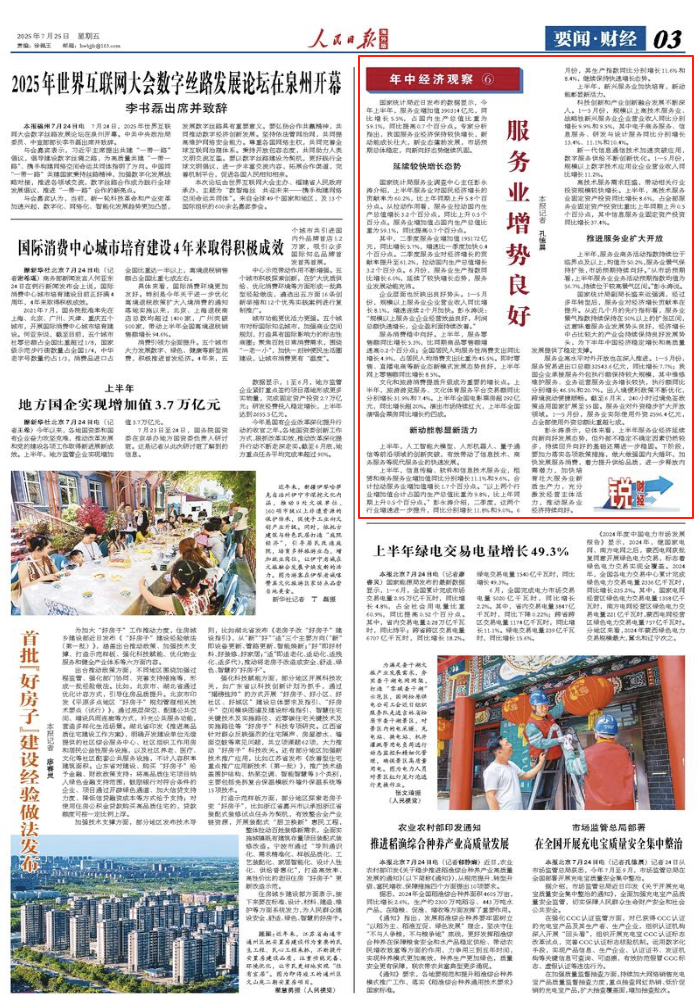
服务业增势良好(锐财经·年中经济观察⑥)
Ren Min Ri Bao Hai Wai Ban· 2025-07-24 22:28
Core Insights - The service industry in China has shown robust growth in the first half of the year, with a value added of 39,031.4 billion yuan, representing a year-on-year increase of 5.5% and accounting for 59.1% of the GDP, an increase of 0.7 percentage points compared to the previous year [1][2][15]. Group 1: Economic Contribution and Growth - The service sector contributed 60.2% to national economic growth, an increase of 5.8 percentage points year-on-year, driving GDP growth by 3.2 percentage points, which is a 0.5 percentage point increase from the previous year [2][7]. - In the second quarter, the service sector's value added reached 19,517.2 billion yuan, growing by 5.7%, with a contribution rate to economic growth rising to 61.2% [2][4]. - The service production index in June grew by 6.0% year-on-year, indicating sustained growth momentum [2][4]. Group 2: Business Performance - From January to May, revenue from large-scale service enterprises increased by 8.1%, with profit margins improving and overall business performance showing positive trends [2][5]. - Service retail sales grew by 5.3%, outpacing the growth of goods retail sales by 0.2 percentage points, while per capita service consumption expenditure rose by 4.9%, accounting for 45.5% of total per capita consumption [2][3]. Group 3: Emerging Trends and Innovations - Cultural and tourism consumption has become a significant growth driver, with tourism services and cultural sports services seeing transaction growth of 31.9% and 7.4% respectively [3][4]. - The first half of the year saw significant advancements in emerging service sectors, with high-tech service industries and strategic emerging service industries reporting revenue growth of 9.9% and 9.5% respectively [5][6]. - The digital services sector also thrived, with revenue from digital technology application enterprises increasing by 11.2% [5][6]. Group 4: Market Outlook and Policy Support - The service industry business activity index remained above the critical point, averaging 50.2, indicating ongoing expansion and positive market expectations [6][7]. - The total value of service trade imports and exports reached 32,543.6 billion yuan, a year-on-year increase of 7.7%, with foreign investment in the service sector accounting for over 70% of total foreign investment [7][8].
“反内卷”系列专题之二:居民如何“反内卷”?
Shenwan Hongyuan Securities· 2025-07-07 08:45
Group 1: Work Hours and Consumer Behavior - Since 2018, China's average weekly working hours have increased to 48.3 hours, which is 21 minutes more per day compared to 2018[3] - The time residents spend on purchasing goods and services has decreased from 80 minutes per day to 43 minutes per day[3] - The most significant "involution" is observed in the manufacturing and productive service sectors, while real estate and life service industries have seen a reduction in working hours[3][4] Group 2: Employment Trends Among Age Groups - The most pronounced "involution" trend is among young people, with an average increase of over 4 hours in weekly working hours over the past five years[4] - For the age group 25-34, weekly working hours increased from 46.7 hours in 2018 to 50.8 hours in 2023[4] - In contrast, individuals aged 55 and above have seen a decrease in working hours by 2.3 hours during the same period[4] Group 3: Policy Recommendations and Economic Rebalancing - Current policies encourage flexible work arrangements and paid leave to address "involution," but these measures primarily target symptoms rather than root causes[5] - The imbalance in employment distribution between manufacturing and service sectors is identified as a core issue, with tariffs potentially facilitating a shift from manufacturing to services[5] - The life service sector has the capacity to absorb labor from the manufacturing sector, as it has seen a 7 percentage point increase in employment share over the past two decades[5][6] Group 4: Service Sector Growth and Consumer Demand - The life service sector's wage growth (18.1%) has outpaced that of manufacturing (10.7%) and productive services (12.4%), indicating a labor shortage in the service sector[6] - There is a significant gap of approximately 1.5 trillion yuan in service employment compared to value-added, suggesting a need for more jobs in this sector[6] - As urbanization increases and GDP per capita rises, service consumption is expected to grow, with a projected annual increase of 0.6% in service consumption share as urbanization reaches 70%[6][7]
热点思考 | 居民如何“反内卷”?(申万宏观·赵伟团队)
申万宏源宏观· 2025-07-07 08:27
Group 1 - The phenomenon of "involution" is most pronounced among young people, with average weekly working hours increasing by over 4 hours in the past five years. The average weekly working hours for employees aged 25-34 rose from 46.7 hours in 2018 to 50.8 hours in 2023 [3][28] - The average daily working time in China increased by 21 minutes from 2018 to 2023, reaching 48.3 hours per week, while the time spent on purchasing goods and services dropped from 80 minutes per day to 43 minutes per day [2][9] - The "involution" trend is particularly evident in the manufacturing and productive service sectors, while the real estate and life service sectors have seen a decrease in working hours [2][21] Group 2 - Current policies to combat "involution" focus on encouraging flexible work arrangements and paid leave, but these measures primarily address symptoms rather than the root causes of prolonged working hours [4][35] - The root cause of "involution" is the uneven distribution of employment across industries, with excessive employment in manufacturing leading to "involution" and insufficient employment in the service sector [4][48] - There is a significant employment gap in the life service sector, with a potential to absorb more jobs, as the wage growth in this sector (18.1%) outpaces that of manufacturing (10.7%) [5][61] Group 3 - The long-term direction for combating "involution" involves aligning supply structures with changing demand structures, particularly as consumer demand trends towards services [6][85] - Global experiences indicate that as GDP per capita reaches between $10,000 and $30,000 and urbanization rates hit 70%, the proportion of service consumption in total consumption increases by approximately 0.6% annually [6][86] - The aging population is expected to drive service consumption, with each 1% increase in the aging rate correlating with a 1.3% increase in service consumption share [6][93]

时代新青年,如何拓展有为新空间?
Yang Guang Wang· 2025-07-05 03:21
Group 1 - The core message emphasizes the importance of youth in driving innovation and progress in various sectors, highlighting their contributions to national development and cultural achievements [1][2]. - Youth represent over 50% in key industries such as information technology services, cultural and sports entertainment, and technology application services, showcasing their significant role in innovation-driven sectors [2]. - Numerous youth-led "unicorn" and "gazelle" companies are emerging across the country, indicating a vibrant entrepreneurial spirit among young people [2]. Group 2 - The article stresses the need for youth to possess aspirations, skills, courage, collective awareness, and a positive mindset to contribute effectively to the nation's goals [4]. - It highlights that the theme of youth is characterized by dedication, energy, and bravery, with young individuals making significant contributions in various fields, including innovation and social development [5]. - The importance of balancing learning and practical experience is emphasized, suggesting that youth should engage in both simultaneously to enhance their capabilities and career prospects [5].
