短剧行业

Search documents
辞去所有职务,郑志刚全面退出家族企业管理
3 6 Ke· 2025-09-05 01:18
Group 1 - The Zheng family, one of Hong Kong's "Four Great Families," has a history spanning over a century, with core businesses in real estate, hotels, and jewelry, including New World Group and Chow Tai Fook Jewelry Group [1][3] - Zheng Zhigang, the grandson of the founder Zheng Yutong, has stepped down from all positions in the family business, citing a desire to focus on public service and personal matters [1][6] - Following his resignation as CEO of New World Development, the company reported a significant loss of approximately HKD 19.683 billion for the fiscal year 2024, marking its first loss in nearly 20 years [6][7] Group 2 - Zheng Zhigang has announced his entry into the short drama industry and continues to promote the development of family offices in Hong Kong as the chairman of the Hong Kong Wealth Preservation Academy [2][19] - In collaboration with JAKOTA Capital, Zheng Zhigang is investing USD 100 million to support short drama companies and related projects, with plans to start operations in March 2025 [7][8] - The Zheng family has established a family office to oversee a diversified global investment portfolio, with a new CEO office structure that includes three co-CEOs [18][19] Group 3 - The succession dynamics within the Zheng family are evolving, with Zheng Jiapun emphasizing the importance of finding a capable successor and considering external recruitment if necessary [9][16] - Zheng Zhigang's brother, Zheng Zhiming, has taken on a leadership role in New Creation, while Zheng Zhigang's younger brother, Zheng Zhilang, has also assumed significant responsibilities within the family business [14][18] - The family is focusing on a governance structure that includes family members, professional managers, and experts to ensure effective decision-making [10][16]




暑假兼职拍短剧,清华女博士回应“赚快钱”:前期多数零片酬,未来想成为制片人
Mei Ri Jing Ji Xin Wen· 2025-09-01 09:58
Core Viewpoint - The rise of short dramas is attracting attention, with a notable example being a Tsinghua University PhD student, Yuan Xiaoge, who is exploring this field during her summer break, emphasizing the importance of diverse life choices and the potential for short dramas to evolve into high-quality productions [1][3][4]. Group 1: Industry Insights - The short drama market in China is projected to exceed 50 billion yuan in 2024, reflecting a significant growth trajectory from 3.68 billion yuan in 2021 to 373.9 billion yuan in 2023 [24]. - The production cycle for short dramas is typically around 6 to 8 days, with some crews compressing it to as little as 3 days to reduce costs, leading to intense working conditions for actors [14]. - The industry is experiencing a shift towards higher quality content, with a focus on diverse themes and intricate storytelling, moving away from merely sensational plots [22]. Group 2: Actor Compensation - Short drama actors generally receive daily wages, with group actors earning hundreds of yuan, while ordinary short drama actors can earn thousands, and top-tier actors may earn between 10,000 to 30,000 yuan per day [10][13]. - The average monthly salary for various roles in the short drama industry varies, with actors earning between 8,747 yuan and 13,125 yuan, while screenwriters earn between 10,736 yuan and 17,840 yuan [12]. Group 3: Future Trends - The future of short dramas is expected to include advancements in technology, such as XR and VR, enhancing the immersive experience and production efficiency [8]. - There is a growing trend towards free viewing models, with revenue generated through in-video advertisements, indicating a shift in how content is monetized [22].

“红果”月活首超优酷,短剧在“虚火”下狂飙
3 6 Ke· 2025-08-12 10:02
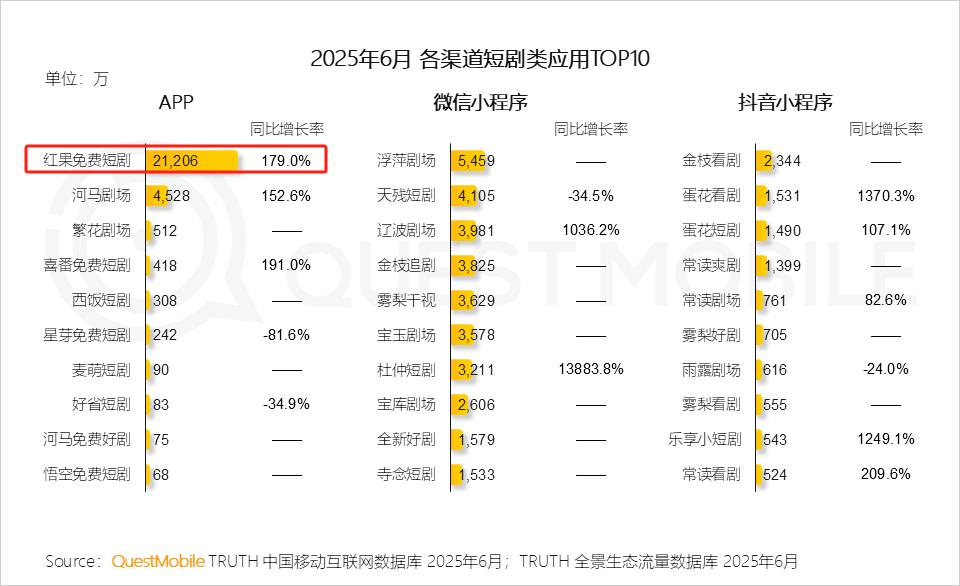
Core Insights - The short drama industry is experiencing significant growth, with platforms like Hongguo surpassing traditional video platforms like Youku, indicating a shift towards short dramas as a mainstream viewing choice [3][6] - The industry is moving towards a premium content model, but challenges such as content homogenization and data authenticity are emerging [2][9] Industry Growth and Trends - The short drama sector has seen a surge in popularity, with 17 short dramas achieving over 1 billion views as of July, including one reaching 3 billion views [3][6] - The market size of China's micro-short drama industry has exceeded 50.5 billion yuan by 2024 [16] Content Production Challenges - There is a contradiction in content creation, where rapid production is prioritized over quality, leading to a prevalence of similar storylines and character designs across different dramas [11][10] - The industry faces issues of plagiarism, with accusations of "one-to-one copying" of content becoming more common [15] Data Authenticity and Market Dynamics - The rise of data manipulation practices, such as inflated view counts, is raising concerns about the authenticity of reported metrics [6][9] - The dominance of Hongguo in the market has led to a lack of competition, with its monthly active users significantly outpacing those of its closest competitor, Hema Theater [6][17] Regulatory and Competitive Landscape - There is a call for more diverse competition in the short drama space, with suggestions for long video platforms like iQIYI, Youku, and Bilibili to enhance their short drama offerings [17] - Industry experts advocate for transparent data reporting and a unified standard for view count metrics to address discrepancies in reported statistics [17]
短剧行业大地震,ReelShort陷入抄袭争议,点众、咪蒙联手“开战”
3 6 Ke· 2025-07-29 08:48
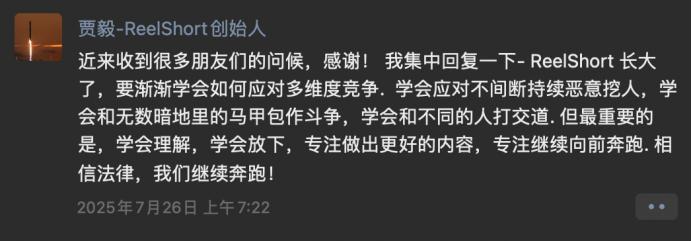
Core Viewpoint - The article discusses the ongoing copyright infringement dispute between domestic short drama companies and the overseas platform ReelShort, highlighting the challenges of protecting intellectual property in the rapidly growing short drama industry. Group 1: Infringement Allegations - Point of contention involves ReelShort allegedly releasing unauthorized adaptations of works owned by Point Crowd Technology and other domestic companies [1][2] - Multiple domestic short drama platforms have publicly condemned ReelShort for its alleged "one-to-one plagiarism" of popular works [1][2] - The founder of ReelShort, Jia Yi, emphasizes the importance of legal processes over public disputes, asserting that the company will focus on its own business [1][2] Group 2: Market Position and Financial Performance - ReelShort is recognized as the top overseas short drama platform, achieving significant success since its launch in August 2022, including topping the Google Play entertainment app free chart for 38 consecutive days [2][6] - The parent company, Fengye Interactive, reported a revenue of approximately 1.087 billion yuan for the first half of 2024, a fivefold increase from the beginning of the year, with a net profit of 22.93 million yuan [2] - The short drama market in China has seen substantial growth, with the market size reaching 37.39 billion yuan in 2023, a 267.65% increase from 2022 [4] Group 3: Industry Dynamics and Challenges - The short drama industry is characterized by a high rate of content replication, with many platforms resorting to copying successful works to minimize risk [11][13] - The cost of producing original content is significant, with estimates suggesting that a single day of filming can cost around $20,000 [14] - The influx of new players into the overseas short drama market has intensified competition, leading to a decrease in ReelShort's competitive edge [16] Group 4: Legal and Copyright Issues - Legal experts suggest that copyright infringement claims should target the infringing parties directly, complicating the situation for companies like Chinese Online, which holds a significant stake in Fengye Interactive [3] - The challenges of enforcing copyright in international markets are highlighted, with companies facing high costs and lengthy processes to protect their intellectual property [17] - The article emphasizes the necessity for the industry to address copyright issues to ensure the sustainability of short drama exports [17]
群起而攻之,出海短剧TOP1 平台ReelShort 深陷抄袭风波
36氪未来消费· 2025-07-25 14:15
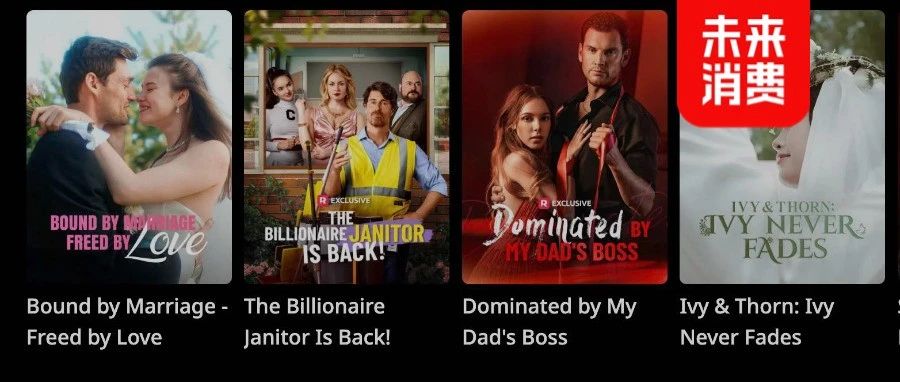
Core Viewpoint - The competition in the overseas short drama market is intensifying, with companies like ReelShort and DramaBox leading the charge, while issues of copyright infringement and market saturation pose significant challenges for growth [6][18][20]. Group 1: Market Dynamics - The short drama platform war has escalated, with multiple companies accusing ReelShort of copyright infringement, highlighting the competitive and contentious nature of the industry [7][10]. - As of March 2024, the number of Chinese short drama apps in the overseas market has surged to 237, a nearly fourfold increase from the previous year, indicating a crowded market [20]. - The average quarterly revenue growth for overseas short dramas is projected at 47.1% for Q3 2024 to Q2 2025, but a significant slowdown is expected in Q2 2025, primarily due to user growth bottlenecks [20]. Group 2: Company Performance - ReelShort has maintained a leading position in the overseas short drama market, generating approximately $300 million (around 2.1 billion RMB) in revenue for 2024 [15]. - DramaBox has also seen success, with revenues exceeding 2 billion RMB and a download count of over 100 million, double that of ReelShort [16][17]. - Both ReelShort and DramaBox command nearly 30% market share each in the overseas short drama sector, indicating a clear market leadership [17]. Group 3: Strategic Approaches - ReelShort's early entry and localization strategy have contributed to its success, but it faces challenges in content supply and production costs, which can reach $150,000 to $200,000 per episode [14][16]. - The industry is witnessing a trend where companies are increasingly resorting to copying successful domestic content to mitigate risks, as seen with ReelShort's alleged plagiarism of popular series [16][21]. - DramaBox, initially focused on dubbed content, is now shifting towards producing local dramas to enhance monetization and user engagement, reflecting a strategic evolution in response to market demands [21].
月活2亿的红果,正在考虑怎么赚更多的钱
3 6 Ke· 2025-07-22 11:01
Core Insights - The article highlights the rapid growth of Hongguo Short Drama, which has reached 199 million monthly active users, positioning itself as a leader in the short drama industry, significantly outpacing its closest competitor, Hema Theater, which has only about one-fifth of its user base [1][4] - The rise of Hongguo Short Drama has disrupted traditional long video platforms, which have struggled to adapt despite efforts to enter the micro-short drama market [1][4] - Hongguo Short Drama's monetization strategy is still in its early stages, primarily relying on a "free + advertising" model, which limits its revenue diversification [1][9] User Engagement and Community Features - Users of Hongguo Short Drama exhibit strong social engagement, as evidenced by the high interaction rates in comment sections, such as over 170,000 discussions on the popular short drama "Good Girl" [2][3] - The platform is testing new features like a graphic community and short video functionality to enhance content diversity and potentially open new revenue streams [1][3] Market Dynamics and Trends - The short drama industry has evolved into a landscape dominated by free models, with the proportion of paid content declining from 50% to an estimated 30% [5][6] - The distribution methods for short dramas have shifted, with producers now favoring direct releases on platforms like Hongguo Short Drama over traditional paid models [6][7] Revenue Generation and Challenges - Hongguo Short Drama's revenue model is based on advertising and revenue sharing, with significant monthly revenue reported, such as over 500 million yuan in March [9][10] - Despite its leading position, Hongguo Short Drama faces competition from major platforms like Xiaohongshu, necessitating exclusive content to attract and retain users [10][11] Future Prospects and Strategies - The platform is focusing on enhancing user retention and engagement through the introduction of community features and short videos, aiming to create a closed-loop ecosystem from content discovery to viewing [4][11] - The emergence of "brand operation" among production companies on Hongguo Short Drama indicates a trend towards building dedicated fan bases and enhancing commercial opportunities [11][12]
霸榜短剧热力榜,抖音话题破亿,“制片中心制”或成主流?
3 6 Ke· 2025-06-27 11:29
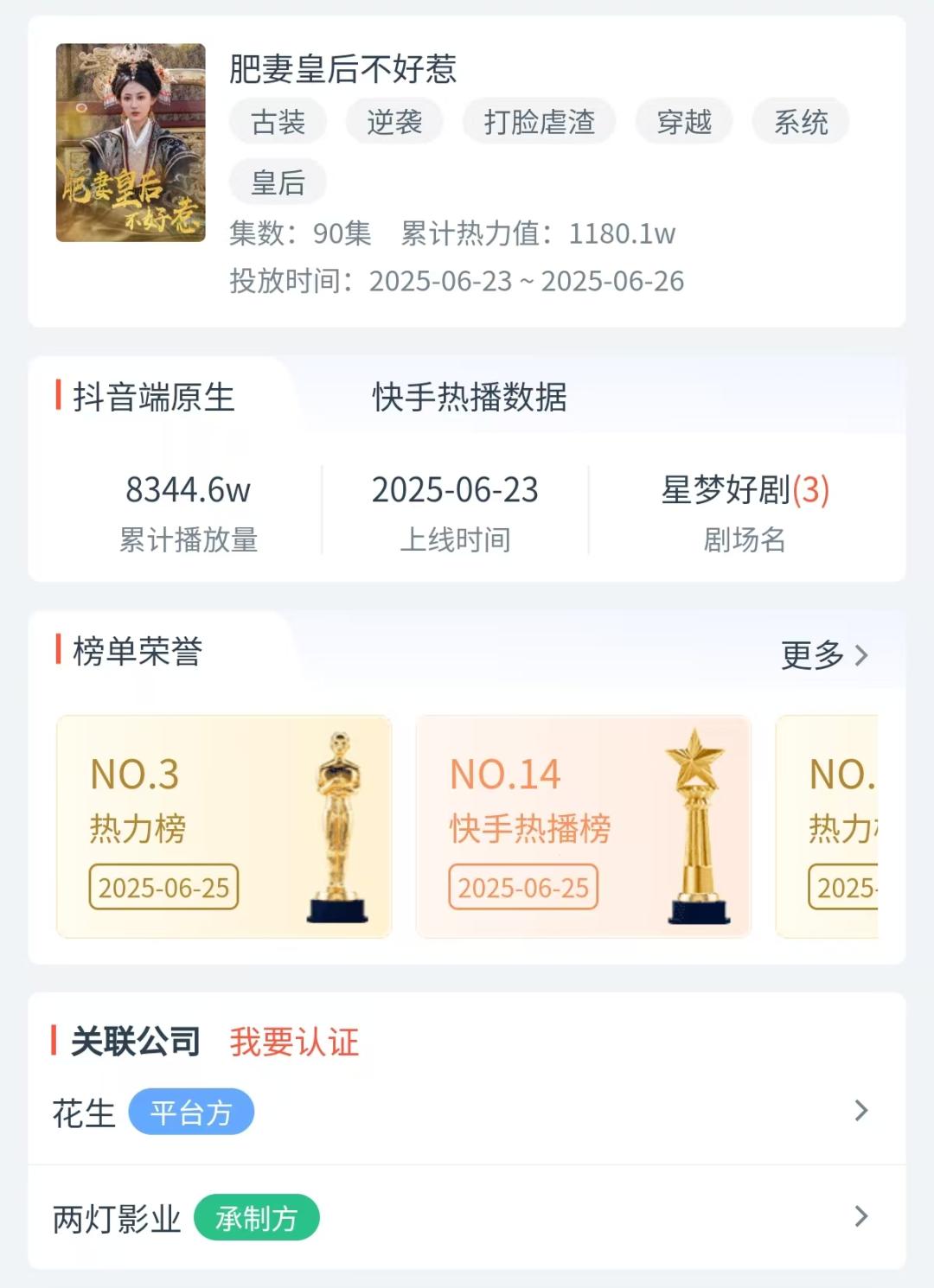
Core Insights - The short drama "Fat Wife Empress is Not to Be Messed With" has become a hit, achieving over 30 million views on Douyin on its release day, surpassing other new dramas and ranking first on the DataEye short drama heat list for two consecutive days [1][3][5] Group 1: Performance Metrics - On June 23, "Fat Wife Empress" garnered a single-day view count of 30.65 million on Douyin, leading the new short drama category by more than double the views of the second-ranked drama [3] - As of June 24, "Fat Wife Empress" maintained its top position on the DataEye short drama heat list with a cumulative heat value of 11.80 million [5] - The hashtag for "Fat Wife Empress" surpassed 100 million views within three days of its release, while another drama, "Fenghuo," achieved over 100 million views across Douyin and Kuaishou [5] Group 2: Creative and Production Highlights - The production of "Fat Wife Empress" and "Fenghuo" emphasizes large-scale effects, with significant time and resources allocated to create immersive scenes, such as a battle scene in "Fenghuo" that took 21 hours to shoot [7] - Costume and set design are meticulously crafted to enhance character portrayal and visual coherence, with specific attention to how clothing reflects character emotions and narrative context [8][11] - The post-production phase focuses on achieving high compatibility between editing and music, ensuring that the rhythm and emotional tone of the drama resonate with the audience [12] Group 3: Industry Trends - The trend towards refined production processes is evident, with a focus on a "producer-centered" approach that integrates market understanding, content quality, and production excellence [13][14] - The production team plays a crucial role in aligning content with market demands, ensuring that the narrative and thematic elements resonate with audience preferences [14] - Actor selection is critical, with a strong emphasis on matching actors to the script and ensuring their performances align with the overall vision of the drama [16]
抖音下场“管版权”,盗版和烂剧要凉了
2 1 Shi Ji Jing Ji Bao Dao· 2025-05-29 10:59
Core Viewpoint - The establishment of the Short Drama Copyright Center by Douyin Group aims to enhance copyright management and improve the quality of short dramas, addressing the rapid growth and challenges in the short drama market [2][5]. Industry Overview - The short drama market in China is experiencing explosive growth, with a projected market size of 504 billion yuan in 2024, representing a year-on-year increase of approximately 35%. By 2025, the market is expected to exceed 680 billion yuan, and by 2027, it may surpass 1 trillion yuan [2]. - The micro-short drama market's revenue has already outstripped the national box office for films, indicating a significant shift in consumer preferences [2]. Challenges in the Industry - The short drama industry faces severe issues, particularly concerning copyright, with rampant piracy and infringement that undermine healthy market development. The lifecycle of micro-short dramas is typically less than three months, leading to significant financial losses for copyright holders due to early piracy [3]. - Data from Hongguo Short Drama indicates that top series experience piracy within 72 hours of release, with legal compensation often falling below 50,000 yuan, while litigation can take 6 to 18 months, creating a high-cost, low-penalty environment for infringement [3]. Content Quality Concerns - The quality of short dramas varies widely, with many creators prioritizing quick monetization over quality, resulting in formulaic and low-quality content. This has led to viewer fatigue and dissatisfaction with repetitive storylines [3][4]. - Users have expressed frustration over the lack of originality in short dramas, with many series following predictable plots [4]. Douyin Group's Strategy - Douyin Group's Short Drama Copyright Center will consolidate resources from Hongguo Short Drama and Douyin Short Drama, aiming to enhance collaboration with creators and improve overall content quality [5]. - The center's core mission is to strengthen copyright management and support high-quality creators, reflecting a shift towards a more refined and sustainable industry model [5][6]. - The trend in the short drama industry mirrors that of the long video sector, where only high-quality productions survive, indicating a move towards a "survival of the fittest" approach in content creation [6].
当“诈骗诱饵”盯上短剧
吴晓波频道· 2025-05-16 15:39
Core Viewpoint - The short drama industry is experiencing rapid growth and transformation, but it faces challenges such as scams and a lack of effective value screening mechanisms, leading to both opportunities and risks for stakeholders [1][26]. Group 1: Industry Growth and Trends - The short drama market has exploded, with a user base reaching 570 million, accounting for 52% of the total internet users in China, surpassing other digital services [5]. - The proportion of free dramas has increased significantly from 11% in early 2023 to 50% by October 2023, indicating a shift towards a "no-cost" model that drives user growth [7]. - The market size of the micro-short drama industry is projected to reach approximately 504 billion yuan in 2024, with a year-on-year growth of 35% [29]. Group 2: Content and Audience Dynamics - The audience for short dramas has shifted, attracting younger demographics and urban populations, leading to a diversification of content themes from sensationalist to more relatable narratives [20]. - The production costs for short dramas have risen significantly, with costs for a hundred-episode series now reaching 600,000 to 700,000 yuan, compared to just 100,000 yuan two years ago [22]. Group 3: Monetization and Platform Strategies - Platforms are adopting new monetization strategies, such as revenue sharing based on viewing time, to incentivize content creators and enhance user engagement [14][15]. - Major platforms like Douyin and Kuaishou are launching subscription models and ad-supported viewing options to attract users and increase revenue [12]. Group 4: Challenges and Risks - The industry is facing issues with scams, where fraudulent schemes exploit the popularity of short dramas to deceive users, particularly targeting vulnerable groups [3][26]. - The phenomenon of "low-cost, quick returns, high risks, and high rewards" characterizes the short drama market, leading to a high failure rate for many productions [10]. Group 5: Future Outlook - The short drama industry is expected to continue evolving, with predictions of surpassing the film industry in market size, indicating a significant shift in content consumption patterns [30]. - The integration of AI and other technologies is anticipated to further transform the industry, creating new opportunities for innovation and business models [34].


实访日本,我发现中式本土剧才是未来
创业邦· 2025-05-16 03:12
Core Viewpoint - Japan is emerging as a significant market for Chinese short dramas, with a projected market size of $1 billion by 2026, despite its smaller population and lower user base compared to North America [3][6][8]. Group 1: Market Overview - Japan's paid share in the overseas short drama market is approximately 7% [3]. - The user base for short dramas in Japan is estimated to be around 4 to 5 million, with local production expected to reach 300 to 500 self-produced dramas by 2025 [3][6]. - The Chinese short drama platforms have made significant inroads into Japan, with at least the top 30 platforms from China entering the market [3][6]. Group 2: Competitive Landscape - Major Chinese companies like ByteDance and CMC Capital have launched short drama platforms in Japan, indicating a competitive environment [6][7]. - Local Japanese companies are also entering the market, with platforms like FANY:D and BUMP focusing on different formats of short dramas [6][7]. - Despite the influx of platforms, the Japanese short drama market is still considered a blue ocean, with a lack of local production teams and a mature production chain [7][15]. Group 3: Production Dynamics - The production landscape in Japan is divided into "Chinese-style" and "Japanese-style" short dramas, with the former focusing on replicating successful domestic models and the latter aiming for local preferences [7][19]. - The production capacity of local companies is limited, with only a few able to produce content that meets the standards of Chinese short dramas [15][17]. - The cost of producing short dramas in Japan is rising, with budgets increasing from $120,000 to $150,000 per project [34]. Group 4: Cultural Adaptation - There is a significant cultural difference in storytelling between Chinese and Japanese short dramas, with Japanese creators emphasizing logic and pacing, while Chinese creators focus on emotional engagement [20][31]. - Successful adaptations of Chinese scripts into Japanese short dramas have been noted, with modifications to suit local tastes [22][24]. - The Japanese audience prefers narratives that resonate with their cultural context, such as themes of personal transformation rather than traditional power dynamics [31][32]. Group 5: Future Prospects - The Japanese short drama market is expected to grow, with increasing interest from both local and international platforms [39]. - The trend towards paid content is strong in Japan, particularly among women aged 30 and above, indicating a potential for revenue growth in this segment [39]. - As the market matures, the need for localized content and production efficiency will become more critical for success [35][39].