
餐厅

Search documents
24家餐厅摘得2026北京“米其林”一星,3家新入榜
Bei Ke Cai Jing· 2025-10-29 07:23
Group 1 - The 2026 Beijing Michelin Guide has been officially released, featuring 24 restaurants awarded one Michelin star, including new entries Rong Pao, Chao Shang Chao (Xicheng), and Jia Quan Qi Fu [1] - The list of one-star restaurants includes notable names such as Cai Yi Xuan, Fu Chun Ju, and Mei Da Dong, among others [1] - Last year's one-star restaurants, Fu Lin Restaurant and Ling Long, are currently closed, while He Tian E and Lan Zhai have been upgraded to two stars this year [2]
6家餐厅摘得2026北京“米其林”二星
Bei Ke Cai Jing· 2025-10-29 07:23
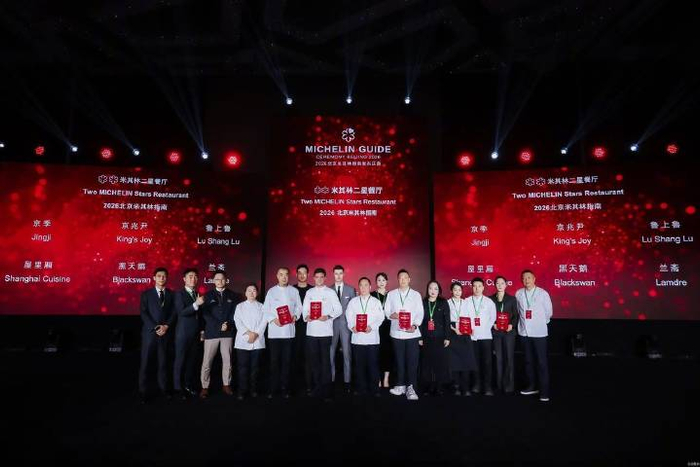
Core Points - The 2026 Beijing Michelin Guide has been officially released, featuring six restaurants awarded two Michelin stars [1] Group 1 - Six restaurants in Beijing received the prestigious two Michelin stars, namely Jingji, Jingzhaoyin, Lushanglu, Wulixiang, Heitiansai, and Lanzhai [1]
两家餐厅登榜2026北京“米其林”三星
Xin Jing Bao· 2025-10-29 07:20
Core Viewpoint - The 2026 Beijing Michelin Guide has been officially released, highlighting the recognition of two Beijing restaurants, Chao Shang Chao and Xin Rong Ji, with the prestigious Michelin three-star rating [1] Group 1 - The release date of the 2026 Beijing Michelin Guide is October 29 [1] - Chao Shang Chao and Xin Rong Ji are the two restaurants in Beijing that received the Michelin three-star rating [1]
26家餐厅获2026北京“米其林”必比登推介
Bei Ke Cai Jing· 2025-10-29 07:18
Core Points - The 2026 Beijing Michelin Guide has been officially released, featuring 26 restaurants that received the "Bib Gourmand" recommendation [1] - New restaurants added to the list this year include Baobaohao, Liu Mama Meat Juice Dumplings (Chaoyang), Mingyuan Restaurant, Mai Soup, Tan, and Xiang Binxuan (Huayuan Road) [1] Summary by Category - **Newly Listed Restaurants** - The newly listed restaurants in the 2026 guide are Baobaohao, Liu Mama Meat Juice Dumplings (Chaoyang), Mingyuan Restaurant, Mai Soup, Tan, and Xiang Binxuan (Huayuan Road) [1] - **Total Restaurants Recommended** - A total of 26 restaurants received the Bib Gourmand recommendation, including notable names such as Baobaohao, Baoyuan, and Hong Fanqie (Yuyuantan South Road) [1]
黑天鹅餐厅晋升二星,99家餐厅入选新版北京米其林指南
Bei Jing Shang Bao· 2025-10-29 06:58
Core Insights - The 2026 Beijing Michelin Guide has officially announced a total of 99 restaurants included in the new edition, with 2 restaurants promoted to two-star status and 3 newly listed as one-star [1]. Group 1: Michelin Star Ratings - The new list features 32 Michelin-starred restaurants, with "Chao Shang Chao" (Chaoyang) and "Xin Rong Ji" (Xin Yuan Nan Lu) retaining the highest honor of three stars [3]. - The two-star category has expanded significantly, with "Black Swan," a French restaurant founded by the son of the Good Luck founder, and the vegetarian restaurant "Lan Zhai" successfully promoted [3]. - The one-star category now includes 24 restaurants, with new entries such as "Chao Shang Chao" (Xicheng), "Rong Pao," and "Jia Quan Qi Fu," showcasing over 10 different culinary styles [3]. Group 2: Bib Gourmand and Other Notable Changes - Eight restaurants have made their debut on the Bib Gourmand list, featuring a variety of cuisines including Cantonese clay pot dishes, homestyle Cantonese soup, Northern-style dumplings, and Hunan cuisine [3]. - Notable changes in the star ratings include the removal of "Fu Lin Restaurant" and "LING LONG" from the one-star list due to closure, while "Huai Yang Fu" and "Xiang Ai" have been downgraded from one star to inclusion [3]. - "Jing Zhao Yin" continues to be recognized as a Michelin Green Star restaurant [3].

黑天鹅餐厅晋升二星 99家餐厅入选新版北京米其林指南
Bei Jing Shang Bao· 2025-10-29 06:48
Core Insights - The 2026 Beijing Michelin Guide has officially announced a total of 99 restaurants included in the new edition, with 2 restaurants promoted to two stars and 3 new entries receiving one star [1][4]. Group 1: Michelin Star Ratings - The new list features 32 Michelin-starred restaurants, with "Chao Shang Chao" (Chaoyang) and "Xin Rong Ji" (Xinyuan South Road) retaining the highest honor of three stars [4]. - The two-star category has expanded significantly, with "Black Swan," a French restaurant founded by the son of the Good Luck founder, and the vegetarian restaurant "Lan Zhai" successfully promoted [4]. - The one-star category has also seen new additions, with "Chao Shang Chao" (Xicheng), "Rong Pao," and "Jia Quan Qi Fu" joining the ranks, bringing the total number of one-star restaurants in Beijing to 24, covering over 10 different culinary styles [4]. Group 2: New Entries and Changes - Eight restaurants have made their debut on the Bib Gourmand list, showcasing a variety of cuisines, including "Bao Bao Hao" specializing in Cantonese clay pot dishes, "Mai Tang" known for its soup dishes, and "Liu Mama Meat Juice Dumplings" (Chaoyang) [4]. - Other new entries include "Ming Yuan Restaurant," a Beijing cuisine establishment operating for decades, "Hua Sheng Feng" (East Third Ring South Road) featuring Zhejiang cuisine, "Tan Restaurant" with Sichuan style, and two authentic Hunan restaurants, "Xiang Bin Xuan" (Garden Road) and "Xiang Lin Tian Xia" [4]. - Notably, the one-star restaurants "Fu Lin Restaurant" and "LING LONG" have dropped off the list due to closure, while "Huai Yang Fu" (Dongcheng) and "Xiang Ai" (Gongti East Road) have been downgraded from one star to inclusion [4]. - "Jing Zhao Yin" continues to be recognized as a Michelin Green Star restaurant [4].
The Cheesecake Factory Incorporated (NASDAQ:CAKE) Earnings Preview
Financial Modeling Prep· 2025-10-27 12:00
Core Insights - The Cheesecake Factory is set to report its third-quarter fiscal 2025 earnings on October 28, with projected EPS of $0.60 and revenue of approximately $913 million [1][2] Financial Performance - Analysts forecast a 3.5% increase in EPS from $0.58 reported in the same quarter last year, driven by strong demand, menu innovations, and efficient cost management [2] - The company has consistently outperformed earnings expectations, with an average surprise of 15.2% over the last four quarters [2][6] - In the most recent quarter, CAKE reported earnings of $1.16 per share, exceeding the Zacks Consensus Estimate of $1.06 per share, resulting in a 9.43% surprise [3] Market Valuation - CAKE's price-to-earnings (P/E) ratio is approximately 16.39, and the price-to-sales ratio is about 0.76, indicating a valuation of $0.76 for every dollar of sales [4] - The enterprise value to sales ratio stands at around 1.29, reflecting the company's total valuation in relation to its sales [4] Financial Health - The current ratio is approximately 0.20, indicating potential liquidity challenges for the company [5][6] - The debt-to-equity ratio is notably high at 5.24, suggesting a significant reliance on debt financing over equity [5][6]

《一饭封神》主厨坐镇,广东首个米其林美食节人气爆棚
2 1 Shi Ji Jing Ji Bao Dao· 2025-10-25 02:19
Core Insights - The first Michelin Food Festival in Guangdong has opened in Shenzhen, featuring 8 Michelin restaurants and 17 local star restaurants, highlighting the city's culinary diversity and appeal [1][2] - The event aims to position Luohu District as a core area for international consumption, with plans for more high-impact international events in the future [1] - The Michelin Guide will include Shenzhen for the first time in 2026, merging it with the Guangzhou guide to release the "2026 Guangzhou and Shenzhen Michelin Guide" [2] Group 1 - The Michelin Food Festival attracted over 6,000 visitors within just three hours of its opening [2] - The festival showcases popular dishes like "Zhong Shui Jiao" from the Michelin-starred restaurant Song, which gained popularity through the variety show "Yi Fan Feng Shen" [1] - The event reflects the growing trend of using food as a means to enhance a city's cultural and tourism appeal, similar to other cities known for their unique culinary offerings [1]
中国7~9月GDP增速放缓至4.8%
日经中文网· 2025-10-20 03:22
Group 1 - The actual GDP growth rate for July to September 2025 is 4.8%, which is a slowdown from 5.2% in April to June, primarily due to weak real estate affecting domestic demand [2][4] - Fixed asset investment decreased by 0.5% in the first three quarters, indicating negative growth, while infrastructure investment grew by 1.1% [4] - The retail sales of consumer goods increased by 4.5% in the first three quarters, a decline from 5.0% in the first half of the year, with restaurant revenue growing by 3.3% [4] Group 2 - Industrial added value for large-scale industries grew by 6.2% in the first three quarters, but the growth rate slowed from 6.4% in the first half [4] - Exports (in USD) increased by 6.6% in July to September, with a trade surplus growing by 12% year-on-year, despite a decrease in exports to the US [5]

九毛九(09922):3季度同店修复节奏仍然偏慢;下调盈利预测,维持中性评级
BOCOM International· 2025-10-16 11:41
Investment Rating - The investment rating for the company is Neutral [2][18]. Core Insights - The company has adjusted its earnings forecast downward due to a slow recovery in same-store sales, maintaining a neutral rating with a target price reduced to HKD 2.32, reflecting a potential upside of 13.7% [6][18]. - Same-store sales for the third quarter showed declines, but there are initial signs of recovery, particularly in the "Tai Er" brand, which has seen improvements in major cities [6][19]. - The company is focusing on optimizing its store network and upgrading its "Tai Er" model, which is expected to drive sales recovery in the latter half of the year [6][19]. Financial Summary - Revenue projections for 2025 have been slightly reduced to RMB 5,553 million, with net profit estimates adjusted to RMB 143 million [5][19]. - The company’s earnings per share (EPS) for 2025 is forecasted at RMB 0.10, reflecting a significant decrease from previous estimates [5][19]. - The price-to-earnings (P/E) ratio for 2025 is projected at 18.8 times, down from earlier estimates [5][19]. Store Performance - As of the end of September, the total number of stores was 686, with a net decrease of 43 stores primarily due to the closure of underperforming locations [6][19]. - The "Tai Er" brand has implemented a new operational model, with 106 upgraded restaurants as of September, aiming to expand to over 200 by the end of 2025 [6][19]. Sales Metrics - The average daily sales for the third quarter showed declines of 9.3% for "Tai Er," 19.1% for "Song Hot Pot," and 14.8% for "Jiu Mao Jiu," although the rate of decline has narrowed compared to the previous quarter [6][19]. - The table turnover rates for "Tai Er," "Song," and "Jiu Mao Jiu" were 3.3, 2.4, and 2.5 respectively, indicating slight improvements in operational efficiency [6][19].