Nonferrous Metals

Search documents
锌周报:风险偏好修复,锌价弱反弹-20251027
Tong Guan Jin Yuan Qi Huo· 2025-10-27 01:51
1. Report Industry Investment Rating No information provided in the report. 2. Core Viewpoints of the Report - Last week, the main contract price of Shanghai zinc futures showed a weak rebound. The inflation data was lower than expected, strengthening the expectation of the Federal Reserve to cut interest rates. The Sino - US economic and trade consultations reached a basic consensus, and the market risk appetite continued to recover. Domestically, the probability of achieving the annual GDP growth target of 5% was high, and mild policy support at the end of the year was still expected [3][4]. - Fundamentally, the LME zinc inventory continued to decline, and the LME0 - 3 spot premium soared to $300, raising concerns about a soft squeeze in the overseas market and strongly supporting zinc prices. The decline in the Shanghai - London ratio strengthened the expectation of zinc ingot exports, and the supply growth of refined zinc was limited due to the narrowing profit of smelters. On the demand side, the start - up rate of primary enterprises decreased slightly, and downstream demand was mainly for rigid procurement. Recently, there were small - scale zinc ingot exports, and the weekly inventory decreased slightly [4]. - Overall, the improvement in Sino - US economic and trade consultations, the lower - than - expected US inflation supporting the Fed's interest - rate cut, and the expected mild policy support in China at the end of the year led to the recovery of market risk appetite. The fundamental contradiction centered around the low overseas inventory and strong market structure, as well as domestic zinc ingot exports. It was expected that the zinc price would continue its weak rebound in the short term, but the upside space was cautiously optimistic. The upside space was expected to open up after the large - scale export of zinc ingots [4][11]. 3. Summary by Relevant Catalogs 3.1 Transaction Data | Contract | Price on Oct 17 | Price on Oct 24 | Change | Unit | | --- | --- | --- | --- | --- | | SHFE zinc | 21,815 | 22,355 | +540 | yuan/ton | | LME zinc | 2939.5 | 3019.5 | +80 | US dollars/ton | | Shanghai - London ratio | 7.42 | 7.40 | - 0.02 | - | | SHFE inventory | 109,627 tons | 109,168 tons | - 459 tons | tons | | LME inventory | 38,025 tons | 37,600 tons | - 425 tons | tons | | Social inventory | 16.53 million tons | 16.21 million tons | - 0.32 million tons | million tons | | Spot premium | - 40 yuan/ton | - 60 yuan/ton | - 20 yuan/ton | yuan/ton | [5] 3.2 Market Review - The main contract price of Shanghai zinc futures, ZN2512, rebounded weakly from a low level, with a weekly increase of 3.48%, and fluctuated narrowly at night on Friday. LME zinc stabilized and trended stronger, breaking through the $3000/ton mark again, with a weekly increase of 2.62% [6]. - In the spot market, after the slight rebound of the futures price, downstream procurement became more cautious, mainly for rigid demand, and most transactions were between traders. The spot premium remained weak [7]. - In terms of inventory, as of October 24, the LME zinc inventory decreased by 425 tons to 37,600 tons, and the SHFE inventory decreased by 459 tons to 109,168 tons. As of October 23, the social inventory decreased by 0.32 million tons to 16.21 million tons. The opening of the export window led to some exports [8]. - Macroscopically, the US CPI in September was 3.0% year - on - year, lower than the expected 3.1% and higher than the previous value of 2.9%. The core CPI was 3.0% year - on - year, lower than the expected and previous value of 3.1%. From October 24 to 25, 2025, the fifth round of Sino - US economic and trade consultations was held in Kuala Lumpur, Malaysia. China's GDP in the third quarter of 2025 was 4.8% year - on - year, and some economic indicators in September were weak [8][9]. 3.3 Industry News - SMM data showed that the average domestic zinc concentrate processing fee in November was 3000 yuan/metal ton, a decrease of 650 yuan/ton month - on - month; the average imported ore processing fee was $105.54/dry ton, an increase of $18.03/dry ton month - on - month [12]. - ILZSG reported that from January to August 2025, the global zinc market had a surplus of 154,000 tons, compared with a surplus of 138,000 tons in the same period last year. The global refined zinc production from January to August was 9.152 million tons, and the consumption was 8.998 million tons [12][13]. - MMG's zinc ore production in the third quarter of 2025 was 58,700 tons, a year - on - year increase of 26%. Boliden's overall output of lead - zinc concentrates in the third quarter of 2025 increased quarter - on - quarter, but the Tara mine's production ramp - up was slower than expected, and the Odda smelter's refined zinc output decreased [13]. - Vedanta's zinc concentrate metal output in the third quarter of 2025 was 318,000 tons, a year - on - year increase of 6%. Customs data showed that in September, the imported zinc concentrate was 505,400 tons, a month - on - month increase of 8.15% and a year - on - year increase of 24.94%. The imported refined zinc was 22,700 tons, a month - on - month decrease of 11.6% and a year - on - year decrease of 57%. The exported refined zinc was 2500 tons, and the exported galvanized sheet was 1.2262 million tons, a month - on - month increase of 11.73% and a year - on - year increase of 2.27% [14]. 3.4 Relevant Charts The report provides multiple charts, including the price trends of Shanghai and LME zinc, the ratio of domestic and foreign markets, spot premiums, inventory changes, zinc ore processing fees, zinc ore import profits and losses, domestic refined zinc production, refined zinc net imports, and the start - up rate of downstream primary enterprises [15][18][22][23][24][26].
A股收评:创业板指涨1.98% 两市成交额创8月8日以来新低
2 1 Shi Ji Jing Ji Bao Dao· 2025-10-20 07:39
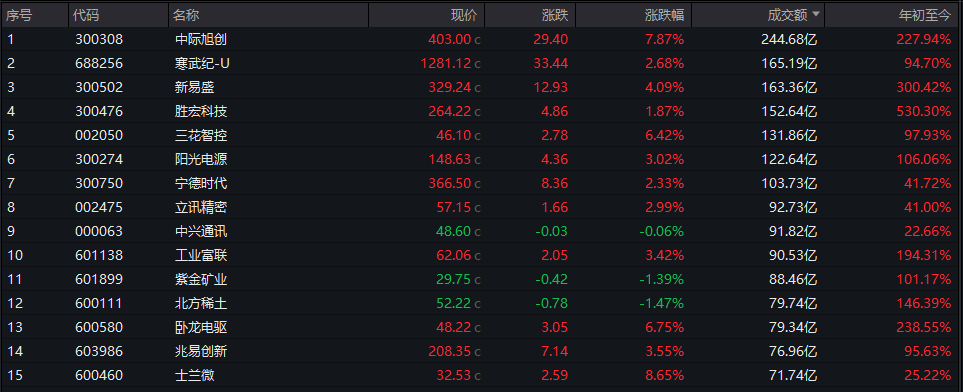
Market Performance - The market experienced a rise and then a pullback, with the ChiNext Index initially increasing by over 3%. By the close, the Shanghai Composite Index rose by 0.63%, the Shenzhen Component Index by 0.98%, and the ChiNext Index by 1.98% [1] Sector Performance - The computing hardware sector was notably active in the morning, with Cambridge Technology hitting the daily limit [2] - In the afternoon, the superhard materials sector surged, with Sifangda and Huanghe Xuanfeng both reaching the daily limit [3] - The coal sector continued to strengthen, with Dayou Energy achieving 11 consecutive trading limits and Antai Group hitting 3 consecutive limits [4] - Gas stocks saw a rapid rise, with Guo Xin Energy achieving 4 limits in 5 days [5] - Conversely, the non-ferrous metals sector experienced significant declines, particularly in gold-related stocks, with Hunan Silver hitting the daily limit down [6] Trading Volume - The total trading volume for the Shanghai and Shenzhen markets was 1.74 trillion yuan, a decrease of 200.5 billion yuan from the previous trading day, marking the lowest trading volume since August 8 [7] Individual Stock Highlights - Zhongji Xuchuang led in trading volume with 24.468 billion yuan, followed by Hanwujing-U, Xinyisheng, and Shenghong Technology [8] - Notable individual stock performances included: - Zhongji Xuchuang: 403.00 yuan, up 29.40 yuan (7.87%), with a year-to-date increase of 227.94% [9] - Hanwujing-U: 1281.12 yuan, up 33.44 yuan (2.68%), with a year-to-date increase of 94.70% [9] - Xinyisheng: 329.24 yuan, up 12.93 yuan (4.09%), with a year-to-date increase of 300.42% [9] - Shenghong Technology: 264.22 yuan, up 4.86 yuan (1.87%), with a year-to-date increase of 530.30% [9]


永安期货有色早报-20251014
Yong An Qi Huo· 2025-10-14 01:27
Group 1: Report Industry Investment Rating - Not provided in the content Group 2: Core Views of the Report - For copper, maintain a callback buying strategy, considering the continuous tightness in the mining end and the growth in infrastructure and power demand in Southeast Asia and the Middle East. Pay attention to the support around $10,300 for LME copper, and consider selling put options below $10,000 or gradually building virtual inventories [1] - For aluminum, the short - term fundamentals are acceptable, and it is advisable to hold at low prices in the long term [1] - For zinc, due to the poor domestic fundamentals but potential export opportunities, and increased macro uncertainties, it is recommended to wait and see. Consider gradually taking profits on domestic - foreign positive spreads and pay attention to reverse spreads in the far - month contracts. Also, pay attention to the positive spread opportunity between December and February contracts [2] - For nickel, the short - term real - world fundamentals are weak, but with potential policy - supported price increases from Indonesia [3][4] - For stainless steel, the fundamentals remain weak, with increased short - term trade friction uncertainties and potential price - support policies from Indonesia [9] - For lead, the price is expected to maintain a high - level oscillation between 17,000 and 17,400 next week, with a potential weakening trend in the future [12] - For tin, follow the macro sentiment in the short term, wait and see, and consider holding at low prices near the cost line in the medium - to - long term [15] - For industrial silicon, the supply - demand is balanced in Q4, and the price is expected to oscillate at the cycle bottom based on the seasonal marginal cost in the long term [16] - For lithium carbonate, the price has high elasticity after supply - side disturbances are realized and strong downward support before such disturbances [16] Group 3: Summary by Metal Copper - Price data shows changes in various indicators from September 29 to October 13, such as a 55 increase in spot premium and a 2926 increase in SHFE warehouse receipts [1] - Macro - level: Trump's tariff announcement led to a 4.5% drop in LME copper on Friday. The impact may be less than the Qingming Festival disturbance. There is still room for negotiation, and the progress of the South Korea negotiation should be monitored [1] - Fundamental: Smelting production cuts exceeded expectations, and there was medium - level inventory accumulation this week. After the price drop on Friday, the volume of pricing and receiving goods is expected to increase next week, leading to inventory reduction. Pay attention to the stability of copper cable production [1] Aluminum - Price data shows changes in aluminum prices, alumina prices, and inventory from September 29 to October 13, such as a 190 decrease in the Shanghai aluminum ingot price [1] - Fundamental: The operating capacity is increasing slightly. The production of photovoltaic modules has stabilized, and the proportion of molten aluminum has rebounded in September. There is seasonal inventory accumulation due to the holiday effect. The global economic recovery and Fed's rate - cut expectations coexist with Sino - US trade uncertainties, causing a divergence in domestic and foreign market trends [1] Zinc - Price data shows changes in zinc prices, inventory, and other indicators from September 29 to October 13, such as a 100 decrease in the Shanghai zinc ingot price [2] - Supply: Domestic TC is decreasing, and imported TC is increasing. Domestic mines will be tighter from Q4 to Q1 next year, while overseas mines had an unexpected increase in Q2. The smelting end is slightly recovering in October [2] - Demand: Domestic demand is seasonally weak, and overseas demand in Europe is average. Some overseas smelters face production difficulties due to processing fees [2] - Strategy: The domestic fundamentals are poor, but the export window may open. Due to increased macro uncertainties, it is recommended to wait and see [2] Nickel - Price data shows changes in nickel - related prices from September 29 to October 13, such as a 1300 decrease in the SHFE nickel spot price [3] - Fundamental: Pure nickel production remains high. Demand is weak, and inventory is stable domestically but increasing overseas. The short - term fundamentals are weak [3][4] - News: The protests in Indonesia have subsided, but there are still disturbances in the mining end, and the policy side has a motivation to support prices [4] Stainless Steel - Price data shows a decrease in stainless - steel prices from September 29 to October 13, such as a 50 decrease in the 304 cold - rolled coil price [9] - Fundamental: Steel mills' production in October is slightly increasing. Demand is mainly for rigid needs. Costs are stable, and inventory has increased during the holiday [9] - Policy: There is potential price - support from Indonesian policies, and trade friction uncertainties have increased [9] Lead - Price data shows changes in lead - related prices and inventory from September 29 to October 13, such as a 9293 decrease in the SHFE inventory [12] - Supply: The scrap volume is weak year - on - year. The profit of recycled lead has recovered, and the production is expected to increase by 30,000 tons in October. The primary lead production may decrease partially, and the recycled lead production will increase, with a total increase of 20,000 - 30,000 tons [12] - Demand: The battery production rate increased this week, but the finished - product inventory is high. After the National Day holiday, the demand may weaken [12] - Price forecast: The price is expected to oscillate between 17,000 and 17,400 next week and may weaken in the future [12] Tin - Price data shows changes in tin - related indicators from September 29 to October 13, such as a 4990 decrease in the tin position [15] - Supply: The processing fee of tin ore is low, and some domestic smelters have cut production. Overseas supply is expected to recover in October, and Indonesian exports have resumed [15] - Demand: The solder market has slightly recovered during the peak season. Domestic inventory has decreased slightly, and overseas LME inventory is oscillating at a low level [15] - Strategy: Follow the macro sentiment in the short term, wait and see, and consider holding at low prices near the cost line in the medium - to - long term [15] Industrial Silicon - Price data shows changes in industrial - silicon - related basis and warehouse receipts from September 29 to October 13, such as a 120 decrease in the 421 Yunnan basis [16] - Supply: A leading enterprise in Xinjiang has resumed production, and the production in Sichuan and Yunnan is stable. There is a strong expectation of production cuts in November [16] - Outlook: The supply - demand is balanced in Q4, and the price is expected to oscillate at the cycle bottom based on the seasonal marginal cost in the long term [16] Lithium Carbonate - Price data shows changes in lithium - carbonate prices, basis, and warehouse receipts from September 29 to October 13, such as a 450 decrease in the SMM electric - grade lithium carbonate price [16] - Supply: Overseas mines are reluctant to lower prices, and traders are reluctant to sell. Salt plants are less willing to accept high - priced lithium ore [16] - Demand: The pre - holiday inventory - building has almost ended. The spot basis is weak, and most transactions are at a discount [16] - Outlook: The price has high elasticity after supply - side disturbances are realized and strong downward support before such disturbances [16]
中国材料行业 ——2025 年第四季度展望:传统材料股票影响-China Materials-4Q25 Outlook – Equity Implications Traditional Materials
2025-10-09 02:00
Summary of Key Points from the Conference Call Industry Overview - **Industry Focus**: Traditional Materials in the Asia Pacific region, specifically gold, copper, aluminum, steel, and coal [1][7]. Core Insights and Arguments Gold - **Price and Volume Growth**: Strong prices and above-peer volume growth are expected for Chinese gold miners, with projected double-digit volume growth from 2024 to 2027, while global production is anticipated to be flat or declining. This is expected to lead to strong earnings growth for Chinese gold miners [2]. Copper - **Super Cycle Factors**: A combination of supply disruptions, loose liquidity, and a weak dollar is expected to widen the global copper supply deficit in 2026. The macroeconomic environment is supportive, with abundant liquidity in the US and China, US rate cuts, and a weakening dollar, leading to a bullish outlook for copper equities [3]. Aluminum - **Sustainable Margin Expansion**: The expansion of bauxite supply from Guinea and other countries is leading to an oversupply of alumina globally. China's aluminum capacity is capped at 45 million tons, resulting in higher margins for aluminum smelters, estimated at around Rmb4,000 per ton year-to-date, which is expected to be sustainable. New supply additions for 2025-26 are estimated at 1.6 million tons and 1.0 million tons, respectively, which is less than the demand growth [4]. Steel - **Production Cuts and Export Strength**: Current steel margins are in the Rmb150-200 per ton range. There is resistance from steel mills and local governments regarding production cuts, which are part of anti-involution measures. Actual cuts are expected to be lower than the previously anticipated 30 million tons, primarily occurring during the winter slow season. Steel exports remain strong as mills adapt to new markets and product types [5]. Coal - **Support for Thermal Coal Prices**: The National Energy Administration's overproduction inspections are expected to reduce coal production in the second half of 2025 to approximately 2.25 billion tons, down 7% quarter-on-quarter and 9% year-on-year. This reduction, combined with the traditional peak consumption season in winter, is expected to support high thermal coal prices [6]. Additional Important Insights - **Price Target Adjustments**: Various companies within the materials sector have had their price targets adjusted based on updated commodity price forecasts. For example, CMOC's price target has been raised to Rmb18.60 from Rmb12.1, reflecting a 6% increase in EPS forecasts for 2025-27 [20]. - **Market Capitalization and Liquidity**: The report includes detailed market capitalization and liquidity data for various companies, indicating a healthy trading environment for the sector [12][14]. - **Long-term Commodity Price Forecasts**: The report provides updated long-term forecasts for commodity prices, indicating expected increases in prices for gold, copper, and aluminum, among others [17][18]. Conclusion - The overall outlook for the traditional materials sector in Asia Pacific is positive, with specific bullish sentiments for gold, copper, and aluminum driven by macroeconomic factors and supply-demand dynamics. The steel and coal sectors face challenges but also show resilience through export strength and seasonal demand.
中国材料行业-2025 年第四季度展望:上行周期延续-China Materials-4Q25 Outlook – Upcycle Continues
2025-10-09 02:00
Summary of Conference Call Notes Industry Overview - **Industry**: Greater China Materials - **Market Condition**: A liquidity-driven bull market is ongoing, supported by supply disruptions, which is positively impacting commodity prices [1][2][17] Key Insights Commodity Preferences - **Preferred Commodities**: Gold, copper, and aluminum equities are favored in the current market environment due to their strong performance and demand [1][2][17] - **Gold Outlook**: Anticipated further upside in gold prices driven by a weakening USD, strong ETF buying, and central bank purchases, alongside safe haven demand amid uncertainty [2][18] - **Copper Supply Dynamics**: Supply disruptions are expected to widen the global copper supply deficit in 2026, with a supportive macro environment of abundant liquidity and a weak dollar [19] - **Aluminum Margins**: Higher margins for aluminum smelters are projected due to capped capacity in China and limited ability to restart idled capacity in the US/Europe [20] Demand and Supply Trends - **Retail Demand**: Retail growth in autos and home appliances has weakened, attributed to a high base and early demand from trade-in subsidies [3] - **Construction Activity**: Property sales and construction remain subdued, with expectations for a major policy pivot requiring endorsement at the 4th Plenary Session [3] - **Anti-involution Policies**: Industries such as coal, cement, glass, and steel are facing production controls to curb overproduction, with specific guidelines issued to stabilize prices [4][21] Specific Sector Insights - **Cement Industry**: Policies to control overproduction are expected to lead to a 20% capacity exit during 2025-26, benefiting industry leaders through consolidation [21] - **Late-cycle Building Materials**: Demand for late-cycle building materials is expected to remain soft, although improvements may arise from secondary home sales and government programs [22] - **Lithium Demand**: Strong demand for lithium is noted, with potential supply disruptions due to resource reclassification at several mines [23] Price Forecasts - **Commodity Price Projections**: - **Gold**: Expected to rise to $4,400/oz by 2026, a 33% increase from current estimates [15] - **Copper**: Projected to reach $10,650/ton by 2026, reflecting a 9% increase [16] - **Aluminum**: Anticipated price of $2,750/ton by 2026, an 8% increase [16] Investment Recommendations - **Overweight Stocks**: CMOC, Hongqiao, Chalco, Anhui Conch, CNBM, and Baosteel are highlighted as preferred investment choices in the materials sector [2][17] - **Underweight Stocks**: Companies such as China Coal, Asia Cement, and Yancoal are recommended for underweight positions due to unfavorable market conditions [14] Additional Considerations - **Uranium Market**: Strong price momentum is expected in uranium, supported by major investment vehicles and contracting from utilities [24] - **Rare Earths**: Prices are anticipated to remain strong due to good downstream demand and tightened supply-side controls in China [25] This summary encapsulates the key points from the conference call, providing insights into the current state and future outlook of the Greater China materials industry.
Deepseek预测:10月有色金属,要紧盯好这两个方向
Sou Hu Cai Jing· 2025-10-07 16:32
Core Viewpoint - The non-ferrous metals industry is undergoing unprecedented changes driven by the global energy revolution, with traditional pricing models being disrupted by the Federal Reserve's anticipated interest rate cuts in 2025, leading to intensified competition between liquidity-driven premiums and supply-demand fundamentals [2][3]. Group 1: Copper Market - The global copper ore grade is continuously declining, and new discoveries are sharply decreasing, resulting in a significant supply constraint with a development cycle of 8-10 years [2]. - The Grasberg copper mine accident in Indonesia in 2025 is expected to widen the global copper concentrate supply-demand gap to 268,000 tons [2]. - Demand remains robust in traditional sectors like electricity and construction, while AI data centers require six times more copper per unit than traditional equipment, and electric vehicle charging stations require 0.8 kg of copper per kilowatt installed [2]. - LME copper prices increased by 11.4% year-on-year in Q1 2025, reaching a historical high of $10,857 per ton in May 2025, before a rapid decline of 19% due to overextension of interest rate cut expectations [2]. Group 2: Aluminum Market - The domestic aluminum industry is facing a "ceiling" policy limiting production capacity to 45 million tons, shifting the competitive focus to cost control and industry chain collaboration [6]. - The price drop of alumina has led to an expansion of profits by 300 yuan per ton for electrolytic aluminum, with companies like Shenhuo and Yun Aluminum benefiting from integrated self-supplied electricity, achieving over 27% year-on-year net profit growth [6]. - The demand for aluminum in lightweight transportation and electric vehicles is expected to grow by 15%, supported by government policies [6]. - Technological advancements, such as the AI-driven Gemini-2.0-Flash project, aim to reduce energy consumption in aluminum production by 200 kWh per ton [6]. Group 3: Rare Metals and Strategic Commodities - The pricing logic for rare metals like rare earths, antimony, and tungsten has evolved beyond supply-demand dynamics, becoming strategic assets in global competition [6]. - After the consolidation of China's rare earth industry, six major groups control 90% of global supply, with a 40% reduction in price volatility due to the 2025 export quota system [6]. - Antimony, essential for photovoltaic glass, faces supply chain anxiety due to a three-week global inventory and export bans from the Democratic Republic of the Congo [6]. - Future demand for lanthanide elements is expected to surge due to solid-state batteries, with a 50% increase in neodymium-iron-boron usage for robotics and a 70% reliance on magnesium alloys for low-altitude economic aircraft [6]. Group 4: Industry Risks and Challenges - Resource nationalism is rising, leading to frequent adjustments in mining taxes in resource-rich countries like Indonesia and Chile, with compliance costs for companies like Zijin Mining increasing by 12% annually [7]. - Domestic electrolytic aluminum companies face increased green electricity requirements, rising from 10% to 30% by 2030, which pressures short-term profits due to necessary technological upgrades [7]. - When copper prices exceed $10,000 per ton, downstream cable and appliance manufacturers may see profit margins drop below 5%, potentially leading to policy interventions due to imbalanced profit distribution across the industry [7]. - Global mining investment is projected to grow by 6.2% in 2025, but less than 1% of that is allocated to deep processing and R&D, indicating a structural mismatch that could limit long-term industry resilience [7]. Group 5: Overall Industry Outlook - The non-ferrous metals industry stands at a crossroads, facing both opportunities and challenges brought by the energy revolution, with the ability to navigate volatility and risks determining the sustainability and success of companies and the industry as a whole [9].

Trump Sanctions Revive Barter Trade: China's Chery Trades Half-Built Cars for Iran's Copper
Yahoo Finance· 2025-10-06 21:31
Core Insights - Barter trade activities between Chery Automobile and Iran have increased due to U.S. sanctions, allowing Chery to supply vehicles in exchange for metal ores from Iran [1][2][5] Group 1: Trade Dynamics - Chery, the largest vehicle exporter in China, has engaged in barter trade with Iran, supplying semi-knocked-down vehicles, which accounted for over half of its exports by 2016 [3] - The trade is facilitated through a separate company that routes the vehicles to Chery's local partner in Iran, MVM, for assembly [4] Group 2: Sanctions Compliance - Chery's trade does not involve U.S. dollars, thus avoiding violations of the sanctions imposed by the Trump administration on Iran [5] Group 3: Financial Performance - Chery's recent IPO on the Hong Kong stock exchange raised $1.2 billion, with its share price increasing by 11% to HK$34.16 from an initial price of HK$30.75 [8]
2025年1-7月中国锌产量为416.6万吨 累计增长1.3%
Chan Ye Xin Xi Wang· 2025-09-03 05:06
Group 1 - The core viewpoint of the article highlights the growth in China's zinc production, with a projected output of 617,000 tons in July 2025, representing a year-on-year increase of 13.8% [1] - From January to July 2025, China's cumulative zinc production reached 4.166 million tons, showing a cumulative growth of 1.3% [1] Group 2 - The article lists several publicly traded companies in the zinc industry, including Zhongjin Lingnan (000060), Chihong Zn & Ge (600497), Luoping Zinc Electric (002114), and others [1] - The report referenced is from Zhiyan Consulting, which discusses investment strategies and market size forecasts for the electrolytic zinc industry in China from 2025 to 2031 [1]


众源新材(603527) - 众源新材2025年半年度主要经营数据公告
2025-08-26 09:12
产品产量、销量及同比变化情况为: 以上经营数据未经审计,仅供投资者及时了解公司生产经营状况所用,敬请 广大投资者理性投资,注意投资风险。 安徽众源新材料股份有限公司 2025 年半年度主要经营数据公告 本公司董事会及全体董事保证本公告内容不存在任何虚假记载、误导性陈述 或者重大遗漏,并对其内容的真实性、准确性和完整性承担法律责任。 根据上海证券交易所《上市公司自律监管指引第 3 号——行业信息披露》及 其附件《第十六号——有色金属》有关规定和披露要求,并结合公司的实际情况, 公司 2025 年半年度主要经营数据如下: | 主要产品 | 单位 | 生产量 | 销售量 | 库存量 | 生产量 比上年 | 销售量 比上年 | 库存量 比上年 | | --- | --- | --- | --- | --- | --- | --- | --- | | | | | | | 同期增 | 同期增 | 同期增 | | | | | | | 减(%) | 减(%) | 减(%) | | 铜板带 | 吨 | 62,414.82 | 62,711.65 | 2,512.85 | 10.29 | 9.89 | 20.25 | | 铜箔 ...

A股收评:沪指涨超1%续创10年新高 白酒板块全线走强
Nan Fang Du Shi Bao· 2025-08-20 08:19
Market Performance - The three major A-share indices collectively rose on the 20th, with the Shanghai Composite Index increasing by 1.04% to close at 3766.21 points, marking a 10-year high [2] - The Shenzhen Component Index rose by 0.89%, while the ChiNext Index increased by 0.23% [2] - The North China 50 Index saw a rise of 1.16%, with total trading volume across Shanghai and Shenzhen reaching 24,484 billion yuan, a decrease of 1,923 billion yuan from the previous day [2] Sector Performance - Over 3,600 stocks in the market experienced gains, with notable strength in the liquor, small metals, and semiconductor sectors [2] - The liquor sector showed strong performance, with stocks like JiuGuiJiu hitting the daily limit and SheDe Liquor rising over 7% [2] - The small metals sector also performed well, with Dongfang Zirconium and Yunnan Zhiye both hitting the daily limit [2] - The semiconductor sector saw a significant rise in the afternoon, with ShengKe Communication reaching the daily limit [2] - Conversely, the innovative drug sector faced adjustments, with FuYuan Pharmaceutical and ChenXin Pharmaceutical hitting the daily limit down [2] - The film and television sector also experienced a downturn, with CiWen Media and HuaCe Film falling over 6% [2]