
基金

Search documents
德邦基金“大V带货”风波后,8年女董事长离任
Xin Lang Cai Jing· 2026-02-27 13:21
Core Viewpoint - The recent leadership change at Debon Fund, with the resignation of Chairman Zuo Chang and the appointment of Wu Xiaochun as acting chairman, comes amid regulatory scrutiny following a marketing violation involving internet influencers. This transition may signal a strategic move to strengthen internal controls within the company [1][22]. Group 1: Leadership Change - Zuo Chang has resigned as chairman after nearly 8 years, marking the end of a 17-year career within the Debon system [1][22]. - Wu Xiaochun, a veteran of Debon Securities with 15 years of experience, has taken over as acting chairman. His background in risk management may indicate a focus on compliance and internal controls following recent regulatory issues [1][22][28]. Group 2: Regulatory Issues - Debon Fund faced regulatory penalties for engaging in improper marketing practices with internet influencers, leading to a suspension of new fund registrations [8][29]. - The company was found to have violated regulations by not adequately disclosing risks to investors, which resulted in accountability measures against several executives [8][29][34]. Group 3: Fund Performance - Under Zuo's leadership, Debon Fund's assets under management grew from 13.1 billion yuan to nearly 70 billion yuan by the end of 2025, despite a drop to 8 billion yuan in 2018 due to regulatory changes [3][35]. - The Debon Stable Growth Fund saw significant performance fluctuations, with a peak net value of 1.2982 in January 2025, reflecting a 36% increase over a short period, driven by investments in AI-related stocks [36][38]. Group 4: Market Reactions - Following the regulatory penalties, Debon Fund implemented purchase limits on its popular funds to protect existing investors and manage inflows, reducing the maximum purchase amounts significantly [40][42]. - The fund's net value has shown volatility, with a recent decline of 7.94% in the A share class, indicating potential risks associated with rapid inflows and market sentiment [42].


基金公司的最大利好?
Xin Lang Cai Jing· 2026-02-27 13:15
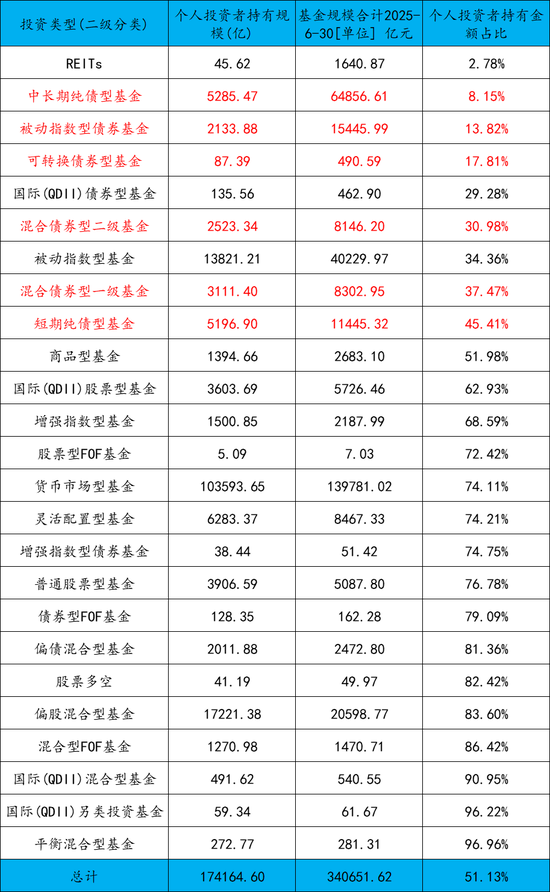
Core Viewpoint - The article discusses the changing landscape of public funds and bank wealth management products, highlighting the shift in performance benchmarks and the implications for individual investors and market dynamics [1][7][35]. Group 1: Public Fund Investor Composition - The article provides data on the proportion of individual investors in various types of public funds, with the total public fund size reaching 3406.52 billion yuan and individual investor holdings at 1741.64 billion yuan, representing 51.13% [1][18]. - Individual investor ownership in short-term pure bond funds is notably high at 45.41%, while REITs have the lowest at 2.78% [1][18]. Group 2: Comparison with Bank Wealth Management - Bank wealth management products have a total scale of 33.29 trillion yuan, predominantly consisting of fixed-income products, with individual investors making up a significant portion [2][19]. - The article notes that the low proportion of individual investors in bond funds compared to bank wealth management is attributed to the latter's historical advantages, such as guaranteed returns and clear performance benchmarks [22][24]. Group 3: Benchmark Changes - Both public funds and bank wealth management products are undergoing a "benchmark alignment," where bank products are shifting from clear numerical benchmarks to more complex index-based benchmarks [26][29]. - This change aims to reduce the frequency of adjustments in performance benchmarks, making both types of products more comparable in terms of performance expectations [27][28]. Group 4: Market Dynamics and Future Implications - The article indicates a potential shift in market dynamics, with public funds gaining momentum as bank wealth management products face challenges, such as a decline in scale [25][35]. - The increasing similarity in performance benchmarks may lead to a convergence in risk-return profiles between public funds and bank wealth management products, raising questions about their distinct advantages [34][35].
超1200亿元!开年公募发行“春意盎然”,权益基金成主力
2 1 Shi Ji Jing Ji Bao Dao· 2026-02-27 12:53
Core Insights - The public fund issuance market in 2026 shows significant growth, with 230 new funds established and a total issuance scale of 210.28 billion yuan, representing a year-on-year increase of over 41% in both quantity and scale [1][2] Fund Structure Changes - The structure of new funds has shifted, with equity funds dominating, while FOF and fixed income+ products are emerging strongly [2][5] - In the first two months of 2026, 74 new mixed funds were established, totaling 79.64 billion yuan, accounting for approximately 38% of the total new fund issuance [3] - New stock funds primarily consist of ETF products, with 91 new stock funds launched, totaling 47.06 billion yuan, representing about 22% of the total [4] Equity Fund Dominance - The total issuance scale of newly established equity funds (stock funds + equity mixed funds) reached 120.84 billion yuan in the first two months of 2026 [4] - The trend indicates a strong willingness for new capital to enter the market, improving liquidity and enhancing institutional pricing power [2][11] Fixed Income Fund Trends - The issuance scale of newly established bond funds has significantly declined, with a total of 28 new bond funds launched, totaling 33.47 billion yuan, compared to 73.64 billion yuan in the same period of 2025 [6][7] - The decline in bond fund issuance reflects a shift in investor preference towards equity assets [11] Market Outlook - The hot issuance of equity funds is expected to attract significant incremental capital into the A-share market, potentially leading to a positive impact on liquidity and pricing power [8][11] - There are 58 new funds scheduled for issuance in March, indicating continued interest in equity investments [10] Investment Themes - Newly established equity funds cover various themes, including technology, consumption, and resource sectors, reflecting a diverse investment strategy [9] - The focus for 2026 is expected to be on performance realization and domestic production, particularly in AI and semiconductor sectors [12][13]
互认基金新规后首批产品获批 摩根资管等4家拿下入场券
Xin Lang Cai Jing· 2026-02-27 12:35
Core Viewpoint - The approval of the first four mutual recognition funds marks a significant step in the implementation of the revised Hong Kong Mutual Recognition of Funds regulations, which will enhance cross-border investment opportunities for mainland Chinese residents [1] Group 1: Fund Approvals - The first batch of four mutual recognition funds approved includes Morgan Asia High Dividend Fund, Fidelity Global Investment Fund - Hong Kong Bond Fund, Huaxia Select RMB Investment Grade Income Fund, and Taiping Greater China New Power Equity Fund [1] - This approval is the first since the implementation of the revised regulations on January 1, 2025, which increased the cross-border sales limit for mutual recognition funds from 50% to 80% [1] Group 2: Market Impact - The approval of these mutual recognition funds is expected to enrich the toolkit for cross-border investments, providing new options for mainland Chinese residents to participate in overseas capital markets and optimize their asset allocation [1]
证监会发布新规,今年9月1日起施行
Jin Rong Shi Bao· 2026-02-27 12:22
Core Viewpoint - The China Securities Regulatory Commission (CSRC) has announced the implementation of the "Private Investment Fund Information Disclosure Supervision and Management Measures," effective from September 1, 2026, aimed at enhancing transparency and protecting investors' rights in the private fund sector [1][2]. Group 1: Overview of the Regulation - The "Private Fund Information Disclosure Measures" consists of seven chapters and forty-four articles, focusing on five main areas [2]. - It establishes the principles for information disclosure by private fund managers, custodians, and sales institutions [2]. Group 2: Basic Disclosure Requirements - Private fund managers are required to disclose information according to the fund contract, including content, channels, methods, and frequency [2]. - The regulation outlines the responsibilities of custodians regarding information disclosure and the review of financial information [2]. - It prohibits certain disclosure practices, such as promising investors against losses or guaranteeing minimum returns [2]. Group 3: Reporting Requirements - The regulation specifies the types and content of regular reports for private securities and equity investment funds [3]. - Fund managers must prepare and disclose interim reports promptly in the event of significant occurrences [3]. - Clear guidelines are provided for the disclosure of liquidation announcements and related significant information [3]. Group 4: Management of Disclosure Affairs - Fund managers and custodians are required to establish robust information disclosure management systems [3]. - There are obligations for shareholders, partners, and actual controllers to cooperate in information disclosure [3]. Group 5: Supervision and Legal Responsibilities - The CSRC will supervise the information disclosure activities of private fund managers, custodians, and sales institutions, with the authority to impose administrative penalties for violations [3]. - The regulation will be enforced starting September 1, 2026, with new private funds needing to comply with the new rules upon submission [3]. Group 6: Future Actions - The CSRC plans to enhance the enforcement of the new disclosure measures and promote the healthy development of the private fund industry [4]. - Ongoing efforts will be made to implement the "Private Fund Supervision Regulations" and improve the regulatory framework for private fund operations [4].
红利板块节后走强,关注红利ETF易方达(515180)、恒生红利低波ETF易方达(159545)等产品投资机会
Sou Hu Cai Jing· 2026-02-27 11:58
Core Viewpoint - The recent performance of various dividend indices indicates a positive trend in high-dividend stocks, with the China Securities Dividend Index rising by 2.8% this week, suggesting a favorable environment for dividend-focused investments [1]. Group 1: Index Performance - The China Securities Dividend Index increased by 2.8% this week, while the Hang Seng High Dividend Low Volatility Index rose by 1.4%, the China Securities Dividend Value Index by 0.9%, and the China Securities Dividend Low Volatility Index by 0.6% [1]. - The dividend yield for the China Securities Dividend Index is 4.9%, with a rolling price-to-earnings (P/E) ratio of 8.2 times, placing it in the 66.7th percentile historically [3]. - The rolling P/E ratio for the China Securities Dividend Low Volatility Index is 8.0 times, with a dividend yield of 4.7%, and it is in the 71.9th percentile historically [3]. Group 2: ETF Management Fees - E Fund is currently the only fund company offering all its dividend ETFs at a low management fee rate of 0.15% per year, which includes products like the E Fund Hang Seng Dividend Low Volatility ETF and others [1]. - The low fee structure is designed to help investors build high-dividend assets at a lower cost [1]. Group 3: Index Composition - The China Securities Dividend Index consists of 100 stocks with high cash dividend yields and stable dividends, with over 50% of its composition from the banking, coal, and transportation sectors [4]. - The China Securities Dividend Low Volatility Index is made up of 50 stocks with good liquidity and continuous dividends, with over 60% from the banking, coal, and transportation sectors [4]. - The Hang Seng High Dividend Low Volatility Index includes 50 stocks from the Hong Kong Stock Connect with high dividend levels and low volatility, with over 60% from the financial, real estate, and energy sectors [4].

证监会召开资本市场“十五五”规划外资机构座谈会:坚持市场化、法治化、国际化方向
Jin Rong Jie· 2026-02-27 11:30
Group 1 - The core viewpoint of the articles emphasizes the positive developments in China's capital market since the implementation of the new "National Nine Articles," highlighting improvements in foundational systems, market functions, and the investment value of listed companies, as well as an increase in foreign participation [1][2] - The China Securities Regulatory Commission (CSRC) is committed to implementing the directives from the 20th Central Committee and the upcoming National "Two Sessions," focusing on high-quality development in the capital market over the next five years [2] - The meeting participants suggested enhancing the adaptability and inclusiveness of capital market systems, steadily expanding high-level institutional openness, and accelerating the establishment of first-class investment banks and institutions [1][2] Group 2 - The CSRC aims to deepen comprehensive reforms in investment and financing, improve the system, products, and service frameworks of the capital market, and better serve technological innovation and new productive forces [2] - There is a strong emphasis on promoting deeper and higher-level openness in the capital market, actively participating in global financial governance reform, and creating a transparent, stable, and predictable market environment [2] - Foreign institutions are recognized as important participants in China's capital market, and their role in global resource allocation and professional expertise is encouraged to contribute to the high-quality development of the capital market [2]
证监会最新发布!私募基金迎信披领域行政规章
Zheng Quan Ri Bao Wang· 2026-02-27 11:06
Core Viewpoint - The China Securities Regulatory Commission (CSRC) has released the "Private Investment Fund Information Disclosure Supervision and Administration Measures," which will take effect on September 1, 2026, marking a significant step in enhancing the regulatory framework for private investment funds in China [1][9]. Group 1: Regulatory Framework - The "Private Fund Information Disclosure Measures" is the first administrative regulation implementing the "Private Investment Fund Supervision Regulations," establishing a comprehensive information disclosure system for private funds [1][2]. - The CSRC aims to create a clear and complete regulatory rule system covering all aspects of private fund operations, enhancing the institutional foundation for standardized operations in the private fund industry [1][2]. Group 2: Information Disclosure Responsibilities - The regulation clarifies the information disclosure responsibilities of various market participants, including private fund managers, custodians, and sales institutions, emphasizing the primary responsibility of fund managers to disclose accurate and timely information [3][4]. - It requires custodians to fulfill their disclosure duties related to fund management and to report any significant issues affecting investor rights [3][5]. Group 3: Disclosure Requirements - The regulation specifies detailed disclosure requirements, including the nature, frequency, and content of reports, while reinforcing the principle of non-public disclosure to protect investor privacy [4][5]. - It mandates enhanced transparency regarding nested investments, requiring disclosure of underlying assets to address long-standing transparency issues [4][5]. Group 4: Risk Disclosure and Investor Protection - The regulation strengthens risk disclosure requirements, ensuring that investors are informed about the risks associated with fund operations, particularly for complex and high-risk funds [5][6]. - It establishes mechanisms for investors to obtain information and seek clarification on disclosure matters, enhancing their ability to protect their rights [5][6]. Group 5: Penalties for Non-compliance - The regulation increases penalties for violations of disclosure requirements, with fines up to 1 million yuan for fund managers and related parties, aiming to improve compliance and transparency in the industry [7][8]. - It also stipulates that penalties can reach five times the illegal gains for shareholders and partners of fund managers who violate the disclosure rules [7][8]. Group 6: Implementation Timeline - The "Private Fund Information Disclosure Measures" will be implemented starting September 1, 2026, allowing market participants time to adapt to the new requirements [9].
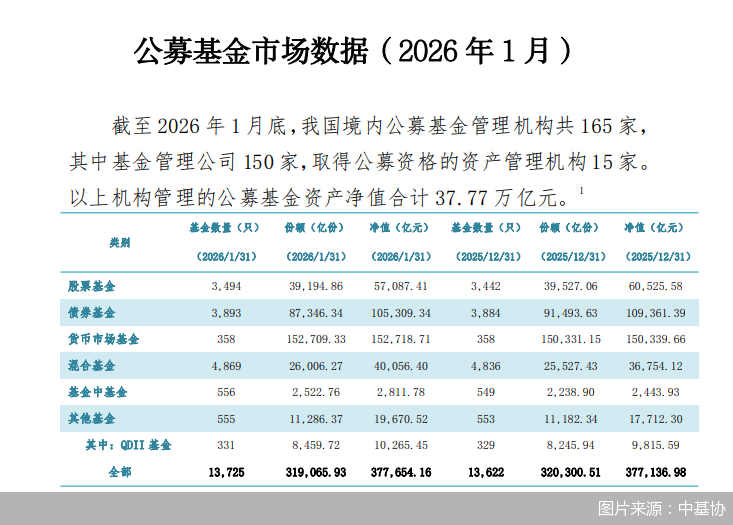
公募基金规模再创新高!1月末资产净值合计37.77万亿元
Bei Jing Shang Bao· 2026-02-27 10:50
Core Insights - The total net asset value of public funds in China reached a historical high of 37.77 trillion yuan as of the end of January 2026, with 165 fund management institutions managing these assets [2]. Group 1: Fund Categories - The number of stock funds increased to 3,494 with a total share of 39.19 billion and a net value of 570.87 billion yuan, while the previous month had 3,442 stock funds with a net value of 605.26 billion yuan, indicating a decrease in net value [2]. - Bond funds totaled 3,893 with 87.35 billion shares and a net value of 1,053.09 billion yuan, down from 3,884 bond funds with a net value of 1,093.61 billion yuan [2]. - Money market funds remained stable at 358 with a net value of 152.72 billion yuan, slightly up from 150.34 billion yuan in the previous month [2]. - Mixed funds saw an increase to 4,869 with a net value of 400.56 billion yuan, compared to 367.54 billion yuan previously [2]. - Fund of funds (FOF) reached a net value of 28.12 billion yuan, up from 24.44 billion yuan, showing a growth trend [2]. - Other funds, including QDII funds, also experienced growth, with QDII funds reaching a net value of 102.65 billion yuan, up from 98.16 billion yuan [2]. Group 2: Growth Rates - FOF, QDII, mixed funds, and money market funds showed respective growth rates of 15.05%, 4.58%, 8.98%, and 1.58% [3]. - Conversely, stock funds and bond funds experienced declines of 5.68% and 3.71%, respectively, with stock funds at 571 billion yuan and bond funds at 1,053 billion yuan [3].
ETF主力榜 | 科创债ETF华安(159115)主力资金净流出4.30亿元,居可比基金前3-20260227
Xin Lang Cai Jing· 2026-02-27 10:36
Group 1 - The core point of the article highlights that the Huazhong Science and Technology Bond ETF (159115.SZ) experienced a slight increase of 0.01% on February 27, 2026, despite a significant net outflow of 430 million yuan from major funds (transactions over 1 million yuan) [1] - The latest trading volume for the fund was reported at 27.0718 million shares, with the total transaction amount falling below 2.8 billion yuan, placing it at the lower end among comparable funds [1]