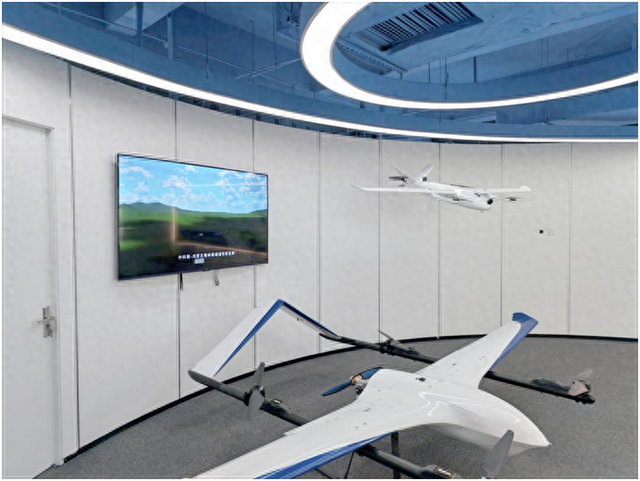
无人机

Search documents
创新创造催生新质生产力(新年谈“新”·五位科技工作者谈创新发展)
Ren Min Ri Bao· 2026-01-04 22:31
Group 1: Technological Innovation and Development - Technological innovation is identified as the core driving force for high-quality development, with advancements in AI models, chip self-research, and applications of humanoid robots and drones marking significant progress [1] - The "14th Five-Year Plan" emphasizes significantly improving the level of technological self-reliance and strength as a primary goal for economic and social development [1] Group 2: Space Exploration and Measurement Technology - The VLBI (Very Long Baseline Interferometry) tracking system for the Tianwen-2 mission has successfully completed 52 observation tasks, demonstrating the reliability and stability required for long-distance space missions [2] - The Tianwen-2 mission aims to explore asteroids and comets, with a complex trajectory requiring high operational reliability and emergency response capabilities [2] Group 3: Drone Technology Advancements - The first 6-ton tilt-rotor unmanned aerial vehicle, Lan Ying R6000, has successfully completed its maiden flight, marking a significant breakthrough in drone technology previously monopolized by foreign entities [4] - The drone's design allows for seamless transitions between vertical takeoff and high-speed flight, expanding its application scenarios [4] Group 4: AI Development and Open Source Models - China's AI large models have gained global recognition through open-source initiatives, significantly accelerating the development of new productive forces and contributing to high-quality growth [6] - The "Qianwen family" of models has been downloaded over 700 million times globally, with nearly 400 models open-sourced, facilitating widespread access to AI technology [6] Group 5: Humanoid Robotics Innovation - The development of humanoid robots by Yushu Technology has involved overcoming complex motion control challenges, leading to successful demonstrations of dynamic balance and rapid response capabilities [8] - The company aims to further integrate AI and sensor technologies into humanoid robots, positioning them as a new productive force for economic and social development [9] Group 6: Chip Development and GPU Technology - The company has achieved significant milestones in GPU development, maintaining a "one generation per year" research and development pace, and has successfully launched four generations of GPU architectures [11] - The focus on creating a comprehensive software ecosystem alongside hardware innovations aims to enhance overall product performance and compatibility [11]
全球首个混动eVTOL获发TC 国内近20款eVTOL“蓄势待飞”
Zhong Guo Jing Ying Bao· 2026-01-04 11:19
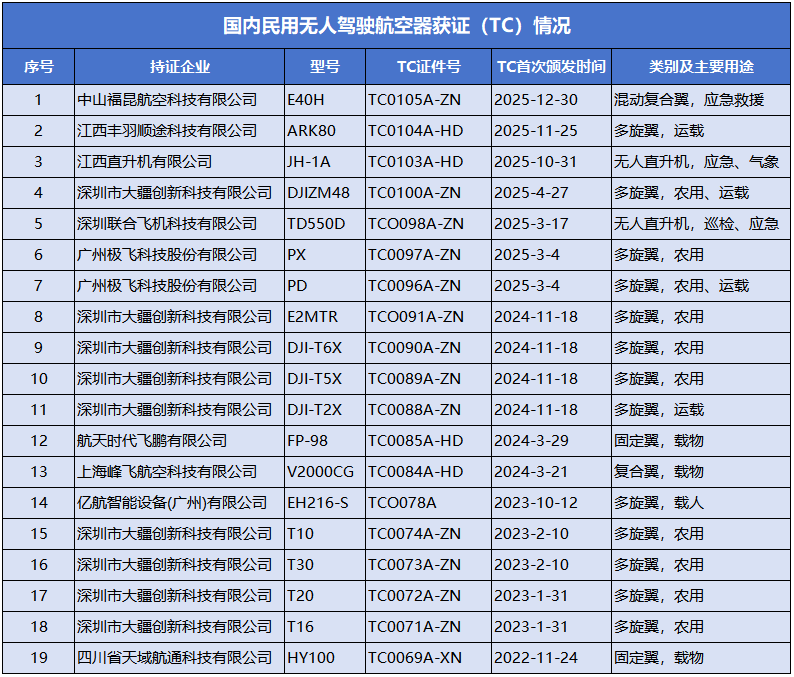
Core Viewpoint - The domestic civil unmanned aerial vehicles (UAVs) have received type certification (TC), with the E40H model from Fukun Aviation being the first to obtain TC under the new Civil Aviation Law, marking a significant milestone in the industry [2][4]. Group 1: Certification and Regulatory Framework - The E40H model is the first medium eVTOL to meet airworthiness requirements globally and is the first unmanned aerial product to receive TC after the new Civil Aviation Law was enacted [2]. - As of now, a total of 19 models of civil unmanned aerial vehicles have been issued TC in China, with DJI holding 9 of these certifications, covering various applications such as emergency response, agriculture, and transportation [4]. Group 2: Technical Achievements and Testing - The E40H underwent rigorous testing, completing 41 compliance verification tests, 42 engineering reports, and over 2000 hours of ground and laboratory tests, along with 167 flights totaling over 480 flight hours and 43,000 kilometers [2]. - The E40H has been actively involved in real-world emergency rescue operations, including flood rescue missions and typhoon response, demonstrating its operational capabilities [3]. Group 3: Future Developments - The company is progressing with the airworthiness certification for its 2-ton eVTOL model M1B, with the TC application accepted in January 2024 and expected to be completed by 2026 for commercial use in emergency firefighting and logistics [4]. - Plans are in place to submit a TC application for a manned version of the M1 model to gradually advance the commercialization of manned operations [4].

御风未来获首张混动+复合翼无人机型号合格证
Guan Cha Zhe Wang· 2026-01-04 09:08
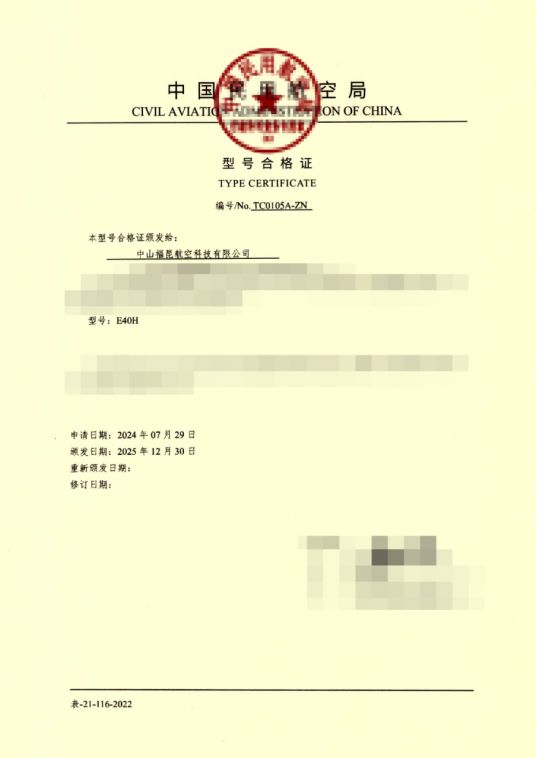
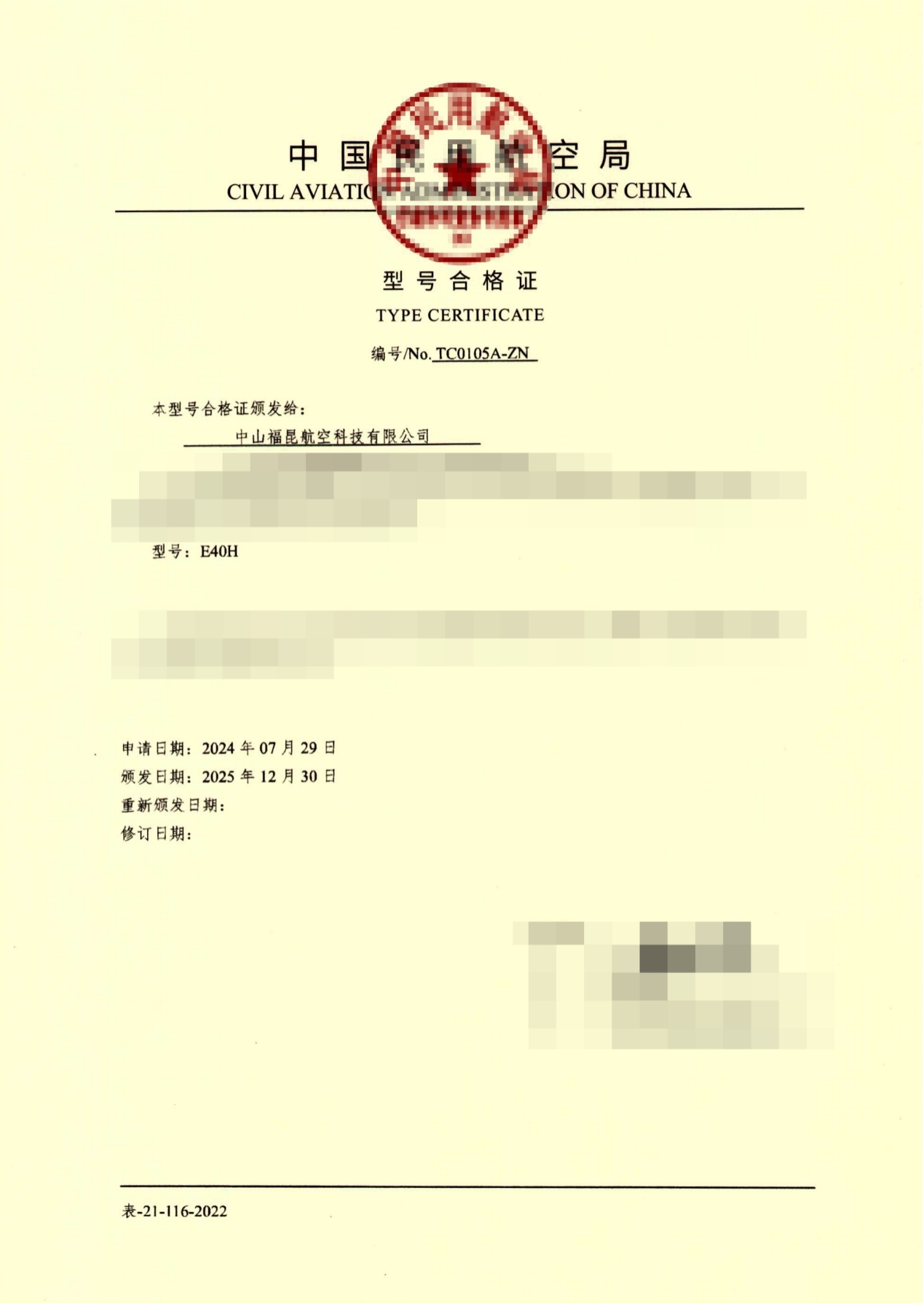
Core Viewpoint - The E40H unmanned aerial vehicle (UAV) developed by Yufeng Future has successfully obtained the Type Certificate (TC) from the Civil Aviation Administration of China, marking it as the first hybrid-powered UAV to meet airworthiness requirements globally and the first to receive a TC under the new Civil Aviation Law in China [1][8]. Technical Specifications - The E40H has a total length of 3.78 meters, a height of 0.99 meters, a maximum flight speed of 115 km/h, a maximum altitude of 1000 meters, a maximum takeoff weight of 150 kilograms, an empty weight of 100 kilograms, a maximum payload of 50 kilograms, a maximum flight time of 10 hours, and a maximum range of 800 kilometers [1][3]. Development Timeline - The application for the TC was submitted on July 29, 2024, and the approval was granted on December 30, 2025, taking a total of 1 year and 5 months [3]. Industry Impact - The E40H is the first of its kind in the industry to achieve airworthiness certification for hybrid and composite wing UAVs, with expectations for a series of similar eVTOLs to follow [3]. - The primary application scenarios for the E40H include emergency cargo transport and surveillance operations, with operational restrictions such as not flying over densely populated areas and prohibiting manned flights [3]. Operational Achievements - The E40H participated in various real-world rescue operations, including flood relief and typhoon rescue missions, and successfully completed logistics flights over a distance of 150 kilometers [5][8]. Future Plans - Yufeng Future is advancing its large eVTOL model M1B, which has already submitted its TC application and is expected to complete certification within the year, focusing on emergency firefighting and logistics [5][8]. - The company plans to submit a TC application for a manned version of the M1 at an appropriate time, gradually moving towards commercial operations [7]. Financing and Commercial Strategy - Yufeng Future has completed nine rounds of financing and is currently in the B round, with a recent funding round aimed at accelerating the testing and certification of the M1 model [8]. - The company follows a development path outlined by the National Development and Reform Commission, focusing on cargo transport before moving to manned operations, with a target for commercial deployment of large eVTOLs by the second half of 2026 [8]. Certification Landscape - As of December 30, 2025, a total of 12 aircraft have received TC certificates this year, with Yufeng Future's E40H being the first UAV certified under the revised Civil Aviation Law [8][9].
混动+复合翼,御风未来E40H获首张中型复合翼无人机型号合格证
Guan Cha Zhe Wang· 2026-01-04 09:00
Core Viewpoint - The E40H unmanned aerial vehicle (UAV) developed by Yufeng Future has successfully obtained the Type Certificate (TC) from the Civil Aviation Administration of China, marking it as the first hybrid and composite wing UAV to meet airworthiness requirements globally, and the first to receive a TC under the new Civil Aviation Law in China [1][4]. Technical Specifications - The E40H has a fuselage length of 3.78 meters, a height of 0.99 meters, a maximum flight speed of 115 km/h, a maximum altitude of 1000 meters, a maximum takeoff weight of 150 kilograms, an empty weight of 100 kilograms, a maximum payload of 50 kilograms, a maximum flight time of 10 hours, and a maximum range of 800 kilometers [2][4]. Development Timeline - The application for the TC was submitted on July 29, 2024, and the approval was granted on December 30, 2025, taking a total of 1 year and 5 months [4]. Industry Impact - The E40H's TC acquisition is seen as a significant milestone in the industry, with expectations for a series of similar eVTOLs to follow in obtaining airworthiness certification [4]. The primary application scenarios for such products are currently focused on emergency cargo transport [4]. Operational Limitations - The operational scenarios for the E40H are limited to cargo transport and surveillance tasks, with restrictions on flying over densely populated areas and in mixed airspace, and it is prohibited from carrying passengers [4]. Practical Applications - The E40H has participated in various real-world rescue operations, including flood relief and typhoon rescue missions, and has successfully completed logistics flights over a distance of 150 kilometers [6]. Future Developments - Yufeng Future is advancing its large eVTOL model M1B, which has already submitted its TC application and is expected to complete certification and commercial launch within the year, focusing on emergency firefighting and logistics [6][9]. The company plans to submit a TC application for a manned version of the M1 at an appropriate time [8]. Financing and Growth Strategy - Yufeng Future has completed nine rounds of financing and is currently in the B round, with a recent funding round aimed at accelerating the testing and certification of the M1 model [9]. The company follows a development path outlined by the National Development and Reform Commission, prioritizing cargo operations before moving to passenger services [9]. Certification Landscape - As of December 30, 2025, a total of 12 aircraft have received TC certificates this year, with Yufeng Future's E40H being the first UAV certified under the revised Civil Aviation Law [10][11].

梦网科技(002123.SZ):与神州六合签署合作协议
Ge Long Hui A P P· 2026-01-04 07:54
Core Viewpoint - The company Mengwang Technology (002123.SZ) has signed a cooperation agreement with Jiangxi Shenzhou Liuhe Helicopter Co., Ltd. to jointly develop and produce heavy-load drone products [1] Group 1: Cooperation Agreement - The cooperation involves joint research and production of heavy-load lifting drone products [1] - The specific planning of the products will be determined through a separate technical development contract signed by the company's subsidiary and Shenzhou Liuhe [1] Group 2: Financial Commitment - The total amount for product research and development is set at 60 million RMB [1] - Payments will be made in stages by the company's subsidiary to Shenzhou Liuhe [1]

梦网科技:与神州六合签署合作协议
Ge Long Hui· 2026-01-04 07:45
Core Viewpoint - The company Mengwang Technology (002123.SZ) has signed a cooperation agreement with Jiangxi Shenzhou Liuhe Helicopter Co., Ltd. to jointly develop and produce heavy-lift drone products [1] Group 1: Cooperation Agreement - The cooperation involves joint research and production of heavy-lift drone products [1] - The specific product planning will be determined through a separate technical development contract signed by the company's subsidiary and Shenzhou Liuhe [1] - The total amount for product research and development is set at RMB 60 million, with payments made in stages by the company's subsidiary to Shenzhou Liuhe [1]
全球首款中型复合翼无人机取得型号合格证
Zhong Guo Min Hang Wang· 2026-01-04 06:55
Core Viewpoint - The E40H unmanned aerial vehicle (UAV) developed by Fukun Aviation has received the Type Certificate (TC) from the Civil Aviation Administration of China, marking it as the first medium composite wing and hybrid power UAV to meet aviation safety standards globally [1][3]. Group 1: Certification and Compliance - As of now, a total of 19 civil UAVs from 10 companies have been awarded Type Certificates in China, with 9 of these from DJI, primarily in emergency, agricultural, and transport applications [3]. - The issuance of the Type Certificate signifies that the E40H's design safety and reliability fully comply with the stringent airworthiness standards set by the Civil Aviation Administration, enabling it for large-scale commercial operations [3][4]. Group 2: Operational Capabilities and Applications - The E40H has been tested in various emergency rescue operations, including significant flood and typhoon rescues, and has successfully completed over 80 modeling tasks and nearly 30 emergency drills [4]. - The UAV has demonstrated its capabilities by carrying 18 kilograms of seafood over a 150-kilometer low-altitude logistics route, showcasing its versatility in different operational scenarios [4]. - The E40H features a composite wing design and hybrid power system, combining vertical takeoff and landing, fixed-wing cruising, and long endurance capabilities, making it suitable for tasks such as search and rescue, emergency communication, and material transport [4]. Group 3: Development Timeline and Testing - The application for the E40H Type Certificate was officially accepted on July 31, 2024, with the review process taking 1 year and 5 months, involving 41 compliance verification tests and over 2,000 hours of ground and laboratory testing [5]. - The testing phase included 167 flights totaling over 480 flight hours and covering 43,000 kilometers, ensuring thorough validation of the UAV's performance [5]. - In total, 106 tests were conducted during the development phase, including over 8,000 hours of software, laboratory, and ground tests, as well as 710 flight hours across more than 600 flights, confirming the technical maturity of the airworthiness configuration [8].
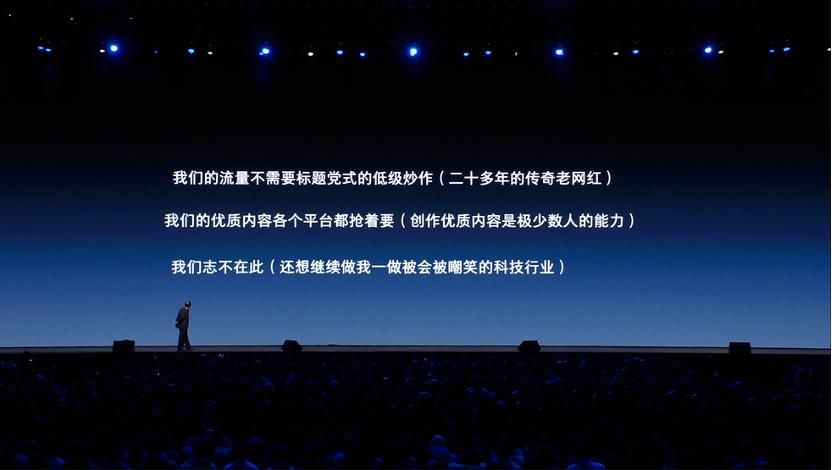
刷新迟到记录的老罗,状况百出的「科技春晚」
3 6 Ke· 2026-01-04 05:31
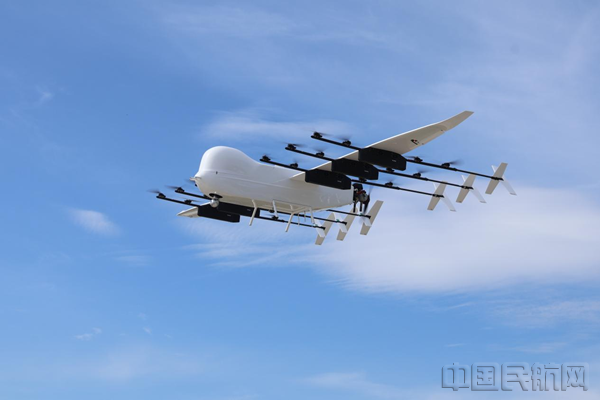
Core Insights - The annual technology innovation sharing conference "Luo Yonghao's Crossroads" returned after seven years, showcasing various products and innovations from ByteDance and other companies [1][2] - Despite high expectations, the event faced multiple errors, including a delayed start and technical issues, leading to audience disappointment [1][2] Product Highlights - **DJI NEO2 Drone**: A user-friendly drone designed for easy operation, featuring gesture control and safety measures to protect users [6] - **Hypershell Exoskeleton**: A lightweight exoskeleton that assists users in climbing and carrying heavy objects, suitable for various extreme environments [8] - **TuoZhu 3D Printer**: Aimed at making 3D printing accessible to the general public, it offers a community for sharing designs and resources [9] - **LiberNovo Ergonomic Chair**: An advanced ergonomic chair that automatically adjusts to the user's posture, enhancing comfort [12] - **LICURV Dishwasher**: A compact dishwasher that cleans dishes in five seconds without detergent, utilizing innovative technology for effective cleaning [15] - **Antigravity Drone**: A panoramic drone that simplifies aerial photography, allowing users to control it intuitively [17] - **New Beanbag AI**: An AI application that enhances communication and translation capabilities, demonstrating quick response times [19] - **Qie Ting AI Reading App**: An application that provides audio summaries of books, highlighting key points and allowing for voice cloning [22] - **LAVA Studio**: An AI music workstation that enables users to create diverse musical sounds with a single instrument [25] Audience Engagement - The event saw significant interest, with tickets selling out quickly and a peak online viewership of around 5 million [1] - Despite the initial excitement, audience reactions were mixed, with many expressing dissatisfaction over the event's execution [5][6]

全球首个!御风未来获颁中型复合翼无人驾驶航空器型号合格证
Huan Qiu Wang Zi Xun· 2026-01-04 02:20
Core Viewpoint - The E40H unmanned aerial vehicle system developed by Yufeng Future has successfully obtained the Type Certificate (TC) from the Civil Aviation Administration of China (CAAC), marking it as the first medium composite wing and hybrid drone globally to meet aviation safety requirements, and the first to receive a TC under the new Civil Aviation Law in China [1][3][9] Group 1: Certification Process - The application for the E40H Type Certificate was officially accepted by the CAAC on July 31, 2024, with the review group formed in August and the first meeting held in December [3] - The certification process included 41 compliance verification tests, 42 engineering reports, and over 2,000 hours of ground and laboratory testing, culminating in 167 flights totaling over 480 flight hours and 43,000 kilometers of flight verification [3] - The successful acquisition of the TC indicates that the design safety and reliability of the E40H fully comply with the stringent aviation standards set by the CAAC, enabling the potential for large-scale commercial operations [3][5] Group 2: Operational Significance - The E40H has been actively utilized in various emergency rescue operations throughout 2025, including flood rescue missions and typhoon response, demonstrating its practical value [5] - The aircraft has completed over 80 modeling tasks for open-pit mines and nearly 30 emergency drills, showcasing its versatility across different application fields [5] - The E40H has established nearly 20 application standards and norms in areas such as daily maintenance, operational management, emergency response, platform scheduling, and airspace security [5] Group 3: Future Developments - Yufeng Future is also progressing with the certification of a 2-ton electric vertical takeoff and landing (eVTOL) aircraft model, M1B, which is expected to complete its certification process in 2024 and begin commercial applications in emergency firefighting and logistics [7] - The company plans to submit a TC application for the manned version of the M1 aircraft to gradually advance the commercialization of manned operations [7] Group 4: Industry Context - Currently, there are 10 companies in China with 19 types of civil unmanned aerial vehicles that have received Type Certificates, with DJI holding 9 of these certificates across various applications [9][10] - The E40H stands out as the first medium composite wing drone and the first hybrid drone globally to receive a TC, highlighting its innovative position in the industry [9]
跨越二十年:何以徽商?
Huan Qiu Wang· 2026-01-04 02:17
Core Viewpoint - Huishang Bank has successfully integrated its development with the economic growth of Anhui Province over the past 20 years, demonstrating the spirit of Huishang in the financial sector and contributing significantly to local economic development [1][3]. Group 1: Financial Contributions to Local Economy - Since its establishment, Huishang Bank has provided over 30 trillion yuan in financial support to Anhui Province during the 14th Five-Year Plan period, playing a crucial role in the province's economic transformation from an agricultural to an industrial powerhouse [3]. - The bank's total assets have exceeded 2.3 trillion yuan, with a net capital of over 170 billion yuan, while maintaining a declining trend in non-performing loans and improving risk control capabilities [3]. Group 2: Support for Innovation and Technology - Huishang Bank has issued over 210 billion yuan in technology loans, nearly 160 billion yuan in green credit, and over 170 billion yuan in inclusive microloans, demonstrating its commitment to nurturing technological innovation and supporting small and micro enterprises [4][11]. - The bank has developed a unique "Science and Technology Bank" model, focusing on providing tailored financial services to innovative enterprises, which has resulted in a significant increase in technology loan balances and the number of serviced technology companies [11][12]. Group 3: Expansion of Financial Services - Huishang Bank has expanded its personal financial services, growing its customer base from 19.5 million to 39 million in three years, indicating a strong market presence in Anhui [15]. - The bank has also launched various financial products, including "Technology Talent Loans" and "Technology R&D Loans," to support the entire lifecycle of technological enterprises [11][12]. Group 4: Strategic Goals and Future Directions - Looking ahead, Huishang Bank aims to deepen its focus on five key areas: technology finance, green finance, inclusive finance, pension finance, and digital finance, to enhance its role in optimizing the economic structure [12][16]. - The bank plans to continue innovating its financial services and products, aiming to create a comprehensive financial ecosystem that covers all aspects of lending, investment, and transaction services [16].