
轨道交通

Search documents
国睿科技股价跌5.14%,中航基金旗下1只基金重仓,持有60万股浮亏损失89.4万元
Xin Lang Cai Jing· 2025-09-02 06:03
Company Overview - Guorui Technology Co., Ltd. is located in Nanjing, Jiangsu Province, established on June 28, 1994, and listed on January 28, 2003. The company specializes in the research, production, debugging, sales, and related services of air traffic control radar, meteorological radar and application systems, rail transit signal systems, microwave devices, and special power supplies [1]. - The main business revenue composition is as follows: radar equipment and related systems account for 78.61%, industrial software and intelligent manufacturing 11.74%, smart rail transit 8.32%, and others 1.33% [1]. Stock Performance - On September 2, Guorui Technology's stock fell by 5.14%, trading at 27.51 CNY per share, with a transaction volume of 403 million CNY and a turnover rate of 1.15%. The total market capitalization is 34.164 billion CNY [1]. Fund Holdings - According to data from the top ten heavy stocks of funds, one fund under AVIC Fund holds a significant position in Guorui Technology. The AVIC Military-Civil Integration Selected A Fund (004926) reduced its holdings by 300,000 shares in the second quarter, retaining 600,000 shares, which represents 8.79% of the fund's net value, ranking as the sixth largest heavy stock [2]. - The AVIC Military-Civil Integration Selected A Fund was established on February 9, 2018, with a latest scale of 55.1098 million CNY. Year-to-date returns are 20.61%, ranking 4016 out of 8184 in its category; the one-year return is 89.43%, ranking 563 out of 7971; and since inception, the return is 64.61% [2]. Fund Manager Information - The fund manager of AVIC Military-Civil Integration Selected A Fund is Han Hao, who has been in the position for 7 years and 265 days. The total asset scale of the fund is 1.788 billion CNY. During his tenure, the best fund return was 216.02%, while the worst return was -21.47% [3].

第十五届中国—东北亚博览会观展人数达12万人次
Zhong Guo Jing Ji Wang· 2025-09-01 11:27
Core Insights - The 15th China-Northeast Asia Expo concluded after five days, showcasing a significant number of exhibitors and innovative technologies [1][3] - The event attracted 20,733 guests from 45 countries and regions, with a total attendance of 120,000 visitors [1][5] Group 1: Event Overview - The expo emphasized "exhibition promotes trade, conference promotes investment," focusing on industry and project connections, and facilitating economic and cultural exchanges [3] - A total of 34 main and thematic activities were held, creating a multi-level and wide-ranging communication mechanism [3] Group 2: Exhibition Details - The expo featured a "display + experience" model with a "4+2" exhibition framework, covering a total area of 73,000 square meters and setting up 3,620 international standard booths [5] - 1,029 domestic and international exhibiting companies participated, including 24 Fortune Global 500 companies and 14 Chinese Fortune 500 companies [5] Group 3: Industry Highlights - The Modern Industry Pavilion showcased advancements in automotive, petrochemical, rail transit, satellite, carbon fiber, biopharmaceuticals, hydrogen energy, artificial intelligence, and low-altitude economy [7] - The Open Cooperation Pavilion highlighted trade, investment, infrastructure, energy, and technology cooperation achievements among Northeast Asian countries [7] Group 4: Consumer and Cultural Exhibits - The New Consumption and New Services Pavilion displayed the latest products in smart wearables, smart home technology, and cultural tourism products [7] - The International and Hong Kong-Macau-Taiwan Specialty Goods Pavilion featured 264 enterprises from 43 countries and regions, showcasing economic development, advantageous industries, and cultural tourism [9]

刘德军:双核引领双圈协同
Jing Ji Ri Bao· 2025-09-01 00:04
Core Viewpoint - The coordinated development of Jinan and Qingdao urban circles is essential for leveraging Shandong's geographical advantages, integrating into national strategies, and enhancing regional competitiveness through industrial collaboration [1][2]. Group 1: Industrial Collaboration - The Jinan-Qingdao dual-circle industrial collaboration aims to optimize resource allocation, foster new growth drivers, and enhance regional core competitiveness [1]. - The collaboration is not merely about relocating projects but requires a systematic restructuring of industrial chains, supply chains, innovation chains, and value chains [1]. - The integration of Jinan's technological innovation strengths with Qingdao's advanced manufacturing and marine economy is expected to amplify the comprehensive competitiveness of the Shandong Peninsula urban agglomeration [1]. Group 2: Core City Development - Jinan and Qingdao, as core cities of the Jinan-Qingdao urban circle, possess distinct industrial advantages that need to be further enhanced to improve their industrial radiating power [2]. - Jinan should focus on strengthening its financial, technological service, and cultural education sectors to establish itself as a regional financial center and innovation hub [2]. - Qingdao should continue to deepen its marine economy and enhance the internationalization of its industries through industrial transfer and technology export [2]. Group 3: Strategic Planning - The development of an industrial map and collaborative development directory is crucial for defining differentiated development directions for each city [2]. - This involves analyzing each city's industrial foundation, resource endowments, and comparative advantages to encourage the development of characteristic industries [2]. - Establishing a co-construction mechanism for industrial cooperation demonstration zones will facilitate the integration of overlapping and complementary industrial chains between Jinan and Qingdao [2]. Group 4: Resource Aggregation - The combined GDP of Jinan and Qingdao has surpassed 3 trillion yuan, indicating a strong aggregation of competitive industrial clusters [3]. - The collaboration aims to create a global brand of "Jinan-Qingdao Manufacturing" and develop world-class industrial clusters to enhance regional economic influence [3]. - Strengthening the collaborative development of traditional and emerging industries will promote economic synergy within the urban circles [3].
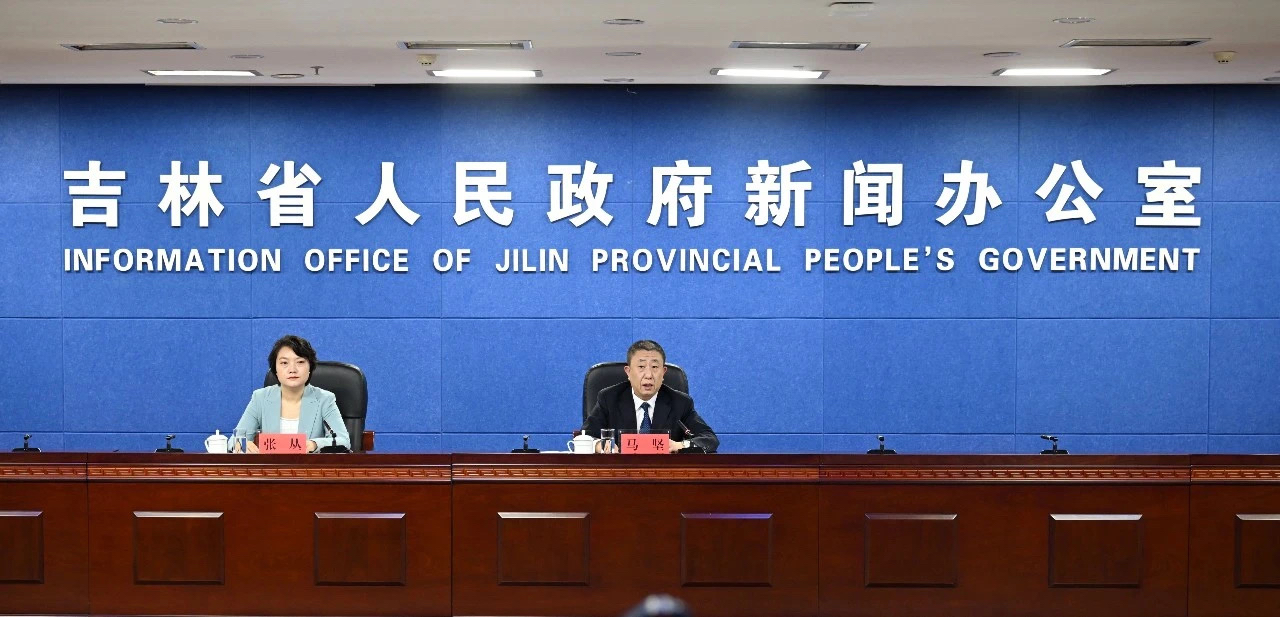
第十五届中国—东北亚博览会闭幕 为各方深度合作搭台
Zhong Guo Xin Wen Wang· 2025-08-31 14:29
Group 1 - The 15th China-Northeast Asia Expo concluded in Changchun, showcasing the deepening and broadening of cooperation among participating countries [1][2] - The expo is the only international comprehensive exhibition involving six Northeast Asian countries, promoting trade and investment cooperation in the region for 20 years [1] - A total of 20,733 guests from 45 countries and regions attended, including executives from 44 Fortune Global 500 companies, indicating a rising level of international participation [1] Group 2 - The expo emphasized the concept of "exhibition promotes trade, conference promotes investment," focusing on industry and project matching, and facilitating economic and cultural exchanges [2] - A total of 34 main and thematic activities were held, creating a multi-level and wide-ranging communication mechanism [2] - Successful events included the Russia Business Day and China-Japan Economic and Trade Exchange, enhancing cooperation in sectors like hydrogen energy [2]
高华科技2025年中报简析:营收净利润同比双双增长,公司应收账款体量较大
Zheng Quan Zhi Xing· 2025-08-30 23:28
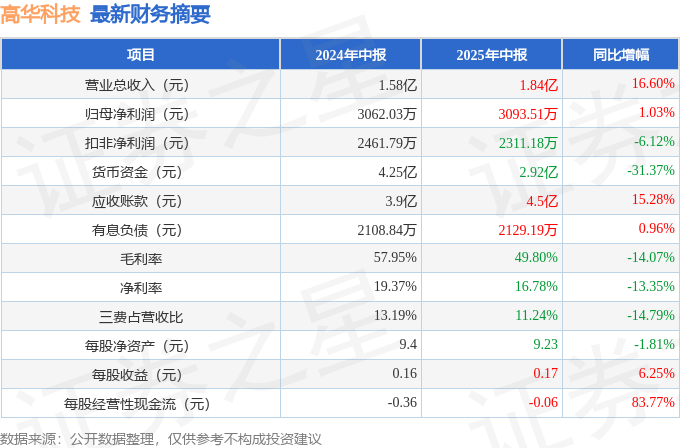
Financial Performance - Company reported total revenue of 184 million yuan for the first half of 2025, a year-on-year increase of 16.6% [1] - Net profit attributable to shareholders reached 30.93 million yuan, up 1.03% year-on-year [1] - In Q2 2025, total revenue was 119 million yuan, reflecting a significant year-on-year increase of 43.37% [1] - Q2 net profit attributable to shareholders was 27.14 million yuan, showing a substantial year-on-year increase of 129.26% [1] Profitability Metrics - Gross margin stood at 49.8%, down 14.07% year-on-year [1] - Net margin was 16.78%, a decrease of 13.35% year-on-year [1] - Earnings per share (EPS) increased by 6.25% year-on-year to 0.17 yuan [1] Financial Ratios and Cash Flow - Company’s return on invested capital (ROIC) was 2.86%, indicating weak capital returns [2] - Historical median ROIC since listing is 13.72%, suggesting better investment returns in the past [2] - Operating cash flow per share was -0.06 yuan, but showed an increase of 83.77% year-on-year [1][2] Accounts Receivable and Expenses - Accounts receivable accounted for 808.65% of the latest annual net profit, indicating a large receivables balance [1][2] - Total sales, management, and financial expenses amounted to 20.72 million yuan, representing 11.24% of revenue, down 14.79% year-on-year [1] Market and Competitive Environment - Company’s net profit decline attributed to market changes, increased competition, and rising production costs [4] - Revenue growth driven by the aerospace industry and increased railway investments, leading to higher demand for products [3][4] Research and Development - Company is expanding its R&D team and increasing R&D expenditures, which has contributed to higher overall costs [4] - Establishment of two wholly-owned subsidiaries to enhance R&D capabilities [4]
【媒体解读】广州推出专精特新中小企业扶持政策“升级版”
Guang Zhou Ri Bao· 2025-08-30 01:32
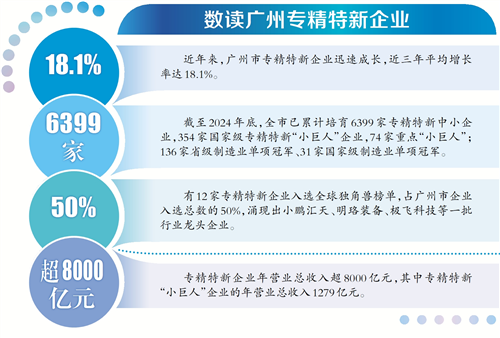
Core Viewpoint - The Guangzhou government has introduced a comprehensive set of measures to support the development of specialized, refined, unique, and innovative small and medium-sized enterprises (SMEs), with a funding commitment exceeding 1 billion yuan over the next three years [2][10]. Group 1: Support Measures - The new measures include 25 specific support initiatives across seven key areas: enhancing gradient cultivation, stimulating innovation, strengthening financial support, deepening digital transformation, promoting integrated development, optimizing comprehensive services, and reinforcing organizational guarantees [2][4]. - The measures represent an upgrade from previous policies, offering more comprehensive and targeted support for SMEs [2]. Group 2: Financial Incentives - The measures provide substantial financial incentives, including rewards of up to 1 million yuan for newly recognized "little giant" enterprises and up to 1.5 million yuan for national-level manufacturing champions [4][6]. - Additional financial support includes up to 500 million yuan for technology transformation and 150 million yuan for digital transformation projects [6][8]. Group 3: Innovation and Development - Specialized SMEs are identified as key drivers of industrial innovation, with the average number of patents for specialized SMEs at 8.66 and "little giants" at 40.93, significantly higher than their peers [5]. - The government aims to create a more robust gradient cultivation system for SMEs, facilitating their growth from micro-enterprises to "little giants" [4][11]. Group 4: Financing and Resource Allocation - The government has allocated special funds annually for financing services and supply-demand matching activities to foster a collaborative ecosystem for SMEs [7]. - The "Yiqi Gongying Plan" has been launched to provide higher credit limits and favorable loan rates for SMEs, with over 590 enterprises signing agreements totaling more than 25 billion yuan [7]. Group 5: Land and Talent Support - The measures include preferential land use policies, allowing for reduced investment intensity and tax contribution standards for specialized SMEs [8][9]. - There is a focus on talent support, prioritizing senior management and core technical personnel from "little giant" enterprises for local talent programs [8]. Group 6: Future Goals - The government plans to establish over 10 national-level and 30 provincial-level characteristic industrial clusters for SMEs, enhancing their integration into larger supply chains [11][12]. - The initiative aims to improve the digital transformation of over 1,000 SMEs within two years, enhancing their competitiveness [11].
重磅文件定调!增强超大特大城市综合竞争力
Di Yi Cai Jing· 2025-08-29 13:03
Group 1 - The core viewpoint of the article is that China is transitioning from a rapid urbanization phase to a stable development phase, focusing on improving existing urban areas rather than large-scale expansion [1] - The "Opinions" released by the Central Committee and the State Council outline a blueprint for future urban development in China, emphasizing high-quality urban growth [1][2] - The development of urban agglomerations and metropolitan areas is prioritized, with a focus on enhancing the competitiveness of mega cities and promoting coordinated regional development [2][4] Group 2 - The article highlights the importance of metropolitan areas and urban agglomerations as platforms for international competition, where central cities drive innovation and surrounding areas support manufacturing [3][6] - The Yangtze River Delta region is cited as an example of successful industrial clustering, with significant advancements in sectors like aerospace and biotechnology, showcasing a collaborative innovation model [3] - The article notes that the domestic manufacturing rate for large aircraft has increased from 10% to 60% due to effective collaboration within the Yangtze River Delta [3] Group 3 - The article discusses the potential for investment in urban infrastructure, particularly in rail transport, with new high-speed rail projects being approved, such as the Shanghai-Hangzhou line [4] - The "Opinions" stress the need to enhance the comprehensive competitiveness of mega cities, advocating for the optimization of core functions and the control of urban scale [4][6] - The article mentions the classification of cities based on permanent resident population, identifying super cities and mega cities, which are crucial for economic development [5][6] Group 4 - The article emphasizes the need to improve the capacity of small and medium-sized cities and county towns, advocating for infrastructure optimization and public service enhancement [7] - It highlights the economic disparities between small and large counties, with some small counties achieving significant economic growth through industrial clusters [7][9] - The article notes that as of 2024, the number of counties with a GDP exceeding 1 billion yuan has increased, indicating a trend of economic growth in smaller regions [7][8]
重庆2021至2024年经济年均增长5.7% 人均GDP突破10万元
Zhong Guo Xin Wen Wang· 2025-08-29 12:50
Economic Growth - Chongqing's economy is projected to grow at an average annual rate of 5.7% from 2021 to 2024, becoming the first city in central and western China with an economic output exceeding 3 trillion yuan [1] - Per capita GDP in Chongqing is expected to surpass 100,000 yuan [1] High-Quality Development - Over the past five years, Chongqing has focused on high-quality development, aiming to establish itself as a significant strategic support for the new era of western development [2] - The industrial revenue of large-scale enterprises is expected to reach 2.8 trillion yuan by 2024, while the service sector's added value is projected to hit 1.8 trillion yuan [2] - The production of laptops has maintained its position as the world's largest for 11 consecutive years, and the output of smart connected new energy vehicles is set to increase from 43,000 units in 2020 to 953,000 units by 2024 [2] Technological Innovation - Chongqing has accelerated the establishment of a nationally influential technology innovation center, with annual growth in R&D expenditure of 11% [2] - The number of national key laboratories has increased to 11, and significant breakthroughs have been made in core technologies such as high-power drive motors [2] - The global ranking of Chongqing as a research city has improved from 98th in 2020 to 40th in 2024 [2] Consumer Market Development - The total retail sales of social consumer goods in Chongqing have exceeded 1.6 trillion yuan, ranking second among cities nationwide [3] - Unique consumer experiences, such as the "8D magical" mountain city and drone light shows, have contributed to the city's consumer market growth [3] Infrastructure Development - The operational mileage of rail transit in Chongqing has increased from 344 kilometers to 582 kilometers [3] - New high-speed rail connections have been established, significantly improving accessibility to the city [3] - Major projects have successfully addressed electricity supply shortages during peak summer periods [3]
新筑股份高层人事调整 蜀道集团持续资源赋能
Zheng Quan Shi Bao Wang· 2025-08-29 09:32
Group 1 - The core viewpoint of the news is that Shudao Group continues to empower Xinzhuzhi Co., Ltd. (002480) with resources, particularly through the appointment of new non-independent directors from Shudao Group [1][2] - Xinzhuzhi announced the resignation of two non-independent directors, Liu Zhumeng and Zhao Kexing, and the nomination of Zhu Jin and Wang Sicheng as their replacements [1] - Zhu Jin and Wang Sicheng are both from Shudao Group's core enterprises, indicating a trend of management talent being transferred from Shudao Group to the listed company [1][2] Group 2 - Hongda Group, a core subsidiary of Shudao Group, focuses on comprehensive investment and financing in the mining sector, participating in major global mining projects [2] - Shudao Clean Energy serves as the strategic implementation entity for Shudao Group's "transportation + energy" industrial ecosystem, with plans to achieve over 21.32 million kilowatts of installed capacity by the end of the 14th Five-Year Plan [2] - The addition of Zhu Jin and Wang Sicheng is expected to inject Shudao's cultural genes into Xinzhuzhi, aiding in the ongoing asset integration of the listed company [2][3] Group 3 - Shudao Group's acquisition of Xinzhuzhi is aimed at deepening state-owned enterprise reform and optimizing the layout of state-owned assets [3] - The restructuring plan involves Xinzhuzhi issuing shares and paying cash to acquire 60% of Shudao Clean Energy, while divesting from loss-making traditional business segments [3] - This transaction is expected to fundamentally improve Xinzhuzhi's operating conditions by integrating high-quality assets and establishing Shudao Clean Energy as a core subsidiary focused on clean energy generation [3]

济南轨道交通年底“四线齐发”
Qi Lu Wan Bao· 2025-08-28 21:25
Group 1 - The Jinan Metro Line 4 and Line 8 have successfully passed project engineering acceptance, indicating readiness for trial operation [1] - Line 4 is scheduled to start a three-month trial operation on August 31, with an expected opening by the end of 2025 [1] - Line 8's first phase has begun dynamic debugging in June, with a total length of 25.5 kilometers and 14 stations, aiming for operation by the end of this year [1][2] Group 2 - The Jinan Metro Line 6 East Section, a key project in the city's transit network, has made significant progress, with dynamic debugging entering the final phase [2] - The East Section of Line 6 spans approximately 19.5 kilometers with 17 underground stations, focusing on seamless integration of various systems [2] - The High-tech East District Yunba project has commenced a three-month trial operation, expected to open in early December, featuring a unique design and energy-efficient technology [2][3] Group 3 - The Yunba project will connect to the Jinan Metro network through five transfer stations, enhancing commuter convenience and addressing public transport congestion [3] - The Jinan Metro Group is committed to standardizing construction and expediting station renovations and safety assessments to ensure timely operation of all lines [3]