
数字经济

Search documents
“大厂”纷至沓来南京打造数据产业“建邺样本”
Zheng Quan Shi Bao· 2025-10-10 19:38
Core Insights - JD Group has signed a strategic cooperation agreement with Nanjing City to establish a regional headquarters and a large-scale R&D center in Jianye District, with an investment of over 10 billion yuan [1] - The influx of major companies like Xiaomi and Alibaba into Jianye District reflects Nanjing's efforts to create a data element industry ecosystem, as outlined in the national "Data Element ×" three-year action plan [1][2] Group 1: Market Dynamics - The JD Group's R&D center will focus on cutting-edge industries such as artificial intelligence, robotics, and autonomous driving, aligning with Jianye District's current development strategy [2] - Jianye District's digital economy is projected to generate nearly 60 billion yuan in revenue by 2024, with the digital economy's broad value-added accounting for over 50% of GDP [2] - Major companies contribute significantly to the local economy; for instance, Xiaomi's East China headquarters has attracted over 20 ecosystem companies, while Alibaba's projects in Nanjing have exceeded 60 billion yuan [2] Group 2: Application Scenarios - By 2026, the goal is to create over 300 exemplary application scenarios for data elements, with Jianye District's "Medicare Data Empowerment Laboratory" being a notable example [3][4] - The laboratory aims to address challenges in healthcare fund supervision and resource allocation, leveraging extensive Medicare data for public health research [3] Group 3: Ecosystem Development - The Jiangsu Medicare Data Empowerment Laboratory will gather various enterprises in the healthcare data industry, forming a specialized ecosystem [4] - Listed companies play a crucial role in developing diverse application scenarios, with over 400 scenarios published since 2020, attracting investments exceeding 6 billion yuan [4] - Jianye District's "Ten New Policies" initiative aims to allocate 1 billion yuan in industry funds over three years to foster new growth drivers in the data industry [5] Group 4: Digital Economy Initiatives - The establishment of the Jiangsu Public Data Authorization Operation Platform and the incubation center marks a significant step towards creating a complete data industry service chain [6] - The district is focused on enhancing the market's internal drive and releasing data value, positioning itself as a leader in the data industry [6]
全球Ai算力需求攀升,数字经济ETF(560800)调整蓄势
Xin Lang Cai Jing· 2025-10-10 06:00
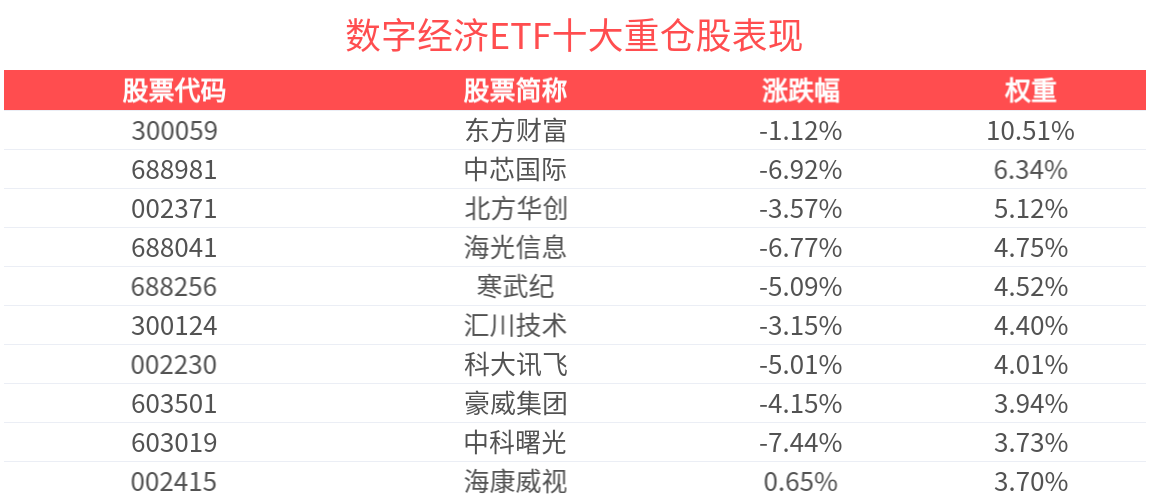
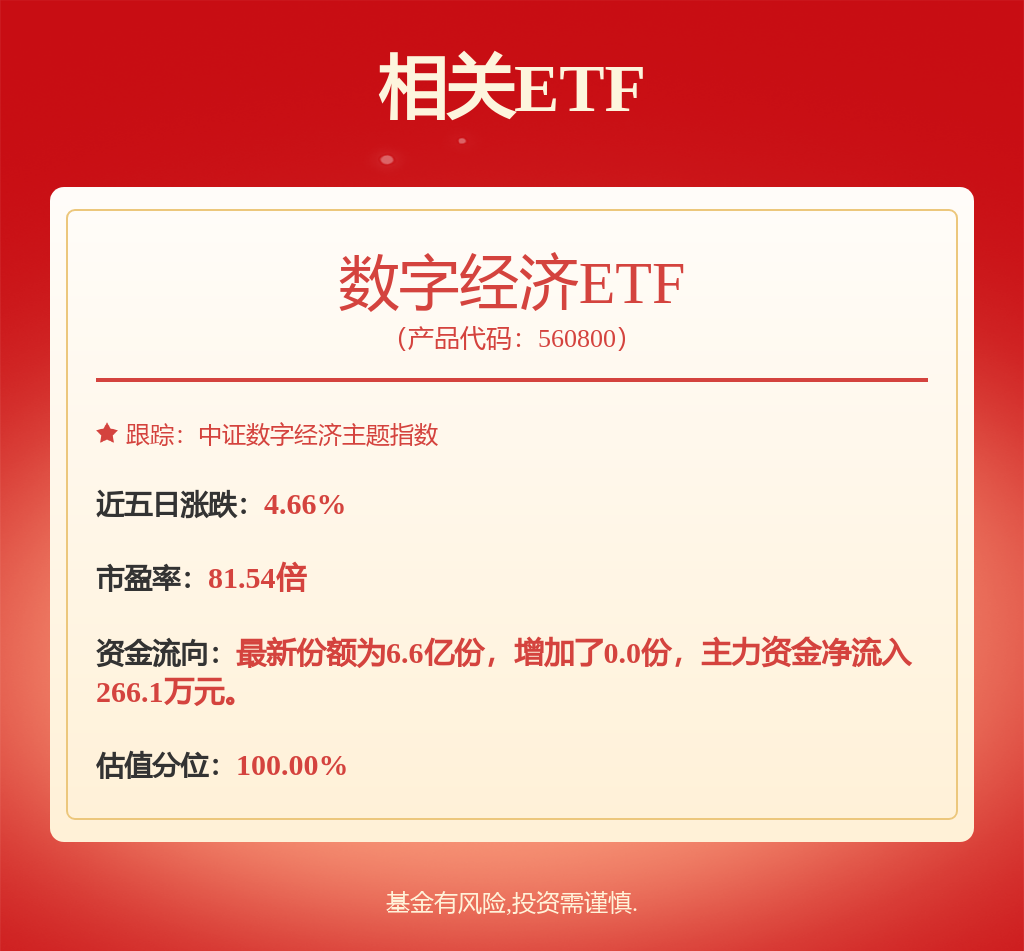
Core Viewpoint - The digital economy theme index has experienced a decline, with significant drops in key component stocks, while the demand for AI computing power is projected to grow exponentially, indicating a potential shift in industry dynamics towards a sustainable growth phase [1][2]. Group 1: Market Performance - As of October 10, 2025, the CSI Digital Economy Theme Index (931582) has decreased by 4.46% [1]. - Key component stocks such as Jinghe Integrated (688249) and others like Runze Technology (300442), Zhongke Shuguang (603019), and Inspur Information (000977) have also seen declines [1]. - The digital economy ETF (560800) has undergone adjustments, with a turnover rate of 4.13% and a transaction volume of 29.6351 million yuan [1]. Group 2: Industry Growth - According to IDC data, global AI computing power demand is growing at a compound annual growth rate (CAGR) of 60% [1]. - By 2025, China's intelligent computing power is expected to exceed 105 EFLOPS, equating to the capability of 7 billion people performing high-intensity mathematical operations simultaneously [1]. - Dongwu Securities indicates that the demand for global computing power, storage, and high-speed connectivity is experiencing exponential growth, suggesting a transition from quantitative to qualitative changes in the industry [1]. Group 3: Index Composition - The CSI Digital Economy Theme Index includes companies involved in digital economy infrastructure and high levels of digitalization [2]. - As of September 30, 2025, the top ten weighted stocks in the index account for 54.31% of the total index weight, with companies like Dongfang Caifu (300059) and Zhongxin International (688981) leading [2].







灵鸽科技龙虎榜数据(10月9日)
Zheng Quan Shi Bao Wang· 2025-10-09 09:23
Core Viewpoint - Lingge Technology (920284) experienced a significant increase in stock price, reaching the daily limit of 29.98%, with a trading volume of 6.63 billion yuan and a turnover rate of 26.01% [1][2]. Trading Activity - The stock was highlighted on the North Exchange due to its daily price fluctuation and turnover rate, with institutional investors net buying 26.09 million yuan [2]. - The top five trading departments accounted for a total transaction volume of 162 million yuan, with net buying amounting to 53.53 million yuan [2]. - Specific trading details show that the leading buying department was an institutional seat, which net bought 26.09 million yuan [2]. Institutional Participation - The institutional buying activity was prominent, with one institutional seat being the top buyer, while several other departments also contributed to the buying side [2]. - The detailed trading data indicates that multiple securities firms participated in the buying, with significant amounts from various departments [2].
山阳镇调研笔记:上海湾区腹地凝聚新质生产力
Di Yi Cai Jing· 2025-10-09 02:07
Core Insights - The article discusses the development and potential of the Shanghai Bay Area, particularly focusing on the Shanyang Town's transformation and its role in the region's innovation and economic growth [1][4][9] Group 1: Economic Performance - In the first half of the year, Jinshan District achieved a GDP of 56.115 billion, with a year-on-year growth of 4.8% [4] - The secondary industry contributed 33.343 billion with a growth of 2.3%, while the tertiary industry saw an increase of 22.477 billion, growing by 9.1% [4] - Shanyang Town's tax revenue reached 2.396 billion, fulfilling 58.43% of the annual target, and the output of industrial enterprises was 7.21 billion [6] Group 2: Industry Development - Shanyang Town has established a modern industrial system with 147 high-tech enterprises and 4 specialized "little giant" companies, enhancing regional innovation momentum [9][11] - The Shanghai Bay Area Innovation City is being developed over an area of 7.4 square kilometers, with significant projects like the China Science Ecology Digital Port and Donghu International Innovation Center [9] - The "Shanyang Innovation" three-year action plan (2025-2027) aims for an industrial output value exceeding 20 billion and over 200 technology-based enterprises by the end of the 14th Five-Year Plan [9] Group 3: Strategic Focus - The local government emphasizes the "three Shanyang" construction, focusing on innovation, urban governance, and legal frameworks to enhance economic vitality and living standards [6][7] - The article highlights the importance of a collaborative ecosystem for innovation, with a full-chain incubation system from co-working spaces to industrial parks [9][11] - The region is increasingly recognized as a brand source for the Shanghai Bay Area, attracting national-level research institutions for collaboration [11]

厚植合作沃土 共筑发展之路(国际论坛)
Ren Min Ri Bao· 2025-10-05 21:52
Core Insights - The Shanghai Cooperation Organization (SCO) aims to strengthen unity, deepen mutually beneficial cooperation, and contribute to building a community with a shared future for mankind [2][5] - The recent SCO Tianjin Summit established a 10-year development strategy and the formation of the SCO Development Bank, enhancing regional and global stability [2] - Economic cooperation, particularly in digital economy, green development, poverty reduction, and infrastructure connectivity, is a key pillar for the SCO's growth [2] Economic Cooperation - The China-Pakistan Economic Corridor has improved Pakistan's transportation, energy, and industrial infrastructure, promoting industrialization and modernization [3] - China's practical initiatives align with the development needs of SCO member states, providing tangible benefits [2][3] Cultural Exchange - Human exchanges are vital for development cooperation, fostering understanding and trust among nations [3][4] - The SCO emphasizes cultural dialogue, youth exchanges, and think tank cooperation to enhance mutual understanding [3] Manufacturing Influence - "Made in China" products play a significant role in the daily lives of people in SCO member countries, serving as a bridge for communication and understanding [4]

前三季度31省GDP预测:山东远超浙江,江西14,甘肃接近万亿
Sou Hu Cai Jing· 2025-10-05 06:51
Core Insights - The economic competition among Chinese provinces is intensifying, with a national GDP forecast to exceed 101.6 trillion yuan, reflecting a growth of 4.47% compared to the same period last year [1] Group 1: Economic Performance - Guangdong and Jiangsu remain the leaders in the economic rankings, both surpassing 8 trillion yuan in GDP, with Jiangsu showing a nominal growth rate of 3.23% [1] - Tibet leads the nation with a remarkable growth rate of 10.27%, while smaller economies like Hainan and Ningxia are achieving stable growth through specialized industries [1] - Shandong's GDP is projected to reach 7.71 trillion yuan, significantly outpacing Zhejiang's 6.86 trillion yuan, with a growth rate of 4.48% [1] Group 2: Regional Highlights - Jiangxi has shown resilience, ranking 14th with a forecasted GDP of 25,788 billion yuan, a 4.88% increase from last year, driven by its electronic information industry [3] - Gansu is nearing the 1 trillion yuan mark with a forecast of 999.9 billion yuan, achieving a growth rate of 6.2% through its renewable energy initiatives [4] Group 3: Growth Dynamics - The data indicates that 19 out of 31 provinces achieved growth rates above 5%, showcasing a positive interaction between major economic provinces and resource-rich regions [5] - The Beijing and Shanghai metropolitan areas maintain a growth rate of 6%, while the Chengdu-Chongqing economic circle continues to grow steadily at 5% [5]

【西安】全力推进“科创+产创”融合发展
Shan Xi Ri Bao· 2025-10-02 23:56
Core Viewpoint - Xi'an is actively promoting the integration of technological innovation and industrial innovation through the development of a digital economy, focusing on data circulation and application to enhance industrial upgrades [1][2]. Group 1: Digital Economy Development - Xi'an's government emphasizes "digital government construction" as a key driver for digital economy development, facilitating the transformation of scientific and technological achievements into industrial applications [1]. - The city aims to become a national hub for data circulation in the western region, focusing on four key aspects: data supply, flow, utilization, and security [1]. - The "Silk Road Data Port" has launched 1,364 data resources and products, with 262 data enterprises participating, establishing a new business model for data industry development [1]. Group 2: Key Infrastructure and Centers - Xi'an is constructing five types of adaptation centers to strengthen the integration of technological and industrial innovation, including the operational Hongmeng Star Flash Adaptation Center and the RDI Open Source Chip Industry Innovation Center [1][2]. - The establishment of the AI Algorithm Model Adaptation Center and the Xinchuang Adaptation Joint Laboratory has been completed, enhancing the overall innovation ecosystem [1]. Group 3: Industry-Specific Initiatives - In the smart transportation sector, Xi'an has identified 3,600 intersections and approximately 25,000 terminal devices to synchronize technology research and equipment manufacturing [2]. - The XR industry is supported through the establishment of a virtual reality film technology innovation center and a 100 million yuan XR industry fund [2]. - The data industry has seen a breakthrough in data labeling, with a scale exceeding 200 million yuan and a growth rate of over 30% [2].
北京丰台积极培育链商生态
Jing Ji Ri Bao· 2025-10-02 22:16
Core Viewpoint - The Fengtai District of Beijing is actively promoting international trade digitalization and collaboration through initiatives like the "Xianfeng Laboratory" and the "Fengtai Global Open Map," aiming to enhance the regional supply chain ecosystem and attract global enterprises [1][2]. Group 1: Digital Trade Initiatives - The "Xianfeng Laboratory" aims to facilitate cross-border trade digitalization and standardization, having completed pilot projects for digital trade between China, Singapore, and the Middle East [2]. - The "Fengtai Global Open Map" highlights 15 overseas enterprises, showcasing Fengtai's international outreach across over 30 countries along the Belt and Road Initiative [2]. - The "Fengtai Smart Supply Chain Industry Brain" and related projects provide a comprehensive solution for the digitalization of industries, featuring specialized office spaces and a professional service system [2]. Group 2: Ecosystem Development - Fengtai is enhancing its business environment by establishing a one-stop service window for foreign trade enterprises and implementing policies to improve the overall business climate [3]. - The district is leveraging resources like the Beijing Fengtai Legal District and International Talent Port to strengthen services related to intellectual property, legal support, and talent cultivation [3]. - Fengtai is focusing on developing its financial and technological sectors while fostering new productive forces through specialized industrial parks [3].
每3个人中有2个在城镇
Di Yi Cai Jing Zi Xun· 2025-09-30 14:14
Core Insights - The report from the National Bureau of Statistics indicates that China's population is stabilizing while the quality of population development is improving, with a continuing labor force dividend and overall stable employment [2] - Urbanization in China is on the rise, with urban population expected to reach 943.5 million by the end of 2024, marking a 3.11 percentage point increase in urbanization rate since the end of 2020 [2] - The eastern region of China accounts for 40.32% of the total population, reflecting a slight increase of 0.30 percentage points since 2020 [2] Urbanization Trends - Ten provinces are projected to see urbanization rates increase by over 1 percentage point by the end of 2024, with eight located in the central and western regions [3] - Population continues to flow from rural areas to urban centers, particularly in developed eastern coastal cities [3] - Guangdong province leads in population growth, with an increase of 740,000 residents, while Zhejiang follows with an increase of 430,000 [3] Economic Development in Cities - Hangzhou has capitalized on the growth of the internet industry, expanding into smart manufacturing and artificial intelligence, contributing to its population growth of 688,000 since the last census [4][5] - The digital economy in Hangzhou is significant, with a core industry value added of 630.5 billion yuan in 2024, representing a 7.1% year-on-year growth [5] - Hefei has also seen substantial population growth, reaching over 10 million residents, driven by industrial and urban development [5][6] Population Growth in Other Cities - Guiyang has experienced a notable population increase of 61,550 since the last census, with a growth rate of 10.3%, making it the fastest-growing city in terms of population [6] - The implementation of "strong provincial capital" and "strong talent" strategies has led to a consistent net population increase in Guiyang [6]

人口分布向城镇和东部地区集聚,每3个人中有2个在城镇
Di Yi Cai Jing· 2025-09-30 10:31
Group 1 - A significant number of modern industrial clusters are accelerating their aggregation in strong provincial capitals and central cities in the Midwest [1] - The urbanization rate in China has reached 67.00% by the end of 2024, an increase of 3.11 percentage points since the end of 2020, indicating a continuous trend towards urbanization [2] - The population in eastern regions is also increasing, with the permanent population in the eastern region reaching 567.02 million, accounting for 40.32% of the national population, up by 0.30 percentage points since 2020 [2] Group 2 - The population continues to flow from rural areas to urban centers, with a notable concentration in provincial capitals and central cities [3] - In the eastern coastal region, Guangdong's permanent population increased by 740,000 to 12,780,000, marking the highest population growth in the country [3] - Hangzhou has seen a population increase of 688,000 since the last census, attributed to its successful development in the internet and smart manufacturing sectors [3] Group 3 - In 2024, the core digital economy industry in Hangzhou is expected to achieve an added value of 630.5 billion yuan, a year-on-year growth of 7.1%, accounting for 28.8% of the city's GDP [4] - The digital economy sector in Hangzhou has generated significant revenue, with total operating income reaching 2,040.1 billion yuan, an increase of 4.9% [4] - The industrialization and urbanization levels in the Midwest are improving, with modern industrial clusters rapidly forming in strong provincial capitals and central cities [4] Group 4 - The development of industries is crucial for population aggregation, with cities like Hefei experiencing a population increase of 632,000 since the last census, reaching 10.02 million in 2024 [5] - Hefei has become the fourth city in the Yangtze River Delta region to exceed a population of 10 million, indicating significant urban growth [4][5] - Guiyang has also seen a population increase of 615,500, with a growth rate of 10.3%, making it the city with the highest population growth among major cities [5][6]